Introduction
Software Composition Analysis (SCA) Tools are designed to analyze application dependencies and identify security vulnerabilities, license risks, and outdated open-source components. These tools are crucial for modern software development, as open-source components constitute a significant portion of production codebases. In with cybersecurity threats escalating and regulatory requirements becoming stricter, SCA tools are a key element of secure DevOps and DevSecOps practice
Best for: Security teams, DevOps engineers, software developers, and compliance officers in SMBs, mid-market, and large enterprises focused on open-source risk management.
Not ideal for: Projects that have minimal external dependencies or primarily proprietary code with no open-source components.
Key Trends in Software Composition Analysis (SCA) Tools
- AI-powered vulnerability detection and prioritization
- Automation of license compliance checks for open-source components
- Integration into CI/CD pipelines for real-time dependency monitoring
- Multi-language and polyglot codebase support
- Cloud-based and hybrid deployment models
- Enhanced dashboards and reporting for security and legal compliance
- Continuous monitoring for newly disclosed vulnerabilities
- Collaboration features for distributed teams
- Subscription and usage-based pricing models
- Real-time alerts and remediation guidance for high-risk components
How We Selected These Tools (Methodology)
- Market adoption and recognition in the security and DevOps communities
- Comprehensive feature coverage including license compliance and vulnerability detection
- Reliability and performance metrics in large-scale projects
- Security posture and regulatory compliance support
- Integration capabilities with CI/CD pipelines, repositories, and IDEs
- Customer fit across SMBs, mid-market, and enterprise organizations
- Usability and learning curve for development teams
- Documentation, onboarding, and vendor support quality
- Extensibility and API capabilities for automation and custom reporting
- Community activity and open-source contributions where applicable
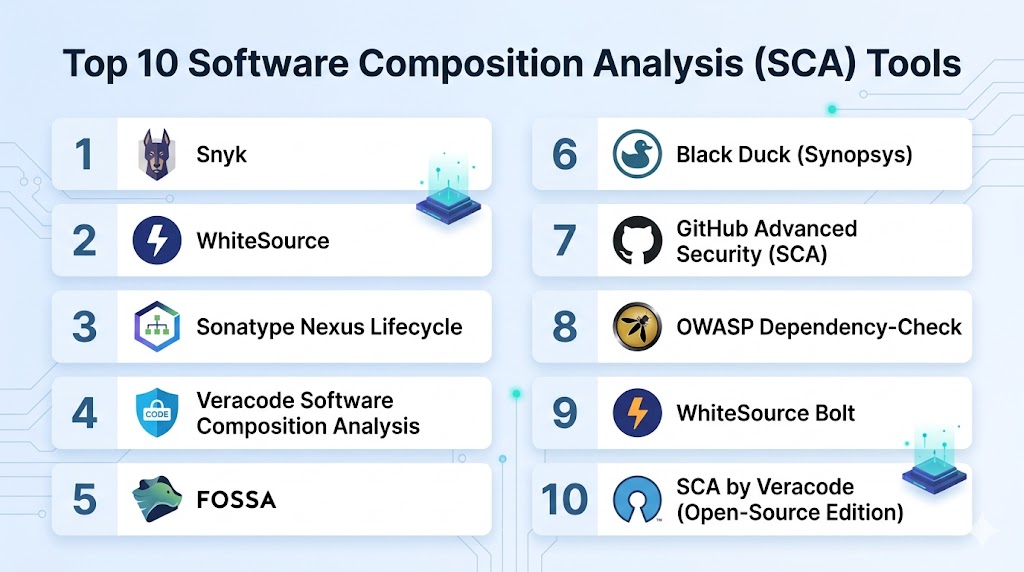
Top 10 Software Composition Analysis (SCA) Tools
#1 — Snyk
Short description: Snyk scans open-source dependencies and container images for vulnerabilities and license risks. It is widely used by DevSecOps teams to ensure security and compliance across development pipelines.
Key Features
- Automated vulnerability scanning
- License compliance checks
- CI/CD and IDE integrations
- Container and infrastructure scanning
- Detailed remediation guidance
- Dashboard and reporting
- Real-time alerts for new vulnerabilities
Pros
- Cloud-based and easy to integrate
- Strong focus on remediation and developer workflow
Cons
- Subscription pricing can be high for small teams
- Some advanced features require enterprise plan
Platforms / Deployment
- Web, Windows, Linux, macOS
- Cloud / Self-hosted / Hybrid
Security & Compliance
- MFA, SSO, audit logs
- SOC 2, ISO 27001, GDPR
Integrations & Ecosystem
- GitHub, GitLab, Bitbucket, Jenkins
- IDE plugins for real-time scanning
- APIs for automation and reporting
Support & Community
- Documentation, professional support, active community
#2 — WhiteSource
Short description: WhiteSource identifies open-source vulnerabilities and licensing issues, providing automated alerts and policy enforcement across repositories.
Key Features
- Real-time vulnerability and license detection
- Policy automation for compliance
- CI/CD integration
- Multi-language support
- Dashboard and reporting
- Automated patch suggestions
Pros
- Enterprise-grade security coverage
- Comprehensive license compliance tools
Cons
- Setup can be complex
- Enterprise features may be costly
Platforms / Deployment
- Windows, Linux, macOS
- Cloud / Self-hosted
Security & Compliance
- SSO, RBAC, encryption
- SOC 2, ISO 27001, GDPR
Integrations & Ecosystem
- GitHub, GitLab, Bitbucket, Jenkins
- APIs for integration and automation
Support & Community
- Vendor support, documentation, professional services
#3 — Sonatype Nexus Lifecycle
Short description: Nexus Lifecycle manages component usage across the software supply chain, enforcing policies and scanning for security vulnerabilities.
Key Features
- Component inventory and risk assessment
- License and security compliance
- CI/CD integration
- Multi-language support
- Automated remediation and policy enforcement
Pros
- Strong supply chain visibility
- Integration with enterprise development workflows
Cons
- Requires configuration for complex pipelines
- Premium pricing for full features
Platforms / Deployment
- Windows, Linux, macOS
- Cloud / Self-hosted / Hybrid
Security & Compliance
- SSO, audit logs, encryption
- ISO 27001, SOC 2
Integrations & Ecosystem
- GitHub, GitLab, Jenkins, IDEs
- REST API for automation
Support & Community
- Professional support, active knowledge base
#4 — Veracode Software Composition Analysis
Short description: Veracode SCA detects vulnerabilities in open-source components and helps ensure compliance with licensing policies.
Key Features
- Vulnerability scanning and reporting
- License compliance enforcement
- CI/CD integration
- Policy management
- Dashboard and remediation guidance
Pros
- Enterprise-focused
- Compliance automation
Cons
- Complex onboarding
- Costly for smaller teams
Platforms / Deployment
- Windows, Linux, macOS
- Cloud
Security & Compliance
- SSO, encryption
- SOC 2, ISO 27001, GDPR
Integrations & Ecosystem
- Jenkins, GitHub, GitLab
- IDE plugins and APIs
Support & Community
- Vendor support, professional services
#5 — FOSSA
Short description: FOSSA automates open-source license compliance and vulnerability detection across codebases and CI/CD pipelines.
Key Features
- License scanning and policy enforcement
- Vulnerability management
- CI/CD integration
- API and CLI support
- Detailed reporting
Pros
- Cloud and self-hosted options
- Strong automation features
Cons
- Limited advanced analytics in lower tiers
- Setup can require technical expertise
Platforms / Deployment
- Windows, Linux, macOS
- Cloud / Self-hosted
Security & Compliance
- Not publicly stated
Integrations & Ecosystem
- GitHub, GitLab, Bitbucket, Jenkins
- APIs for automation
Support & Community
- Vendor documentation, support plans
#6 — Black Duck (Synopsys)
Short description: Black Duck scans open-source dependencies to detect security vulnerabilities and license compliance risks, providing actionable insights.
Key Features
- Component inventory and risk assessment
- Security vulnerability scanning
- License compliance management
- CI/CD integration
- Policy enforcement and reporting
Pros
- Enterprise-ready
- Strong supply chain insights
Cons
- Premium pricing
- Setup complexity
Platforms / Deployment
- Windows, Linux, macOS
- Cloud / Self-hosted
Security & Compliance
- SOC 2, ISO 27001, encryption
Integrations & Ecosystem
- GitHub, GitLab, Jenkins
- APIs and plugins
Support & Community
- Vendor support, documentation, training
#7 — GitHub Advanced Security (SCA)
Short description: GitHub Advanced Security offers SCA for repositories, scanning dependencies for vulnerabilities and license issues.
Key Features
- Automated dependency scanning
- License compliance enforcement
- Pull request security checks
- CI/CD integration
- Dashboard reporting
Pros
- Native GitHub integration
- Developer-friendly
Cons
- Limited outside GitHub
- Subscription required for full features
Platforms / Deployment
- Web
- Cloud
Security & Compliance
- MFA, SSO
- SOC 2, GDPR
Integrations & Ecosystem
- GitHub repositories
- CI/CD pipelines
Support & Community
- GitHub support, documentation, community
#8 — OWASP Dependency-Check
Short description: Dependency-Check is an open-source tool that identifies publicly disclosed vulnerabilities in project dependencies.
Key Features
- Vulnerability scanning for open-source dependencies
- CLI and CI/CD integration
- Reports in multiple formats
- Multi-language support
Pros
- Free and open-source
- Community-driven
Cons
- Requires manual configuration
- Limited enterprise features
Platforms / Deployment
- Windows, Linux, macOS
- Self-hosted
Security & Compliance
- Not publicly stated
Integrations & Ecosystem
- Jenkins, GitHub Actions, CI/CD pipelines
- API for automation
Support & Community
- Community forums, documentation
#9 — WhiteSource Bolt
Short description: WhiteSource Bolt provides free SCA for small teams, integrating with Git repositories and CI/CD pipelines to detect vulnerabilities.
Key Features
- Dependency scanning
- License and security alerts
- CI/CD and Git repository integration
- Dashboard reporting
Pros
- Free for small teams
- Easy setup and integration
Cons
- Limited features compared to full WhiteSource
- Cloud-only deployment
Platforms / Deployment
- Web
- Cloud
Security & Compliance
- SOC 2, GDPR
Integrations & Ecosystem
- GitHub, GitLab, Bitbucket
- CI/CD pipelines
Support & Community
- Vendor support, documentation
#10 — SCA by Veracode (Open-Source Edition)
Short description: Veracode’s open-source SCA edition provides lightweight scanning of dependencies for vulnerabilities and license risks.
Key Features
- Open-source dependency scanning
- CI/CD integration
- Dashboard reporting
- License compliance alerts
Pros
- Free edition for small projects
- Easy integration
Cons
- Limited feature set
- Enterprise features require paid plan
Platforms / Deployment
- Windows, Linux, macOS
- Cloud
Security & Compliance
- Not publicly stated
Integrations & Ecosystem
- GitHub, GitLab, Bitbucket
- APIs for automation
Support & Community
- Vendor support, community resources
Comparison Table (Top 10)
| Tool Name | Best For | Platform(s) Supported | Deployment | Standout Feature | Public Rating |
|---|---|---|---|---|---|
| Snyk | DevSecOps teams | Web, Windows, Linux, macOS | Cloud / Self-hosted / Hybrid | Real-time remediation guidance | N/A |
| WhiteSource | License & security | Windows, Linux, macOS | Cloud / Self-hosted | Policy automation | N/A |
| Nexus Lifecycle | Supply chain | Windows, Linux, macOS | Cloud / Self-hosted / Hybrid | Component risk assessment | N/A |
| Veracode SCA | Security & compliance | Windows, Linux, macOS | Cloud | License & vulnerability checks | N/A |
| FOSSA | Open-source license management | Windows, Linux, macOS | Cloud / Self-hosted | Automation & CI/CD integration | N/A |
| Black Duck | Enterprise SCA | Windows, Linux, macOS | Cloud / Self-hosted | Supply chain insights | N/A |
| GitHub Advanced Security | GitHub-native | Web | Cloud | Native dependency scanning | N/A |
| OWASP Dependency-Check | Open-source scanning | Windows, Linux, macOS | Self-hosted | Free and community-driven | N/A |
| WhiteSource Bolt | Small teams | Web | Cloud | Easy Git integration | N/A |
| Veracode Open-Source SCA | Lightweight scanning | Windows, Linux, macOS | Cloud | Free open-source edition | N/A |
Evaluation & Scoring of Software Composition Analysis (SCA) Tools
| Tool Name | Core (25%) | Ease (15%) | Integrations (15%) | Security (10%) | Performance (10%) | Support (10%) | Value (15%) | Weighted Total |
|---|---|---|---|---|---|---|---|---|
| Snyk | 9 | 8 | 9 | 8 | 8 | 8 | 8 | 8.4 |
| WhiteSource | 9 | 7 | 8 | 9 | 8 | 7 | 7 | 8.0 |
| Nexus Lifecycle | 8 | 7 | 8 | 9 | 8 | 7 | 7 | 7.8 |
| Veracode SCA | 9 | 7 | 8 | 9 | 8 | 7 | 7 | 8.0 |
| FOSSA | 8 | 8 | 7 | 7 | 8 | 7 | 8 | 7.7 |
| Black Duck | 9 | 7 | 8 | 9 | 8 | 7 | 7 | 8.0 |
| GitHub Advanced Security | 8 | 9 | 8 | 8 | 8 | 7 | 7 | 7.9 |
| OWASP Dependency-Check | 7 | 8 | 7 | 7 | 7 | 7 | 9 | 7.6 |
| WhiteSource Bolt | 7 | 9 | 7 | 7 | 7 | 7 | 8 | 7.7 |
| Veracode Open-Source | 7 | 8 | 7 | 7 | 7 | 7 | 8 | 7.6 |
Scores are comparative, reflecting feature depth, usability, integrations, security, and overall value.
Which Software Composition Analysis (SCA) Tool Is Right for You?
Solo / Freelancer
- OWASP Dependency-Check, WhiteSource Bolt, Veracode Open-Source – lightweight, free, or open-source options
SMB
- Snyk, FOSSA – cloud-based, easy CI/CD integration, automated alerts
Mid-Market
- Veracode SCA, Nexus Lifecycle – advanced reporting, license compliance, multi-language support
Enterprise
- WhiteSource, Black Duck – full supply chain visibility, enterprise compliance, scalable
Budget vs Premium
- Budget: OWASP Dependency-Check, WhiteSource Bolt, Veracode Open-Source
- Premium: Snyk, Black Duck, WhiteSource Enterprise
Feature Depth vs Ease of Use
- Feature Depth: Black Duck, WhiteSource, Snyk
- Ease of Use: GitHub Advanced Security, FOSSA, WhiteSource Bolt
Integrations & Scalability
- Enterprise: Snyk, Black Duck, WhiteSource
- Small teams: OWASP Dependency-Check, WhiteSource Bolt
Security & Compliance Needs
- High compliance: Veracode SCA, Black Duck, WhiteSource
Frequently Asked Questions (FAQs)
1. Are SCA tools free?
Some tools like OWASP Dependency-Check are open-source; enterprise tools require subscriptions.
2. Do SCA tools integrate with CI/CD pipelines?
Yes, most support automation in build pipelines for continuous scanning.
3. Can they detect license compliance issues?
Yes, SCA tools identify licenses and enforce policies.
4. Are they suitable for multi-language projects?
Yes, enterprise tools support multiple programming languages.
5. Do they provide real-time alerts?
Many tools, such as Snyk and FOSSA, offer real-time vulnerability notifications.
6. Can they scan container images?
Yes, tools like Snyk and WhiteSource can scan container images for vulnerabilities.
7. Are cloud-based options available?
Yes, most tools offer cloud and hybrid deployment models.
8. Can they generate compliance reports?
Yes, reporting for audits and management review is a standard feature.
9. Are open-source projects supported?
Yes, many SCA tools focus on scanning open-source dependencies.
10. How to choose the right tool?
Consider team size, language stack, CI/CD integration, security needs, and regulatory compliance requirements.
Conclusion
Software Composition Analysis Tools are essential for managing open-source risk, ensuring security, and enforcing license compliance. For small teams and freelancers, OWASP Dependency-Check, WhiteSource Bolt, and Veracode Open-Source provide lightweight, cost-effective solutions. Mid-market and enterprise organizations benefit from Snyk, Black Duck, and WhiteSource for comprehensive scanning, CI/CD integration, and supply chain visibility. Selecting the right tool depends on language support, deployment flexibility, integration needs, security, and compliance requirements. Teams should pilot tools in their workflow to validate effectiveness and scalability.

Find Trusted Cardiac Hospitals
Compare heart hospitals by city and services — all in one place.
Explore Hospitals
SCA tools can find vulnerable dependencies, but upgrading them is not always straightforward. A newer package may fix a security issue but also introduce compatibility problems in the application. Testing dependency updates before releasing them can help teams improve security without creating new issues.