Introduction
Agile Project Management Tools are software platforms designed to help teams implement, manage, and optimize Agile workflows. They enable iterative project planning, sprint management, backlog prioritization, team collaboration, and continuous delivery tracking. Agile practices have expanded beyond software development into marketing, operations, and cross-functional enterprise projects, making these tools essential for adaptive planning and high-performing teams.
Organizations use Agile project management tools to track sprint progress, manage backlog items, improve collaboration, monitor team performance, and deliver products faster with greater quality. They also integrate with DevOps pipelines, automation systems, and reporting tools for a complete Agile ecosystem.
Real-world use cases include:
- Software development sprint and release planning
- Marketing campaign management
- Product feature tracking and delivery
- Cross-functional operational projects
- Remote team collaboration and performance monitoring
Evaluation Criteria for Buyers:
- Sprint and backlog management
- Workflow visualization (Kanban, Scrum, Gantt)
- Task assignment and collaboration features
- Reporting and analytics dashboards
- Integration with DevOps, CRM, and communication tools
- Automation and notifications
- Mobile accessibility
- Security and compliance
- Ease of adoption and onboarding
- Pricing and scalability
Best for: Agile teams, project managers, software developers, marketing teams, operations managers, and enterprises adopting iterative project workflows.
Not ideal for: Teams with static, linear workflows or organizations that only require lightweight task tracking.
Key Trends in Agile Project Management Tools for 2026 and Beyond
- Integration of AI for sprint planning and backlog prioritization.
- Enhanced support for remote and hybrid teams with real-time collaboration.
- Automation of repetitive project updates and notifications.
- Adoption of low-code workflows for non-technical stakeholders.
- Unified dashboards for cross-team visibility and reporting.
- Integration with DevOps pipelines, CI/CD tools, and version control systems.
- Compliance tracking for regulated projects.
- Predictive analytics for delivery risk and performance optimization.
- Mobile-first experiences for on-the-go team management.
- Flexible pricing models with SaaS subscriptions and enterprise options.
How We Selected These Tools
- Market adoption and industry recognition.
- Feature completeness for Agile planning and tracking.
- Performance reliability and scalability signals.
- Security posture and compliance features.
- Integration capabilities with third-party tools.
- Usability for technical and non-technical users.
- Support, documentation, and community presence.
- Pricing models suitable for SMBs to enterprise.
- Flexibility in deployment (cloud, hybrid, on-prem).
- AI and automation capabilities for modern workflows.
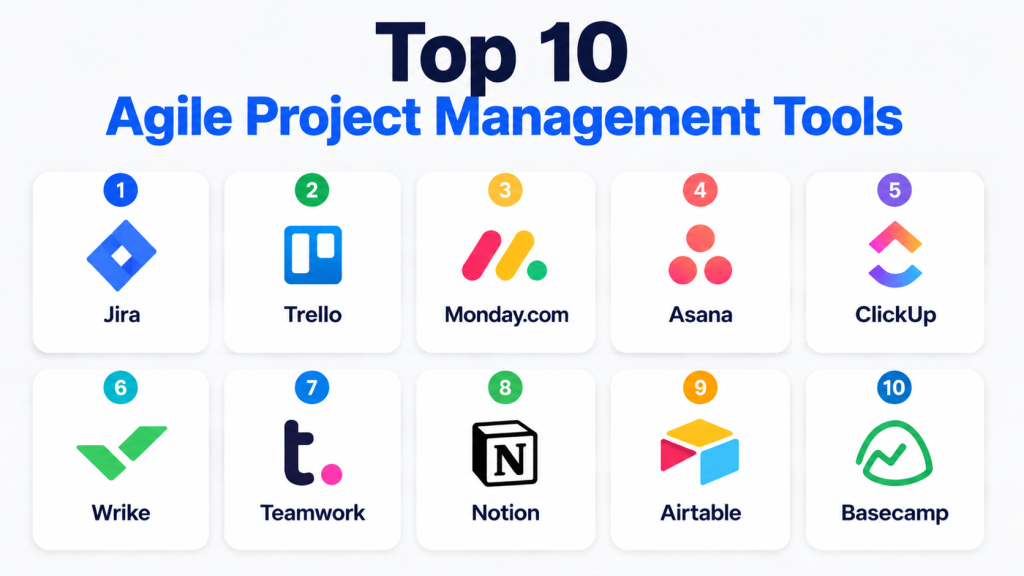
Top 10 Agile Project Management Tools
1- Jira
Short description: Jira is a comprehensive Agile project management tool used for software development and cross-functional projects, enabling Scrum and Kanban workflows.
Key Features
- Scrum and Kanban boards
- Sprint planning and backlog management
- Reporting dashboards and burndown charts
- DevOps and CI/CD integration
- Issue and bug tracking
- Custom workflows and automation
- Portfolio and roadmap tracking
Pros
- Deeply supports Agile methodologies
- Scalable for enterprise teams
- Strong integration with developer tools
Cons
- Steep learning curve for new users
- Complex setup for non-software teams
- Advanced reporting requires premium plans
Platforms / Deployment
- Web, Windows, macOS, iOS, Android
- Cloud / On-prem
Security & Compliance
- SSO, encryption, audit logs
- SOC 2, GDPR
Integrations & Ecosystem
- GitHub, Bitbucket, GitLab
- Slack, Teams, Confluence
- REST APIs and Atlassian Marketplace
- CI/CD pipelines and DevOps tools
Support & Community
- Enterprise support tiers
- Extensive documentation, tutorials, and webinars
- Active global user community
2- Trello
Short description: Trello is a visual Kanban-based Agile management platform ideal for lightweight project workflows and SMB teams.
Key Features
- Kanban boards and cards
- Checklists and labels
- Automation via Butler
- Timeline and calendar views
- Team collaboration
- Power-Ups for integrations
- Notifications and reminders
Pros
- Intuitive and easy to adopt
- Fast setup for teams
- Flexible for multiple use cases
Cons
- Limited reporting for complex projects
- Less suitable for enterprise Agile scaling
- Advanced workflow automation requires Power-Ups
Platforms / Deployment
- Web, iOS, Android
- Cloud
Security & Compliance
- SSO, encryption
- GDPR
Integrations & Ecosystem
- Slack, Google Workspace, Microsoft Teams
- APIs and marketplace apps
- Zapier integration
Support & Community
- Knowledge base and tutorials
- Community forums and templates
- Paid support tiers for business plans
3- Monday.com
Short description: Monday.com offers a visual work operating system for Agile teams to track projects, sprints, and cross-functional workflows.
Key Features
- Custom dashboards and workflows
- Timeline, Kanban, and Gantt views
- Automation of repetitive tasks
- AI-assisted planning and notifications
- Collaboration and file sharing
- Reporting and analytics
- Template library
Pros
- Highly visual and customizable
- Good automation flexibility
- Scalable for SMBs and mid-sized enterprises
Cons
- Pricing increases with advanced plans
- Complexity for first-time users
- Reporting dashboards require setup
Platforms / Deployment
- Web, Windows, macOS, iOS, Android
- Cloud
Security & Compliance
- SSO, encryption, MFA
- SOC 2, GDPR
Integrations & Ecosystem
- Slack, Teams, Zoom
- Salesforce, Google Workspace
- REST APIs and Zapier
- CRM and DevOps tool integration
Support & Community
- Enterprise support and onboarding
- Webinars, tutorials, and documentation
- Active user community
4- Asana
Short description: Asana is a collaborative Agile project management tool focusing on task tracking, sprints, and workflow automation.
Key Features
- Task assignment and tracking
- Kanban, timeline, and calendar views
- Workflow automation and rules
- Dashboards and reporting
- Team collaboration and communication
- Portfolio and goals tracking
- AI-driven task recommendations
Pros
- Easy-to-use interface
- Strong workflow visualization
- Scalable for SMBs and enterprises
Cons
- Advanced features require premium plan
- Complex workflows may need configuration
- Pricing can scale with team size
Platforms / Deployment
- Web, Windows, macOS, iOS, Android
- Cloud
Security & Compliance
- SSO, encryption, RBAC
- SOC 2, GDPR
Integrations & Ecosystem
- Slack, Microsoft Teams, Google Workspace
- Salesforce, Zoom, REST APIs
- Workflow automation integrations
Support & Community
- Tutorials, webinars, and knowledge base
- Enterprise onboarding support
- Active global community
5- ClickUp
Short description: ClickUp is an all-in-one Agile work platform combining task management, docs, dashboards, and automation for teams of all sizes.
Key Features
- Customizable task hierarchy
- Kanban, Gantt, and calendar views
- AI writing and task assistance
- Workflow automation and reminders
- Time tracking and reporting
- Team collaboration and chat
- Sprint management
Pros
- Highly flexible and customizable
- Centralized collaboration tools
- Affordable for small teams
Cons
- UI can feel crowded
- Learning curve for complex setups
- Mobile app limitations
Platforms / Deployment
- Web, Windows, macOS, Linux, iOS, Android
- Cloud
Security & Compliance
- SSO, encryption
- SOC 2, GDPR
Integrations & Ecosystem
- Slack, GitHub, Google Workspace
- Zoom, API integrations
- Productivity and DevOps tools
Support & Community
- Strong tutorials and documentation
- Enterprise support available
- Active community forums
6- Wrike
Short description: Wrike is an enterprise-focused Agile project management solution for tracking tasks, resources, and project performance.
Key Features
- Workflow automation
- Resource management
- Gantt charts and dashboards
- Reporting and analytics
- AI-powered insights
- Collaboration and file sharing
- Time tracking
Pros
- Enterprise-grade scalability
- Strong reporting capabilities
- Flexible task visualization
Cons
- Premium pricing tiers
- Setup complexity
- Learning curve for large teams
Platforms / Deployment
- Web, Windows, macOS, iOS, Android
- Cloud
Security & Compliance
- SSO, encryption, MFA
- SOC 2, GDPR
Integrations & Ecosystem
- Salesforce, Microsoft Teams, Slack
- Adobe Creative Cloud, API integrations
- ERP and DevOps tools
Support & Community
- Onboarding and consulting support
- Documentation and webinars
- Active enterprise community
7- Teamwork
Short description: Teamwork is a project and task management platform focusing on client projects, time tracking, and collaboration.
Key Features
- Task lists and boards
- Time tracking and billing
- Collaboration tools
- Reporting dashboards
- Custom workflows
- Gantt charts
- Project templates
Pros
- Strong client project focus
- Integrated billing and time tracking
- Collaboration-friendly
Cons
- Higher cost for premium features
- Complex for small teams
- Steeper learning curve
Platforms / Deployment
- Web, Windows, macOS, iOS, Android
- Cloud
Security & Compliance
- SSO, encryption
- SOC 2, GDPR
Integrations & Ecosystem
- Slack, Google Workspace, Microsoft Teams
- CRM integrations, APIs
Support & Community
- Tutorials, knowledge base
- Active support channels
8- Notion
Short description: Notion combines project management with documentation and collaboration for flexible Agile workflows.
Key Features
- Task databases
- Notes and documents
- Kanban and timeline views
- AI assistant
- Templates and dashboards
- Team collaboration
- Knowledge management
Pros
- Flexible workspace
- Integrated tasks and documentation
- Good for small teams
Cons
- Limited enterprise reporting
- Can become disorganized without governance
- Scaling requires careful structure
Platforms / Deployment
- Web, Windows, macOS, iOS, Android
- Cloud
Security & Compliance
- SSO, encryption
- SOC 2
Integrations & Ecosystem
- Slack, Google Workspace, GitHub
- Zapier, APIs
- Template marketplace
Support & Community
- Tutorials, templates, active community
9- Airtable
Short description: Airtable combines database flexibility with task management for teams needing highly customizable Agile workflows.
Key Features
- Relational databases
- Kanban, grid, and calendar views
- Workflow automation
- Dashboards
- Collaboration tools
- Template library
- AI-assisted features
Pros
- Highly customizable
- Flexible for multiple workflow types
- Collaboration-friendly
Cons
- Premium pricing for enterprise-scale use
- Complex workflows require planning
- Reporting depth varies
Platforms / Deployment
- Web, Windows, macOS, iOS, Android
- Cloud
Security & Compliance
- SSO, encryption
- SOC 2, GDPR
Integrations & Ecosystem
- Slack, Salesforce, Google Workspace
- API and Zapier integrations
- ERP and productivity platforms
Support & Community
- Tutorials, templates, and enterprise support
10- Basecamp
Short description: Basecamp is a simple project management platform focusing on tasks, collaboration, and team communication.
Key Features
- To-do lists
- Team chat and messaging
- File sharing
- Project scheduling
- Notifications and alerts
- Client collaboration
- Basic reporting
Pros
- Simple to use
- Flat pricing model
- Strong communication tools
Cons
- Limited automation and reporting
- Not ideal for complex enterprise projects
- Minimal workflow customization
Platforms / Deployment
- Web, Windows, macOS, iOS, Android
- Cloud
Security & Compliance
- Encryption, access controls
- GDPR
Integrations & Ecosystem
- Google Drive, Slack
- API access for custom integrations
- Zapier
Support & Community
- Active knowledge base
- Community forums
Comparison Table
| Tool Name | Best For | Platforms Supported | Deployment | Standout Feature | Public Rating |
|---|---|---|---|---|---|
| Microsoft Project | Enterprise project planning | Web, Desktop, Mobile | Cloud / On-prem | Resource management | N/A |
| Smartsheet | Spreadsheet-style workflows | Web, Mobile | Cloud | Grid interface | N/A |
| Asana | Team collaboration | Web, Desktop, Mobile | Cloud | Workflow visibility | N/A |
| Jira | Agile software teams | Web, Desktop, Mobile | Cloud / On-prem | Scrum/Kanban management | N/A |
| Monday.com | Visual dashboards | Web, Desktop, Mobile | Cloud | Custom workflows | N/A |
| ClickUp | All-in-one productivity | Web, Desktop, Mobile | Cloud | Workflow flexibility | N/A |
| Wrike | Enterprise collaboration | Web, Desktop, Mobile | Cloud | Resource management | N/A |
| Teamwork | Client projects | Web, Desktop, Mobile | Cloud | Billing + time tracking | N/A |
| Notion | Flexible workspace | Web, Desktop, Mobile | Cloud | Integrated docs + tasks | N/A |
| Airtable | Customizable workflows | Web, Desktop, Mobile | Cloud | Relational task management | N/A |
Evaluation & Scoring
| Tool Name | Core | Ease | Integrations | Security | Performance | Support | Value | Weighted Total |
|---|---|---|---|---|---|---|---|---|
| Microsoft Project | 10 | 7 | 9 | 9 | 9 | 8 | 7 | 8.65 |
| Smartsheet | 9 | 8 | 8 | 8 | 8 | 8 | 7 | 8.05 |
| Asana | 9 | 9 | 8 | 8 | 8 | 8 | 7 | 8.20 |
| Jira | 10 | 6 | 10 | 9 | 9 | 9 | 7 | 8.65 |
| Monday.com | 9 | 8 | 8 | 8 | 8 | 8 | 7 | 8.10 |
| ClickUp | 9 | 7 | 8 | 8 | 7 | 8 | 9 | 8.15 |
| Wrike | 8 | 7 | 8 | 8 | 8 | 8 | 7 | 7.85 |
| Teamwork | 8 | 7 | 8 | 8 | 8 | 7 | 7 | 7.75 |
| Notion | 8 | 8 | 7 | 7 | 7 | 7 | 9 | 7.75 |
| Airtable | 8 | 8 | 8 | 7 | 7 | 7 | 8 | 7.80 |
Which Agile Project Management Tool Is Right for You?
Solo / Freelancer
Trello, Basecamp, and Notion provide simplicity, affordability, and easy onboarding.
SMB
Asana, Monday.com, ClickUp offer collaboration, dashboards, and automation suitable for growing teams.
Mid-Market
Wrike, Smartsheet, and Airtable are ideal for mid-sized organizations needing visibility, reporting, and workflow customization.
Enterprise
Microsoft Project, Jira, and Wrike are preferred for large-scale projects, governance, and complex workflows.
Budget vs Premium
Budget-conscious teams may choose Trello, Basecamp, or Notion. Enterprises with higher governance needs should evaluate Microsoft Project, Jira, or Wrike.
Feature Depth vs Ease of Use
Jira and Microsoft Project offer deep functionality, while Trello and Basecamp prioritize simplicity and usability.
Integrations & Scalability
Jira, Asana, Monday.com, and Microsoft Project provide extensive integration and scalability for enterprise operations.
Security & Compliance Needs
Enterprises with strict security and compliance requirements should consider Microsoft Project, Jira, Wrike, or Smartsheet.
Frequently Asked Questions
1. What is Agile Project Management software?
Agile Project Management software helps teams plan, execute, and track projects using iterative methods, promoting collaboration, transparency, and adaptability.
2. Which industries use Agile Project Management tools?
Technology, marketing, software development, consulting, and operations teams commonly use these tools for project planning and execution.
3. Are these tools suitable for remote teams?
Yes, cloud-based tools support real-time updates, notifications, collaboration, and workflow tracking for distributed teams.
4. Can these tools integrate with other software?
Most platforms integrate with communication, productivity, ERP, CRM, and automation tools to streamline workflows.
5. What is the difference between task and project management software?
Task management focuses on individual tasks, while project management software handles planning, resource allocation, timelines, and cross-team coordination.
6. Are these platforms secure for enterprise use?
Leading vendors offer encryption, SSO, MFA, RBAC, and compliance with GDPR and SOC 2.
7. Which platform is easiest for beginners?
Trello and Basecamp are user-friendly and simple to adopt.
8. Which tools are best for Agile software teams?
Jira, Monday.com, and ClickUp are widely used for Scrum, Kanban, and sprint-based workflows.
9. How important are automation features?
Automation reduces repetitive work, improves workflow consistency, and enhances team productivity.
10. What should buyers evaluate before selecting software?
Evaluate usability, workflow flexibility, integrations, security, reporting, scalability, pricing, and collaboration capabilities.
Conclusion
Agile Project Management tools are essential for modern teams managing iterative projects and distributed workflows. Platforms like Jira, Microsoft Project, and Wrike provide deep enterprise functionality, governance, and reporting. SMBs and growing teams benefit from ClickUp, Asana, or Trello for ease of use and automation. Selecting the right tool depends on team size, project complexity, collaboration requirements, and long-term scalability goals. Buyers should shortlist 2–3 tools, conduct pilot sprints, and validate workflows, reporting, and integration capabilities before full-scale adoption.

Find Trusted Cardiac Hospitals
Compare heart hospitals by city and services — all in one place.
Explore Hospitals
I now understand how time tracking software helps accurately monitor work hours and improve productivity and project accountability. I’d like to explore more about which tools work best for hybrid and remote teams.