Introduction
Treasury Management Systems help finance and treasury teams manage cash, liquidity, payments, bank accounts, debt, investments, risk, and financial operations from one centralized platform. In simple terms, a TMS gives companies better control over money movement, cash visibility, banking relationships, and treasury risk. Treasury teams now need faster cash forecasting, stronger payment controls, real-time bank connectivity, fraud prevention, liquidity planning, and better integration with ERP and finance systems. Manual spreadsheets and bank portals are no longer enough for companies managing many accounts, currencies, entities, and payment workflows.
Real World Use Cases
- Monitoring global cash positions across banks and entities
- Forecasting short-term and long-term liquidity needs
- Managing payments, approvals, and bank connectivity
- Tracking debt, investments, FX exposure, and financial risk
- Supporting treasury reporting, compliance, and audit controls
Evaluation Criteria for Buyers
- Cash visibility and cash positioning
- Cash forecasting and liquidity planning
- Bank connectivity and payment workflows
- Fraud prevention and payment controls
- ERP, accounting, and banking integrations
- Debt, investment, and risk management capabilities
- Multi-currency and multi-entity support
- Reporting, dashboards, and analytics
- Security, approvals, roles, and audit trails
- Implementation effort and treasury team usability
Best for: CFOs, treasurers, finance leaders, cash managers, controllers, global finance teams, shared service centers, banks, large enterprises, and mid-market companies that need better cash visibility, payment governance, liquidity planning, and treasury risk control.
Not ideal for: freelancers, very small businesses, or companies with only one bank account and simple cash tracking needs. These users may be better served by accounting software, online banking dashboards, or basic cash flow tools.
Key Trends in Treasury Management Systems
- Real-time cash visibility is becoming essential: Treasury teams want daily or intraday visibility across bank accounts, regions, currencies, and business units.
- Payment fraud controls are a top priority: Companies are investing in approval workflows, payment validation, user controls, audit trails, and bank account verification.
- AI-assisted cash forecasting is growing: Treasury platforms are adding forecasting automation, anomaly detection, variance analysis, and predictive liquidity insights.
- Bank connectivity is becoming more strategic: Modern TMS platforms increasingly support bank APIs, host-to-host connections, SWIFT connectivity, and multi-bank workflows.
- ERP integration is a major selection factor: Treasury data must connect with ERP, accounting, AP, AR, payroll, billing, and financial reporting systems.
- Liquidity planning is more dynamic: Teams need scenario planning for working capital, borrowing needs, market volatility, and unexpected cash flow changes.
- Treasury is moving toward centralized control: Global businesses want one source of truth for cash, payments, debt, investments, and risk.
- Compliance and audit readiness are more important: Buyers need approval history, segregation of duties, role-based access, policy controls, and traceable payment actions.
- Multi-currency operations are expanding: Global companies need FX exposure management, currency visibility, and cross-border payment support.
- Treasury and working capital are becoming connected: Modern platforms increasingly link cash forecasting with AP, AR, collections, supply chain finance, and liquidity optimization.
How We Selected These Tools
The following tools were selected based on practical relevance to treasury operations, market recognition, enterprise adoption, feature depth, and fit across treasury team sizes.
- Strong capabilities for cash visibility, cash positioning, and cash forecasting
- Bank connectivity and payment workflow support
- Relevance for treasurers, CFOs, finance teams, and global enterprises
- Ability to support multi-entity, multi-bank, and multi-currency operations
- Integration strength with ERP, accounting, payment, AP, AR, and banking systems
- Support for treasury risk, debt, investments, liquidity, and working capital workflows
- Security controls such as approvals, permissions, audit trails, and segregation of duties
- Reporting and analytics for treasury decision-making
- Product maturity, implementation ecosystem, and support resources
- Practical fit across mid-market, enterprise, and treasury transformation use cases
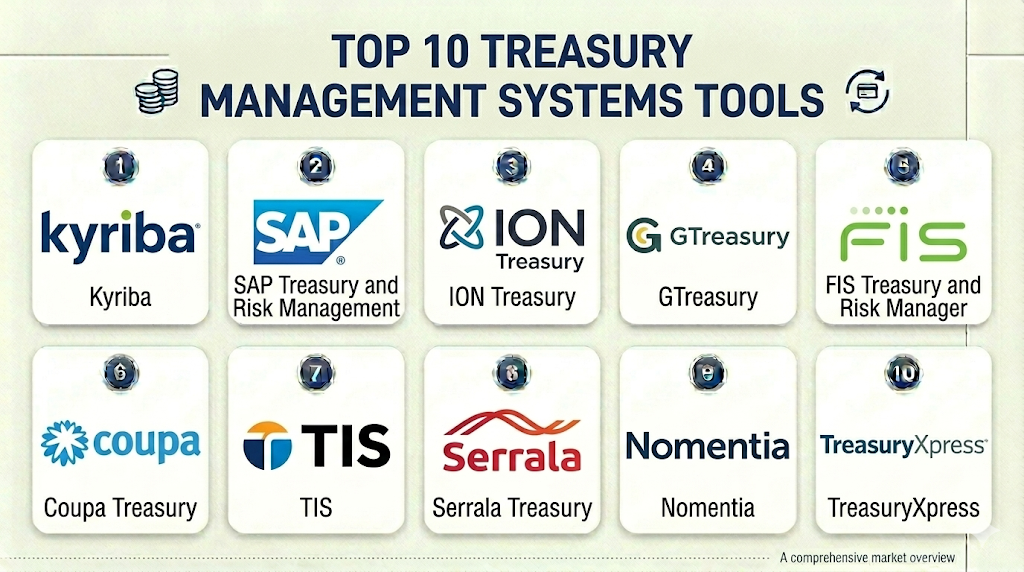
Top 10 Treasury Management Systems Tools
1- Kyriba
Short description: Kyriba is a widely recognized treasury and liquidity management platform used by enterprises and finance teams to manage cash, payments, bank connectivity, liquidity, and risk. It is best suited for organizations that need global visibility and stronger treasury control.
Key Features
- Global cash visibility and cash positioning
- Cash forecasting and liquidity planning
- Bank connectivity and payment workflows
- Fraud prevention and payment control features
- Debt, investment, and risk management capabilities
- Working capital and liquidity optimization workflows
- Treasury reporting and analytics
Pros
- Strong fit for global treasury teams
- Broad treasury and liquidity management capabilities
- Useful for centralizing cash, payments, and risk workflows
Cons
- Implementation can require treasury process planning
- May be more than small businesses need
- Advanced configurations may require experienced treasury users
Platforms / Deployment
Web
Cloud
Security & Compliance
Kyriba is designed for enterprise treasury environments and supports controlled access, payment approvals, auditability, and treasury governance. Specific certifications and compliance documentation should be verified directly during vendor review.
Integrations & Ecosystem
Kyriba connects treasury workflows with banks, ERP systems, payment channels, and finance platforms. It is suitable for companies managing multiple banks, entities, currencies, and treasury processes.
- ERP systems
- Bank connectivity networks
- Payment systems
- Accounting platforms
- FX and risk workflows
- Treasury reporting systems
Support & Community
Kyriba provides documentation, onboarding support, implementation partners, customer success resources, and treasury-focused expertise. Support experience depends on deployment scope and customer tier.
2- SAP Treasury and Risk Management
Short description: SAP Treasury and Risk Management supports treasury operations for organizations using SAP finance and ERP environments. It helps companies manage cash, liquidity, payments, financial risk, debt, investments, and treasury accounting workflows.
Key Features
- Cash and liquidity management
- Treasury and risk management workflows
- Debt and investment management
- FX and financial risk support
- Integration with SAP ERP and finance systems
- Payment and bank account workflows
- Treasury reporting and controls
Pros
- Strong fit for SAP-centered enterprises
- Deep integration with SAP finance and ERP workflows
- Useful for complex treasury, risk, and accounting requirements
Cons
- Best suited for companies already using SAP
- Implementation may require SAP treasury expertise
- Can be too complex for small treasury teams
Platforms / Deployment
Web
Cloud / Hybrid depending on SAP environment
Security & Compliance
SAP provides enterprise access controls, auditability, and administrative governance across its finance ecosystem. Specific compliance and certification details should be verified based on deployment and region.
Integrations & Ecosystem
SAP Treasury and Risk Management works best in SAP-centered enterprise environments where treasury data must align with ERP, finance, accounting, procurement, and payment workflows.
- SAP S/4HANA
- SAP finance systems
- Banking connections
- Payment workflows
- Risk management data
- Enterprise reporting tools
Support & Community
SAP provides product documentation, enterprise support, implementation partners, training, and consulting resources. Support quality depends on licensing and partner involvement.
3- ION Treasury
Short description: ION Treasury offers treasury management solutions for cash, liquidity, payments, risk, debt, investments, and financial operations. It is suitable for enterprises and treasury teams that require broad treasury functionality and strong operational control.
Key Features
- Cash visibility and cash positioning
- Liquidity planning and forecasting
- Payments and bank connectivity
- Debt and investment management
- FX and financial risk management
- Treasury accounting workflows
- Reporting and analytics
Pros
- Broad treasury functionality for complex organizations
- Good fit for treasury teams managing multiple financial instruments
- Supports cash, risk, and liquidity workflows
Cons
- May require specialized implementation support
- Smaller teams may find it more advanced than needed
- Buyer should validate product fit within the ION treasury portfolio
Platforms / Deployment
Web
Cloud / Hybrid depending on product and implementation
Security & Compliance
ION Treasury solutions are designed for financial and enterprise treasury environments. Specific access controls, security documentation, and compliance certifications should be verified directly.
Integrations & Ecosystem
ION Treasury connects treasury operations with banks, ERPs, financial market data, risk workflows, and reporting systems. It is relevant for organizations with mature treasury functions.
- ERP systems
- Banking networks
- Market data workflows
- Risk management tools
- Payment systems
- Treasury reporting platforms
Support & Community
ION provides enterprise support, implementation services, treasury expertise, and customer resources. Support experience depends on solution scope and contract structure.
4- GTreasury
Short description: GTreasury is a treasury and risk management platform for cash visibility, cash forecasting, payments, risk, debt, investments, and bank account management. It is commonly considered by mid-market and enterprise treasury teams.
Key Features
- Cash positioning and liquidity visibility
- Cash forecasting and variance tracking
- Payments and bank connectivity
- Debt and investment management
- FX exposure and risk workflows
- Bank account management
- Dashboards and treasury reporting
Pros
- Strong fit for treasury teams needing practical cash and risk workflows
- Useful for improving cash visibility and forecasting accuracy
- Covers both core treasury and advanced treasury operations
Cons
- Implementation effort depends on bank and ERP complexity
- May require treasury process redesign
- Smaller companies may not need full functionality
Platforms / Deployment
Web
Cloud
Security & Compliance
GTreasury supports treasury workflow controls, approvals, permissions, and audit-friendly processes. Specific certifications and compliance details should be verified directly.
Integrations & Ecosystem
GTreasury integrates treasury operations with ERP systems, banks, payment workflows, and reporting environments. It is useful for teams seeking better liquidity control and treasury automation.
- ERP systems
- Bank connectivity
- Payment systems
- FX and risk systems
- Accounting workflows
- Treasury dashboards
Support & Community
GTreasury provides implementation support, documentation, training, and customer support resources. Support quality depends on project scope and service agreement.
5- FIS Treasury and Risk Manager
Short description: FIS Treasury and Risk Manager is a treasury management solution for organizations that need cash, liquidity, payments, risk, debt, investments, and financial transaction support. It is suited for enterprises with complex treasury and financial risk needs.
Key Features
- Cash and liquidity management
- Treasury payments and bank connectivity
- Debt and investment tracking
- FX and risk management workflows
- Financial instrument support
- Treasury accounting and reporting
- Enterprise finance integration
Pros
- Strong fit for large treasury and finance organizations
- Supports complex treasury and risk workflows
- Useful for enterprises managing financial instruments and liquidity
Cons
- May be too advanced for smaller businesses
- Implementation can require deep treasury expertise
- Buyers should validate product fit and support model carefully
Platforms / Deployment
Web
Cloud / Hybrid depending on implementation
Security & Compliance
FIS treasury solutions are designed for enterprise financial environments. Specific security controls, certifications, and compliance documentation should be verified directly.
Integrations & Ecosystem
FIS Treasury and Risk Manager connects treasury operations with financial systems, banking channels, market data, ERP systems, and reporting workflows.
- ERP systems
- Bank connectivity
- Payment systems
- Risk and market data workflows
- Accounting systems
- Enterprise reporting platforms
Support & Community
FIS provides enterprise support, implementation assistance, product documentation, and financial technology expertise. Support varies by contract, region, and deployment complexity.
6- Coupa Treasury
Short description: Coupa Treasury is part of Coupa’s broader business spend management ecosystem and helps companies manage cash, liquidity, payments, bank connectivity, and treasury workflows. It is useful for organizations that want treasury connected with spend, AP, procurement, and finance operations.
Key Features
- Cash visibility and liquidity planning
- Bank connectivity and payment workflows
- Treasury reporting and dashboards
- Cash forecasting support
- Integration with spend and finance workflows
- Payment control and approval processes
- Working capital and liquidity visibility
Pros
- Strong fit for companies using Coupa’s broader spend platform
- Useful for connecting treasury with AP and procurement workflows
- Helps centralize cash and payment visibility
Cons
- Best value may come inside the Coupa ecosystem
- May not fit every advanced treasury risk use case
- Buyers should validate depth for debt, investments, and FX workflows
Platforms / Deployment
Web
Cloud
Security & Compliance
Coupa provides enterprise access controls and workflow governance across its platform. Specific treasury-related security and compliance documentation should be verified directly.
Integrations & Ecosystem
Coupa Treasury is relevant for companies that want treasury connected to spend management, payments, suppliers, AP, procurement, and finance operations.
- Coupa platform
- ERP systems
- Banks
- AP workflows
- Payment systems
- Finance reporting tools
Support & Community
Coupa provides customer support, documentation, implementation partners, and business spend management expertise. Support depth may vary by package and deployment scope.
7- TIS
Short description: TIS is a treasury and payment platform focused on payment management, bank connectivity, liquidity visibility, and enterprise payment workflows. It is especially useful for companies that need centralized payment control and multi-bank connectivity.
Key Features
- Enterprise payment management
- Bank connectivity and payment file handling
- Cash visibility and bank account reporting
- Payment fraud prevention workflows
- Payment approvals and controls
- ERP and finance system integration
- Reporting and audit trails
Pros
- Strong fit for payment-heavy treasury teams
- Useful for centralizing multi-bank payment workflows
- Helps improve payment control and visibility
Cons
- May be more payment-focused than full treasury risk platforms
- Advanced debt, investment, or FX needs may require additional systems
- Implementation depends heavily on bank and ERP connectivity
Platforms / Deployment
Web
Cloud
Security & Compliance
TIS is designed for secure enterprise payments and treasury workflows, with controls for approvals, permissions, and auditability. Specific compliance documentation should be verified directly.
Integrations & Ecosystem
TIS integrates with ERP systems, banks, payment channels, and treasury workflows. It is a strong fit for companies prioritizing secure payments and bank connectivity.
- ERP systems
- Bank networks
- Payment channels
- Bank account reporting
- Fraud prevention workflows
- Treasury dashboards
Support & Community
TIS provides implementation support, documentation, customer success resources, and payment connectivity expertise. Support depends on bank connectivity complexity and customer requirements.
8- Serrala Treasury
Short description: Serrala Treasury supports cash visibility, payments, liquidity, working capital, and finance automation workflows. It is suitable for organizations that want treasury, payments, and finance automation connected across enterprise systems.
Key Features
- Cash visibility and liquidity management
- Payment automation and bank connectivity
- Treasury reporting and analytics
- Working capital workflows
- Finance process automation
- ERP integration support
- Payment security and approval controls
Pros
- Strong fit for companies connecting treasury and payments
- Useful for finance automation and cash visibility
- Works well for organizations needing ERP-connected treasury workflows
Cons
- Buyers should validate advanced treasury risk depth
- Implementation depends on process and system complexity
- May be more suitable for larger finance teams than small companies
Platforms / Deployment
Web
Cloud / Hybrid depending on implementation
Security & Compliance
Serrala supports controlled finance workflows, payment security, and treasury governance. Specific certifications and compliance details should be verified directly.
Integrations & Ecosystem
Serrala integrates treasury and payments with ERP, banking, finance, and working capital workflows. It is useful for companies that want treasury automation connected to broader finance operations.
- ERP systems
- Bank connectivity
- Payment workflows
- Working capital systems
- Finance automation tools
- Reporting and analytics
Support & Community
Serrala provides documentation, customer support, implementation resources, and finance automation expertise. Support may vary by region and solution scope.
9- Nomentia
Short description: Nomentia is a treasury and cash management platform focused on cash visibility, payments, bank connectivity, liquidity management, and treasury workflows. It is suitable for companies seeking better control over bank accounts, cash, and payment operations.
Key Features
- Cash visibility and cash positioning
- Payments and bank connectivity
- Cash forecasting and liquidity planning
- Bank account management
- Treasury reporting and analytics
- Payment controls and approval workflows
- Multi-bank and multi-entity support
Pros
- Strong fit for improving cash and bank visibility
- Useful for payment workflow centralization
- Practical for treasury teams managing multiple banks and entities
Cons
- Buyers should validate advanced risk and investment capabilities
- Implementation depends on bank connectivity requirements
- May require integration planning with ERP and accounting systems
Platforms / Deployment
Web
Cloud
Security & Compliance
Nomentia supports secure treasury workflows, access controls, and payment approval structures. Specific certifications and compliance documentation should be verified directly.
Integrations & Ecosystem
Nomentia connects treasury teams with banks, ERP systems, payment channels, and reporting workflows. It is practical for companies that need clearer liquidity and payment control.
- Bank connectivity
- ERP systems
- Payment workflows
- Bank account management
- Reporting dashboards
- Finance data sources
Support & Community
Nomentia provides implementation assistance, support resources, and treasury workflow expertise. Support quality depends on deployment scope and bank connectivity complexity.
10- TreasuryXpress
Short description: TreasuryXpress is a treasury management platform for cash visibility, payments, bank connectivity, forecasting, and treasury automation. It is often considered by mid-market and growing enterprise treasury teams that want modern treasury workflows.
Key Features
- Cash visibility and bank reporting
- Cash forecasting and liquidity planning
- Payment workflow support
- Bank connectivity and file management
- Treasury dashboards and reporting
- Multi-entity treasury support
- Integration with ERP and accounting systems
Pros
- Good fit for mid-market treasury teams
- Useful for improving cash visibility and payment workflows
- More focused than broad enterprise finance platforms
Cons
- Buyers should validate fit for advanced treasury risk use cases
- May require implementation support for complex bank connections
- Not ideal for very small businesses with simple banking needs
Platforms / Deployment
Web
Cloud
Security & Compliance
TreasuryXpress supports treasury access controls, approval workflows, and audit-friendly processes. Specific certifications and compliance details should be verified directly.
Integrations & Ecosystem
TreasuryXpress connects treasury operations with banks, ERP systems, payment workflows, and finance reporting. It is useful for teams looking to move away from manual bank portal and spreadsheet processes.
- Banks
- ERP systems
- Accounting platforms
- Payment workflows
- Treasury reporting
- Data imports and exports
Support & Community
TreasuryXpress provides implementation support, documentation, and customer assistance. Support experience may vary by customer size and bank integration needs.
Comparison Table
| Tool Name | Best For | Platform Supported | Deployment | Standout Feature | Public Rating |
|---|---|---|---|---|---|
| Kyriba | Global treasury and liquidity teams | Web | Cloud | Enterprise liquidity and treasury platform | N/A |
| SAP Treasury and Risk Management | SAP-centered enterprises | Web | Cloud / Hybrid | Treasury integrated with SAP finance | N/A |
| ION Treasury | Complex enterprise treasury operations | Web | Cloud / Hybrid | Broad treasury and risk management | N/A |
| GTreasury | Mid-market and enterprise treasury teams | Web | Cloud | Cash visibility and treasury risk workflows | N/A |
| FIS Treasury and Risk Manager | Large enterprises with complex risk needs | Web | Cloud / Hybrid | Treasury and financial risk management | N/A |
| Coupa Treasury | Spend and treasury-connected organizations | Web | Cloud | Treasury connected with spend management | N/A |
| TIS | Payment-heavy treasury teams | Web | Cloud | Centralized enterprise payment management | N/A |
| Serrala Treasury | Treasury and finance automation teams | Web | Cloud / Hybrid | Payment and cash automation | N/A |
| Nomentia | Multi-bank cash and payment teams | Web | Cloud | Cash visibility and bank connectivity | N/A |
| TreasuryXpress | Mid-market treasury teams | Web | Cloud | Modern cash visibility and forecasting | N/A |
Evaluation & Scoring of Treasury Management Systems
| Tool Name | Core 25% | Ease 15% | Integrations 15% | Security 10% | Performance 10% | Support 10% | Value 15% | Weighted Total |
|---|---|---|---|---|---|---|---|---|
| Kyriba | 10 | 7 | 9 | 9 | 9 | 8 | 7 | 8.50 |
| SAP Treasury and Risk Management | 9 | 6 | 9 | 9 | 9 | 8 | 6 | 8.00 |
| ION Treasury | 9 | 6 | 8 | 9 | 8 | 8 | 7 | 7.90 |
| GTreasury | 9 | 8 | 8 | 8 | 8 | 8 | 8 | 8.30 |
| FIS Treasury and Risk Manager | 9 | 6 | 8 | 9 | 8 | 8 | 6 | 7.75 |
| Coupa Treasury | 8 | 8 | 8 | 8 | 8 | 8 | 8 | 8.00 |
| TIS | 8 | 8 | 9 | 9 | 8 | 8 | 8 | 8.25 |
| Serrala Treasury | 8 | 7 | 8 | 8 | 8 | 8 | 8 | 7.85 |
| Nomentia | 8 | 8 | 8 | 8 | 8 | 8 | 8 | 8.00 |
| TreasuryXpress | 8 | 8 | 7 | 8 | 8 | 7 | 8 | 7.75 |
These scores are comparative and should be used for shortlisting, not as a universal ranking. A global enterprise may prioritize Kyriba, SAP, ION, or FIS because of depth and scale, while a mid-market treasury team may prefer GTreasury, Nomentia, TIS, or TreasuryXpress for usability and faster adoption. Payment-heavy teams may score TIS or Serrala higher based on workflow fit. Always test bank connectivity, ERP integration, payment controls, forecasting workflows, and security requirements before selecting a platform.
Which Treasury Management System Is Right for You?
Solo / Freelancer
Solo professionals usually do not need a dedicated treasury management system. Basic accounting software, online banking, and cash flow spreadsheets are usually enough for small-scale financial visibility.
A TMS becomes relevant only when a business manages multiple bank accounts, large cash balances, international payments, liquidity risk, debt, investments, or structured treasury workflows.
SMB
SMBs with simple cash needs may not need a full TMS, but growing companies with multiple bank accounts, frequent payments, and cash forecasting challenges may benefit from lighter treasury platforms. GTreasury, Nomentia, TreasuryXpress, and Coupa Treasury may be practical options depending on needs.
SMBs should prioritize usability, bank connectivity, payment controls, cash visibility, and integration with accounting or ERP systems. Avoid overbuying enterprise complexity unless treasury risk is already significant.
Mid-Market
Mid-market organizations often need cash visibility, bank connectivity, payment approvals, short-term cash forecasting, and liquidity reporting. GTreasury, TIS, Serrala, Nomentia, TreasuryXpress, Coupa Treasury, and Kyriba are strong options to evaluate.
The best fit depends on treasury maturity. A payment-heavy company may prefer TIS or Serrala, while a broader treasury team may prefer GTreasury, Kyriba, or Nomentia.
Enterprise
Enterprises usually need multi-entity cash visibility, global bank connectivity, FX risk management, debt and investment tracking, liquidity planning, approvals, audit trails, and ERP integration. Kyriba, SAP Treasury and Risk Management, ION Treasury, FIS Treasury and Risk Manager, and GTreasury are strong enterprise candidates.
Enterprise buyers should include treasury, finance, IT, compliance, AP, risk, and regional finance teams in the evaluation. Implementation success depends heavily on bank connectivity, data quality, payment controls, and change management.
Budget vs Premium
Budget-conscious companies should avoid choosing a TMS only by brand recognition. TreasuryXpress, Nomentia, GTreasury, TIS, or Coupa Treasury may provide a practical balance depending on use case.
Premium buyers should evaluate Kyriba, SAP Treasury and Risk Management, ION Treasury, FIS Treasury and Risk Manager, and GTreasury when global treasury complexity, risk management, and deep integration matter more than simplicity.
Feature Depth vs Ease of Use
For feature depth, Kyriba, SAP Treasury and Risk Management, ION Treasury, FIS Treasury and Risk Manager, and GTreasury are strong candidates. These platforms are more suitable for mature treasury teams.
For ease of use and focused workflows, Nomentia, TreasuryXpress, TIS, Serrala, and Coupa Treasury may be easier to adopt depending on treasury scope and integration needs.
Integrations & Scalability
A TMS should integrate with ERP, general ledger, accounting, AP, AR, payroll, payment systems, banks, and reporting tools. Weak integrations create reconciliation issues, payment delays, and unreliable cash forecasts.
Before selecting a system, map your end-to-end treasury workflow: bank data, cash position, forecast inputs, payment approvals, debt tracking, FX exposure, ERP posting, and reporting.
Security & Compliance Needs
Treasury systems control sensitive bank data, payment files, cash balances, approvals, and financial risk workflows. Buyers should review MFA, SSO, RBAC, payment approval controls, audit logs, encryption, segregation of duties, and bank file security.
For organizations processing high-value payments, payment fraud prevention and approval governance should be treated as core requirements, not optional features.
Frequently Asked Questions
1- What is a Treasury Management System?
A Treasury Management System is software that helps companies manage cash, liquidity, payments, bank accounts, debt, investments, and financial risk. It gives treasury teams better visibility and control over money movement.
2- How is a TMS different from accounting software?
Accounting software records financial transactions and prepares reports, while a TMS focuses on cash visibility, liquidity, payments, bank connectivity, treasury risk, and financial operations control.
3- Which companies need treasury management software?
Companies with multiple bank accounts, currencies, entities, payment workflows, debt, investments, or cash forecasting challenges often need a TMS. Very small businesses may not need one.
4- What are the main benefits of a TMS?
Main benefits include better cash visibility, stronger payment controls, improved forecasting, reduced fraud risk, centralized bank connectivity, and faster treasury reporting.
5- Can a TMS help prevent payment fraud?
Yes, many TMS platforms support payment approvals, segregation of duties, user permissions, audit trails, payment validation, and controlled workflows to reduce payment fraud risk.
6- What integrations are important for a TMS?
Important integrations include ERP, general ledger, banks, payment systems, AP, AR, payroll, accounting platforms, market data, and reporting tools. Bank connectivity is especially important.
7- How long does TMS implementation take?
Implementation time depends on the number of banks, accounts, entities, payment formats, ERP integrations, workflows, and reporting needs. Complex global implementations require careful planning.
8- Is a cloud TMS secure?
Reputable cloud treasury systems provide access controls, encryption, approval workflows, and auditability. Buyers should still validate vendor security documentation and payment control processes before purchase.
9- What are common TMS selection mistakes?
Common mistakes include underestimating bank connectivity complexity, ignoring payment approval controls, choosing only by price, skipping ERP integration testing, and failing to involve treasury users early.
10- Can a TMS support cash forecasting?
Yes, most treasury platforms support cash forecasting. Forecast quality depends on data inputs from ERP, AP, AR, payroll, sales, banking, and business units.
Conclusion
Treasury Management Systems help companies move from fragmented bank portals and spreadsheets to centralized cash visibility, stronger payment controls, better liquidity planning, and more reliable treasury reporting. The best TMS depends on company size, bank complexity, global footprint, ERP environment, payment volume, risk exposure, and treasury maturity. Kyriba, SAP Treasury and Risk Management, ION Treasury, FIS Treasury and Risk Manager, and GTreasury are strong options for complex enterprise treasury teams, while TIS, Serrala, Nomentia, TreasuryXpress, and Coupa Treasury may be practical for focused payment, cash visibility, and mid-market treasury workflows. There is no single universal winner because every treasury function has different banks, entities, controls, and reporting needs. The best next step is to shortlist two or three tools, test bank connectivity and payment workflows, validate ERP integration, review security controls, and run a focused pilot using real treasury data before scaling the platform across the organization.

Find Trusted Cardiac Hospitals
Compare heart hospitals by city and services — all in one place.
Explore Hospitals
Treasury management systems are most valuable when they help organizations manage cash, liquidity, banking relationships, and financial risks through a centralized platform. By providing cash flow forecasting, liquidity management, bank account administration, payment management, bank connectivity, reconciliation, debt and investment tracking, foreign exchange and risk management, reporting, and financial analytics, these platforms enable businesses to improve cash visibility, optimize liquidity, reduce financial risk, streamline treasury operations, and make more informed decisions about working capital and corporate finances.