Introduction
Choosing a hospital for planned medical treatment is one of the most important healthcare decisions a patient and family can make. Whether the treatment involves a surgical procedure, cancer care, orthopedic surgery, cardiac intervention, maternity services, or another specialized medical requirement, selecting the right hospital can influence the quality of care, treatment experience, recovery process, and overall expenses. However, comparing hospitals is not always straightforward. One facility may offer a lower treatment estimate, while another may have more experienced specialists, advanced diagnostic facilities, stronger intensive care capabilities, or better post-treatment support. Online ratings and patient reviews can provide useful insights, but they rarely tell the complete story.
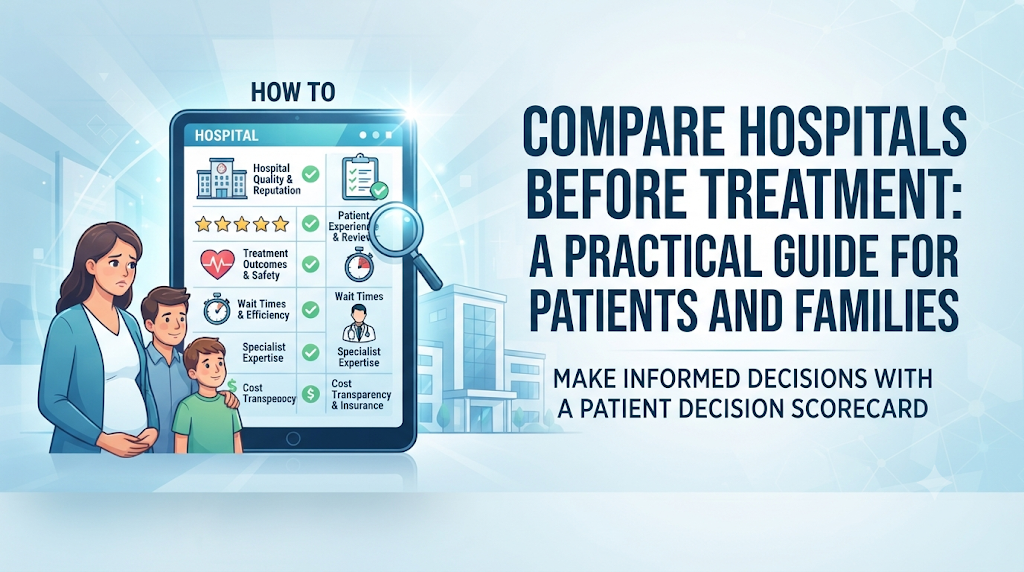
A hospital should not be selected based on its reputation, appearance, location, or advertised treatment price alone. Patients need a structured approach that considers clinical expertise, patient safety, medical infrastructure, transparency, communication, and continuity of care. A hospital comparison scorecard provides a practical way to evaluate different facilities using consistent criteria. Instead of relying on assumptions or promotional claims, patients can collect relevant information, assign scores, identify important differences, and discuss their findings with qualified healthcare professionals.
This guide explains how to compare hospitals for planned treatment, which factors deserve the most attention, and how to use a patient decision scorecard to make a more informed choice.
1. Start by Understanding Your Medical Requirements
Before comparing hospitals, patients should understand the treatment they need and the type of medical support involved.
Different procedures require different clinical capabilities. A hospital that provides excellent general medical services may not necessarily have the specialized expertise, equipment, or support systems required for a complex surgical procedure.
Begin by discussing the proposed treatment with your treating physician or an appropriate specialist.
Collect the following information:
- Confirmed diagnosis or suspected medical condition.
- Recommended treatment or surgical procedure.
- Expected treatment duration.
- Whether hospitalization is required.
- Possible treatment alternatives.
- Expected recovery period.
- Potential complications and associated risks.
- Required diagnostic tests and specialist consultations.
- Expected follow-up appointments.
For example, a patient considering knee replacement surgery should evaluate orthopedic expertise, anesthesia services, infection prevention, rehabilitation facilities, and postoperative physiotherapy.
Similarly, someone planning cardiac surgery should investigate cardiac surgical experience, intensive care capabilities, cardiac diagnostic services, emergency support, and postoperative monitoring.
Creating a clear list of medical requirements prevents patients from comparing hospitals that do not offer equivalent treatment capabilities.
2. Evaluate the Hospital’s Experience in Your Required Specialty
Clinical expertise should be one of the most important considerations when selecting a hospital.
A hospital may have a strong overall reputation but limited experience with a particular procedure. Patients should therefore investigate the experience of the relevant medical department and the specialists who will actually participate in their treatment.
What should patients investigate?
Specialist qualifications
Review the treating physician’s medical qualifications, relevant postgraduate training, professional registration, and specialization.
Procedure-specific experience
Ask how frequently the specialist performs the proposed procedure and whether they regularly manage patients with similar medical conditions.
Multidisciplinary support
Complex treatments may require collaboration between surgeons, physicians, anesthesiologists, radiologists, pathologists, nurses, and rehabilitation professionals.
Clinical decision-making
Understand whether the medical team can explain the proposed treatment, alternative approaches, expected benefits, and possible complications.
Availability of specialists
Ask whether the primary specialist will personally supervise important stages of treatment or whether other clinicians will provide coverage.
Patients should avoid assuming that the most famous doctor or largest hospital is automatically the best choice. The relevant question is whether the available clinical team has the appropriate expertise for the patient’s specific medical needs.
3. Check Accreditation, Licensing, and Patient Safety Standards
Hospital accreditation and regulatory compliance can provide useful information about institutional quality and safety practices.
However, accreditation should be interpreted carefully. Requirements differ between countries, and accreditation does not guarantee that every patient will receive a particular outcome.
Patients should verify the hospital’s current licensing status and any applicable accreditation through official regulatory or accreditation sources.
Important areas to examine
Hospital licensing
Confirm that the hospital is legally authorized to provide the relevant healthcare services in its jurisdiction.
Accreditation status
Check whether the hospital holds recognized accreditation and whether the certification is current.
Infection prevention
Ask about hand hygiene practices, sterilization procedures, surgical-site infection prevention, and hospital infection-control policies.
Medication safety
Understand how medicines are prescribed, administered, documented, and monitored.
Patient identification
Check whether the hospital uses appropriate patient-identification procedures before medication administration, diagnostic testing, and surgery.
Surgical safety
Ask whether standardized surgical safety checks and preoperative verification procedures are followed.
Incident management
A responsible healthcare institution should have processes for identifying, reporting, reviewing, and learning from patient safety incidents.
Patients should distinguish between a hospital displaying an accreditation logo and a hospital providing verifiable evidence of its current accreditation.
4. Compare Medical Infrastructure and Available Facilities
Medical infrastructure is important because planned treatment may require more than the primary procedure itself.
The hospital should have the facilities necessary to support diagnosis, treatment, emergency management, and recovery.
Depending on the procedure, investigate the availability of:
- Operation theatres and surgical equipment.
- Intensive care units.
- Diagnostic imaging facilities.
- Laboratory and pathology services.
- Blood bank or transfusion support.
- Anesthesia and pain management services.
- Emergency medical services.
- Rehabilitation and physiotherapy facilities.
- Specialized treatment equipment.
- Appropriate nursing and clinical support.
Not every patient requires access to every facility. The relevant question is whether the hospital has the infrastructure necessary for the proposed treatment and its foreseeable complications.
For example, a patient undergoing a complex abdominal operation should ask about intensive care availability, emergency surgical support, anesthesia services, blood transfusion arrangements, and the hospital’s ability to manage postoperative complications.
Patients should also ask whether important services are available within the hospital or provided through external arrangements.
This distinction can influence treatment coordination, scheduling, and emergency response.
5. Understand Treatment Costs Beyond the Initial Estimate
Treatment affordability is an important consideration, but comparing hospitals using only the advertised package price can lead to unexpected expenses.
Two hospitals may provide different estimates for what appears to be the same procedure. However, the estimates may include different services, room categories, medical supplies, or postoperative arrangements.
Patients should request a written, itemized treatment estimate.
What should a treatment estimate include?
- Surgeon and specialist consultation fees.
- Hospital admission charges.
- Operation theatre charges.
- Anesthesia fees.
- Room and accommodation charges.
- Medicines and medical supplies.
- Diagnostic investigations.
- Nursing and monitoring expenses.
- Intensive care charges, if applicable.
- Rehabilitation and physiotherapy.
- Follow-up consultation fees.
Ask about possible additional expenses
Some expenses may arise depending on the patient’s condition and clinical requirements.
Examples include:
- Additional hospitalization days.
- Unplanned intensive care admission.
- Additional diagnostic investigations.
- Treatment of complications.
- Blood transfusions.
- Special medical equipment or implants.
- Additional specialist consultations.
- Discharge medications.
Patients should also ask whether the estimate is fixed, package-based, or subject to revision.
A lower initial estimate does not necessarily represent a lower final cost. Similarly, a higher estimate does not automatically indicate better clinical quality.
The objective is to understand what is included, what is excluded, and what circumstances could change the total expense.
6. Examine Patient Experience and Communication Quality
The way healthcare professionals communicate with patients can significantly influence the treatment experience.
Patients need clear explanations, realistic expectations, respectful interactions, and opportunities to ask questions.
During preliminary consultations, observe how the medical team responds to your concerns.
Consider the following:
Clarity of medical explanations
Does the doctor explain the diagnosis, treatment options, expected benefits, and possible risks in understandable language?
Informed consent
Are patients given sufficient information before agreeing to a procedure?
Availability of information
Can patients obtain written treatment instructions, cost estimates, and relevant medical documents?
Family communication
Does the hospital explain how authorized family members can receive updates about treatment progress?
Response to questions
Are concerns addressed professionally, without unnecessary pressure or unrealistic promises?
Language accessibility
Can the hospital communicate effectively in a language the patient understands?
Patient reviews can help identify recurring experiences involving communication, waiting times, staff behavior, and administrative coordination.
Nevertheless, reviews should be interpreted cautiously. Individual experiences may not reflect the hospital’s overall clinical performance.
Look for consistent patterns across multiple sources rather than relying on isolated positive or negative comments.
7. Evaluate Location, Accessibility, and Recovery Support
Location is another important factor when comparing hospitals.
A hospital located far from home may offer specialized treatment that is unavailable locally. However, distance can introduce additional logistical challenges.
Patients should consider:
- Travel time from home.
- Availability of public and private transportation.
- Accommodation options for accompanying family members.
- Accessibility for patients with mobility limitations.
- Availability of follow-up consultations.
- Emergency transportation arrangements.
- Expected duration of hospitalization.
- Requirements for rehabilitation after discharge.
For treatments involving repeated visits, such as chemotherapy, dialysis, or rehabilitation, travel convenience may become especially important.
For major surgery, patients should also consider whether they can remain near the hospital during the initial recovery period.
A facility that offers appropriate medical expertise but creates significant travel difficulties may require additional planning.
8. Investigate Post-Treatment Care and Continuity
Treatment does not necessarily end when a patient leaves the hospital.
Recovery may require medication management, wound care, physiotherapy, follow-up consultations, dietary guidance, and monitoring for complications.
Before selecting a hospital, understand how postoperative and continuing care will be organized.
Ask the hospital:
- Will the treating specialist review the patient after discharge?
- How frequently are follow-up appointments required?
- Are discharge instructions provided in writing?
- Is rehabilitation available when medically necessary?
- Who should patients contact if unexpected symptoms develop?
- Are medical records and investigation reports accessible?
- Can follow-up care be coordinated with a local physician?
For example, a patient undergoing orthopedic surgery may require several weeks of physiotherapy and periodic assessments.
A patient receiving cancer treatment may need coordinated consultations involving oncology, radiology, pathology, and other relevant specialties.
Continuity of care is particularly important when treatment involves multiple departments or long-term monitoring.
9. Use a Patient Decision Scorecard to Compare Hospitals
After gathering information, patients can organize their findings using a structured scorecard.
A weighted scorecard helps distinguish essential clinical factors from secondary considerations.
The following model uses a total of 100 points.
Hospital comparison scorecard
| Evaluation criterion | Weight |
|---|---|
| Relevant specialist expertise | 25 |
| Patient safety and accreditation | 20 |
| Clinical capabilities and infrastructure | 15 |
| Treatment cost transparency | 15 |
| Communication and patient experience | 10 |
| Post-treatment care | 10 |
| Location and accessibility | 5 |
| Total | 100 |
Each hospital can be scored from 1 to 5 for every criterion.
Use the following rating system:
- 1 – Poor: Important information is missing or major concerns remain.
- 2 – Below expectations: Several limitations require clarification.
- 3 – Acceptable: Basic requirements appear to be satisfied.
- 4 – Good: Strong evidence supports the hospital’s capabilities.
- 5 – Excellent: Relevant, current, and verifiable information demonstrates strong performance.
If information is unavailable, mark the criterion as pending rather than automatically assigning a low or high score.
How to calculate weighted scores
Use this formula:
Weighted Score = (Criterion Rating ÷ 5) × Criterion Weight
For example, if a hospital receives a rating of 4 out of 5 for specialist expertise, which carries 25 points:
(4 ÷ 5) × 25 = 20 points.
Calculate the weighted score for each criterion and add the results.
Example of a hospital comparison
Consider a hypothetical patient comparing three hospitals for a planned surgical procedure.
| Evaluation criterion | Weight | Hospital A | Hospital B | Hospital C |
|---|---|---|---|---|
| Specialist expertise | 25 | 5 | 4 | 3 |
| Safety and accreditation | 20 | 4 | 5 | 3 |
| Infrastructure | 15 | 5 | 4 | 3 |
| Cost transparency | 15 | 3 | 5 | 4 |
| Communication | 10 | 4 | 4 | 3 |
| Post-treatment care | 10 | 5 | 4 | 3 |
| Accessibility | 5 | 3 | 4 | 5 |
Illustrative weighted results:
- Hospital A: 86/100
- Hospital B: 87/100
- Hospital C: 66/100
In this hypothetical example, Hospital B receives the highest overall score, while Hospital A performs almost equally well.
However, the one-point difference should not automatically determine the patient’s decision.
Hospital A may have more experience with the specific procedure, while Hospital B may offer stronger cost transparency and safety documentation.
The patient should review the underlying evidence, discuss clinical differences with the treating specialist, and identify whether either hospital has a critical limitation.
The scorecard is a decision-support tool, not a medical quality certification or a substitute for professional clinical judgment.
10. Ask the Right Questions Before Finalizing a Hospital
Before confirming treatment, patients should arrange a consultation or discussion with the relevant medical team.
A prepared list of questions can help prevent important details from being overlooked.
Questions about the treatment
- What is the recommended treatment, and why is it appropriate?
- Are there reasonable alternatives?
- What benefits and risks should I understand?
- How frequently is this procedure performed by the treating specialist?
- What complications may require additional medical support?
Questions about hospital facilities
- Does the hospital have the required specialist department and equipment?
- Is intensive care available if clinically necessary?
- How are emergencies handled?
- What infection prevention procedures are followed?
- Which diagnostic services are available on-site?
Questions about treatment expenses
- What services are included in the written estimate?
- Which expenses are excluded?
- Could additional hospitalization increase the cost?
- Is the proposed treatment covered by my insurance policy?
- Can the hospital provide an itemized estimate?
Questions about recovery
- How long is hospitalization generally expected to last?
- What follow-up care will be required?
- Will rehabilitation or physiotherapy be necessary?
- Who should I contact after discharge if a concern develops?
- What medical records and instructions will I receive?
These questions encourage transparent discussions and help patients compare facilities using more reliable information.
11. Common Mistakes Patients Should Avoid
Even when patients research multiple hospitals, certain mistakes can affect the quality of their final decision.
Selecting a hospital based only on price
A lower treatment estimate may exclude important services or depend on assumptions that need clarification.
Compare equivalent treatment packages and consider clinical suitability before evaluating affordability.
Depending entirely on online ratings
Ratings can reflect administrative experiences, waiting times, or individual expectations rather than clinical outcomes.
Use reviews as supporting information, not as proof of medical quality.
Assuming that a larger hospital is always better
Hospital size does not establish expertise in every specialty.
A smaller facility with an experienced specialist team and appropriate infrastructure may be suitable for certain procedures, while complex cases may require broader institutional capabilities.
Ignoring the treating doctor’s experience
The hospital’s reputation is important, but the expertise of the individual specialist and supporting clinical team also deserves careful consideration.
Overlooking emergency arrangements
Even planned procedures may involve unexpected complications.
Patients should understand how the hospital manages emergencies and whether appropriate critical care support is available.
Failing to obtain written estimates
Verbal cost discussions can lead to misunderstandings.
Request written estimates that explain inclusions, exclusions, payment requirements, and possible additional expenses.
Making decisions under unnecessary pressure
Patients should have reasonable opportunities to review medical information, ask questions, and seek a second opinion when appropriate.
A hospital or healthcare professional should not discourage patients from understanding their treatment options.
12. How Families Can Participate in the Hospital Selection Process
Hospital selection is often a shared responsibility, particularly when patients require major surgery or long-term treatment.
Family members can support the process by organizing medical documents, comparing treatment estimates, coordinating consultations, and discussing logistical requirements.
However, the patient’s preferences, privacy, and informed consent should remain central to the decision.
A practical family approach includes:
- Appointing one person to organize hospital information.
- Maintaining copies of medical reports and prescriptions.
- Recording consultation notes.
- Comparing written estimates.
- Checking insurance requirements.
- Discussing travel and accommodation arrangements.
- Preparing questions for medical consultations.
- Reviewing discharge and recovery arrangements.
Families should avoid making decisions based entirely on convenience or financial considerations without understanding the medical recommendation.
Where possible, the patient should participate directly in discussions and give informed consent.
13. A Practical Final Checklist Before Choosing a Hospital
Once the comparison is complete, review the following checklist before making a final decision.
- The hospital can provide the required treatment.
- The relevant specialist’s qualifications have been checked.
- Procedure-specific clinical experience has been discussed.
- Hospital licensing and relevant accreditation have been verified.
- Required medical infrastructure is available.
- Emergency and intensive care arrangements are understood.
- A written treatment estimate has been received.
- Additional expenses have been discussed.
- Insurance coverage has been checked.
- Communication and informed consent procedures are satisfactory.
- Post-treatment and rehabilitation arrangements are understood.
- Travel and accommodation requirements have been considered.
- The patient has had an opportunity to ask questions and consider alternatives.
If important information remains unavailable, request clarification before proceeding whenever the medical situation allows.
Frequently Asked Questions
1. What is the most important factor when comparing hospitals?
Clinical suitability should be the primary consideration. Patients should evaluate specialist expertise, experience with the required procedure, appropriate infrastructure, and patient safety practices before focusing on secondary factors such as convenience or price.
2. How many hospitals should patients compare before planned treatment?
There is no universal number. Comparing two or three clinically suitable hospitals can provide useful perspective, provided the facilities offer comparable treatment capabilities and patients have enough reliable information to evaluate them.
For complex or high-risk procedures, a specialist second opinion may be particularly valuable.
3. Is an accredited hospital always the best choice?
No. Accreditation indicates that a hospital has been assessed against specified standards, but it does not guarantee a particular treatment outcome.
Patients should also consider the relevant specialist’s expertise, available facilities, safety practices, and the hospital’s suitability for their medical condition.
4. Should patients always choose the hospital with the lowest treatment cost?
No. The lowest estimate may not include all necessary services or provide an equivalent treatment package.
Patients should compare itemized estimates, understand potential additional expenses, and evaluate clinical suitability before making a financial decision.
5. How can patients verify a doctor’s qualifications?
Patients can request information about the doctor’s qualifications, postgraduate training, specialty, professional registration, and relevant experience.
Where possible, verify registration through the appropriate official medical regulatory body in the country or jurisdiction where the doctor practices.
6. What should patients do if two hospitals receive almost identical scores?
Review the individual category scores rather than relying only on the final totals.
Give particular attention to specialist expertise, patient safety, procedure-specific experience, and critical infrastructure requirements. Discuss meaningful clinical differences with the treating physician.
7. Are online hospital reviews reliable?
Online reviews can provide useful information about communication, administration, waiting times, and patient experiences.
However, they may not accurately represent clinical quality or treatment outcomes. Patients should consider multiple sources and look for consistent, verifiable information.
8. Why is post-treatment care important when choosing a hospital?
Recovery may involve medication, rehabilitation, follow-up appointments, and monitoring for complications.
A hospital with appropriate continuity-of-care arrangements can help patients understand their recovery plan and access necessary medical support after discharge.
Conclusion
Comparing hospitals for planned treatment requires more than checking prices, ratings, or location. Patients need to understand their medical requirements, assess specialist expertise, investigate patient safety, review available facilities, and evaluate the financial and practical aspects of treatment. A structured patient decision scorecard makes this process easier by organizing important information into measurable categories. It also helps families identify missing details, compare treatment estimates, and ask more informed questions during hospital consultations. The most suitable hospital is not necessarily the largest, most expensive, or highest-rated facility. It is the hospital whose clinical capabilities, specialist expertise, safety practices, treatment arrangements, and recovery support appropriately match the patient’s medical needs. Ultimately, an informed hospital decision should combine verified information, transparent communication, professional medical advice, and the patient’s own preferences. A thoughtful comparison before treatment can help patients approach their healthcare journey with greater clarity and confidence.

Find Trusted Cardiac Hospitals
Compare heart hospitals by city and services — all in one place.
Explore Hospitals