Introduction
Employee engagement platforms help organizations improve communication, collaboration, recognition, feedback collection, and workforce satisfaction. These platforms combine surveys, performance insights, rewards systems, analytics, internal communication tools, and employee experience features into a centralized environment that helps businesses build stronger workplace cultures. Modern organizations increasingly rely on employee engagement tools because hybrid work, distributed teams, burnout concerns, retention challenges, and workforce expectations continue to evolve. Companies are investing in platforms that help managers understand employee sentiment, improve productivity, reduce turnover, and create more transparent workplace experience
Real-world use cases include:
- Running employee pulse surveys
- Managing recognition and rewards programs
- Tracking workforce sentiment and morale
- Supporting hybrid and remote collaboration
- Improving onboarding and employee retention
When evaluating employee engagement platforms, buyers should consider:
- Survey and feedback capabilities
- Analytics and reporting depth
- Recognition and rewards features
- Collaboration and communication tools
- Integration ecosystem
- Scalability across departments and regions
- Mobile accessibility
- Security and compliance controls
- Ease of administration
- Pricing flexibility
Best for: HR teams, enterprise organizations, remote-first companies, people operations leaders, workforce experience teams, and businesses focused on retention and culture improvement.
Not ideal for: Very small teams with simple communication needs or organizations that already manage engagement effectively through lightweight collaboration tools alone.
Key Trends in Employee Engagement Platforms
- AI-powered sentiment analysis is becoming standard for identifying workforce morale trends and burnout risks.
- Platforms increasingly combine engagement, recognition, performance, and wellbeing tools into unified employee experience suites.
- Mobile-first engagement experiences are improving participation rates among frontline and distributed employees.
- Real-time pulse surveys are replacing traditional annual employee engagement reviews.
- Analytics dashboards now provide predictive insights related to retention and employee satisfaction.
- Integration with collaboration tools like Microsoft Teams and Slack is now expected.
- Companies are demanding stronger compliance controls, audit logs, and role-based access management.
- Employee recognition platforms are increasingly tied to measurable business outcomes and retention metrics.
- Automation workflows for onboarding, feedback collection, and engagement campaigns continue to expand.
- Organizations are prioritizing localized and multilingual engagement capabilities for global teams.
How We Selected These Tools
The platforms in this list were selected using a practical SaaS evaluation methodology focused on business usability, scalability, and workforce experience capabilities.
Evaluation criteria included:
- Market adoption and enterprise visibility
- Breadth of engagement and recognition features
- Employee feedback and survey capabilities
- Reporting and workforce analytics depth
- Integration ecosystem maturity
- Mobile and remote workforce support
- Security and compliance readiness
- Ease of deployment and administration
- Flexibility across SMB and enterprise environments
- Long-term scalability and product innovation
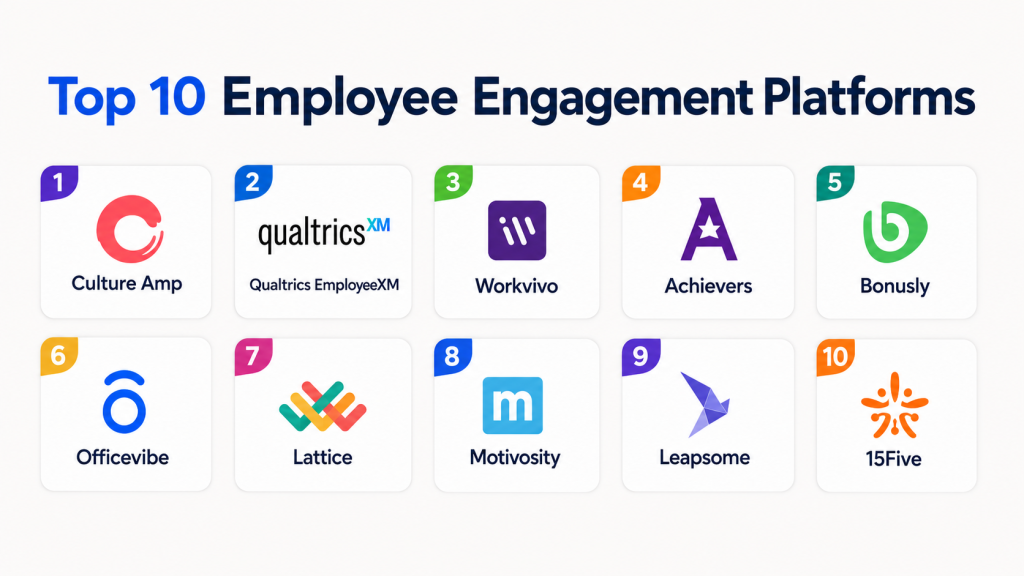
Top 10 Employee Engagement Platforms
1- Culture Amp
Culture Amp is a widely adopted employee engagement and people analytics platform focused on workforce feedback, performance management, and employee development. It is especially popular among mid-market and enterprise organizations seeking data-driven people operations strategies.
Key Features
- Employee engagement surveys
- Performance management workflows
- Goal tracking and feedback systems
- AI-assisted workforce insights
- Employee development planning
- Benchmarking analytics
- Manager enablement tools
Pros
- Strong analytics and benchmarking capabilities
- Excellent survey customization
- Mature enterprise feature set
Cons
- Advanced analytics may require training
- Premium pricing for larger deployments
- Some integrations require additional configuration
Platforms / Deployment
- Web / iOS / Android
- Cloud
Security & Compliance
Supports SSO/SAML, encryption, RBAC, GDPR compliance, and audit capabilities. Additional certifications not publicly stated.
Integrations & Ecosystem
Culture Amp integrates with HRIS, communication, and productivity systems commonly used by enterprise organizations.
- Slack
- Microsoft Teams
- Workday
- BambooHR
- Okta
- API access
Support & Community
Strong onboarding resources, customer success programs, implementation guidance, and enterprise support availability.
2- Qualtrics EmployeeXM
Qualtrics EmployeeXM is an enterprise-grade employee experience platform focused on workforce sentiment analysis, engagement measurement, and predictive analytics. It is commonly used by large organizations requiring advanced reporting and experience management capabilities.
Key Features
- Advanced employee surveys
- Predictive workforce analytics
- Sentiment analysis
- Lifecycle feedback tracking
- AI-powered recommendations
- Benchmarking tools
- Enterprise reporting dashboards
Pros
- Deep analytics functionality
- Strong enterprise scalability
- Extensive customization options
Cons
- Complex implementation for smaller teams
- Higher learning curve
- Premium enterprise pricing
Platforms / Deployment
- Web / iOS / Android
- Cloud
Security & Compliance
Supports encryption, SSO/SAML, GDPR readiness, RBAC, and enterprise security controls.
Integrations & Ecosystem
Qualtrics supports broad enterprise integration capabilities and workflow automation.
- SAP
- Workday
- Salesforce
- Microsoft Teams
- Slack
- APIs and automation connectors
Support & Community
Comprehensive enterprise onboarding, consulting services, technical documentation, and global support options.
3- Workvivo
Workvivo combines employee engagement, communication, and social collaboration features into a modern employee experience platform. It is widely used by organizations seeking stronger internal communication and community building.
Key Features
- Social intranet functionality
- Employee recognition
- Pulse surveys
- Internal communications hub
- Community engagement tools
- Mobile-first experience
- Content publishing features
Pros
- Excellent employee communication experience
- Strong mobile usability
- Engaging social-style interface
Cons
- Analytics less advanced than some competitors
- May overlap with existing collaboration tools
- Enterprise reporting depth varies
Platforms / Deployment
- Web / iOS / Android
- Cloud
Security & Compliance
Supports SSO, encryption, and enterprise access controls. Additional certifications not publicly stated.
Integrations & Ecosystem
Workvivo focuses heavily on workplace collaboration integrations.
- Microsoft Teams
- Slack
- Zoom
- Google Workspace
- HRIS integrations
- APIs
Support & Community
Strong implementation support and growing enterprise customer community.
4- Achievers
Achievers focuses on employee recognition, rewards, and engagement analytics. The platform is widely adopted by organizations looking to improve employee morale and retention through continuous recognition programs.
Key Features
- Recognition and rewards system
- Engagement surveys
- Behavioral analytics
- Incentive programs
- Manager reporting
- Goal alignment tools
- Workforce insights
Pros
- Strong recognition workflows
- Good retention-focused analytics
- Employee-friendly interface
Cons
- Some advanced features cost extra
- Reporting customization can vary
- Reward management may require configuration
Platforms / Deployment
- Web / iOS / Android
- Cloud
Security & Compliance
Supports SSO, RBAC, encryption, and enterprise-grade access management.
Integrations & Ecosystem
Achievers supports integrations with HR and collaboration ecosystems.
- Workday
- SAP SuccessFactors
- Microsoft Teams
- Slack
- HRIS systems
- APIs
Support & Community
Offers onboarding services, customer support programs, and implementation assistance.
5- Bonusly
Bonusly is a lightweight employee recognition and rewards platform designed for SMBs and growing companies. It emphasizes peer recognition and team engagement through simple social workflows.
Key Features
- Peer-to-peer recognition
- Rewards marketplace
- Engagement tracking
- Team celebration tools
- Employee analytics
- Mobile support
- Incentive workflows
Pros
- Easy to deploy and use
- Strong employee adoption rates
- Good SMB affordability
Cons
- Limited enterprise analytics depth
- Fewer advanced HR capabilities
- Recognition-focused rather than full-suite engagement
Platforms / Deployment
- Web / iOS / Android
- Cloud
Security & Compliance
Supports encryption, SSO integrations, and standard enterprise security practices.
Integrations & Ecosystem
Bonusly integrates with common collaboration and HR platforms.
- Slack
- Microsoft Teams
- BambooHR
- Zapier
- HRIS integrations
- APIs
Support & Community
Simple onboarding experience with responsive customer support.
6- Officevibe
Officevibe is an employee engagement and feedback platform focused on pulse surveys, manager insights, and employee wellbeing. It is commonly used by SMB and mid-market organizations.
Key Features
- Pulse surveys
- Anonymous feedback
- Manager coaching tools
- Employee recognition
- Team health metrics
- Engagement analytics
- Action planning dashboards
Pros
- Easy survey deployment
- Strong manager-focused insights
- User-friendly interface
Cons
- Less suitable for large enterprises
- Limited customization in some modules
- Analytics depth may be basic for advanced HR teams
Platforms / Deployment
- Web / iOS / Android
- Cloud
Security & Compliance
Supports encryption, SSO integrations, and access management features.
Integrations & Ecosystem
Officevibe supports integrations with communication and HR systems.
- Slack
- Microsoft Teams
- BambooHR
- Workday
- HRIS connectors
- APIs
Support & Community
Strong onboarding support with accessible training resources.
7- Lattice
Lattice combines employee engagement, performance management, and career development into a unified workforce management platform. It is widely adopted by technology companies and modern HR teams.
Key Features
- Engagement surveys
- Performance reviews
- Goal management
- Career development planning
- Feedback workflows
- Analytics dashboards
- Employee growth tracking
Pros
- Strong all-in-one HR experience
- Excellent manager workflows
- Scalable feature set
Cons
- Can become expensive at scale
- Some modules sold separately
- Learning curve for advanced features
Platforms / Deployment
- Web / iOS / Android
- Cloud
Security & Compliance
Supports SSO/SAML, RBAC, encryption, and enterprise access management controls.
Integrations & Ecosystem
Lattice integrates broadly with HR and productivity platforms.
- Slack
- Microsoft Teams
- Workday
- BambooHR
- Okta
- APIs
Support & Community
Strong implementation support and active HR technology ecosystem presence.
8- Motivosity
Motivosity focuses on employee recognition, appreciation, and workplace connection tools. The platform is especially popular among organizations prioritizing culture-building initiatives.
Key Features
- Peer recognition
- Social engagement feeds
- Employee rewards
- Manager development tools
- Pulse surveys
- Team insights
- Culture-building workflows
Pros
- Simple and engaging interface
- Strong employee participation
- Good culture-focused features
Cons
- Limited enterprise analytics
- Smaller ecosystem compared to major competitors
- Advanced customization may be limited
Platforms / Deployment
- Web / iOS / Android
- Cloud
Security & Compliance
Supports standard enterprise authentication and encryption features.
Integrations & Ecosystem
Motivosity supports common HR and communication platform integrations.
- Slack
- Microsoft Teams
- BambooHR
- HRIS integrations
- APIs
- Payroll integrations
Support & Community
Offers responsive support and onboarding assistance for SMB and mid-market organizations.
9- Leapsome
Leapsome is an employee enablement platform combining engagement, learning, performance, and development tools. It is commonly used by organizations focused on continuous improvement and employee growth.
Key Features
- Engagement surveys
- Learning management features
- Goal tracking
- Performance reviews
- Feedback workflows
- Workforce analytics
- Development planning
Pros
- Broad feature coverage
- Strong learning and growth tools
- Modern interface design
Cons
- Smaller market presence than some competitors
- Enterprise scalability varies
- Reporting depth may differ by module
Platforms / Deployment
- Web / iOS / Android
- Cloud
Security & Compliance
Supports SSO, encryption, RBAC, and enterprise access management capabilities.
Integrations & Ecosystem
Leapsome supports integrations across HR and collaboration environments.
- Slack
- Microsoft Teams
- HRIS systems
- Google Workspace
- APIs
- Calendar integrations
Support & Community
Provides onboarding support, documentation, and implementation guidance.
10- 15Five
15Five is a performance and engagement platform focused on continuous feedback, manager effectiveness, and employee development. It is widely adopted by growth-stage and mid-market businesses.
Key Features
- Weekly check-ins
- Employee surveys
- Goal management
- Performance reviews
- Manager coaching
- Engagement analytics
- Employee development tools
Pros
- Strong manager-focused workflows
- Easy employee feedback collection
- Good balance of engagement and performance tools
Cons
- Some advanced analytics are limited
- Enterprise customization may vary
- Feature depth differs across plans
Platforms / Deployment
- Web / iOS / Android
- Cloud
Security & Compliance
Supports SSO/SAML, encryption, RBAC, and enterprise authentication controls.
Integrations & Ecosystem
15Five integrates with common HR and workplace productivity systems.
- Slack
- BambooHR
- Workday
- Okta
- Microsoft Teams
- APIs
Support & Community
Strong educational resources, onboarding programs, and HR-focused customer support.
Comparison Table
| Tool Name | Best For | Platforms Supported | Deployment | Standout Feature | Public Rating |
|---|---|---|---|---|---|
| Culture Amp | Enterprise engagement analytics | Web, iOS, Android | Cloud | Advanced people analytics | N/A |
| Qualtrics EmployeeXM | Large enterprise workforce insights | Web, iOS, Android | Cloud | Predictive experience analytics | N/A |
| Workvivo | Internal communication and culture | Web, iOS, Android | Cloud | Social employee experience | N/A |
| Achievers | Recognition and rewards | Web, iOS, Android | Cloud | Employee recognition programs | N/A |
| Bonusly | SMB recognition workflows | Web, iOS, Android | Cloud | Peer-to-peer rewards | N/A |
| Officevibe | SMB engagement surveys | Web, iOS, Android | Cloud | Pulse feedback tools | N/A |
| Lattice | Performance and engagement | Web, iOS, Android | Cloud | Unified HR workflows | N/A |
| Motivosity | Culture-focused recognition | Web, iOS, Android | Cloud | Social appreciation features | N/A |
| Leapsome | Learning and engagement | Web, iOS, Android | Cloud | Employee enablement suite | N/A |
| 15Five | Continuous employee feedback | Web, iOS, Android | Cloud | Weekly check-in workflows | N/A |
Evaluation & Scoring of Employee Engagement Platforms
| Tool Name | Core 25% | Ease 15% | Integrations 15% | Security 10% | Performance 10% | Support 10% | Value 15% | Weighted Total |
|---|---|---|---|---|---|---|---|---|
| Culture Amp | 9.5 | 8.5 | 9.0 | 9.0 | 9.0 | 8.5 | 8.0 | 8.85 |
| Qualtrics EmployeeXM | 9.5 | 7.5 | 9.5 | 9.5 | 9.0 | 9.0 | 7.0 | 8.73 |
| Workvivo | 8.5 | 9.0 | 8.5 | 8.0 | 8.5 | 8.5 | 8.5 | 8.53 |
| Achievers | 8.5 | 8.5 | 8.5 | 8.5 | 8.5 | 8.5 | 8.0 | 8.43 |
| Bonusly | 7.5 | 9.5 | 8.0 | 8.0 | 8.0 | 8.0 | 9.0 | 8.20 |
| Officevibe | 8.0 | 9.0 | 8.0 | 8.0 | 8.0 | 8.0 | 8.5 | 8.18 |
| Lattice | 9.0 | 8.5 | 9.0 | 9.0 | 8.5 | 8.5 | 7.5 | 8.58 |
| Motivosity | 7.5 | 8.5 | 7.5 | 7.5 | 8.0 | 8.0 | 8.5 | 7.93 |
| Leapsome | 8.5 | 8.5 | 8.0 | 8.5 | 8.5 | 8.0 | 8.0 | 8.28 |
| 15Five | 8.5 | 8.5 | 8.5 | 8.5 | 8.5 | 8.5 | 8.0 | 8.43 |
These scores are comparative rather than absolute. Enterprise-focused platforms typically score higher in analytics, security, and scalability, while SMB-focused tools often perform better in ease of use and pricing value. Buyers should prioritize the categories most aligned with their organizational goals rather than focusing only on total score rankings.
Which Employee Engagement Tool Is Right for You?
Solo / Freelancer
Most solo professionals do not require enterprise engagement platforms. Lightweight recognition or communication tools may be sufficient. Bonusly or Officevibe can work for small distributed teams with simple engagement requirements.
SMB
SMBs usually benefit from platforms that are easy to deploy and affordable. Officevibe, Bonusly, and Motivosity provide strong engagement capabilities without excessive enterprise complexity.
Mid-Market
Mid-market organizations often require deeper analytics, performance management, and employee development tools. Lattice, 15Five, and Culture Amp are strong choices for growing organizations.
Enterprise
Large enterprises typically need scalable analytics, advanced compliance controls, and multi-region workforce support. Qualtrics EmployeeXM and Culture Amp are particularly strong in this segment.
Budget vs Premium
Budget-friendly tools generally focus on recognition and surveys, while premium platforms provide workforce analytics, AI insights, and integrated employee experience management. Organizations should avoid paying for advanced analytics they may never use.
Feature Depth vs Ease of Use
Feature-rich enterprise suites often require training and implementation resources. Simpler platforms typically achieve faster adoption and easier onboarding. The right balance depends on internal HR maturity and workforce size.
Integrations & Scalability
Organizations with mature HR ecosystems should prioritize integration capabilities with HRIS, collaboration, and identity management systems. Scalability becomes especially important for global or rapidly growing companies.
Security & Compliance Needs
Regulated industries and large enterprises should prioritize platforms with SSO/SAML, RBAC, encryption, audit logging, and strong compliance documentation. Smaller businesses may focus more on usability and deployment speed.
Frequently Asked Questions
1- What is an employee engagement platform?
An employee engagement platform helps organizations improve communication, feedback collection, recognition, collaboration, and workforce satisfaction. These tools support culture-building and employee retention initiatives.
2- Why are employee engagement platforms important?
They help organizations understand workforce sentiment, improve morale, reduce turnover, and support better employee experiences across remote, hybrid, and in-office environments.
3- Are employee engagement platforms only for large enterprises?
No. Many platforms offer SMB-friendly pricing and lightweight deployment options. Smaller organizations often use these tools to improve communication and retention as they scale.
4- What features should buyers prioritize?
Important features include surveys, analytics, recognition systems, integrations, mobile access, reporting, automation, and security controls. Buyers should align features with business priorities.
5- How long does implementation usually take?
Implementation timelines vary by complexity. Lightweight platforms may be deployed within days, while enterprise deployments involving HR integrations and custom workflows may require several weeks.
6- Can these platforms integrate with HR systems?
Yes. Most leading platforms integrate with HRIS, payroll systems, communication tools, identity providers, and productivity platforms through APIs or prebuilt connectors.
7- Are employee engagement platforms secure?
Most leading vendors support enterprise security features such as SSO, encryption, RBAC, and audit controls. However, compliance depth varies between vendors.
8- What are common mistakes during deployment?
Organizations often fail when they collect employee feedback but do not take visible action afterward. Poor communication and lack of manager involvement can also reduce adoption.
9- Do these platforms support remote employees?
Yes. Modern employee engagement platforms are heavily focused on supporting hybrid and remote workforces through mobile apps, surveys, communication tools, and recognition workflows.
10- How should companies shortlist vendors?
Organizations should identify core engagement goals, compare integration requirements, evaluate analytics capabilities, assess scalability, and run pilot programs before committing to long-term deployments.
Conclusion
Employee engagement platforms have evolved from simple survey tools into comprehensive workforce experience ecosystems that support communication, recognition, analytics, performance management, and employee wellbeing. As organizations continue managing hybrid workforces and retention challenges, engagement technology has become increasingly important for maintaining workplace culture and employee satisfaction. The right platform can improve transparency, strengthen leadership visibility, and help organizations make better people-focused decisions. There is no universal best solution for every company. Enterprise organizations may prioritize advanced analytics, compliance, and scalability, while SMBs often value simplicity, affordability, and fast deployment. Platforms like Qualtrics EmployeeXM and Culture Amp excel in enterprise analytics, while tools like Bonusly and Officevibe offer accessible engagement workflows for growing businesses. Organizations should shortlist two or three platforms, run pilot evaluations, validate integration and security requirements, and involve HR leaders, managers, and employees in the selection process.

Find Trusted Cardiac Hospitals
Compare heart hospitals by city and services — all in one place.
Explore Hospitals
I learned how employee engagement platforms can help improve team morale and workplace satisfaction. I’d like to explore which features make the biggest difference in keeping employees motivated.
I now understand how time tracking software helps accurately monitor working hours and improve productivity and accountability in teams. I’d like to explore more about how it integrates with payroll and project management systems in real workflows.