Introduction
Business Phone Systems VoIP platforms allow organizations to make voice calls, manage communication workflows, support customer interactions, and enable remote collaboration using internet-based telephony instead of traditional landline infrastructure. Modern VoIP systems now combine cloud calling, video conferencing, messaging, AI-powered call intelligence, contact center capabilities, and workflow integrations into unified communication platforms. As remote work, hybrid operations, and globally distributed teams continue expanding, businesses increasingly rely on cloud-based phone systems to reduce operational costs, improve communication flexibility, simplify administration, and support mobile workforces. Modern VoIP platforms also help organizations centralize communication management while improving scalability, security, analytics, and customer experience.
Real-world use cases include:
- Business voice communication
- Remote and hybrid workforce collaboration
- Customer support and call routing
- Sales and contact center operations
- Multi-location business communication
Evaluation Criteria for Buyers
- Call quality and reliability
- Scalability and global coverage
- AI-powered communication features
- Security and compliance controls
- Ease of deployment and management
- Mobile and remote workforce support
- CRM and workflow integrations
- Contact center capabilities
- Pricing flexibility and licensing
- Analytics and reporting functionality
Best for: SMBs, enterprises, remote teams, customer support organizations, sales teams, healthcare providers, educational institutions, and distributed businesses.
Not ideal for: Very small organizations with minimal communication needs or businesses only requiring basic mobile phone communication.
Key Trends in Business Phone Systems VoIP
- AI-powered call transcription and summaries are becoming standard features.
- Cloud-native VoIP systems continue replacing traditional PBX infrastructure.
- Unified communication platforms are merging voice, messaging, and collaboration.
- Mobile-first communication experiences are improving workforce flexibility.
- Contact center and UCaaS convergence is accelerating.
- Workflow automation and intelligent call routing are expanding rapidly.
- Compliance and security requirements are increasing across industries.
- Browser-based calling experiences are improving adoption.
- Global communication scalability is becoming easier for SMBs.
- Analytics and workforce intelligence capabilities are evolving rapidly.
How We Selected These Tools
The following platforms were selected using practical SaaS and enterprise communication evaluation criteria:
- Market adoption and enterprise visibility
- Reliability and call quality
- Unified communication capabilities
- Security and governance maturity
- AI and automation readiness
- Integration ecosystem strength
- Scalability across organization sizes
- Administrative and reporting controls
- Mobile workforce support
- Customer support and onboarding quality
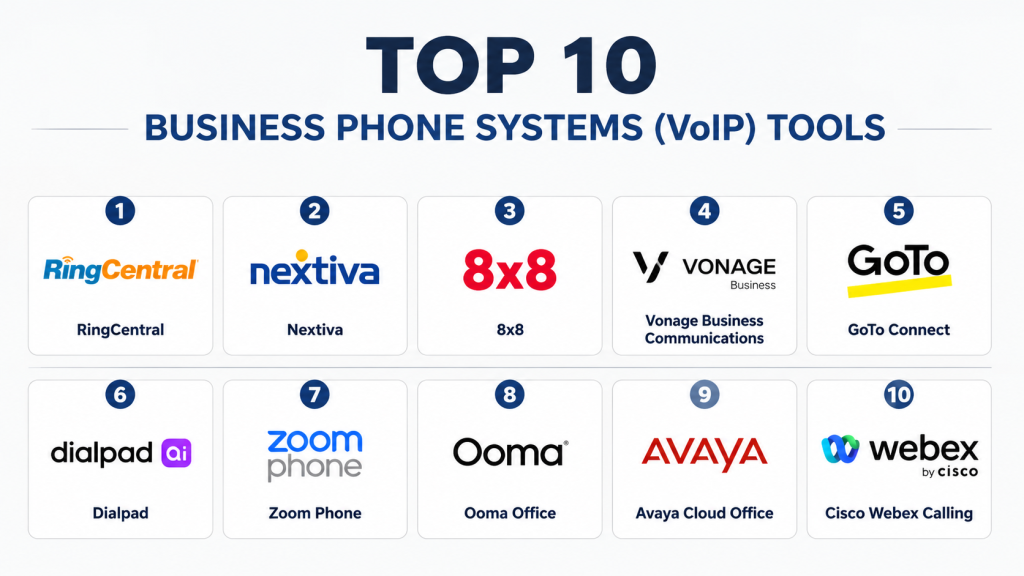
Top 10 Business Phone Systems VoIP Tools
1- RingCentral
Short description: Enterprise-grade cloud phone system designed for business communication, collaboration, and unified communication workflows.
Key Features
- Cloud business calling
- Team messaging and collaboration
- AI communication analytics
- Video conferencing support
- Call routing and IVR
- Contact center integrations
- Mobile and remote workforce support
Pros
- Strong enterprise scalability
- Reliable call infrastructure
- Mature communication ecosystem
Cons
- Advanced features can increase costs
- Administrative setup may require expertise
Platforms / Deployment
Cloud
Security & Compliance
SSO/SAML, MFA, encryption, audit logs, RBAC, GDPR, SOC 2
Integrations & Ecosystem
Supports integrations with enterprise productivity and CRM platforms.
- Salesforce
- Microsoft 365
- Google Workspace
- Zendesk
Support & Community
Strong enterprise onboarding and partner support ecosystem.
2- Nextiva
Short description: Business VoIP platform designed for SMB communication, customer engagement, and cloud collaboration.
Key Features
- Business voice services
- Team collaboration tools
- Video conferencing
- Call analytics and reporting
- Customer communication management
- Contact center support
- Mobile calling support
Pros
- Strong SMB usability
- Reliable communication quality
- Good customer support
Cons
- Advanced enterprise customization is moderate
- AI capabilities are lighter than competitors
Platforms / Deployment
Cloud
Security & Compliance
MFA, encryption, SSO, GDPR
Integrations & Ecosystem
Supports integrations with CRM and customer communication systems.
- Salesforce
- HubSpot
- Zendesk
- Microsoft 365
Support & Community
Responsive customer onboarding and SMB support experience.
3- 8×8
Short description: Unified communication and VoIP platform built for global business communication and contact center operations.
Key Features
- Global cloud telephony
- Video meetings and messaging
- Omnichannel communication
- Workforce analytics
- Contact center integration
- AI-powered routing
- Call monitoring and reporting
Pros
- Strong international communication support
- Good contact center capabilities
- Competitive enterprise pricing
Cons
- Interface modernization could improve
- Administrative controls may feel complex
Platforms / Deployment
Cloud
Security & Compliance
Encryption, MFA, SSO, audit logs, GDPR
Integrations & Ecosystem
Supports enterprise communication and CRM integrations.
- Salesforce
- Microsoft Teams
- Zendesk
- HubSpot
Support & Community
Enterprise onboarding and communication support resources.
4- Vonage Business Communications
Short description: Flexible cloud VoIP platform combining business calling, messaging, and API-driven communication workflows.
Key Features
- Business VoIP calling
- Unified messaging
- Team collaboration
- Contact center support
- API-based customization
- Call analytics
- Mobile communication tools
Pros
- Strong developer API ecosystem
- Flexible communication workflows
- Good scalability
Cons
- Reporting depth varies
- Advanced features may require additional licensing
Platforms / Deployment
Cloud
Security & Compliance
Encryption, MFA, SSO, GDPR
Integrations & Ecosystem
Supports CRM and workflow communication integrations.
- Salesforce
- Microsoft Teams
- Zendesk
- APIs
Support & Community
Strong API documentation and enterprise onboarding support.
5- GoTo Connect
Short description: Cloud business phone system designed for SMB communication and remote workforce collaboration.
Key Features
- Cloud phone system
- Team messaging
- Video conferencing
- Call routing and IVR
- Mobile communication
- Admin management tools
- Contact center support
Pros
- Easy deployment
- Reliable voice performance
- Strong SMB usability
Cons
- Limited enterprise customization
- Smaller ecosystem than leading competitors
Platforms / Deployment
Cloud
Security & Compliance
Encryption, MFA, SSO, GDPR
Integrations & Ecosystem
Supports productivity and communication integrations.
- Microsoft 365
- Google Workspace
- Salesforce
- Zendesk
Support & Community
Responsive SMB support and onboarding experience.
6- Dialpad
Short description: AI-powered business phone platform designed for modern cloud communication and intelligent voice workflows.
Key Features
- AI-powered call transcription
- Cloud business calling
- Real-time voice intelligence
- Team messaging
- Contact center support
- AI meeting summaries
- Workflow automation
Pros
- Strong AI functionality
- Modern user interface
- Good remote workforce support
Cons
- International support may vary
- Advanced analytics require premium plans
Platforms / Deployment
Cloud
Security & Compliance
Encryption, MFA, SSO, GDPR, SOC 2
Integrations & Ecosystem
Supports integrations with productivity and CRM systems.
- Salesforce
- HubSpot
- Google Workspace
- Microsoft 365
Support & Community
Strong onboarding resources and growing enterprise adoption.
7- Zoom Phone
Short description: Cloud-based business phone system integrated into the Zoom communication ecosystem.
Key Features
- Cloud VoIP calling
- Video conferencing integration
- Team messaging
- AI meeting summaries
- Call routing and IVR
- Mobile collaboration
- Analytics dashboards
Pros
- Easy onboarding experience
- Strong hybrid communication support
- Unified collaboration environment
Cons
- Some advanced capabilities require upgrades
- Enterprise governance depth varies by plan
Platforms / Deployment
Cloud
Security & Compliance
Encryption, MFA, SSO, RBAC, GDPR
Integrations & Ecosystem
Supports integrations across productivity and collaboration environments.
- Microsoft 365
- Google Workspace
- Slack
- Salesforce
Support & Community
Strong documentation and enterprise support ecosystem.
8- Ooma Office
Short description: Affordable business VoIP platform designed for small businesses and remote communication teams.
Key Features
- Business phone calling
- Virtual receptionist
- Call forwarding
- Mobile application support
- Voicemail management
- Video meetings
- Team messaging
Pros
- Affordable pricing
- Simple setup process
- Good SMB usability
Cons
- Limited enterprise scalability
- Smaller integration ecosystem
Platforms / Deployment
Cloud
Security & Compliance
Encryption, MFA, GDPR
Integrations & Ecosystem
Supports essential communication and productivity integrations.
- Microsoft 365
- Google Workspace
- CRM integrations
- APIs
Support & Community
Good SMB support and onboarding experience.
9- Avaya Cloud Office
Short description: Enterprise communication platform focused on scalable business voice infrastructure and collaboration.
Key Features
- Enterprise VoIP calling
- Team messaging
- Video conferencing
- Contact center support
- Global communication support
- Administrative controls
- Collaboration workflows
Pros
- Strong enterprise communication capabilities
- Reliable telephony infrastructure
- Scalable deployment options
Cons
- Licensing complexity
- Interface modernization could improve
Platforms / Deployment
Cloud / Hybrid
Security & Compliance
SSO/SAML, MFA, encryption, audit logs, GDPR
Integrations & Ecosystem
Supports enterprise communication and CRM integrations.
- Salesforce
- Microsoft 365
- ServiceNow
- APIs
Support & Community
Enterprise-level onboarding and implementation support.
10- Cisco Webex Calling
Short description: Enterprise cloud calling solution integrated into the Cisco Webex collaboration ecosystem.
Key Features
- Enterprise business calling
- Video meetings integration
- Team messaging
- AI-powered communication features
- Device ecosystem support
- Security and compliance management
- Call analytics
Pros
- Strong enterprise security
- Reliable communication infrastructure
- Mature hybrid workplace support
Cons
- Enterprise-focused pricing
- Interface may feel complex
Platforms / Deployment
Cloud / Hybrid
Security & Compliance
SSO/SAML, MFA, encryption, audit logs, RBAC, SOC 2, GDPR
Integrations & Ecosystem
Supports enterprise communication and collaboration workflows.
- Microsoft 365
- Salesforce
- Google Workspace
- ServiceNow
Support & Community
Global enterprise support and implementation ecosystem.
Comparison Table
| Tool Name | Best For | Platforms Supported | Deployment | Standout Feature | Public Rating |
|---|---|---|---|---|---|
| RingCentral | Enterprise communication | Desktop, Mobile | Cloud | Unified communications | N/A |
| Nextiva | SMB communication | Desktop, Mobile | Cloud | Customer engagement workflows | N/A |
| 8×8 | Global business communication | Desktop, Mobile | Cloud | International telephony | N/A |
| Vonage Business Communications | API-driven workflows | Desktop, Mobile | Cloud | Developer communication APIs | N/A |
| GoTo Connect | SMB collaboration | Desktop, Mobile | Cloud | Easy deployment | N/A |
| Dialpad | AI-powered communication | Desktop, Mobile | Cloud | AI voice intelligence | N/A |
| Zoom Phone | Hybrid collaboration | Desktop, Mobile | Cloud | Zoom ecosystem integration | N/A |
| Ooma Office | Small business VoIP | Desktop, Mobile | Cloud | Affordable business calling | N/A |
| Avaya Cloud Office | Enterprise voice systems | Desktop, Mobile | Cloud, Hybrid | Enterprise telephony | N/A |
| Cisco Webex Calling | Enterprise security | Desktop, Mobile | Cloud, Hybrid | Secure communication infrastructure | N/A |
Evaluation & Scoring of Business Phone Systems VoIP
| Tool Name | Core 25% | Ease 15% | Integrations 15% | Security 10% | Performance 10% | Support 10% | Value 15% | Weighted Total |
|---|---|---|---|---|---|---|---|---|
| RingCentral | 9.5 | 8.5 | 9 | 9 | 9 | 9 | 8 | 8.9 |
| Nextiva | 8.5 | 8.5 | 7.5 | 8 | 8.5 | 8.5 | 8.5 | 8.3 |
| 8×8 | 8.5 | 8 | 8 | 8 | 8.5 | 8 | 8.5 | 8.3 |
| Vonage Business Communications | 8.5 | 7.5 | 8.5 | 8 | 8 | 8 | 8 | 8.1 |
| GoTo Connect | 8 | 8.5 | 7 | 8 | 8 | 8 | 8.5 | 8.0 |
| Dialpad | 8.5 | 8.5 | 7.5 | 8.5 | 8.5 | 8 | 8 | 8.3 |
| Zoom Phone | 8.5 | 8.5 | 8 | 8.5 | 8.5 | 8.5 | 8 | 8.4 |
| Ooma Office | 7.5 | 8.5 | 6.5 | 7.5 | 7.5 | 7.5 | 9 | 7.8 |
| Avaya Cloud Office | 8.5 | 7.5 | 7.5 | 8.5 | 8.5 | 8 | 7.5 | 8.0 |
| Cisco Webex Calling | 9 | 7.5 | 8 | 9.5 | 9 | 8.5 | 7 | 8.4 |
These scores are comparative rather than absolute. Enterprise-focused platforms generally perform better in governance, scalability, and integrations, while SMB-focused tools often provide stronger affordability and simpler onboarding experiences. Buyers should prioritize communication reliability, scalability, security, and workflow integration needs when selecting a VoIP platform.
Which Business Phone Systems VoIP Tool Is Right for You?
Solo / Freelancer
Ooma Office and GoTo Connect work well for freelancers and small businesses because of their affordability and ease of deployment.
SMB
Nextiva, Zoom Phone, and Dialpad provide balanced usability, communication quality, and scalability for growing businesses.
Mid-Market
RingCentral and 8×8 are strong choices for organizations requiring advanced communication workflows and unified collaboration capabilities.
Enterprise
Cisco Webex Calling, RingCentral, and Avaya Cloud Office are ideal for enterprises requiring governance, compliance, scalability, and global communication infrastructure.
Budget vs Premium
Budget-focused organizations should evaluate Ooma Office and GoTo Connect, while enterprises needing advanced AI, analytics, and governance may prefer RingCentral or Cisco Webex Calling.
Feature Depth vs Ease of Use
RingCentral and Cisco Webex Calling offer deeper enterprise functionality, while Zoom Phone and Nextiva prioritize simpler adoption and usability.
Integrations & Scalability
Organizations with large SaaS ecosystems should prioritize RingCentral, Vonage, or Dialpad because of their stronger APIs and workflow integrations.
Security & Compliance Needs
Highly regulated industries should prioritize Cisco Webex Calling, RingCentral, or Avaya Cloud Office because of their enterprise-grade governance and compliance capabilities.
Frequently Asked Questions
1. What are Business Phone Systems VoIP platforms?
VoIP platforms allow businesses to make voice calls and manage communication workflows using internet-based cloud telephony systems.
2. Why are businesses replacing traditional PBX systems?
Organizations are moving to VoIP systems because they provide better scalability, lower costs, remote workforce flexibility, and unified communication capabilities.
3. Which VoIP platform is best for enterprises?
RingCentral, Cisco Webex Calling, and Avaya Cloud Office are commonly selected for enterprise-scale communication environments.
4. Are VoIP systems secure?
Most enterprise-grade VoIP providers support encryption, MFA, SSO, audit logs, and compliance-focused security controls.
5. What AI features do modern VoIP systems provide?
Modern platforms increasingly support AI transcription, call summaries, intelligent routing, analytics, and workflow automation.
6. Can VoIP systems support remote workforces?
Yes. Cloud VoIP platforms are widely used to support remote employees, mobile workers, and globally distributed teams.
7. Which VoIP system is best for SMBs?
Nextiva, Dialpad, Zoom Phone, and GoTo Connect are strong choices for SMB communication environments.
8. What integrations should businesses prioritize?
Common integrations include CRM systems, productivity suites, ticketing tools, identity providers, and workflow automation platforms.
9. Are cloud VoIP systems difficult to deploy?
Most cloud deployments are relatively simple, although large enterprise migrations may require phased onboarding and network planning.
10. What are common mistakes when selecting a VoIP platform?
Common mistakes include overlooking scalability, ignoring integration requirements, underestimating governance needs, and focusing only on pricing.
Conclusion
Business Phone Systems VoIP platforms have evolved into critical communication infrastructures that support voice communication, collaboration, customer engagement, and hybrid workforce operations across modern organizations. Platforms such as RingCentral, Cisco Webex Calling, and Zoom Phone continue expanding their AI, automation, and unified communication capabilities, while Nextiva, Dialpad, and GoTo Connect provide strong alternatives for SMB and mid-market environments. The best VoIP platform ultimately depends on your organization’s communication workflows, scalability goals, security expectations, integration ecosystem, and workforce requirements. Before making a final decision, businesses should shortlist a few platforms, evaluate call quality and usability, validate integrations and governance controls, and run pilot deployments to ensure long-term operational alignment.

Find Trusted Cardiac Hospitals
Compare heart hospitals by city and services — all in one place.
Explore Hospitals
It helped me understand how business phone systems improve communication and team efficiency. I’d like to explore which VoIP solution fits best for growing businesses.