Introduction
Web Servers are software platforms that process client requests, deliver web content, manage HTTP and HTTPS traffic, and enable websites, APIs, and web applications to function across internet and enterprise environments. They act as the communication layer between users, browsers, applications, and backend infrastructure while supporting security, scalability, caching, load balancing, and performance optimization. As organizations continue expanding digital services, cloud-native architectures, APIs, e-commerce platforms, and AI-driven applications, web servers have become foundational infrastructure components. Modern web servers now support containerized environments, edge delivery, TLS encryption, reverse proxy functionality, microservices traffic routing, and hybrid cloud scalability while maintaining high availability and low-latency performance.
Common Real-world use cases include:
- Website and application hosting
- API gateway and reverse proxy operations
- Load balancing and traffic management
- Edge and CDN traffic delivery
- Microservices and Kubernetes networking
When Evaluating Web Servers, buyers should assess:
- Performance and scalability
- Security and TLS support
- Reverse proxy and load balancing capabilities
- Container and Kubernetes compatibility
- Ease of configuration and administration
- Observability and monitoring support
- API and extensibility ecosystem
- Caching and optimization capabilities
- Hybrid cloud compatibility
- Community and enterprise support availability
Best for: Developers, DevOps teams, cloud infrastructure teams, hosting providers, enterprises, SMBs, SaaS companies, and organizations running web applications or APIs.
Not ideal for: Organizations requiring only fully managed serverless application hosting without infrastructure-level management needs.
Key Trends in Web Servers
- AI-assisted traffic optimization is improving load balancing and anomaly detection.
- eBPF-based networking optimization is enhancing observability and performance.
- Zero-trust web infrastructure security is becoming standard across enterprises.
- Kubernetes-native ingress architectures continue replacing traditional monolithic web server deployments.
- Edge-native web delivery is growing rapidly for low-latency applications.
- HTTP/3 and QUIC adoption is accelerating across modern web infrastructure.
- Integrated API gateway functionality is becoming increasingly common.
- Cloud-native observability integrations are improving infrastructure monitoring.
- Immutable and containerized deployments are reducing operational complexity.
- GPU-aware infrastructure optimization is emerging for AI-driven applications.
How We Selected These Tools (Methodology)
The web servers in this list were selected using practical infrastructure evaluation criteria focused on performance, scalability, ecosystem maturity, and enterprise adoption.
Our evaluation methodology included:
- Market adoption and infrastructure mindshare
- Performance and scalability capabilities
- Security and TLS functionality
- Reverse proxy and load balancing support
- Kubernetes and cloud-native compatibility
- API and integration ecosystem maturity
- Reliability and operational performance
- Ease of administration and configuration
- Customer fit across SMB, mid-market, and enterprise environments
- Vendor support and open-source community strength
The final list balances enterprise-grade web infrastructure platforms, open-source ecosystems, lightweight developer-focused solutions, and cloud-native traffic management technologies.
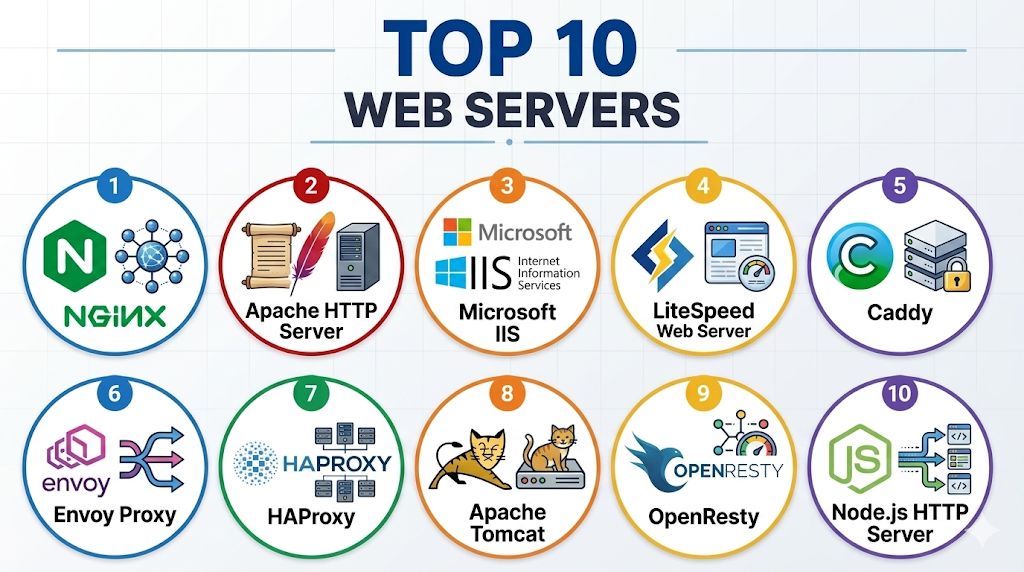
Top 10 Web Servers
1 — NGINX
Short description:
NGINX is one of the world’s most widely adopted web servers and reverse proxy platforms, designed for high-performance web delivery, load balancing, and cloud-native application infrastructure.
Key Features
- High-performance HTTP serving
- Reverse proxy capabilities
- Load balancing
- TLS termination
- Kubernetes ingress support
- Caching and compression
- API gateway functionality
Pros
- Excellent scalability
- Strong cloud-native ecosystem
- Lightweight and efficient architecture
Cons
- Advanced configuration complexity
- Enterprise features may require licensing
- Large deployments require expertise
Platforms / Deployment
Linux / Windows / Cloud / Hybrid / Self-hosted
Security & Compliance
Supports TLS encryption, RBAC compatibility, secure traffic management, and enterprise security controls.
Integrations & Ecosystem
NGINX integrates deeply into cloud-native and web infrastructure ecosystems.
- Kubernetes integrations
- Docker compatibility
- API gateway support
- Observability integrations
- CI/CD ecosystem support
Support & Community
Massive global infrastructure community with strong enterprise support availability.
2 — Apache HTTP Server
Short description:
Apache HTTP Server is a highly flexible open-source web server platform widely used for website hosting, enterprise infrastructure, and application delivery.
Key Features
- Modular architecture
- HTTP and HTTPS serving
- Virtual hosting
- Extensive plugin ecosystem
- URL rewriting
- Authentication support
- Reverse proxy capabilities
Pros
- Extremely mature ecosystem
- Broad compatibility
- Highly customizable
Cons
- Higher resource usage than lightweight alternatives
- Complex configuration at scale
- Performance tuning may require expertise
Platforms / Deployment
Linux / Windows / macOS / Cloud / Self-hosted
Security & Compliance
Supports TLS encryption, authentication modules, RBAC compatibility, and access control configurations.
Integrations & Ecosystem
Apache integrates into enterprise and hosting ecosystems.
- PHP compatibility
- Kubernetes integrations
- Database ecosystem support
- Monitoring integrations
- API extensibility
Support & Community
Massive open-source ecosystem with decades of enterprise adoption.
3 — Microsoft IIS
Short description:
Microsoft Internet Information Services IIS is a web server platform optimized for Windows-based enterprise applications and Microsoft infrastructure environments.
Key Features
- Windows-native integration
- ASP.NET support
- Application pool management
- TLS and authentication controls
- Centralized administration
- Reverse proxy support
- Hybrid cloud integration
Pros
- Excellent Microsoft ecosystem integration
- Strong enterprise management capabilities
- Simplified Windows administration
Cons
- Best suited for Windows environments
- Less lightweight than Linux alternatives
- Limited open-source flexibility
Platforms / Deployment
Windows / Cloud / Hybrid
Security & Compliance
Supports Active Directory integration, TLS encryption, RBAC, audit logging, and enterprise access controls.
Integrations & Ecosystem
IIS integrates deeply into Microsoft infrastructure ecosystems.
- Azure integrations
- ASP.NET compatibility
- Active Directory support
- PowerShell automation
Support & Community
Strong enterprise support ecosystem with mature Microsoft documentation.
4 — LiteSpeed Web Server
Short description:
LiteSpeed Web Server is a high-performance web infrastructure platform designed for speed optimization, caching, and scalable website hosting environments.
Key Features
- High-performance HTTP serving
- Built-in caching
- HTTP/3 support
- WordPress optimization
- Reverse proxy support
- Load balancing
- Security protections
Pros
- Excellent website performance
- Strong caching optimization
- Lower server resource usage
Cons
- Enterprise licensing costs
- Smaller ecosystem than Apache or NGINX
- Advanced tuning may require expertise
Platforms / Deployment
Linux / Cloud / Hybrid / Self-hosted
Security & Compliance
Supports TLS encryption, anti-DDoS protections, access controls, and secure web traffic management.
Integrations & Ecosystem
LiteSpeed integrates into hosting and web performance ecosystems.
- WordPress optimization
- cPanel compatibility
- Cloud infrastructure support
- API integrations
Support & Community
Strong hosting-focused ecosystem with growing enterprise adoption.
5 — Caddy
Short description:
Caddy is a modern web server platform designed for simplified HTTPS management, developer usability, and cloud-native deployments.
Key Features
- Automatic HTTPS
- HTTP/3 support
- Reverse proxy functionality
- Simplified configuration
- Modern API support
- Container compatibility
- Lightweight deployment
Pros
- Easy operational management
- Automatic TLS provisioning
- Developer-friendly workflows
Cons
- Smaller enterprise ecosystem
- Fewer advanced enterprise modules
- Limited large-scale enterprise adoption
Platforms / Deployment
Linux / Windows / macOS / Cloud / Self-hosted
Security & Compliance
Supports automatic TLS encryption, secure traffic management, and access control configurations.
Integrations & Ecosystem
Caddy integrates into modern development and cloud-native environments.
- Docker compatibility
- Kubernetes support
- API integrations
- Cloud-native deployments
Support & Community
Strong developer-focused community with growing infrastructure adoption.
6 — Envoy Proxy
Short description:
Envoy Proxy is a cloud-native proxy and web traffic management platform designed for microservices networking and service mesh environments.
Key Features
- Layer 7 proxying
- Advanced traffic routing
- Service mesh compatibility
- Observability integrations
- API gateway functionality
- Kubernetes-native support
- High-performance networking
Pros
- Excellent cloud-native scalability
- Strong observability capabilities
- Modern microservices architecture support
Cons
- Advanced operational complexity
- Requires cloud-native expertise
- Configuration management can be difficult
Platforms / Deployment
Linux / Cloud / Hybrid / Self-hosted
Security & Compliance
Supports mTLS, secure traffic routing, RBAC compatibility, and service-level encryption.
Integrations & Ecosystem
Envoy integrates deeply into cloud-native and Kubernetes ecosystems.
- Istio compatibility
- Kubernetes integrations
- Observability tooling
- API gateway support
Support & Community
Large cloud-native ecosystem with strong enterprise adoption.
7 — HAProxy
Short description:
HAProxy is a high-performance load balancer and web traffic management platform widely used for scalability, reliability, and reverse proxy operations.
Key Features
- Load balancing
- Reverse proxying
- High availability support
- Traffic routing
- TLS termination
- Performance optimization
- Health monitoring
Pros
- Extremely reliable
- Excellent traffic performance
- Strong enterprise scalability
Cons
- Advanced configuration complexity
- Less beginner-friendly
- Limited built-in application features
Platforms / Deployment
Linux / Cloud / Hybrid / Self-hosted
Security & Compliance
Supports TLS encryption, secure traffic routing, RBAC compatibility, and traffic filtering controls.
Integrations & Ecosystem
HAProxy integrates into enterprise traffic management ecosystems.
- Kubernetes compatibility
- Monitoring integrations
- Cloud infrastructure support
- API extensibility
Support & Community
Strong enterprise networking community with mature support resources.
8 — Tomcat
Short description:
Apache Tomcat is a Java application server and web server platform designed for Java-based enterprise applications and web services.
Key Features
- Java servlet support
- JSP compatibility
- Web application hosting
- Session management
- TLS support
- Enterprise deployment tooling
- Lightweight Java application hosting
Pros
- Excellent Java ecosystem support
- Lightweight compared to full Java EE platforms
- Broad enterprise adoption
Cons
- Primarily Java-focused
- Limited modern reverse proxy functionality
- Requires additional tooling for advanced traffic management
Platforms / Deployment
Linux / Windows / Cloud / Self-hosted
Security & Compliance
Supports TLS encryption, authentication controls, RBAC compatibility, and secure Java application deployment.
Integrations & Ecosystem
Tomcat integrates deeply into enterprise Java ecosystems.
- Java frameworks support
- Kubernetes compatibility
- CI/CD integrations
- Database ecosystem compatibility
Support & Community
Massive Java developer ecosystem with long-standing enterprise adoption.
9 — OpenResty
Short description:
OpenResty is a web platform built on NGINX and Lua designed for high-performance web applications and programmable web infrastructure.
Key Features
- NGINX-based architecture
- Lua scripting support
- API gateway functionality
- High-performance networking
- Reverse proxy support
- Cloud-native compatibility
- Traffic customization
Pros
- Highly programmable architecture
- Excellent API infrastructure support
- Strong performance optimization
Cons
- Requires Lua expertise
- Smaller ecosystem than NGINX
- Advanced operational complexity
Platforms / Deployment
Linux / Cloud / Hybrid / Self-hosted
Security & Compliance
Supports TLS encryption, traffic controls, secure proxying, and API security capabilities.
Integrations & Ecosystem
OpenResty integrates into programmable web infrastructure ecosystems.
- Lua ecosystem support
- Kubernetes compatibility
- API management integrations
- Monitoring tooling
Support & Community
Strong developer-focused community with cloud-native adoption.
10 — Node.js HTTP Server
Short description:
Node.js HTTP Server environments provide lightweight event-driven web serving for modern JavaScript applications and API-driven services.
Key Features
- Event-driven architecture
- JavaScript runtime support
- Lightweight API serving
- Real-time application support
- WebSocket compatibility
- Cloud-native deployment
- Microservices compatibility
Pros
- Excellent for real-time applications
- Massive JavaScript ecosystem
- Strong developer flexibility
Cons
- Not a traditional enterprise web server
- Performance tuning complexity
- Requires application-level management
Platforms / Deployment
Windows / Linux / macOS / Cloud / Self-hosted
Security & Compliance
Supports TLS encryption, authentication middleware, RBAC compatibility, and secure API development workflows.
Integrations & Ecosystem
Node.js integrates deeply into modern web development ecosystems.
- JavaScript frameworks
- Kubernetes compatibility
- API integrations
- DevOps tooling
Support & Community
Massive global JavaScript ecosystem with extensive developer adoption.
Comparison Table
| Tool Name | Best For | Platform(s) Supported | Deployment | Standout Feature | Public Rating |
|---|---|---|---|---|---|
| NGINX | High-performance web infrastructure | Linux, Windows | Hybrid | Reverse proxy scalability | N/A |
| Apache HTTP Server | Flexible web hosting | Linux, Windows | Self-hosted | Modular architecture | N/A |
| Microsoft IIS | Windows enterprise hosting | Windows | Hybrid | Microsoft ecosystem integration | N/A |
| LiteSpeed Web Server | Performance-focused hosting | Linux | Hybrid | Built-in caching | N/A |
| Caddy | Simplified HTTPS management | Linux, Windows | Self-hosted | Automatic TLS | N/A |
| Envoy Proxy | Cloud-native networking | Linux | Hybrid | Service mesh integration | N/A |
| HAProxy | Enterprise traffic management | Linux | Hybrid | High availability | N/A |
| Tomcat | Java web applications | Linux, Windows | Self-hosted | Java ecosystem support | N/A |
| OpenResty | Programmable web infrastructure | Linux | Hybrid | Lua extensibility | N/A |
| Node.js HTTP Server | Real-time web applications | Windows, Linux | Cloud | Event-driven architecture | N/A |
Evaluation & Scoring of Web Servers
| Tool Name | Core 25% | Ease 15% | Integrations 15% | Security 10% | Performance 10% | Support 10% | Value 15% | Weighted Total |
|---|---|---|---|---|---|---|---|---|
| NGINX | 10 | 8 | 10 | 9 | 10 | 9 | 9 | 9.3 |
| Apache HTTP Server | 9 | 7 | 9 | 8 | 8 | 9 | 10 | 8.5 |
| Microsoft IIS | 8 | 8 | 9 | 9 | 8 | 8 | 7 | 8.0 |
| LiteSpeed Web Server | 9 | 8 | 7 | 8 | 9 | 7 | 7 | 8.0 |
| Caddy | 8 | 10 | 7 | 8 | 8 | 7 | 10 | 8.4 |
| Envoy Proxy | 9 | 6 | 9 | 9 | 10 | 8 | 8 | 8.5 |
| HAProxy | 9 | 6 | 8 | 9 | 10 | 8 | 9 | 8.6 |
| Tomcat | 8 | 7 | 8 | 8 | 8 | 9 | 9 | 8.1 |
| OpenResty | 8 | 6 | 8 | 8 | 9 | 7 | 9 | 7.9 |
| Node.js HTTP Server | 8 | 8 | 10 | 7 | 8 | 9 | 10 | 8.5 |
These scores are comparative evaluations rather than absolute rankings. Enterprise organizations generally prioritize scalability, traffic management, observability, and security, while SMBs often focus more heavily on usability and operational simplicity. Lightweight developer-focused platforms provide strong flexibility and cloud-native support but may require deeper operational expertise. Buyers should align scoring priorities with application architecture, operational scale, and infrastructure strategy.
Which Web Server Is Right for You?
Solo / Freelancer
Developers and smaller projects often benefit most from Caddy or Node.js HTTP Server environments because of simplicity and developer-friendly workflows.
SMB
SMBs typically prefer NGINX, Apache HTTP Server, and LiteSpeed due to flexibility, strong hosting support, and operational reliability.
Mid-Market
Mid-sized organizations requiring scalability and traffic optimization should evaluate HAProxy, NGINX, and Envoy Proxy.
Enterprise
Large enterprises generally prioritize NGINX, Envoy Proxy, and HAProxy because of scalability, observability, and cloud-native infrastructure compatibility.
Budget vs Premium
Open-source platforms such as Apache, NGINX, and Caddy provide excellent operational value, while enterprise solutions justify additional costs through support and advanced traffic management capabilities.
Feature Depth vs Ease of Use
Caddy prioritizes simplicity and usability, while Envoy and HAProxy provide deeper networking and traffic management functionality with greater operational complexity.
Integrations & Scalability
Organizations operating cloud-native environments should prioritize Kubernetes compatibility, observability integrations, API gateway support, and container ecosystem alignment.
Security & Compliance Needs
Highly regulated industries should prioritize TLS encryption, RBAC compatibility, audit logging, secure proxying, mTLS support, and traffic filtering controls.
Frequently Asked Questions (FAQs)
1. What is a Web Server?
A Web Server processes HTTP and HTTPS requests, delivers web content, manages application traffic, and enables websites and APIs to function.
2. Why are Web Servers important?
Web servers provide the foundational infrastructure required for websites, APIs, traffic routing, load balancing, and cloud-native application delivery.
3. Which Web Server is best for enterprises?
NGINX, HAProxy, and Envoy Proxy are among the most widely adopted enterprise-grade web infrastructure platforms.
4. Is Apache still relevant for modern infrastructure?
Yes. Apache HTTP Server remains widely used because of its flexibility, modular architecture, and broad hosting ecosystem support.
5. What security features should organizations prioritize?
Organizations should prioritize TLS encryption, secure authentication, RBAC compatibility, audit logging, mTLS support, and traffic filtering controls.
6. What is the difference between a Web Server and a Reverse Proxy?
A web server primarily delivers content, while a reverse proxy routes traffic between clients and backend services for scalability and security.
7. Can Web Servers support Kubernetes environments?
Yes. Many modern web servers increasingly integrate into Kubernetes ingress and cloud-native networking environments.
8. Is HTTP/3 becoming important?
Yes. HTTP/3 and QUIC are improving performance, latency, and reliability for modern internet applications.
9. Which Web Server is best for developers?
Caddy, Node.js HTTP Server environments, and NGINX are commonly preferred by developers for modern web application deployment.
10. When should organizations modernize their Web Server infrastructure?
Organizations should modernize when scalability, observability, cloud-native compatibility, or security limitations affect application performance and operations.
Conclusion
Web Servers remain foundational technologies for modern web infrastructure, API delivery, cloud-native networking, and enterprise application operations. While traditional platforms such as Apache HTTP Server continue providing strong flexibility and compatibility, modern cloud-native environments increasingly depend on scalable platforms such as NGINX, Envoy Proxy, and HAProxy for traffic management, observability, and Kubernetes integration. The right web server ultimately depends on workload architecture, operational scale, security priorities, developer workflows, and cloud strategy. Some organizations prioritize simplicity and ease of management, while others require advanced reverse proxy functionality, service mesh integration, and large-scale traffic optimization. Before selecting a platform, organizations should shortlist several solutions, validate application compatibility, evaluate observability integrations, test scalability under production workloads, and confirm long-term security and operational alignment.

Find Trusted Cardiac Hospitals
Compare heart hospitals by city and services — all in one place.
Explore Hospitals
This gave me a better understanding of how web servers help deliver fast, secure, and reliable websites. I’d like to explore which server fits different project needs best.