Introduction
Performance Testing Tools help organizations evaluate the speed, responsiveness, stability, scalability, and reliability of applications, APIs, databases, and infrastructure under different workloads and traffic conditions. These tools simulate user interactions and system stress to identify bottlenecks, optimize infrastructure, and ensure applications maintain acceptable performance levels during peak usage. As modern applications increasingly rely on cloud-native architectures, microservices, APIs, and globally distributed infrastructure, performance testing has become essential for maintaining customer experience, uptime, and operational efficiency. Businesses can no longer rely only on functional testing because even fully functional applications can fail under real-world traffic loads if performance issues remain undetected.
Common Real-world use cases include:
- Testing API response times under heavy traffic
- Validating e-commerce website stability during peak sales
- Measuring cloud infrastructure scalability
- Benchmarking database and application server performance
- Evaluating Kubernetes and microservices environments
When Evaluating Performance Testing Tools, buyers should assess:
- Scalability and concurrency support
- Cloud and on-premises deployment flexibility
- API and protocol compatibility
- Real-time analytics and reporting
- CI/CD integration support
- Security and compliance features
- Ease of scripting and automation
- Distributed load generation capabilities
- Observability and monitoring integrations
- Pricing and operational complexity
Best for: QA teams, DevOps engineers, SRE teams, cloud infrastructure teams, SaaS companies, and enterprises running high-traffic applications or APIs.
Not ideal for: Small static websites, lightweight internal applications, or projects without significant traffic or scalability requirements.
Key Trends in Performance Testing Tools
- AI-driven performance analysis and bottleneck prediction
- Cloud-native distributed load testing environments
- Kubernetes-aware and microservices-aware testing
- Shift-left performance testing inside CI/CD pipelines
- Real-time observability integrations with monitoring stacks
- API-first testing strategies for modern SaaS platforms
- Low-code and scriptless performance testing interfaces
- Edge and globally distributed traffic simulation
- Automated anomaly detection and reporting
- Integration of security and resilience testing into performance workflows
How We Selected These Tools (Methodology)
The tools in this list were selected using practical performance engineering evaluation criteria focused on scalability, ecosystem maturity, automation, and enterprise adoption.
Our evaluation methodology included:
- Market adoption and enterprise mindshare
- Protocol and application compatibility
- Performance scalability and distributed testing
- Reliability and operational maturity
- Security and governance capabilities
- CI/CD and DevOps ecosystem integrations
- Real-time monitoring and observability support
- Cloud-native and Kubernetes compatibility
- Customer fit across SMB, mid-market, and enterprise segments
- Community support and vendor ecosystem strength
The final list balances enterprise-grade performance testing platforms, open-source ecosystems, cloud-native developer tools, and modern API-focused solutions.
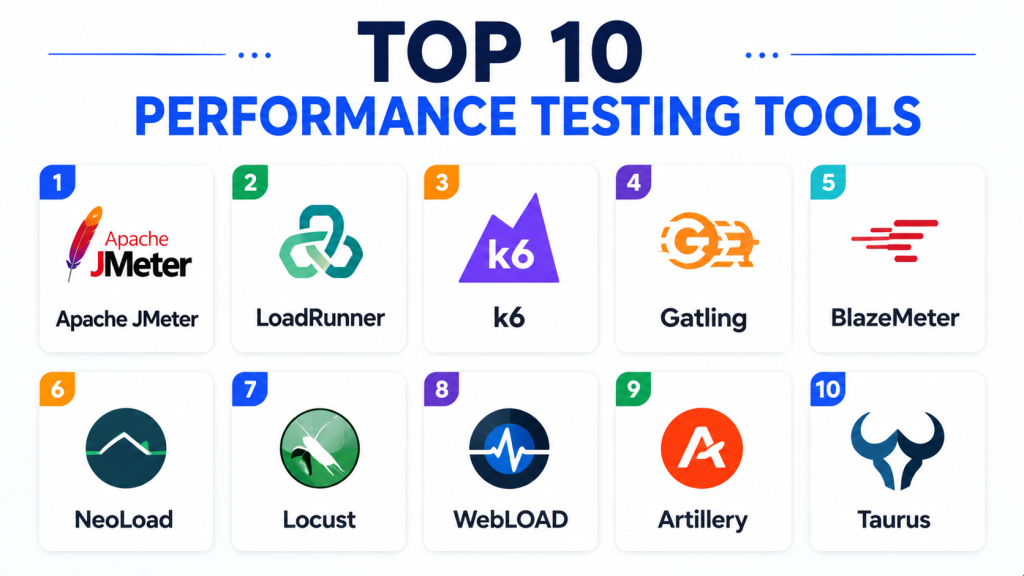
Top 10 Performance Testing Tools
1 — Apache JMeter
Short description:
Apache JMeter is one of the most widely used open-source performance testing platforms for APIs, web applications, databases, and distributed systems.
Key Features
- HTTP, HTTPS, SOAP, REST testing
- Distributed load generation
- Real-time metrics and reporting
- Plugin extensibility
- Database performance testing
- API and web application simulation
- CI/CD integration support
Pros
- Open-source and highly flexible
- Large global community
- Strong protocol support
Cons
- GUI can become resource-heavy
- Advanced scripting complexity
- Cloud execution requires integrations
Platforms / Deployment
Windows / macOS / Linux / Cloud / Self-hosted
Security & Compliance
Supports encrypted traffic testing and secure credential configurations. Additional compliance capabilities depend on deployment architecture.
Integrations & Ecosystem
JMeter integrates into DevOps and observability ecosystems.
- Jenkins
- GitLab CI/CD
- Grafana
- Prometheus
- Kubernetes environments
Support & Community
Massive open-source ecosystem with extensive tutorials, plugins, and community support.
2 — LoadRunner
Short description:
LoadRunner is an enterprise-grade performance testing platform designed for large-scale applications, enterprise systems, APIs, and cloud environments.
Key Features
- Enterprise protocol support
- Distributed testing infrastructure
- Cloud and hybrid execution
- Advanced analytics dashboards
- Real-time monitoring
- CI/CD automation support
- Application performance diagnostics
Pros
- Enterprise scalability
- Rich analytics and diagnostics
- Extensive protocol compatibility
Cons
- Premium licensing costs
- Complex setup and administration
- Steeper learning curve
Platforms / Deployment
Windows / Cloud / Hybrid
Security & Compliance
Supports RBAC, secure traffic testing, audit logging compatibility, and enterprise-grade security controls.
Integrations & Ecosystem
LoadRunner integrates into enterprise DevOps and testing ecosystems.
- Jenkins
- Azure DevOps
- Kubernetes monitoring
- Observability platforms
Support & Community
Strong enterprise support ecosystem with extensive documentation and consulting services.
3 — k6
Short description:
k6 is a modern developer-focused performance testing platform optimized for APIs, cloud-native environments, and CI/CD automation workflows.
Key Features
- JavaScript-based scripting
- API and web testing
- Cloud-native execution
- Real-time metrics
- CI/CD integrations
- Distributed execution
- Lightweight architecture
Pros
- Developer-friendly scripting
- Excellent CI/CD compatibility
- Cloud-native operational model
Cons
- Advanced enterprise features require subscriptions
- Limited GUI compared to traditional tools
- Requires scripting knowledge
Platforms / Deployment
Windows / macOS / Linux / Cloud / Self-hosted
Security & Compliance
Supports secure traffic testing and encrypted communication. Additional compliance capabilities vary by deployment.
Integrations & Ecosystem
k6 integrates deeply into modern DevOps workflows.
- Grafana
- Jenkins
- GitHub Actions
- Kubernetes
- Observability ecosystems
Support & Community
Strong open-source community with growing enterprise adoption through Grafana Labs.
4 — Gatling
Short description:
Gatling is a high-performance load and performance testing platform focused on APIs and modern web applications with code-based simulation scripting.
Key Features
- Scala-based scripting
- HTTP and WebSocket testing
- Real-time analytics
- CI/CD automation
- Distributed testing
- High concurrency support
- Cloud execution support
Pros
- Excellent concurrency handling
- Strong API testing support
- Lightweight execution engine
Cons
- Requires coding expertise
- Smaller enterprise ecosystem
- Limited GUI functionality
Platforms / Deployment
Windows / macOS / Linux / Cloud / Self-hosted
Security & Compliance
Supports secure traffic testing and encrypted communication workflows.
Integrations & Ecosystem
Gatling integrates into developer-first ecosystems.
- Jenkins
- GitLab CI/CD
- Grafana
- Kubernetes
- DevOps pipelines
Support & Community
Strong developer-focused community with enterprise support options.
5 — BlazeMeter
Short description:
BlazeMeter is a cloud-based performance testing platform designed for scalable web, API, and application testing with strong CI/CD compatibility.
Key Features
- Cloud-native load generation
- JMeter and Gatling compatibility
- Distributed global testing
- Real-time reporting
- Continuous testing workflows
- API performance testing
- Enterprise observability integrations
Pros
- Easy cloud scalability
- Strong DevOps integration
- Multi-script compatibility
Cons
- Subscription-based pricing
- Cloud dependency for some workflows
- Advanced enterprise features cost extra
Platforms / Deployment
Cloud
Security & Compliance
Supports encrypted traffic testing and enterprise-grade cloud security practices.
Integrations & Ecosystem
BlazeMeter integrates into enterprise DevOps ecosystems.
- Jenkins
- GitHub Actions
- Grafana
- Kubernetes
- CI/CD pipelines
Support & Community
Enterprise-grade support ecosystem with extensive documentation and onboarding resources.
6 — NeoLoad
Short description:
NeoLoad is an enterprise performance testing platform designed for continuous testing, APIs, web applications, and cloud-native infrastructure environments.
Key Features
- Web and API testing
- Continuous performance testing
- Real-time analytics
- Cloud and hybrid deployment
- Automated scenario generation
- Kubernetes compatibility
- CI/CD integration support
Pros
- Enterprise-ready automation
- Strong reporting capabilities
- Good cloud-native support
Cons
- Premium enterprise pricing
- Operational complexity for beginners
- Advanced scripting learning curve
Platforms / Deployment
Windows / Linux / Cloud / Hybrid
Security & Compliance
Supports encrypted traffic testing and enterprise security workflows.
Integrations & Ecosystem
NeoLoad integrates into enterprise testing and DevOps ecosystems.
- Jenkins
- Bamboo
- Azure DevOps
- Kubernetes
- Grafana
Support & Community
Strong enterprise support organization with mature documentation.
7 — Locust
Short description:
Locust is an open-source distributed performance testing platform designed for developers and QA teams using Python-based scripting.
Key Features
- Python scripting support
- Distributed load generation
- Real-time statistics
- API testing support
- Lightweight architecture
- CI/CD compatibility
- Scalable distributed execution
Pros
- Flexible Python-based scripting
- Lightweight operational footprint
- Open-source and cost-effective
Cons
- Requires Python knowledge
- Minimal GUI functionality
- Enterprise analytics limitations
Platforms / Deployment
Windows / macOS / Linux / Cloud / Self-hosted
Security & Compliance
Supports secure traffic testing and encrypted communication workflows.
Integrations & Ecosystem
Locust integrates into developer and observability ecosystems.
- Jenkins
- Grafana
- Kubernetes
- CI/CD pipelines
- Monitoring integrations
Support & Community
Strong open-source ecosystem with growing developer adoption.
8 — WebLOAD
Short description:
WebLOAD is an enterprise-grade performance testing platform focused on web applications, APIs, and large-scale traffic simulation.
Key Features
- Large-scale traffic simulation
- Web and API testing
- Real-time monitoring
- Advanced analytics
- Cloud and hybrid execution
- Distributed load generation
- Scriptable test scenarios
Pros
- Strong enterprise scalability
- Detailed reporting
- Multi-protocol support
Cons
- Commercial licensing costs
- Smaller community ecosystem
- Learning curve for advanced testing
Platforms / Deployment
Windows / Linux / Cloud / Hybrid
Security & Compliance
Supports secure traffic testing and enterprise-grade encryption workflows.
Integrations & Ecosystem
WebLOAD integrates into enterprise testing environments.
- Jenkins
- GitLab CI/CD
- Selenium
- Monitoring platforms
Support & Community
Enterprise support resources with structured onboarding and documentation.
9 — Artillery
Short description:
Artillery is a modern developer-first performance testing toolkit focused on APIs, microservices, and serverless environments.
Key Features
- Node.js-based scripting
- API and WebSocket testing
- Distributed execution
- Real-time metrics
- CI/CD integration
- Cloud-native support
- Lightweight deployment
Pros
- Developer-friendly workflows
- Excellent API testing capabilities
- Lightweight architecture
Cons
- Smaller enterprise ecosystem
- Limited enterprise analytics
- Requires scripting knowledge
Platforms / Deployment
Windows / macOS / Linux / Cloud / Self-hosted
Security & Compliance
Supports encrypted traffic testing and secure API workflows.
Integrations & Ecosystem
Artillery integrates into modern API and DevOps ecosystems.
- GitHub Actions
- Jenkins
- Kubernetes
- Monitoring stacks
Support & Community
Growing open-source ecosystem with active developer community support.
10 — Taurus
Short description:
Taurus is an automation-friendly performance testing framework designed to simplify JMeter, Gatling, and Selenium-based testing workflows.
Key Features
- YAML-based configuration
- JMeter and Gatling integration
- Selenium compatibility
- CI/CD automation
- Distributed execution
- Lightweight orchestration
- Simplified scripting workflows
Pros
- Simplifies complex testing workflows
- Excellent automation support
- Open-source flexibility
Cons
- Depends on underlying testing engines
- Advanced workflows require expertise
- Smaller ecosystem than JMeter
Platforms / Deployment
Windows / macOS / Linux / Cloud / Self-hosted
Security & Compliance
Supports encrypted traffic testing and secure automation workflows.
Integrations & Ecosystem
Taurus integrates into automated testing and DevOps environments.
- JMeter
- Gatling
- Jenkins
- GitLab CI/CD
- Selenium
Support & Community
Strong open-source ecosystem with automation-focused community support.
Comparison Table
| Tool Name | Best For | Platform(s) Supported | Deployment | Standout Feature | Public Rating |
|---|---|---|---|---|---|
| Apache JMeter | Open-source performance testing | Windows, Linux, macOS | Self-hosted | Protocol flexibility | N/A |
| LoadRunner | Enterprise performance testing | Windows | Hybrid | Enterprise protocol coverage | N/A |
| k6 | Cloud-native API testing | Windows, Linux, macOS | Cloud / Self-hosted | JavaScript scripting | N/A |
| Gatling | High-concurrency API testing | Windows, Linux, macOS | Cloud / Self-hosted | Lightweight execution | N/A |
| BlazeMeter | Cloud-based performance testing | Cloud | Cloud | Distributed global testing | N/A |
| NeoLoad | Continuous enterprise testing | Windows, Linux | Hybrid | Automated performance testing | N/A |
| Locust | Python-based testing | Windows, Linux, macOS | Self-hosted | Distributed Python scripting | N/A |
| WebLOAD | Enterprise traffic simulation | Windows, Linux | Hybrid | Advanced analytics | N/A |
| Artillery | API and microservices testing | Windows, Linux, macOS | Cloud / Self-hosted | Lightweight API testing | N/A |
| Taurus | Automation-focused orchestration | Windows, Linux, macOS | Self-hosted | Simplified automation workflows | N/A |
Evaluation & Scoring of Performance Testing Tools
| Tool Name | Core 25% | Ease 15% | Integrations 15% | Security 10% | Performance 10% | Support 10% | Value 15% | Weighted Total |
|---|---|---|---|---|---|---|---|---|
| Apache JMeter | 9 | 7 | 9 | 8 | 9 | 8 | 10 | 8.7 |
| LoadRunner | 10 | 7 | 9 | 9 | 10 | 9 | 6 | 8.7 |
| k6 | 8 | 9 | 9 | 8 | 9 | 8 | 9 | 8.6 |
| Gatling | 9 | 7 | 8 | 8 | 9 | 8 | 9 | 8.3 |
| BlazeMeter | 8 | 8 | 9 | 8 | 8 | 8 | 7 | 8.0 |
| NeoLoad | 9 | 7 | 8 | 8 | 9 | 8 | 7 | 8.1 |
| Locust | 8 | 8 | 8 | 7 | 8 | 7 | 10 | 8.1 |
| WebLOAD | 8 | 7 | 8 | 8 | 8 | 7 | 7 | 7.7 |
| Artillery | 8 | 8 | 8 | 7 | 8 | 7 | 9 | 8.0 |
| Taurus | 7 | 8 | 9 | 7 | 8 | 7 | 9 | 7.9 |
These scores are comparative evaluations rather than absolute rankings. Enterprise organizations generally prioritize scalability, protocol support, and analytics, while developers and SMBs often focus more heavily on flexibility, automation, and operational simplicity. Open-source platforms provide strong long-term value but may require deeper technical expertise. Buyers should align scoring priorities with application scale, infrastructure complexity, and DevOps maturity.
Which Performance Testing Tool Is Right for You?
Solo / Freelancer
Independent developers and smaller testing environments often benefit most from JMeter, Locust, and Artillery because of flexibility and open-source accessibility.
SMB
SMBs typically prefer k6, BlazeMeter, and Gatling due to cloud-native support, CI/CD integrations, and simplified automation workflows.
Mid-Market
Mid-sized organizations requiring stronger automation and distributed execution should evaluate NeoLoad and Taurus.
Enterprise
Large enterprises generally prioritize LoadRunner, BlazeMeter, and NeoLoad because of scalability, analytics, and enterprise-grade testing infrastructure.
Budget vs Premium
Open-source tools such as JMeter, Locust, and Taurus provide excellent operational value, while enterprise platforms justify higher pricing through analytics, support, and automation capabilities.
Feature Depth vs Ease of Use
k6 and Artillery prioritize developer usability and lightweight automation, while LoadRunner and NeoLoad provide deeper enterprise functionality with greater operational complexity.
Integrations & Scalability
Organizations operating modern DevOps pipelines should prioritize Kubernetes compatibility, observability integrations, CI/CD support, and distributed execution capabilities.
Security & Compliance Needs
Highly regulated industries should prioritize secure traffic testing, RBAC compatibility, audit logging, encryption, and centralized governance workflows.
Frequently Asked Questions (FAQs)
1. What are Performance Testing Tools?
Performance Testing Tools simulate traffic and workloads to evaluate application speed, stability, scalability, and reliability under different usage conditions.
2. Why is performance testing important?
Performance testing helps organizations prevent downtime, identify bottlenecks, improve user experience, and validate infrastructure scalability before production deployment.
3. Which Performance Testing Tool is best for enterprises?
LoadRunner, BlazeMeter, and NeoLoad are among the most widely adopted enterprise-grade performance testing platforms.
4. Are open-source Performance Testing Tools reliable?
Yes. Open-source platforms such as Apache JMeter, Gatling, and Locust are widely trusted in enterprise and cloud-native environments.
5. What security features should organizations prioritize?
Organizations should prioritize encrypted traffic testing, RBAC compatibility, secure credential management, and audit logging capabilities.
6. Can Performance Testing Tools integrate with CI/CD pipelines?
Yes. Most modern performance testing tools integrate with Jenkins, GitHub Actions, GitLab CI/CD, and other DevOps automation platforms.
7. What is distributed load testing?
Distributed load testing uses multiple systems or cloud nodes to simulate large-scale traffic from geographically distributed locations.
8. Are cloud-native Performance Testing Tools becoming more important?
Yes. Cloud-native and Kubernetes-aware testing platforms are increasingly important for modern distributed application architectures.
9. Which Performance Testing Tool is best for APIs?
k6, Gatling, Artillery, and JMeter are commonly preferred for API performance testing workflows.
10. When should organizations perform performance testing?
Organizations should perform performance testing before production releases, major infrastructure changes, peak traffic events, and cloud migrations.
Conclusion
Performance Testing Tools have become essential infrastructure components for ensuring scalability, reliability, and user experience across modern applications, APIs, and cloud-native environments. While open-source platforms such as Apache JMeter, Gatling, and Locust provide strong flexibility and operational value, enterprise organizations increasingly rely on platforms such as LoadRunner, BlazeMeter, and NeoLoad for large-scale testing, advanced analytics, and centralized governance. The right tool ultimately depends on application complexity, infrastructure scale, automation requirements, developer expertise, and budget constraints. Some organizations prioritize lightweight scripting and CI/CD integration, while others require enterprise-grade observability, distributed execution, and protocol-level testing capabilities. Before selecting a platform, organizations should shortlist several tools, validate integration compatibility, run pilot tests under realistic workloads, evaluate observability workflows, and confirm long-term scalability and operational alignment.

Find Trusted Cardiac Hospitals
Compare heart hospitals by city and services — all in one place.
Explore Hospitals
This gave me a better understanding of how performance testing tools help ensure speed, stability, and scalability. I’d like to explore which tool fits different testing needs best.