Introduction
Network Monitoring Tools are enterprise-grade systems designed to continuously observe, analyze, and optimize the performance, availability, and security of network infrastructure across on-premise, cloud, and hybrid environments. These tools go beyond simple uptime tracking—they provide deep visibility into traffic flow, device behavior, latency patterns, bandwidth utilization, and infrastructure dependencies. In modern distributed architectures where microservices, Kubernetes clusters, multi-cloud workloads, and remote endpoints are standard, network complexity has increased exponentially. Traditional monitoring approaches are no longer sufficient. Organizations now require real-time telemetry, predictive analytics, and automated anomaly detection to maintain service reliability.
Modern network monitoring platforms combine observability, AI-driven analytics, automation, and security insights to help IT teams move from reactive troubleshooting to proactive network optimization.
Real-World Use Cases Include:
- Detecting and resolving network bottlenecks before user impact occurs
- Monitoring hybrid cloud connectivity between AWS, Azure, and on-prem systems
- Identifying packet loss, jitter, and latency in real-time
- Supporting DevOps and SRE teams with infrastructure observability
- Enhancing cybersecurity visibility through traffic anomaly detection
Key Buyer Evaluation Criteria Include:
- Depth of network visibility (layer 2–7 monitoring capabilities)
- Real-time analytics and alerting accuracy
- Scalability across enterprise and multi-cloud environments
- AI/ML-driven anomaly detection and forecasting
- Integration with observability and DevOps ecosystems
- Support for hybrid, edge, and cloud-native infrastructure
- Security governance (RBAC, audit logs, compliance readiness)
- Data visualization and root cause analysis capability
- Automation and remediation workflows
- Total cost of ownership (licensing + infrastructure overhead)
Best for:
Large enterprises, cloud-native companies, telecom providers, SaaS platforms, financial institutions, and organizations managing complex distributed infrastructure.
Not ideal for:
Very small businesses, static websites, or teams without dedicated IT infrastructure operations.
Key Trends in Network Monitoring Tools
Network monitoring has evolved into a core pillar of observability and digital operations engineering.
- Shift from reactive monitoring to predictive network intelligence
- AI-driven anomaly detection replacing rule-based alerting systems
- Convergence of network monitoring + application observability + security analytics
- Rise of cloud-native and Kubernetes-aware monitoring systems
- Increased adoption of real-time streaming telemetry (instead of polling)
- Expansion of multi-cloud visibility and cross-region dependency mapping
- Growing importance of zero-trust network monitoring models
- Integration with AIOps for automated incident resolution
- Edge and IoT network monitoring becoming mainstream
- Cost-aware monitoring aligned with FinOps practices
How We Selected These Tools (Methodology)
This list is curated based on enterprise evaluation criteria:
- Market adoption across enterprise and mid-market segments
- Depth of network telemetry and observability coverage
- Ability to scale in distributed and hybrid environments
- AI/ML capabilities for anomaly detection and forecasting
- Integration ecosystem maturity (cloud, DevOps, ITSM)
- Security compliance readiness (SOC2, RBAC, encryption)
- Performance under high-volume network traffic conditions
- Ease of operational adoption and onboarding experience
- Community strength and enterprise support reliability
- Architectural flexibility (agent-based vs agentless models)
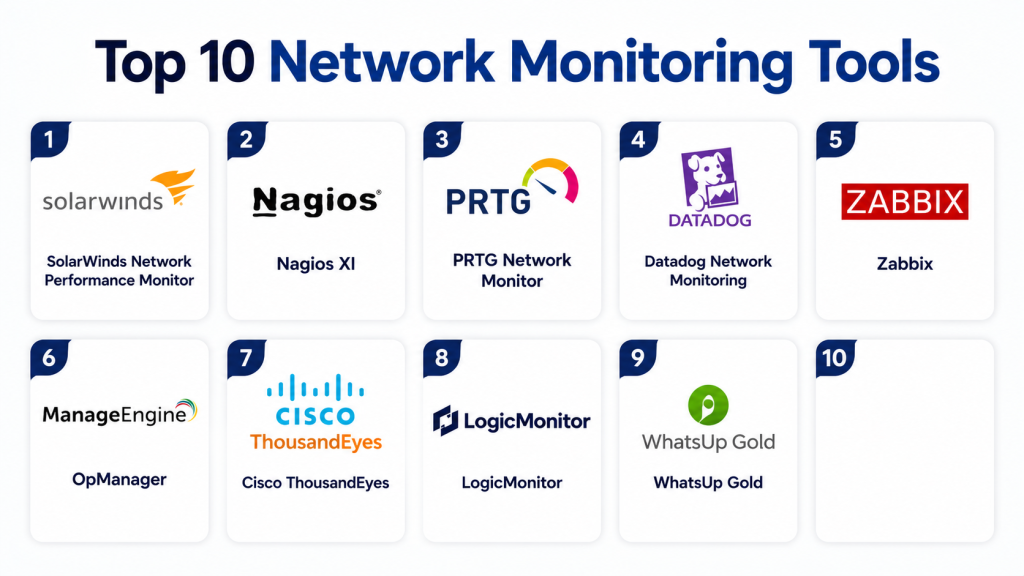
Top 10 Network Monitoring Tools (Deep Analysis)
1- SolarWinds Network Performance Monitor
Short Description
SolarWinds NPM is a traditional enterprise-grade network monitoring platform known for deep infrastructure visibility, topology mapping, and fault detection across large-scale enterprise networks.
Key Features
- Layer 2–4 network performance monitoring
- Advanced network topology visualization
- SNMP-based device monitoring
- Intelligent alert correlation
- Bandwidth and traffic flow analysis
- Network path and dependency mapping
- Historical performance trend analysis
Pros
- Extremely mature enterprise solution
- Strong on-prem infrastructure support
- Deep visibility into legacy network systems
Cons
- High operational and licensing cost
- Less modern cloud-native support
- Requires significant setup and tuning
Platforms / Deployment
Web / Windows / Linux
Cloud / On-prem
Security & Compliance
RBAC, SSO, encryption, audit logging
Integrations & Ecosystem
- ServiceNow ITSM
- AWS / Azure monitoring
- VMware infrastructure
- SNMP ecosystems
- APIs for custom integrations
Support & Community
Strong enterprise support with long-standing IT operations adoption
2- Nagios XI
Short Description
Nagios XI is a highly customizable open-source based monitoring platform focused on infrastructure and network observability with plugin-driven architecture.
Key Features
- Plugin-based monitoring framework
- Infrastructure and network device tracking
- Alert escalation workflows
- Performance graphing and reporting
- Log and event monitoring
- Distributed monitoring support
- Custom script integrations
Pros
- Highly flexible and extensible
- Strong open-source ecosystem
- Wide community adoption
Cons
- Requires technical expertise
- Outdated UI/UX experience
- Heavy manual configuration
Platforms / Deployment
Web / Linux / Windows
Self-hosted / Cloud
Security & Compliance
RBAC, encryption, authentication controls
Integrations & Ecosystem
- SNMP integrations
- APIs for custom workflows
- DevOps tools (CI/CD pipelines)
- Cloud providers
- Third-party plugins ecosystem
Support & Community
Large open-source community with enterprise support options
3- PRTG Network Monitor
Short Description
PRTG is a sensor-based monitoring platform designed for simplified network observability with strong usability and fast deployment.
Key Features
- Sensor-based monitoring architecture
- Auto-discovery of network devices
- Real-time alerting system
- Bandwidth usage analytics
- Custom dashboards and reporting
- Multi-protocol support (SNMP, WMI, etc.)
- Network health visualization
Pros
- Very easy setup and onboarding
- Strong visualization capabilities
- Flexible monitoring model
Cons
- Can become expensive at scale
- Limited advanced AI capabilities
- Heavy resource consumption in large environments
Platforms / Deployment
Web / Windows
Cloud / On-prem
Security & Compliance
Encryption, RBAC, authentication layers
Integrations & Ecosystem
- SNMP-based devices
- Cloud APIs
- ITSM tools
- DevOps monitoring stacks
- Third-party plugins
Support & Community
Strong vendor-backed enterprise support
4- Datadog Network Monitoring
Short Description
Datadog provides cloud-native network monitoring integrated into a full observability platform combining metrics, traces, logs, and network insights.
Key Features
- Real-time cloud network telemetry
- Kubernetes and container visibility
- AI-based anomaly detection
- Traffic flow analysis
- Service dependency mapping
- Cross-layer observability correlation
- Custom dashboards and alerting
Pros
- Best-in-class cloud-native observability
- Strong DevOps integration
- Highly scalable architecture
Cons
- Expensive at scale
- Requires tuning for optimization
- Complex pricing structure
Platforms / Deployment
Web / Cloud
Security & Compliance
SOC2, RBAC, encryption, SSO
Integrations & Ecosystem
- AWS, Azure, GCP
- Kubernetes ecosystems
- Slack, PagerDuty
- CI/CD pipelines
- APIs and webhooks
Support & Community
Strong enterprise-grade support and developer ecosystem
5- Zabbix
Short Description
Zabbix is a powerful open-source monitoring platform offering full-stack network and infrastructure monitoring with high customization flexibility.
Key Features
- Agent-based and agentless monitoring
- Auto-discovery of network assets
- Real-time performance tracking
- Flexible alerting engine
- Distributed monitoring support
- Custom dashboards and widgets
- Historical trend analysis
Pros
- Completely open-source
- Highly scalable architecture
- Strong customization control
Cons
- Complex setup process
- Requires experienced administrators
- UI not modern compared to SaaS tools
Platforms / Deployment
Web / Linux / Windows
Self-hosted / Cloud
Security & Compliance
RBAC, encryption, authentication
Integrations & Ecosystem
- SNMP systems
- Cloud providers
- APIs
- DevOps tools
- ITSM systems
Support & Community
Large global open-source community
6- ManageEngine OpManager
Short Description
OpManager is a mid-market network monitoring solution designed for easy deployment and strong infrastructure visibility.
Key Features
- Network performance monitoring
- Fault detection system
- Real-time alerting
- Bandwidth tracking
- Data center monitoring
- Device auto-discovery
- Reporting dashboards
Pros
- Easy to deploy and manage
- Affordable for mid-market
- Strong IT operations features
Cons
- Limited cloud-native depth
- UI complexity in large setups
- Requires tuning for scale
Platforms / Deployment
Web / Windows / Linux
Cloud / On-prem
Security & Compliance
RBAC, MFA, encryption
Integrations & Ecosystem
- ServiceNow
- AWS / Azure
- ITSM tools
- APIs
- Monitoring ecosystems
Support & Community
Strong vendor support ecosystem
7- Cisco ThousandEyes
Short Description
ThousandEyes provides deep internet and WAN visibility across global networks, focusing on user experience and path-level analysis.
Key Features
- Internet path visualization
- WAN performance monitoring
- BGP route tracking
- Application experience monitoring
- Cloud connectivity insights
- Endpoint network tracking
- Network dependency mapping
Pros
- Exceptional internet visibility
- Strong enterprise-grade reliability
- Deep network path analysis
Cons
- High cost structure
- Cisco ecosystem dependency
- Complex onboarding
Platforms / Deployment
Web / Cloud
Security & Compliance
SSO, RBAC, encryption
Integrations & Ecosystem
- Cisco ecosystem
- AWS / Azure
- APIs
- DevOps tools
- Monitoring systems
Support & Community
Enterprise-level global support
8- LogicMonitor
Short Description
LogicMonitor is a SaaS-based hybrid infrastructure monitoring platform offering strong network and cloud visibility.
Key Features
- Automated device discovery
- Hybrid network monitoring
- Predictive analytics
- Custom dashboards
- Performance alerting
- Cloud monitoring support
- Infrastructure health tracking
Pros
- Easy SaaS deployment
- Strong hybrid IT support
- Scalable architecture
Cons
- Pricing complexity
- Limited deep customization
- Learning curve for UI
Platforms / Deployment
Web / Cloud
Security & Compliance
SSO, RBAC, encryption
Integrations & Ecosystem
- AWS / Azure / GCP
- Kubernetes
- ServiceNow
- APIs
- Monitoring tools
Support & Community
Strong enterprise support ecosystem
9- WhatsUp Gold
Short Description
WhatsUp Gold is a simple yet effective network monitoring solution focused on SMB and mid-market IT environments.
Key Features
- Network device monitoring
- Real-time alerting
- Infrastructure mapping
- Bandwidth analysis
- Log monitoring
- Auto-discovery
- Reporting dashboards
Pros
- Easy-to-use interface
- Good SMB fit
- Fast deployment
Cons
- Limited AI capabilities
- Less cloud-native focus
- Scaling limitations
Platforms / Deployment
Web / Windows
Cloud / On-prem
Security & Compliance
RBAC, encryption
Integrations & Ecosystem
- SNMP systems
- APIs
- ITSM tools
- Cloud platforms
- Monitoring ecosystems
Support & Community
Reliable vendor support
10- Netdata
Short Description
Netdata is a lightweight real-time monitoring platform designed for high-resolution network and system observability.
Key Features
- Real-time metric streaming
- Lightweight agent architecture
- Network performance analytics
- Anomaly detection engine
- Auto-generated dashboards
- Distributed monitoring support
- High-frequency data collection
Pros
- Extremely fast and lightweight
- Open-source flexibility
- Real-time insights
Cons
- Limited enterprise governance features
- Requires tuning at scale
- Smaller ITSM integration depth
Platforms / Deployment
Web / Linux / Windows / macOS
Self-hosted / Cloud
Security & Compliance
RBAC, encryption
Integrations & Ecosystem
- Kubernetes
- AWS
- APIs
- DevOps tools
- Logging systems
Support & Community
Strong open-source community
Comparison Table
| Tool Name | Best For | Platform(s) Supported | Deployment | Standout Feature | Public Rating |
|---|---|---|---|---|---|
| SolarWinds Network Performance Monitor | Enterprise infrastructure monitoring | Windows | Self-hosted / Hybrid | Deep network visibility | N/A |
| Datadog Network Monitoring | Cloud-native observability | Web | Cloud | Unified SaaS observability | N/A |
| PRTG Network Monitor | SMB infrastructure monitoring | Windows | Self-hosted | Sensor-based monitoring | N/A |
| Nagios XI | Customizable enterprise monitoring | Linux | Self-hosted | Extensive plugin ecosystem | N/A |
| ManageEngine OpManager | Mid-market IT operations | Windows / Linux | Self-hosted / Hybrid | Balanced feature depth | N/A |
| Cisco ThousandEyes | Internet and WAN visibility | Web | Cloud / Hybrid | Internet path intelligence | N/A |
| Zabbix | Open-source enterprise monitoring | Linux | Self-hosted | Open-source scalability | N/A |
| LogicMonitor | Hybrid infrastructure monitoring | Web | Cloud | Automated discovery | N/A |
| Dynatrace | Enterprise observability | Web | Cloud / Hybrid | AI-powered root cause analysis | N/A |
| WhatsUp Gold | SMB network visibility | Windows | Self-hosted | Easy operational onboarding | N/A |
Evaluation & Scoring of Network Monitoring Tools
| Tool Name | Core 25% | Ease 15% | Integrations 15% | Security 10% | Performance 10% | Support 10% | Value 15% | Weighted Total |
|---|---|---|---|---|---|---|---|---|
| SolarWinds Network Performance Monitor | 9 | 7 | 9 | 8 | 9 | 8 | 7 | 8.2 |
| Datadog Network Monitoring | 9 | 8 | 9 | 9 | 9 | 8 | 6 | 8.4 |
| PRTG Network Monitor | 7 | 9 | 7 | 7 | 7 | 8 | 9 | 7.8 |
| Nagios XI | 8 | 6 | 8 | 7 | 8 | 8 | 9 | 7.8 |
| ManageEngine OpManager | 8 | 8 | 8 | 8 | 8 | 8 | 8 | 8.0 |
| Cisco ThousandEyes | 9 | 7 | 8 | 9 | 9 | 8 | 6 | 8.1 |
| Zabbix | 8 | 6 | 8 | 7 | 8 | 8 | 10 | 7.9 |
| LogicMonitor | 8 | 8 | 8 | 8 | 8 | 8 | 7 | 7.9 |
| Dynatrace | 10 | 7 | 9 | 9 | 10 | 9 | 6 | 8.7 |
| WhatsUp Gold | 7 | 8 | 7 | 7 | 7 | 7 | 8 | 7.4 |
These scores are comparative and intended to help organizations evaluate relative strengths across different operational priorities. Enterprise platforms generally score higher in scalability, AI analytics, and governance capabilities, while SMB-focused tools often perform better in usability and value. Open-source solutions may provide exceptional flexibility and cost advantages but require more operational expertise. Buyers should align scoring priorities with their infrastructure complexity, operational maturity, and long-term monitoring strategy.
Which Network Monitoring Tool Is Right for You?
Solo / Freelancer
PRTG Network Monitor and WhatsUp Gold are suitable for small operational environments that prioritize simplicity, visibility, and lower operational overhead.
SMB
ManageEngine OpManager, PRTG, and WhatsUp Gold provide balanced monitoring capabilities with manageable deployment complexity and competitive pricing.
Mid-Market
LogicMonitor, SolarWinds, and Zabbix are strong choices for organizations needing scalable monitoring across hybrid environments and distributed infrastructure.
Enterprise
Large enterprises should evaluate Dynatrace, Datadog, Cisco ThousandEyes, and SolarWinds for advanced observability, AI analytics, and hybrid infrastructure visibility.
Budget vs Premium
Open-source platforms like Zabbix and Nagios XI offer strong value for technically mature teams. Premium enterprise platforms such as Dynatrace and Cisco ThousandEyes deliver advanced analytics and automation capabilities at higher cost.
Feature Depth vs Ease of Use
PRTG and LogicMonitor focus on easier onboarding and operational usability. Dynatrace and SolarWinds provide deeper observability and analytics but require greater expertise.
Integrations & Scalability
Organizations with mature DevOps or cloud-native ecosystems should prioritize Datadog, Dynatrace, and LogicMonitor due to their API ecosystems and automation capabilities.
Security & Compliance Needs
Highly regulated industries should focus on platforms with mature RBAC, audit logging, encryption, SSO, and operational governance features such as Datadog, Dynatrace, Cisco ThousandEyes, and SolarWinds.
Frequently Asked Questions (FAQs)
1. What are Network Monitoring Tools used for?
Network Monitoring Tools help organizations monitor infrastructure health, bandwidth usage, uptime, traffic flows, and operational performance across networks and connected systems.
2. Are network monitoring and observability the same thing?
Not exactly. Traditional monitoring focuses on predefined metrics and alerts, while observability platforms provide broader analytics, telemetry correlation, and root cause analysis capabilities.
3. Which tool is best for cloud-native environments?
Datadog and Dynatrace are commonly preferred for cloud-native and Kubernetes-heavy environments because of their modern observability capabilities.
4. Are open-source monitoring tools reliable?
Yes. Platforms like Zabbix and Nagios XI are widely used in enterprise environments, though they may require more technical expertise and manual configuration.
5. How important are AI features in modern monitoring platforms?
AI capabilities are increasingly valuable for anomaly detection, predictive analytics, automated troubleshooting, and reducing alert fatigue in complex environments.
6. Can these tools monitor hybrid cloud environments?
Most modern platforms support hybrid infrastructure visibility across on-premises systems, public cloud services, containers, and edge environments.
7. What are common deployment challenges?
Organizations often struggle with alert tuning, integration complexity, scaling telemetry collection, and ensuring monitoring coverage across distributed systems.
8. Do Network Monitoring Tools include security monitoring?
Some platforms include network security analytics, anomaly detection, and traffic inspection capabilities, though dedicated SIEM or NDR platforms may still be required.
9. Which tool is best for SMBs?
PRTG, ManageEngine OpManager, and WhatsUp Gold are commonly favored by SMBs due to easier deployment and balanced pricing.
10. How should organizations evaluate vendors?
Buyers should assess scalability, automation, integration support, analytics quality, deployment flexibility, governance capabilities, and operational fit before making a decision.
Conclusion
Network Monitoring Tools have evolved far beyond simple uptime tracking and now serve as strategic operational intelligence platforms for modern digital infrastructure. As enterprises continue adopting hybrid cloud architectures, remote work environments, AI-driven operations, and distributed applications, the need for real-time visibility, predictive analytics, and automated remediation continues growing rapidly. The ideal solution depends on organizational complexity, operational maturity, budget, and long-term observability goals. SMBs may prioritize simplicity and affordability, while enterprises often require advanced automation, AI-driven analytics, security governance, and hybrid infrastructure scalability. Before selecting a platform, organizations should shortlist two or three vendors, validate integrations with existing operational ecosystems, conduct pilot deployments using real workloads, and carefully evaluatescalability, alerting quality, and operational ROI over time.

Find Trusted Cardiac Hospitals
Compare heart hospitals by city and services — all in one place.
Explore Hospitals
This gave me a better understanding of how network monitoring tools help track performance, detect issues, and maintain reliable network operations. I’d like to explore which tool fits best for cloud and enterprise environments.