Introduction
Identity Verification (IDV) tools are software platforms that help businesses confirm that a user is who they claim to be. These tools use technologies such as document verification, biometric authentication (face, voice, fingerprint), database validation, and AI-driven fraud detection to establish trust during digital interactions. IDV tools have become essential due to the rapid growth of digital onboarding, remote transactions, and increasing cyber threats. Regulatory pressures (KYC/AML), rising fraud sophistication, and customer expectations for seamless onboarding are driving widespread adoption across industries.
Common Real-world use cases include:
- Customer onboarding for banking and fintech platforms
- Identity verification for gig economy and remote hiring
- Fraud prevention in e-commerce and marketplaces
- Compliance for crypto exchanges and digital assets
- Secure access for healthcare and insurance services
Key Evaluation criteria for buyers include:
- Identity verification accuracy and fraud detection rates
- Global document and identity coverage
- Biometric authentication capabilities
- API flexibility and developer experience
- Integration with onboarding and CRM systems
- User experience and conversion rates
- Compliance readiness (KYC, GDPR, etc.)
- Scalability for high-volume onboarding
- Automation and workflow customization
- Deployment flexibility
Best for: Fintech companies, banks, marketplaces, SaaS platforms, and enterprises handling sensitive customer data.
Not ideal for: Small offline businesses or use cases requiring only basic authentication (e.g., password-based login systems).
Key Trends in Identity Verification (IDV) Tools
- AI-powered fraud detection: Detecting deepfakes, synthetic identities, and spoofing attacks
- Passive identity verification: Reducing friction with background checks and behavioral signals
- Biometric advancements: Face, voice, and behavioral biometrics becoming standard
- Continuous identity verification: Monitoring user behavior beyond onboarding
- Decentralized identity (DID): User-controlled identity frameworks gaining traction
- Privacy-first architecture: Data minimization and regional compliance (GDPR-like frameworks)
- No-code/low-code onboarding workflows: Faster deployment for non-technical teams
- Cross-border verification: Supporting diverse identity documents globally
- Real-time decisioning: Instant verification and risk scoring
- Usage-based pricing models: API-driven billing based on verification volume
How We Selected These Tools (Methodology)
- Evaluated market adoption and brand credibility
- Assessed feature completeness and innovation
- Reviewed performance, uptime, and reliability signals
- Considered security and compliance readiness
- Analyzed integration flexibility and API maturity
- Looked at developer experience and documentation quality
- Balanced enterprise vs SMB suitability
- Included global and regional coverage capabilities
- Prioritized scalability and automation features
- Considered ecosystem partnerships and extensibility
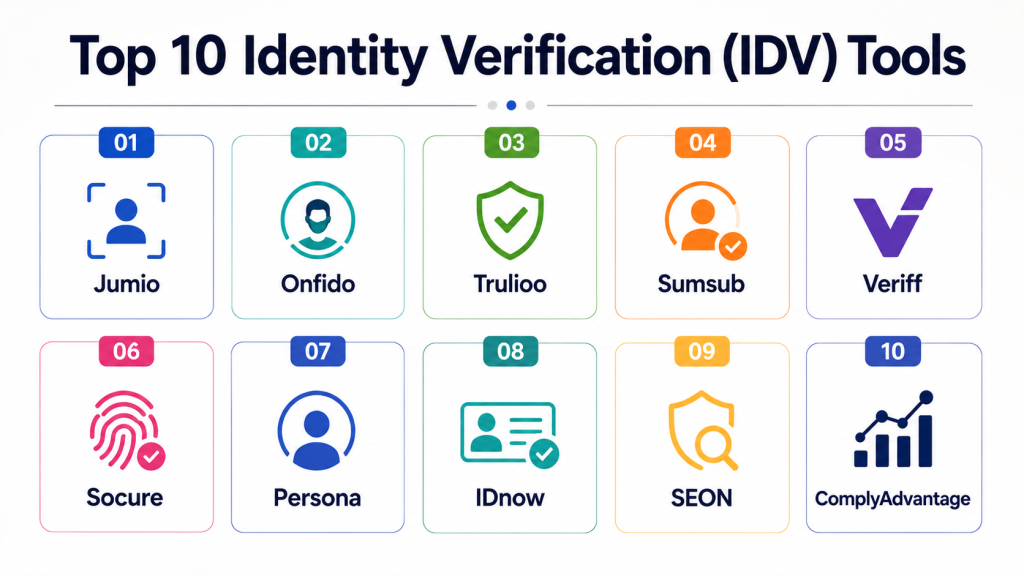
Top 10 Identity Verification (IDV) Tools
1 — Jumio
Short description: A leading AI-powered identity verification platform designed for enterprises requiring global coverage and advanced fraud detection.
Key Features
- AI-driven document verification
- Biometric facial recognition
- Liveness detection
- Risk scoring engine
- AML screening support
- Global ID coverage
Pros
- High verification accuracy
- Strong global coverage
- Enterprise scalability
Cons
- Premium pricing
- Complex setup for smaller teams
Platforms / Deployment
Web / iOS / Android — Cloud
Security & Compliance
MFA, encryption, audit logs, GDPR, SOC 2 (reported)
Integrations & Ecosystem
Jumio offers a robust API-first ecosystem suitable for fintech and enterprise deployments.
- REST APIs
- Mobile SDKs
- CRM integrations
- Fraud detection systems
- Workflow automation tools
Support & Community
Strong enterprise onboarding, documentation, and dedicated support tiers.
2 — Onfido
Short description: Developer-friendly IDV platform focused on AI-based document and biometric verification.
Key Features
- Document verification
- Facial biometrics
- Liveness detection
- Fraud detection signals
- Workflow automation
Pros
- Easy API integration
- Fast onboarding flows
- Strong mobile UX
Cons
- Pricing varies by usage
- Limited AML capabilities
Platforms / Deployment
Web / iOS / Android — Cloud
Security & Compliance
Encryption, MFA, audit logs, GDPR
Integrations & Ecosystem
Onfido integrates seamlessly with digital onboarding systems and mobile applications.
- REST APIs
- Mobile SDKs
- Web SDKs
- CRM integrations
- Workflow tools
Support & Community
Well-documented APIs and strong developer support.
3 — Trulioo
Short description: Global identity verification platform known for its extensive data coverage.
Key Features
- Global identity verification
- Business verification
- AML screening
- Risk scoring
- Data aggregation
Pros
- Wide global reach
- Strong compliance capabilities
- Flexible APIs
Cons
- Complex pricing
- Data accuracy varies by region
Platforms / Deployment
Web — Cloud
Security & Compliance
Encryption, MFA, audit logs, GDPR
Integrations & Ecosystem
Trulioo provides extensive integrations with global data providers and onboarding systems.
- API integrations
- CRM systems
- Identity data connectors
- Fraud tools
Support & Community
Enterprise-grade support with onboarding assistance.
4 — Sumsub
Short description: All-in-one verification platform combining IDV, AML, and fraud prevention.
Key Features
- Document verification
- Facial biometrics
- AML screening
- Fraud detection
- Continuous monitoring
Pros
- Comprehensive feature set
- Flexible workflows
- Good for fintech and crypto
Cons
- UI complexity
- Learning curve
Platforms / Deployment
Web / iOS / Android — Cloud
Security & Compliance
Encryption, MFA, audit logs, GDPR
Integrations & Ecosystem
Sumsub integrates with fintech platforms and crypto exchanges.
- APIs
- Mobile SDKs
- CRM integrations
- Workflow tools
Support & Community
Responsive support and strong documentation.
5 — SEON
Short description: Fraud prevention and identity intelligence platform with strong digital footprint analysis.
Key Features
- Email and phone verification
- Device fingerprinting
- Risk scoring
- Fraud detection
- Real-time alerts
Pros
- Fast implementation
- Strong fraud signals
- Developer-friendly
Cons
- Limited document verification
- Not a full IDV suite
Platforms / Deployment
Web — Cloud
Security & Compliance
Encryption, RBAC, audit logs, GDPR
Integrations & Ecosystem
SEON integrates with payment platforms and fraud detection systems.
- APIs
- Payment gateways
- CRM tools
- Fraud intelligence systems
Support & Community
Good onboarding and developer resources.
6 — LexisNexis Risk Solutions
Short description: Enterprise identity and risk intelligence platform with strong data-driven insights.
Key Features
- Identity verification
- Risk scoring
- Fraud intelligence
- AML screening
- Case management
Pros
- Extensive data network
- Reliable analytics
- Enterprise-ready
Cons
- Expensive
- Complex integration
Platforms / Deployment
Web — Cloud / Hybrid
Security & Compliance
RBAC, encryption, audit logs, GDPR
Integrations & Ecosystem
LexisNexis integrates with enterprise systems and fraud platforms.
- APIs
- Banking systems
- Data platforms
- Fraud tools
Support & Community
Enterprise support with consulting services.
7 — ComplyAdvantage
Short description: AI-driven compliance and identity risk intelligence platform.
Key Features
- Risk scoring
- AML screening
- Sanctions monitoring
- Real-time alerts
- API-first design
Pros
- Fast integration
- Strong fintech focus
- Modern UX
Cons
- Limited biometric verification
- Less enterprise customization
Platforms / Deployment
Web — Cloud
Security & Compliance
Encryption, RBAC, audit logs, GDPR
Integrations & Ecosystem
API-centric integrations for fintech and compliance tools.
- REST APIs
- CRM integrations
- Payment systems
- Workflow tools
Support & Community
Good documentation and onboarding support.
8 — IDnow
Short description: European-focused identity verification provider with strong compliance features.
Key Features
- Video verification
- Document verification
- Biometric checks
- eID support
- Compliance workflows
Pros
- Strong EU compliance
- Multiple verification methods
- Trusted in regulated sectors
Cons
- Region-focused
- Limited global reach
Platforms / Deployment
Web / Mobile — Cloud
Security & Compliance
GDPR, encryption, audit logs
Integrations & Ecosystem
- APIs
- Banking integrations
- Workflow tools
- Identity systems
Support & Community
Enterprise and regional support services.
9 — Veriff
Short description: AI-powered identity verification platform focused on fraud prevention and automation.
Key Features
- Document verification
- Biometric authentication
- Fraud detection
- Video verification
- Risk scoring
Pros
- Strong fraud detection
- Fast verification
- Global support
Cons
- Pricing varies
- Limited AML depth
Platforms / Deployment
Web / Mobile — Cloud
Security & Compliance
Encryption, GDPR, audit logs
Integrations & Ecosystem
- APIs
- Mobile SDKs
- CRM integrations
- Fraud systems
Support & Community
Developer-friendly documentation.
10 — Socure
Short description: AI-based digital identity verification platform focusing on predictive identity scoring.
Key Features
- Predictive identity scoring
- Fraud detection
- Document verification
- Email/phone intelligence
- Risk analytics
Pros
- Advanced AI models
- Strong fraud prevention
- Scalable
Cons
- Enterprise-focused
- Limited transparency in models
Platforms / Deployment
Web — Cloud
Security & Compliance
Encryption, RBAC, audit logs, GDPR
Integrations & Ecosystem
Socure integrates with fintech and fraud prevention systems.
- APIs
- CRM tools
- Payment systems
- Risk engines
Support & Community
Enterprise onboarding and support.
Comparison Table (Top 10)
| Tool Name | Best For | Platform(s) Supported | Deployment | Standout Feature | Public Rating |
|---|---|---|---|---|---|
| Jumio | Enterprises | Web, iOS, Android | Cloud | AI verification | N/A |
| Onfido | Developers | Web, Mobile | Cloud | Easy API | N/A |
| Trulioo | Global onboarding | Web | Cloud | Data coverage | N/A |
| Sumsub | Fintech/crypto | Web, Mobile | Cloud | All-in-one | N/A |
| SEON | Fraud detection | Web | Cloud | Digital footprint | N/A |
| LexisNexis | Enterprises | Web | Hybrid | Data intelligence | N/A |
| ComplyAdvantage | Fintech | Web | Cloud | Risk intelligence | N/A |
| IDnow | EU compliance | Web, Mobile | Cloud | Video verification | N/A |
| Veriff | Fraud prevention | Web, Mobile | Cloud | AI verification | N/A |
| Socure | Enterprise AI | Web | Cloud | Predictive scoring | N/A |
Evaluation & Scoring of Identity Verification (IDV)
| Tool Name | Core | Ease | Integrations | Security | Performance | Support | Value | Weighted Total |
|---|---|---|---|---|---|---|---|---|
| Jumio | 9 | 7 | 8 | 9 | 9 | 8 | 6 | 8.1 |
| Onfido | 8 | 9 | 8 | 8 | 8 | 8 | 7 | 8.1 |
| Trulioo | 8 | 7 | 9 | 8 | 8 | 8 | 7 | 8.0 |
| Sumsub | 9 | 8 | 8 | 8 | 8 | 8 | 8 | 8.2 |
| SEON | 7 | 9 | 7 | 7 | 8 | 7 | 8 | 7.8 |
| LexisNexis | 9 | 6 | 8 | 9 | 9 | 8 | 6 | 8.0 |
| ComplyAdvantage | 8 | 9 | 8 | 8 | 8 | 8 | 8 | 8.3 |
| IDnow | 8 | 7 | 7 | 8 | 8 | 7 | 7 | 7.8 |
| Veriff | 8 | 8 | 8 | 8 | 8 | 8 | 7 | 8.0 |
| Socure | 9 | 7 | 8 | 9 | 9 | 8 | 6 | 8.1 |
How to interpret scores:
- These scores are comparative benchmarks, not absolute ratings
- Enterprise tools score higher in security and scalability
- Developer-first tools excel in ease of use
- Value scores reflect flexibility and cost-efficiency
- Choose based on your specific use case, not just totals
Which Identity Verification (IDV) Tool Is Right for You?
Solo / Freelancer
Choose lightweight tools like Onfido or SEON for quick integration and minimal setup.
SMB
Sumsub and Veriff offer a balance of features, pricing, and usability.
Mid-Market
Trulioo and ComplyAdvantage provide scalability and compliance readiness.
Enterprise
Jumio, LexisNexis, and Socure offer deep analytics and global compliance.
Budget vs Premium
- Budget-friendly: SEON, Sumsub
- Premium: Jumio, Socure
Feature Depth vs Ease of Use
- Easy: Onfido, Veriff
- Advanced: LexisNexis, Socure
Integrations & Scalability
- API-first: Onfido, ComplyAdvantage
- Enterprise integrations: Jumio, LexisNexis
Security & Compliance Needs
- High compliance: Jumio, LexisNexis
- Moderate: Sumsub, Veriff
Frequently Asked Questions (FAQs)
1. What are Identity Verification (IDV) tools?
Identity Verification tools help businesses confirm a user’s identity using documents, biometrics, and data checks. They are widely used in digital onboarding and compliance processes. These tools reduce fraud risk and improve trust in online transactions.
2. How do IDV tools work?
IDV tools verify identities by analyzing government-issued IDs, matching facial biometrics, and checking databases. Advanced platforms also use AI to detect fake identities and suspicious behavior. The process is usually completed in real-time during onboarding.
3. Are IDV tools secure?
Most IDV platforms include strong security features like encryption, MFA, and audit logs. They are designed to comply with global regulations such as GDPR and KYC requirements. However, businesses should always validate vendor security practices.
4. How much do IDV tools cost?
Pricing varies depending on usage, number of verifications, and feature access. Many tools follow API-based or pay-per-verification models. Enterprise solutions may offer custom pricing based on scale and requirements.
5. Can IDV tools detect fraud?
Yes, modern IDV tools use AI and machine learning to detect fraud patterns. They can identify deepfakes, fake documents, and suspicious user behavior. This helps reduce financial losses and compliance risks.
6. Do IDV tools support global verification?
Many IDV tools support verification across multiple countries and document types. However, coverage may vary depending on the provider and region. Businesses should check global database support before choosing a tool.
7. How long does implementation take?
Cloud-based IDV tools can be implemented within a few days or weeks using APIs. Enterprise deployments may take longer due to customization and integration requirements. Proper planning can speed up the process.
8. Are IDV tools required for compliance?
In regulated industries like banking and fintech, IDV tools are essential for KYC and AML compliance. They help organizations meet legal requirements and avoid penalties. Even non-regulated businesses use them for fraud prevention.
9. Can IDV tools integrate with existing systems?
Yes, most IDV platforms offer APIs and SDKs for integration with CRMs, onboarding systems, and payment platforms. This allows seamless identity verification within existing workflows. Integration flexibility is a key buying factor.
10. What are common mistakes when choosing an IDV tool?
Common mistakes include ignoring global coverage, underestimating integration complexity, and focusing only on cost. Businesses should also evaluate accuracy, scalability, and compliance capabilities. Choosing the wrong tool can impact user experience and security.
Conclusion
Identity Verification (IDV) tools have become a critical part of modern digital ecosystems, enabling businesses to onboard users securely while minimizing fraud risks. As regulations tighten and cyber threats evolve, organizations must rely on advanced, AI-driven verification solutions to maintain trust and compliance. The right IDV tool depends on your business size, industry, and operational needs—whether you prioritize speed, global coverage, or deep compliance capabilities. Startups may prefer flexible, API-first platforms, while enterprises often require robust, scalable systems with advanced analytics. There is no one-size-fits-all solution, so it’s important to evaluate tools based on integration, accuracy, and user experience. Shortlisting a few options and running pilot tests can help ensure the best fit.

Find Trusted Cardiac Hospitals
Compare heart hospitals by city and services — all in one place.
Explore Hospitals
I am trying to learn more about identity verification tools, and this guide helped me understand how IDV works in real digital onboarding systems.
This article explains identity verification tools in a simple way. The comparison helps understand their features, pros, and cons for secure user authentication.