Introduction
Security Orchestration Automation & Response SOAR platforms help security teams automate repetitive incident response tasks, connect multiple cybersecurity tools, and improve how threats are investigated and resolved. Modern SOAR platforms combine automation, orchestration, case management, threat intelligence, and AI-assisted workflows into a centralized security operations environment. As cyberattacks continue to grow in complexity, organizations are under pressure to reduce alert fatigue, improve response times, and manage increasingly distributed infrastructure. Security teams now deal with cloud workloads, SaaS platforms, endpoint threats, phishing campaigns, ransomware, insider risks, and compliance requirements simultaneously. SOAR tools help teams standardize incident handling and reduce manual operational work.
Real-world use cases include:
- Automated phishing response
- Threat intelligence enrichment
- Malware containment workflows
- SIEM alert triage
- Compliance investigation management
Buyers should Evaluate:
- Automation depth
- Integration ecosystem
- Ease of playbook creation
- AI-assisted workflows
- Incident management capabilities
- Scalability
- Cloud and hybrid deployment support
- Compliance reporting
- Analyst collaboration tools
- Pricing flexibility
Best for: SOC teams, MSSPs, enterprise security operations, regulated industries, cloud-first organizations, and businesses managing large alert volumes.
Not ideal for: Very small businesses with minimal security tooling, organizations without dedicated security operations teams, or companies seeking only basic SIEM functionality.
Key Trends in Security Orchestration Automation & Response SOAR
- AI-powered incident triage is becoming a core capability across modern SOAR platforms.
- Vendors are embedding generative AI copilots for investigation summarization and workflow recommendations.
- Low-code and no-code playbook builders are reducing operational complexity.
- Cloud-native SOAR adoption continues to grow as hybrid environments become standard.
- Integrated threat intelligence enrichment is becoming more automated and contextual.
- Security teams increasingly demand unified SecOps platforms combining SIEM, XDR, and SOAR.
- Automation metrics and ROI visibility are becoming major purchasing factors.
- API-first integration ecosystems are replacing rigid connector architectures.
- Compliance-driven automation for frameworks like GDPR and HIPAA is growing.
- MSSP-focused multi-tenant capabilities are becoming more mature.
How We Selected These Tools
The following tools were selected based on several practical evaluation criteria:
- Market adoption and industry visibility
- Breadth and maturity of automation capabilities
- Incident response orchestration quality
- Integration ecosystem size
- Support for modern cloud and hybrid infrastructure
- AI-assisted investigation and workflow features
- Enterprise scalability and reliability
- Analyst usability and onboarding experience
- Security posture and compliance capabilities
- Fit across SMB, mid-market, enterprise, and MSSP environments
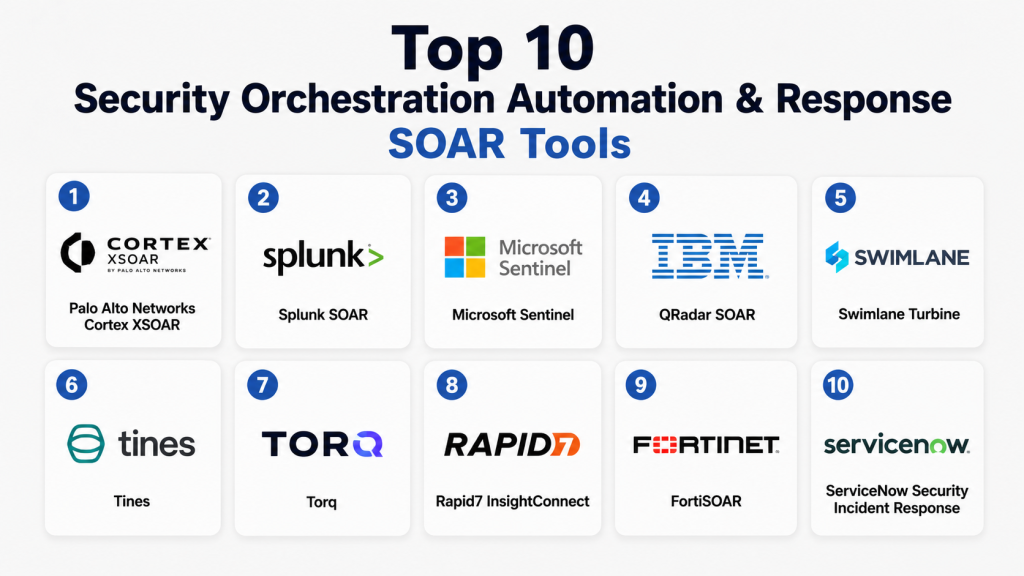
Top 10 Security Orchestration Automation & Response SOAR Tools
1- Palo Alto Networks Cortex XSOAR
Short description: Cortex XSOAR is a widely adopted enterprise SOAR platform designed for large-scale security operations centers. It combines incident management, orchestration, automation, and threat intelligence in a unified environment.
Key Features
- Advanced automation playbooks
- Integrated case management
- Threat intelligence management
- AI-assisted incident analysis
- Extensive third-party integrations
- Multi-tenant support
- Low-code workflow builder
Pros
- Extremely mature automation ecosystem
- Strong enterprise scalability
- Large integration marketplace
Cons
- Can require complex onboarding
- Premium pricing for advanced deployments
- Learning curve for smaller teams
Platforms / Deployment
Cloud / Self-hosted / Hybrid
Security & Compliance
SSO/SAML, MFA, RBAC, encryption, audit logs. Additional certifications vary by deployment.
Integrations & Ecosystem
Cortex XSOAR offers one of the largest security integration ecosystems in the SOAR market. It supports SIEM, EDR, IAM, email security, cloud security, and threat intelligence platforms.
- Splunk
- Microsoft Sentinel
- CrowdStrike
- Okta
- ServiceNow
- AWS
Support & Community
Strong enterprise support structure with extensive documentation, professional services, and partner ecosystem.
2- Splunk SOAR
Short description: Splunk SOAR focuses on automation-driven incident response for organizations already invested in the Splunk ecosystem. It is particularly strong in orchestration and SOC workflow automation.
Key Features
- Visual playbook editor
- Automated alert enrichment
- Case management
- Threat intelligence integrations
- Analyst collaboration tools
- SIEM integration
- Custom workflow scripting
Pros
- Excellent integration with Splunk Enterprise Security
- Mature automation workflows
- Strong customization flexibility
Cons
- Best experience often tied to Splunk ecosystem
- Pricing may be high for SMBs
- Can require dedicated operational resources
Platforms / Deployment
Cloud / Self-hosted
Security & Compliance
RBAC, SSO, audit logging, MFA support. Additional compliance details vary.
Integrations & Ecosystem
Splunk SOAR integrates deeply with security analytics, cloud, endpoint, and identity tools.
- Microsoft Defender
- CrowdStrike
- AWS
- Azure
- ServiceNow
- Cisco Secure
Support & Community
Large enterprise customer base with strong technical documentation and community forums.
3- Microsoft Sentinel
Short description: Microsoft Sentinel combines SIEM and SOAR capabilities into a cloud-native security operations platform. It is particularly attractive for Microsoft-centric enterprises.
Key Features
- Cloud-native automation
- AI-assisted analytics
- Automated playbooks using Logic Apps
- Threat hunting
- Integrated SIEM capabilities
- Security analytics
- Native Microsoft ecosystem integration
Pros
- Strong cloud scalability
- Deep Microsoft integration
- Unified SecOps experience
Cons
- Best suited for Microsoft-heavy environments
- Customization complexity can grow
- Costs may increase with data ingestion
Platforms / Deployment
Cloud
Security & Compliance
Azure security controls, RBAC, MFA, audit logs, encryption, compliance capabilities through Microsoft ecosystem.
Integrations & Ecosystem
Microsoft Sentinel integrates strongly with Azure, Microsoft 365, Defender products, and third-party tools.
- Microsoft Defender
- Azure
- AWS
- Okta
- Palo Alto Networks
- Cisco
Support & Community
Large ecosystem with strong enterprise documentation and extensive training resources.
4- IBM QRadar SOAR
Short description: IBM QRadar SOAR is designed for enterprise incident response and security workflow automation. It emphasizes structured response management and regulatory operations.
Key Features
- Incident orchestration
- Workflow automation
- Case management
- Compliance-focused workflows
- Threat intelligence support
- Collaboration features
- Reporting dashboards
Pros
- Strong enterprise governance
- Mature incident management
- Good compliance alignment
Cons
- Interface can feel dated
- Deployment complexity
- Customization may require expertise
Platforms / Deployment
Cloud / Self-hosted / Hybrid
Security & Compliance
RBAC, audit logging, encryption, SSO integration. Compliance support varies.
Integrations & Ecosystem
IBM QRadar SOAR supports integrations across security analytics and infrastructure tools.
- IBM QRadar
- ServiceNow
- CrowdStrike
- Microsoft tools
- AWS
- Threat intelligence feeds
Support & Community
Enterprise-focused support with professional services and IBM partner network.
5- Swimlane Turbine
Short description: Swimlane Turbine is a low-code security automation platform built for flexible orchestration and process automation across security operations environments.
Key Features
- Low-code automation
- Multi-domain orchestration
- AI-assisted workflows
- Drag-and-drop playbook creation
- Automation metrics
- Case management
- Integration marketplace
Pros
- Strong low-code experience
- Flexible workflow customization
- Good operational visibility
Cons
- Enterprise pricing model
- Advanced customization may require planning
- Smaller ecosystem compared to larger vendors
Platforms / Deployment
Cloud / Self-hosted / Hybrid
Security & Compliance
SSO, MFA, RBAC, encryption, audit logging.
Integrations & Ecosystem
Swimlane supports integration with security, ITSM, and cloud platforms.
- Splunk
- ServiceNow
- Microsoft Sentinel
- AWS
- Okta
- CrowdStrike
Support & Community
Good onboarding resources with enterprise support services.
6- Tines
Short description: Tines is an automation-first security orchestration platform known for flexibility, simplicity, and strong no-code workflow design capabilities.
Key Features
- No-code automation builder
- Event-driven workflows
- Security orchestration
- API integrations
- Workflow visualization
- Reusable templates
- AI workflow support
Pros
- Easy workflow creation
- Strong flexibility
- Fast deployment experience
Cons
- Advanced enterprise governance may require customization
- Smaller legacy enterprise footprint
- Complex workflows can grow difficult to manage
Platforms / Deployment
Cloud / Self-hosted
Security & Compliance
SSO, MFA, audit logs, RBAC. Additional certifications vary.
Integrations & Ecosystem
Tines emphasizes API-first integrations and workflow flexibility.
- Slack
- ServiceNow
- CrowdStrike
- Okta
- Microsoft 365
- AWS
Support & Community
Strong user community and modern product documentation.
7- Torq
Short description: Torq is a modern hyperautomation-focused SOAR platform designed to simplify security workflow automation for cloud-first security teams.
Key Features
- Hyperautomation workflows
- AI-assisted orchestration
- No-code automation
- Cloud-native architecture
- Security workflow templates
- Cross-platform orchestration
- Real-time automation monitoring
Pros
- Modern cloud-native design
- User-friendly automation builder
- Fast workflow deployment
Cons
- Newer vendor compared to legacy competitors
- Smaller enterprise footprint
- Some advanced workflows may need tuning
Platforms / Deployment
Cloud
Security & Compliance
RBAC, SSO, MFA, encryption capabilities.
Integrations & Ecosystem
Torq supports modern security stack integrations with API-driven workflows.
- CrowdStrike
- Okta
- AWS
- Microsoft Defender
- Slack
- ServiceNow
Support & Community
Growing community with responsive vendor engagement and onboarding support.
8- Rapid7 InsightConnect
Short description: Rapid7 InsightConnect focuses on simplifying security automation for SOC teams using the Rapid7 ecosystem and broader third-party environments.
Key Features
- Workflow automation
- Alert triage
- Threat enrichment
- Case management
- Visual workflow builder
- Incident response automation
- Cloud integrations
Pros
- Strong usability
- Good integration quality
- Simplified automation workflows
Cons
- Advanced customization can be limited
- Best fit alongside Rapid7 tools
- Enterprise-scale complexity may vary
Platforms / Deployment
Cloud
Security & Compliance
SSO, RBAC, audit logging, encryption support.
Integrations & Ecosystem
Rapid7 InsightConnect integrates with SIEM, endpoint, cloud, and ticketing systems.
- InsightIDR
- ServiceNow
- AWS
- CrowdStrike
- Microsoft Defender
- Slack
Support & Community
Strong customer onboarding and accessible documentation.
9- FortiSOAR
Short description: FortiSOAR delivers orchestration and automated response capabilities with strong integration across Fortinet security products and third-party tools.
Key Features
- Incident orchestration
- Threat intelligence management
- Workflow automation
- Playbook editor
- Case management
- Multi-tenant support
- Reporting dashboards
Pros
- Strong Fortinet ecosystem integration
- Good enterprise automation
- Broad security visibility
Cons
- Best experience within Fortinet stack
- User interface complexity
- Learning curve for advanced workflows
Platforms / Deployment
Cloud / Self-hosted / Hybrid
Security & Compliance
RBAC, encryption, MFA, SSO integration, audit logging.
Integrations & Ecosystem
FortiSOAR supports broad integrations across networking and security infrastructure.
- Fortinet products
- Splunk
- ServiceNow
- Microsoft tools
- CrowdStrike
- AWS
Support & Community
Enterprise-focused support backed by Fortinet ecosystem resources.
10- ServiceNow Security Incident Response
Short description: ServiceNow Security Incident Response combines ITSM workflows with security operations automation and incident response coordination.
Key Features
- Security incident workflows
- ITSM integration
- Automation orchestration
- Case management
- Collaboration tools
- Compliance workflows
- AI-assisted operations
Pros
- Excellent workflow governance
- Strong enterprise process management
- Unified IT and security operations
Cons
- Can be expensive
- Complex deployments
- Requires process maturity
Platforms / Deployment
Cloud
Security & Compliance
SSO/SAML, RBAC, MFA, audit logging, encryption support.
Integrations & Ecosystem
ServiceNow integrates broadly across ITSM, cloud, endpoint, and security tools.
- Microsoft Defender
- Splunk
- CrowdStrike
- AWS
- Okta
- Palo Alto Networks
Support & Community
Large enterprise ecosystem with mature support and implementation network.
Comparison Table
| Tool Name | Best For | Platform(s) Supported | Deployment | Standout Feature | Public Rating |
|---|---|---|---|---|---|
| Cortex XSOAR | Large enterprises | Web / Linux | Cloud / Hybrid | Massive integration ecosystem | N/A |
| Splunk SOAR | Splunk users | Web / Linux | Cloud / Self-hosted | Deep SIEM integration | N/A |
| Microsoft Sentinel | Microsoft environments | Web | Cloud | Unified SIEM + SOAR | N/A |
| IBM QRadar SOAR | Compliance-heavy enterprises | Web | Hybrid | Structured incident management | N/A |
| Swimlane Turbine | Low-code automation | Web | Hybrid | Flexible low-code workflows | N/A |
| Tines | Automation-first teams | Web | Cloud / Self-hosted | No-code automation simplicity | N/A |
| Torq | Cloud-native security teams | Web | Cloud | Hyperautomation workflows | N/A |
| Rapid7 InsightConnect | Mid-market SOCs | Web | Cloud | Easy workflow automation | N/A |
| FortiSOAR | Fortinet customers | Web | Hybrid | Fortinet ecosystem integration | N/A |
| ServiceNow SIR | ITSM-driven enterprises | Web | Cloud | IT and security workflow alignment | N/A |
Evaluation & Scoring of Security Orchestration Automation & Response SOAR
| Tool Name | Core 25% | Ease 15% | Integrations 15% | Security 10% | Performance 10% | Support 10% | Value 15% | Weighted Total |
|---|---|---|---|---|---|---|---|---|
| Cortex XSOAR | 9.5 | 7.5 | 9.5 | 9 | 9 | 9 | 7 | 8.7 |
| Splunk SOAR | 9 | 7 | 9 | 9 | 8.5 | 8.5 | 7 | 8.3 |
| Microsoft Sentinel | 8.5 | 8 | 8.5 | 9 | 8.5 | 8.5 | 8 | 8.4 |
| IBM QRadar SOAR | 8.5 | 6.5 | 8 | 9 | 8 | 8 | 7 | 7.9 |
| Swimlane Turbine | 8 | 8.5 | 8 | 8 | 8 | 8 | 7.5 | 8.0 |
| Tines | 8 | 9 | 8 | 8 | 8 | 8 | 8 | 8.2 |
| Torq | 8 | 8.5 | 8 | 8 | 8 | 7.5 | 8 | 8.0 |
| Rapid7 InsightConnect | 7.5 | 8.5 | 7.5 | 8 | 8 | 8 | 8 | 7.9 |
| FortiSOAR | 8 | 7 | 8 | 8.5 | 8 | 8 | 7 | 7.8 |
| ServiceNow SIR | 8.5 | 7 | 8.5 | 9 | 8.5 | 8.5 | 6.5 | 8.0 |
These scores are comparative and designed to help buyers evaluate relative strengths across the SOAR market. Enterprise-focused platforms generally score higher in integrations and security depth, while modern cloud-native vendors often perform better in usability and deployment simplicity. Organizations should prioritize criteria based on operational maturity, integration needs, compliance requirements, and automation goals.
Which Security Orchestration Automation & Response SOAR Tool Is Right for You?
Solo / Freelancer
Most solo security practitioners may not need a full enterprise SOAR platform. Lightweight automation tools or SIEM-native automation may provide sufficient functionality. Tines and Torq are often easier starting points due to lower operational complexity.
SMB
SMBs should focus on ease of deployment, automation simplicity, and pricing flexibility. Rapid7 InsightConnect and Tines can work well for smaller SOC teams with limited engineering resources.
Mid-Market
Mid-market organizations often require balanced scalability and usability. Swimlane Turbine, Rapid7 InsightConnect, and Microsoft Sentinel provide strong operational flexibility without excessive complexity.
Enterprise
Large enterprises typically prioritize integration depth, governance, compliance, and scalability. Cortex XSOAR, Splunk SOAR, IBM QRadar SOAR, and ServiceNow Security Incident Response are strong enterprise candidates.
Budget vs Premium
Premium enterprise platforms often provide deeper automation and larger integration ecosystems but come with operational and licensing complexity. Smaller organizations may gain faster ROI from simpler cloud-native platforms.
Feature Depth vs Ease of Use
Feature-rich platforms may require experienced security engineering teams. Organizations prioritizing rapid deployment and usability should evaluate low-code and no-code platforms carefully.
Integrations & Scalability
Organizations with large security stacks should prioritize integration maturity and API extensibility. MSSPs and global enterprises should also evaluate multi-tenant and distributed workflow support.
Security & Compliance Needs
Highly regulated industries should prioritize audit logging, RBAC, compliance workflows, encryption capabilities, and mature governance features.
Frequently Asked Questions FAQs
1. What does a SOAR platform actually do?
A SOAR platform automates security operations workflows, orchestrates multiple security tools, and helps analysts investigate and respond to threats faster.
2. How is SOAR different from SIEM?
SIEM primarily focuses on log collection and analytics, while SOAR focuses on workflow automation, orchestration, and incident response processes.
3. Are SOAR platforms only for enterprises?
No. While many SOAR platforms target enterprises, several modern vendors now offer SMB-friendly and cloud-native deployment models.
4. Do SOAR tools require coding skills?
Not always. Many platforms now include low-code or no-code playbook builders, though advanced customization may still require scripting knowledge.
5. What integrations are most important in SOAR?
Common integrations include SIEM, EDR, IAM, cloud platforms, ticketing systems, email security, and threat intelligence services.
6. Can SOAR reduce analyst burnout?
Yes. Automation can significantly reduce repetitive manual tasks, helping analysts focus on higher-value investigations and threat hunting.
7. How long does SOAR implementation take?
Implementation timelines vary widely depending on workflow complexity, integrations, governance requirements, and organizational maturity.
8. Is cloud-native SOAR becoming more popular?
Yes. Many organizations prefer cloud-native SOAR for scalability, simplified maintenance, and hybrid infrastructure support.
9. What are common mistakes when deploying SOAR?
Common mistakes include automating poor workflows, lacking governance controls, overcomplicating playbooks, and insufficient analyst training.
10. What should buyers evaluate first?
Buyers should first assess integration coverage, operational complexity, automation maturity, deployment flexibility, and long-term scalability.
Conclusion
Security Orchestration Automation & Response SOAR platforms have become critical components of modern security operations. As organizations face growing alert volumes, expanding cloud environments, and increasingly sophisticated cyber threats, automation and orchestration are no longer optional. The right SOAR platform can improve response speed, reduce analyst workload, strengthen operational consistency, and help security teams scale effectively. However, there is no universal best solution. Some organizations prioritize deep enterprise governance and massive integration ecosystems, while others value usability, rapid deployment, or low-code automation flexibility. Cortex XSOAR, Splunk SOAR, Microsoft Sentinel, Tines, Torq, and other leading platforms each address different operational priorities and maturity levels. Before making a final decision, organizations should shortlist two or three platforms, run controlled pilot deployments, validate integration compatibility, and confirm security and compliance alignment with internal operational requirements.

Find Trusted Cardiac Hospitals
Compare heart hospitals by city and services — all in one place.
Explore Hospitals
Security Orchestration, Automation and Response (SOAR) tools are most valuable when they help security teams coordinate, automate, and streamline incident detection and response workflows across multiple security systems. By providing security playbooks, automated response actions, alert management, case and incident tracking, threat intelligence integration, workflow orchestration, investigation support, evidence management, reporting, and integration with SIEM, EDR, firewalls, and other security tools, these platforms enable organizations to reduce manual workloads, accelerate incident response, improve alert handling, standardize security processes, and strengthen overall security operations.