Introduction
NoSQL Database Platforms are modern database systems designed to handle unstructured, semi-structured, and rapidly changing data at scale. Unlike traditional relational databases that rely heavily on fixed schemas and SQL tables, NoSQL databases support flexible data models such as document, key-value, graph, and wide-column storage. These platforms are widely used for cloud-native applications, AI workloads, real-time analytics, IoT systems, gaming, e-commerce, and high-scale web platforms.
The importance of NoSQL databases has grown significantly as organizations process massive datasets, distributed workloads, and AI-driven applications that demand horizontal scalability and low-latency performance. Modern development teams also prefer schema flexibility to accelerate product iteration and microservices adoption.
Common Real-world use cases include:
- Real-time recommendation engines
- IoT telemetry and sensor data collection
- AI and machine learning pipelines
- High-traffic mobile and gaming applications
- Product catalogs and customer personalization systems
When Evaluating NoSQL Database Platforms, buyers should assess:
- Scalability and distributed architecture
- Multi-model database support
- Performance under heavy workloads
- Cloud-native capabilities
- Security and compliance controls
- Backup and disaster recovery
- Integration ecosystem
- Developer experience and APIs
- Cost efficiency at scale
- Managed service availability
Best for: Enterprises, SaaS companies, cloud-native startups, AI-driven businesses, fintech platforms, gaming companies, IoT providers, and organizations managing massive or fast-changing datasets.
Not ideal for: Small projects requiring strict ACID relational modeling, legacy ERP-style transactional systems, or workloads better suited for traditional SQL databases with fixed schemas.
Key Trends in NoSQL Database Platforms
- AI-native application architectures are increasing demand for vector search and embedding storage capabilities.
- Multi-cloud and hybrid deployment support are becoming standard expectations.
- Serverless NoSQL platforms are reducing operational overhead for developers.
- Real-time analytics integration is becoming a core differentiator.
- Distributed edge computing workloads are driving geo-replication innovation.
- Security expectations now include fine-grained RBAC, encryption-by-default, and zero-trust access controls.
- Multi-model databases are gaining traction to reduce infrastructure sprawl.
- Kubernetes-native deployments are becoming more common across enterprise environments.
- Cost optimization and autoscaling are critical due to rising cloud infrastructure expenses.
- Integration with AI frameworks and event-streaming platforms is becoming increasingly important.
How We Selected These Tools (Methodology)
The platforms in this list were selected using a balanced evaluation approach focused on enterprise readiness, developer adoption, and long-term platform viability.
Selection criteria included:
- Strong market adoption and ecosystem maturity
- Proven scalability in production environments
- Feature completeness across multiple use cases
- Cloud-native deployment flexibility
- Performance and reliability reputation
- Security and compliance capabilities
- Integration support with analytics and AI tools
- Developer experience and documentation quality
- Community adoption and enterprise support options
- Suitability for SMB, mid-market, and enterprise workloads
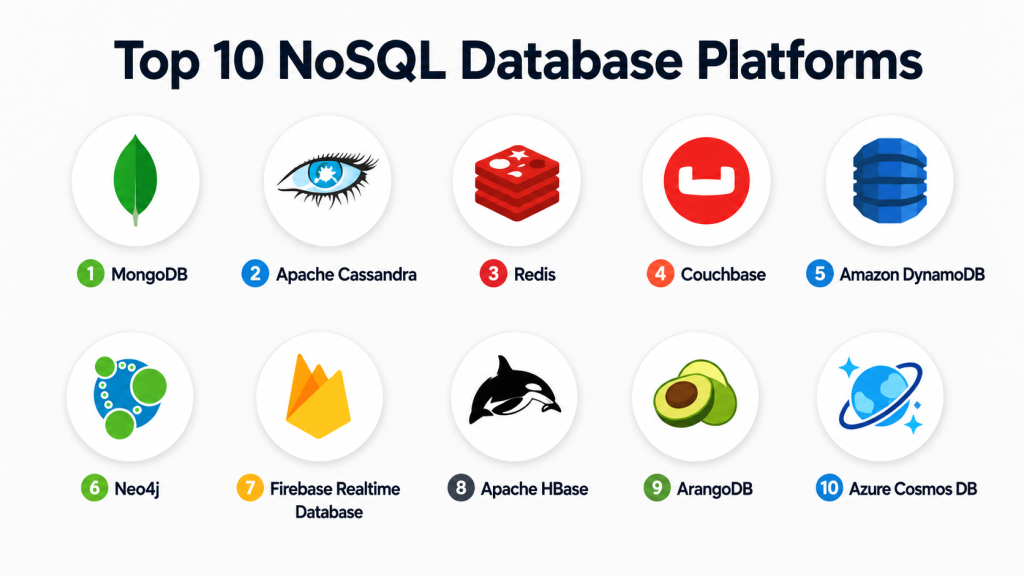
Top 10 NoSQL Database Platforms
1 — MongoDB
Short description: MongoDB is one of the most widely adopted document-oriented NoSQL databases. It is designed for developers building scalable applications requiring schema flexibility and modern cloud-native capabilities.
Key Features
- Document-oriented JSON-style storage
- Horizontal scaling with sharding
- Built-in replication and failover
- Atlas managed cloud platform
- Full-text and vector search support
- Aggregation pipeline for analytics
- Multi-cloud deployment support
Pros
- Excellent developer ecosystem
- Strong cloud-native tooling
- Flexible schema design
Cons
- Resource-intensive at very large scale
- Complex query optimization in some workloads
- Licensing concerns for some enterprises
Platforms / Deployment
Cloud / Self-hosted / Hybrid
Security & Compliance
Supports RBAC, encryption, MFA, auditing, SSO/SAML, and compliance frameworks including SOC 2 and GDPR.
Integrations & Ecosystem
MongoDB integrates with major cloud providers, analytics tools, AI pipelines, and developer frameworks.
- Kubernetes
- Apache Spark
- Kafka
- AWS
- Azure
- Google Cloud
Support & Community
Strong enterprise support ecosystem with extensive documentation, certifications, and one of the largest NoSQL developer communities.
2 — Cassandra
Short description: Apache Cassandra is a distributed wide-column NoSQL database optimized for massive scalability, high availability, and fault tolerance across distributed environments.
Key Features
- Peer-to-peer distributed architecture
- High write throughput
- Multi-region replication
- Linear scalability
- Tunable consistency
- Fault-tolerant design
- Open-source ecosystem
Pros
- Excellent for large distributed workloads
- Highly resilient infrastructure
- Strong performance at scale
Cons
- Steeper learning curve
- Operational complexity
- Query flexibility limitations
Platforms / Deployment
Cloud / Self-hosted / Hybrid
Security & Compliance
Supports encryption, authentication, RBAC, and audit logging. Compliance capabilities vary by deployment model.
Integrations & Ecosystem
Cassandra integrates well with streaming and analytics ecosystems.
- Apache Kafka
- Spark
- Kubernetes
- DataStax ecosystem
- Grafana
- Prometheus
Support & Community
Large open-source community with enterprise support available through DataStax and cloud providers.
3 — Redis
Short description: Redis is a high-performance in-memory NoSQL database commonly used for caching, session management, real-time analytics, and fast application workloads.
Key Features
- In-memory data storage
- Ultra-low latency performance
- Pub/Sub messaging
- Data persistence options
- Stream processing
- Vector similarity search
- High availability clustering
Pros
- Extremely fast performance
- Simple developer experience
- Excellent caching capabilities
Cons
- Memory costs can grow quickly
- Not ideal for highly relational data
- Complex scaling for certain workloads
Platforms / Deployment
Cloud / Self-hosted / Hybrid
Security & Compliance
Supports TLS encryption, ACLs, RBAC, and audit features. Compliance support varies by provider.
Integrations & Ecosystem
Redis supports a broad ecosystem of developer frameworks and cloud integrations.
- Kubernetes
- Kafka
- Node.js
- Python
- AWS
- Azure
Support & Community
Strong open-source community and commercial enterprise support through Redis Inc.
4 — Couchbase
Short description: Couchbase is a distributed NoSQL database platform combining document storage, caching, SQL-like querying, and edge synchronization capabilities.
Key Features
- Multi-model database architecture
- Built-in caching engine
- SQL++ query language
- Mobile and edge synchronization
- High availability clustering
- Full-text search
- Real-time analytics
Pros
- Strong mobile synchronization
- Flexible developer experience
- Good performance for interactive applications
Cons
- Smaller ecosystem than MongoDB
- Licensing costs for enterprises
- Complex advanced configurations
Platforms / Deployment
Cloud / Self-hosted / Hybrid
Security & Compliance
Supports encryption, RBAC, SSO, audit logging, and enterprise security controls.
Integrations & Ecosystem
Couchbase integrates with cloud-native and analytics environments.
- Kubernetes
- Kafka
- Spark
- AWS
- Azure
- Mobile SDKs
Support & Community
Commercial enterprise support is strong, though the open-source community is smaller compared to some competitors.
5 — Amazon DynamoDB
Short description: Amazon DynamoDB is a fully managed serverless NoSQL database designed for high-performance applications on AWS infrastructure.
Key Features
- Fully managed serverless architecture
- Automatic scaling
- Single-digit millisecond latency
- Global tables
- Built-in backup and recovery
- Event-driven integrations
- Tight AWS ecosystem integration
Pros
- Minimal operational overhead
- Excellent AWS integration
- Strong scalability
Cons
- Vendor lock-in concerns
- Complex pricing at scale
- Limited portability
Platforms / Deployment
Cloud
Security & Compliance
Supports IAM, encryption, auditing, RBAC, and compliance standards available through AWS.
Integrations & Ecosystem
Deep integration across AWS services and analytics platforms.
- Lambda
- Kinesis
- S3
- CloudWatch
- IAM
- SageMaker
Support & Community
Backed by AWS enterprise support and extensive documentation resources.
6 — Neo4j
Short description: Neo4j is a leading graph database platform designed for relationship-heavy workloads including fraud detection, recommendation systems, and knowledge graphs.
Key Features
- Native graph database engine
- Cypher query language
- Graph analytics
- AI knowledge graph support
- Real-time traversal queries
- Visualization tools
- Clustered architecture
Pros
- Excellent relationship modeling
- Strong graph analytics
- Powerful for AI and recommendation workloads
Cons
- Specialized use case focus
- Higher learning curve
- Not ideal for simple CRUD applications
Platforms / Deployment
Cloud / Self-hosted / Hybrid
Security & Compliance
Supports RBAC, SSO, encryption, and enterprise security capabilities.
Integrations & Ecosystem
Neo4j integrates with analytics, AI, and visualization ecosystems.
- Apache Spark
- Kafka
- GraphQL
- Kubernetes
- Python AI libraries
Support & Community
Strong developer community with enterprise-grade commercial support.
7 — Firebase Realtime Database
Short description: Firebase Realtime Database is a cloud-hosted NoSQL platform optimized for mobile and web application development.
Key Features
- Real-time synchronization
- Mobile-first architecture
- Offline support
- Serverless deployment
- Authentication integration
- Google Cloud ecosystem
- Developer SDKs
Pros
- Rapid application development
- Excellent for mobile apps
- Easy onboarding
Cons
- Limited advanced querying
- Vendor dependency
- Scaling complexity for enterprise workloads
Platforms / Deployment
Cloud
Security & Compliance
Supports authentication, encryption, and Google Cloud security controls.
Integrations & Ecosystem
Firebase integrates closely with Google development ecosystems.
- Google Cloud
- Android
- iOS
- Web SDKs
- Analytics
- Cloud Functions
Support & Community
Large developer community with strong documentation and onboarding resources.
8 — HBase
Short description: Apache HBase is a distributed NoSQL database built on Hadoop for handling massive structured and semi-structured datasets.
Key Features
- Hadoop ecosystem integration
- Column-oriented architecture
- Real-time read/write access
- Distributed scalability
- Strong consistency
- Large dataset optimization
- Open-source flexibility
Pros
- Excellent big data integration
- Handles massive datasets
- Strong consistency guarantees
Cons
- Operational complexity
- Heavy infrastructure requirements
- Less developer-friendly
Platforms / Deployment
Self-hosted / Hybrid
Security & Compliance
Supports Kerberos authentication, encryption, and Hadoop security controls.
Integrations & Ecosystem
HBase works closely with Hadoop and analytics environments.
- Hadoop
- Hive
- Spark
- Kafka
- YARN
- HDFS
Support & Community
Strong open-source ecosystem with enterprise support through Hadoop vendors.
9 — ArangoDB
Short description: ArangoDB is a multi-model NoSQL database supporting graph, document, and key-value workloads within a unified platform.
Key Features
- Multi-model architecture
- Native graph capabilities
- Distributed scaling
- Flexible querying
- Integrated search
- Kubernetes support
- Cloud deployment options
Pros
- Unified database architecture
- Flexible query support
- Good developer experience
Cons
- Smaller ecosystem
- Lower enterprise adoption
- Fewer third-party integrations
Platforms / Deployment
Cloud / Self-hosted / Hybrid
Security & Compliance
Supports encryption, authentication, RBAC, and enterprise security capabilities.
Integrations & Ecosystem
ArangoDB supports modern developer and orchestration ecosystems.
- Kubernetes
- GraphQL
- Python
- Java
- Cloud providers
Support & Community
Growing community with commercial support options available.
10 — Azure Cosmos DB
Short description: Azure Cosmos DB is Microsoft’s globally distributed multi-model NoSQL database platform designed for cloud-scale applications.
Key Features
- Global distribution
- Multi-model APIs
- Automatic scaling
- SLA-backed performance
- Multi-region replication
- AI integration support
- Serverless options
Pros
- Excellent global scalability
- Strong Azure integration
- Multiple API compatibility
Cons
- Complex pricing model
- Azure-centric architecture
- Query optimization challenges
Platforms / Deployment
Cloud
Security & Compliance
Supports encryption, RBAC, auditing, SSO, and Microsoft compliance frameworks.
Integrations & Ecosystem
Deep integration with Microsoft cloud and analytics ecosystems.
- Azure AI
- Power BI
- Kubernetes
- Synapse Analytics
- Azure Functions
- Microsoft Fabric
Support & Community
Strong enterprise support and extensive Microsoft ecosystem documentation.
Comparison Table
| Tool Name | Best For | Platform(s) Supported | Deployment | Standout Feature | Public Rating |
|---|---|---|---|---|---|
| MongoDB | Developer-first applications | Windows, Linux, macOS, Cloud | Hybrid | Flexible document model | N/A |
| Cassandra | Massive distributed systems | Linux, Cloud | Hybrid | High scalability | N/A |
| Redis | Real-time performance | Linux, Cloud | Hybrid | In-memory speed | N/A |
| Couchbase | Interactive applications | Windows, Linux, Cloud | Hybrid | Built-in caching | N/A |
| DynamoDB | AWS-native applications | Cloud | Cloud | Serverless scalability | N/A |
| Neo4j | Graph workloads | Windows, Linux, Cloud | Hybrid | Relationship modeling | N/A |
| Firebase | Mobile apps | Web, iOS, Android | Cloud | Real-time sync | N/A |
| HBase | Big data analytics | Linux | Hybrid | Hadoop integration | N/A |
| ArangoDB | Multi-model workloads | Windows, Linux, Cloud | Hybrid | Unified architecture | N/A |
| Azure Cosmos DB | Global cloud applications | Cloud | Cloud | Multi-region replication | N/A |
Evaluation & Scoring of NoSQL Database Platforms
| Tool Name | Core | Ease | Integrations | Security | Performance | Support | Value | Weighted Total |
|---|---|---|---|---|---|---|---|---|
| MongoDB | 9 | 9 | 9 | 8 | 8 | 9 | 8 | 8.6 |
| Cassandra | 9 | 6 | 8 | 7 | 9 | 8 | 8 | 8.0 |
| Redis | 8 | 9 | 8 | 7 | 10 | 8 | 8 | 8.4 |
| Couchbase | 8 | 7 | 8 | 8 | 8 | 7 | 7 | 7.7 |
| DynamoDB | 9 | 8 | 9 | 9 | 9 | 9 | 7 | 8.6 |
| Neo4j | 8 | 7 | 7 | 8 | 8 | 8 | 7 | 7.7 |
| Firebase | 7 | 9 | 8 | 8 | 7 | 8 | 8 | 7.9 |
| HBase | 8 | 5 | 7 | 7 | 9 | 7 | 7 | 7.2 |
| ArangoDB | 7 | 7 | 7 | 7 | 7 | 6 | 8 | 7.1 |
| Azure Cosmos DB | 9 | 8 | 9 | 9 | 9 | 9 | 7 | 8.6 |
These scores are comparative rather than absolute. A higher score does not necessarily mean the platform is universally better for every workload. Enterprise buyers may prioritize scalability and security, while startups may focus more heavily on developer productivity and operational simplicity. Cost structures and cloud dependencies can also significantly affect long-term value.
Which NoSQL Database Tool Is Right for You?
Solo / Freelancer
Firebase and MongoDB are strong options for solo developers and small teams due to their fast onboarding, cloud simplicity, and developer-friendly tooling.
SMB
MongoDB, Couchbase, and Redis provide strong scalability without overwhelming operational complexity. SMBs often benefit from managed cloud deployments.
Mid-Market
Redis, Cassandra, and Cosmos DB work well for mid-market organizations managing larger distributed workloads and real-time systems.
Enterprise
Large enterprises often prefer Cassandra, DynamoDB, Cosmos DB, and Neo4j for their scalability, reliability, compliance capabilities, and global distribution support.
Budget vs Premium
Open-source platforms such as Cassandra, Redis, and MongoDB Community Edition can reduce licensing costs. Managed enterprise offerings deliver easier operations but may increase long-term spending.
Feature Depth vs Ease of Use
MongoDB and Firebase are easier to adopt quickly, while Cassandra and HBase provide deeper scalability and infrastructure control for experienced engineering teams.
Integrations & Scalability
Organizations heavily invested in AWS or Azure ecosystems may gain operational advantages from DynamoDB or Cosmos DB due to native cloud integrations.
Security & Compliance Needs
Highly regulated industries should prioritize platforms offering enterprise-grade RBAC, auditing, encryption, and compliance alignment. Managed enterprise cloud services often simplify governance and compliance management.
Frequently Asked Questions FAQs
1. What is a NoSQL database platform?
A NoSQL database platform is a non-relational database system designed to handle flexible, distributed, and large-scale data workloads. These platforms support document, graph, key-value, or wide-column storage models.
2. When should businesses choose NoSQL over SQL?
NoSQL is often preferred when applications require rapid scaling, flexible schemas, real-time processing, or distributed architectures. SQL remains better for highly structured transactional workloads.
3. Are NoSQL databases suitable for AI workloads?
Yes. Many AI applications rely on NoSQL databases for storing embeddings, vector data, telemetry, and unstructured datasets used in machine learning pipelines.
4. Are NoSQL databases secure?
Most enterprise-grade NoSQL platforms support encryption, RBAC, MFA, audit logging, and cloud security integrations. Security maturity varies across vendors and deployment models.
5. Which NoSQL database is easiest for developers?
MongoDB and Firebase are generally considered highly developer-friendly due to their flexible schema design and strong SDK ecosystems.
6. What is the biggest challenge with NoSQL databases?
Operational complexity and data modeling can become challenging at scale. Some NoSQL platforms also require careful consistency and replication planning.
7. Can NoSQL databases scale globally?
Yes. Many platforms such as Cassandra, Cosmos DB, and DynamoDB are designed for multi-region replication and global-scale deployments.
8. Are NoSQL databases expensive?
Costs vary significantly depending on storage, compute, scaling, and managed service usage. Serverless models can reduce upfront infrastructure expenses but may become costly at high scale.
9. How difficult is migration from SQL to NoSQL?
Migration complexity depends on the application architecture and data relationships. Schema redesign and application logic changes are often required.
10. What alternatives exist besides NoSQL databases?
Traditional relational databases, NewSQL platforms, data warehouses, and distributed analytics engines may be better alternatives depending on workload requirements and consistency needs.
Conclusion
NoSQL Database Platforms have become foundational infrastructure for modern cloud-native, AI-driven, and large-scale distributed applications. The market now includes highly specialized platforms optimized for document storage, graph relationships, in-memory performance, real-time synchronization, and globally distributed architectures. The right choice depends heavily on workload patterns, scalability requirements, cloud strategy, developer expertise, and long-term operational costs. MongoDB remains a strong all-around platform for modern application development, while Cassandra excels in distributed scalability. Redis dominates ultra-low-latency workloads, and DynamoDB or Cosmos DB offer compelling fully managed cloud-native experiences. Neo4j stands out for graph-based intelligence, while Firebase simplifies mobile-first development. Organizations should shortlist two or three platforms aligned with their architecture goals, run proof-of-concept deployments, validate integration and compliance needs, and benchmark real-world performance before committing to production-scale adoption.

Find Trusted Cardiac Hospitals
Compare heart hospitals by city and services — all in one place.
Explore Hospitals
This article explains NoSQL database platforms in a simple way. The comparison of features, pros, and cons helps understand which database works best for different types of applications and data needs.