Introduction
Time Series Database Platforms are specialized databases designed to store, process, and analyze time-stamped data efficiently. Unlike traditional relational databases, time series databases are optimized for handling continuously generated data points such as metrics, events, logs, IoT sensor data, financial transactions, and infrastructure telemetry. As organizations scale cloud-native applications, AI systems, IoT deployments, and observability pipelines time series databases have become essential infrastructure components. Modern businesses increasingly rely on real-time analytics, predictive monitoring, and high-frequency data ingestion, making traditional database architectures less effective for these workloads.
Common Real-world use cases include:
- Infrastructure and application monitoring
- IoT sensor analytics
- Financial market data analysis
- Industrial telemetry and manufacturing analytics
- AI and machine learning observability
When Evaluating time series database platforms, buyers should consider:
- Data ingestion performance
- Query speed and scalability
- Compression efficiency
- Real-time analytics support
- Cloud-native deployment capabilities
- Retention and downsampling features
- Security and compliance controls
- Integration ecosystem
- Multi-region scalability
- Operational complexity and pricing
Best for: DevOps teams, SREs, IoT platforms, fintech organizations, AI infrastructure teams, observability platforms, industrial analytics environments, and enterprises managing high-frequency telemetry data.
Not ideal for: Lightweight transactional applications, simple relational workloads, or organizations without continuous streaming or metric-heavy data requirements.
Key Trends in Time Series Database Platforms
- AI-driven anomaly detection is increasingly embedded into observability platforms.
- Edge computing and IoT deployments are driving distributed time series architectures.
- Cloud-native and serverless deployment models continue expanding.
- Compression efficiency is becoming a major differentiator for large-scale telemetry environments.
- Real-time stream processing integration is improving operational analytics.
- Multi-model databases are combining time series, vector, and analytics workloads.
- Kubernetes-native observability ecosystems are accelerating adoption.
- Security, governance, and compliance tooling are becoming stronger in enterprise deployments.
- OpenTelemetry integration is becoming standard across monitoring ecosystems.
- Cost optimization through tiered storage and data lifecycle management is gaining importance.
How We Selected These Tools
The platforms in this list were selected using the following methodology:
- Strong market adoption and ecosystem maturity
- Proven scalability for enterprise telemetry workloads
- Performance for high-ingestion environments
- Query flexibility and analytics capabilities
- Security and compliance readiness
- Cloud-native deployment support
- Integration ecosystem breadth
- Community activity and documentation quality
- Flexibility across SMB and enterprise use cases
- Operational simplicity and reliability reputation
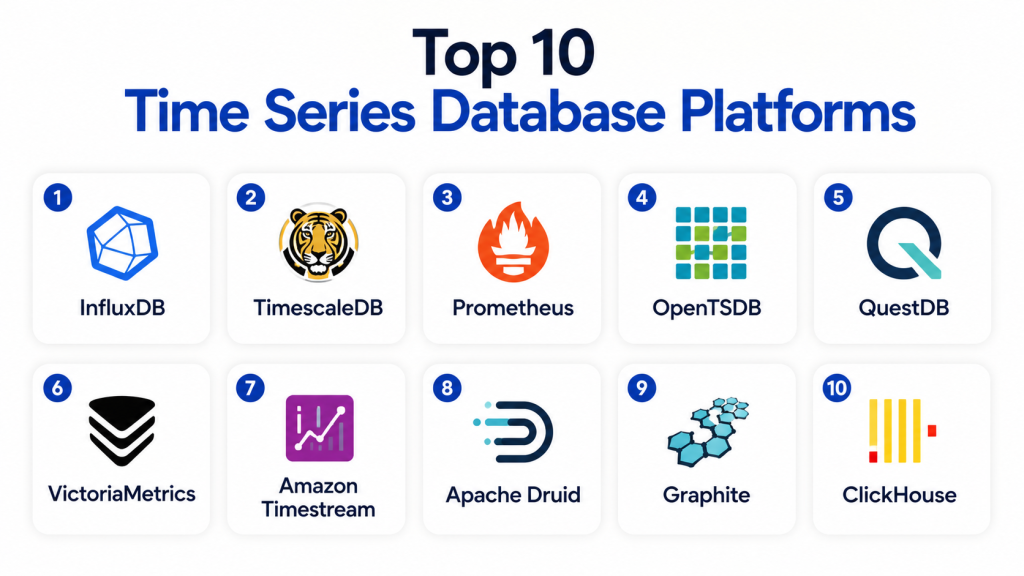
Top 10 Time Series Database Platforms
1- InfluxDB
Short description: InfluxDB is one of the most recognized time series databases, widely used for infrastructure monitoring, IoT analytics, and real-time telemetry workloads.
Key Features
- High-speed time series ingestion
- SQL-like Flux query language
- Built-in retention policies
- Data compression optimization
- Real-time dashboards
- Edge and cloud deployment support
- Native observability tooling
Pros
- Excellent for DevOps and observability workloads
- Strong ecosystem maturity
- Optimized for high-frequency metrics
Cons
- Advanced Flux queries may have a learning curve
- Enterprise features may increase costs
- Large-scale tuning can require expertise
Platforms / Deployment
- Cloud / Self-hosted / Hybrid
Security & Compliance
- RBAC
- Encryption
- Authentication support
- Audit capabilities
Integrations & Ecosystem
InfluxDB integrates strongly with monitoring and telemetry ecosystems.
- Grafana
- Telegraf
- Kubernetes
- AWS
- Azure
- OpenTelemetry
Support & Community
Large community with strong documentation and enterprise support options.
2- TimescaleDB
Short description: TimescaleDB extends PostgreSQL with time series functionality, combining relational database familiarity with scalable time series analytics.
Key Features
- PostgreSQL compatibility
- Time-series optimized indexing
- SQL query support
- Compression and retention policies
- Continuous aggregates
- Multi-node scaling
- Hybrid transactional and analytics support
Pros
- Familiar PostgreSQL ecosystem
- Excellent SQL compatibility
- Strong analytics flexibility
Cons
- Scaling may require tuning
- Less specialized than native TSDB engines
- Advanced features may require enterprise licensing
Platforms / Deployment
- Cloud / Self-hosted / Hybrid
Security & Compliance
- Depends on PostgreSQL deployment
- RBAC
- Encryption
- Authentication support
Integrations & Ecosystem
TimescaleDB benefits from the extensive PostgreSQL ecosystem.
- PostgreSQL tools
- Grafana
- Kafka
- Python
- Kubernetes
Support & Community
Strong open-source community with growing enterprise adoption.
3- Prometheus
Short description: Prometheus is an open-source monitoring and alerting platform widely used for Kubernetes and cloud-native observability environments.
Key Features
- Pull-based metrics collection
- Powerful query language
- Alert management
- Kubernetes-native monitoring
- Service discovery
- Multi-dimensional metrics
- Open-source architecture
Pros
- Industry standard for Kubernetes monitoring
- Excellent ecosystem support
- Strong alerting capabilities
Cons
- Long-term storage may require integrations
- Scaling large environments can be complex
- Primarily metrics-focused
Platforms / Deployment
- Self-hosted / Cloud
Security & Compliance
- Authentication support
- Encryption support
- RBAC via integrations
Integrations & Ecosystem
Prometheus integrates deeply with cloud-native observability stacks.
- Grafana
- Kubernetes
- Alertmanager
- OpenTelemetry
- Docker
Support & Community
Massive open-source community with extensive monitoring documentation.
4- OpenTSDB
Short description: OpenTSDB is a scalable distributed time series database built on Hadoop and HBase for large telemetry workloads.
Key Features
- Distributed architecture
- Massive scalability
- HBase backend support
- Real-time metric ingestion
- Flexible APIs
- High availability
- Historical analytics
Pros
- Strong scalability capabilities
- Good for large infrastructure environments
- Open-source flexibility
Cons
- Operational complexity
- Requires Hadoop ecosystem expertise
- Smaller modern ecosystem adoption
Platforms / Deployment
- Self-hosted / Hybrid
Security & Compliance
- Depends on infrastructure configuration
Integrations & Ecosystem
OpenTSDB integrates with large-scale distributed infrastructure.
- Hadoop
- HBase
- Grafana
- Java ecosystems
Support & Community
Community-driven project with infrastructure-focused adoption.
5- QuestDB
Short description: QuestDB is a high-performance open-source time series database optimized for financial market data and real-time analytics.
Key Features
- High-ingestion architecture
- SQL support
- Column-oriented storage
- Time-series partitioning
- Parallel query execution
- Real-time analytics
- Low-latency processing
Pros
- Excellent performance for financial workloads
- Developer-friendly SQL support
- Lightweight deployment model
Cons
- Smaller ecosystem than major platforms
- Enterprise tooling still evolving
- Advanced clustering support varies
Platforms / Deployment
- Cloud / Self-hosted
Security & Compliance
- Authentication support
- Encryption support
Integrations & Ecosystem
QuestDB integrates well with real-time analytics environments.
- Kafka
- Grafana
- Python
- PostgreSQL tools
Support & Community
Rapidly growing community with strong developer-focused documentation.
6- VictoriaMetrics
Short description: VictoriaMetrics is a fast and cost-efficient monitoring database compatible with Prometheus ecosystems.
Key Features
- Prometheus compatibility
- High compression efficiency
- Fast query execution
- Scalable cluster architecture
- Long-term metrics storage
- Resource-efficient operation
- Multi-tenancy support
Pros
- Excellent cost efficiency
- Strong Prometheus integration
- High performance at scale
Cons
- Primarily observability-focused
- Smaller enterprise ecosystem
- Visualization requires integrations
Platforms / Deployment
- Cloud / Self-hosted
Security & Compliance
- Authentication support
- Encryption support
Integrations & Ecosystem
VictoriaMetrics integrates naturally into cloud-native monitoring stacks.
- Prometheus
- Grafana
- Kubernetes
- OpenTelemetry
Support & Community
Growing community with strong observability adoption.
7- Amazon Timestream
Short description: Amazon Timestream is AWS’s managed time series database service designed for IoT and operational analytics workloads.
Key Features
- Fully managed infrastructure
- Serverless scaling
- Built-in lifecycle management
- Time-series analytics
- SQL querying
- AWS-native integrations
- Automatic storage tiering
Pros
- Minimal operational overhead
- Strong AWS integration
- Good scalability for IoT analytics
Cons
- AWS-centric ecosystem
- Limited flexibility outside AWS
- Pricing complexity at scale
Platforms / Deployment
- Cloud
Security & Compliance
- Encryption
- IAM integration
- Audit logging
- Compliance support through AWS
Integrations & Ecosystem
Timestream integrates tightly with AWS services.
- AWS IoT
- Lambda
- SageMaker
- CloudWatch
- QuickSight
Support & Community
Strong enterprise support through AWS infrastructure services.
8- Apache Druid
Short description: Apache Druid is a real-time analytics database optimized for event-driven analytics and high-performance OLAP queries.
Key Features
- Real-time ingestion
- Columnar storage
- OLAP analytics
- Distributed architecture
- Sub-second queries
- Stream processing support
- Multi-dimensional analytics
Pros
- Excellent analytical query performance
- Strong real-time ingestion
- Good scalability for event analytics
Cons
- Operational complexity
- Requires distributed infrastructure expertise
- Learning curve for advanced tuning
Platforms / Deployment
- Cloud / Self-hosted / Hybrid
Security & Compliance
- RBAC
- Encryption
- Authentication support
Integrations & Ecosystem
Druid integrates with streaming and analytics ecosystems.
- Kafka
- Hadoop
- Spark
- Superset
- Grafana
Support & Community
Strong analytics-focused open-source ecosystem.
9- Graphite
Short description: Graphite is a mature monitoring and graphing platform designed for storing and visualizing time series metrics.
Key Features
- Metrics collection
- Data visualization
- Retention management
- Real-time monitoring
- Alerting integrations
- Lightweight architecture
- Historical analysis
Pros
- Simple and mature architecture
- Strong visualization ecosystem
- Easy monitoring deployment
Cons
- Less scalable than modern platforms
- Limited advanced analytics
- Older architecture design
Platforms / Deployment
- Self-hosted
Security & Compliance
- Authentication support
- Encryption via infrastructure layers
Integrations & Ecosystem
Graphite integrates with monitoring and visualization environments.
- Grafana
- StatsD
- Python
- Linux monitoring tools
Support & Community
Long-standing monitoring community with stable documentation resources.
10- ClickHouse
Short description: ClickHouse is a columnar analytics database increasingly used for time series analytics, observability, and real-time event processing.
Key Features
- Column-oriented architecture
- High-speed analytics
- Massive scalability
- Compression optimization
- Real-time ingestion
- SQL support
- Distributed clustering
Pros
- Extremely fast analytical queries
- Strong scalability
- Excellent cost-performance balance
Cons
- Not exclusively designed for time series workloads
- Advanced tuning can be complex
- Operational expertise may be required
Platforms / Deployment
- Cloud / Self-hosted / Hybrid
Security & Compliance
- RBAC
- Encryption
- Authentication support
Integrations & Ecosystem
ClickHouse integrates strongly with analytics and observability ecosystems.
- Kafka
- Grafana
- Kubernetes
- Python
- BI tools
Support & Community
Rapidly growing enterprise adoption with strong analytics ecosystem momentum.
Comparison Table
| Tool Name | Best For | Platform(s) Supported | Deployment | Standout Feature | Public Rating |
|---|---|---|---|---|---|
| InfluxDB | Observability and IoT | Web/Linux | Cloud/Self-hosted/Hybrid | Native time-series engine | N/A |
| TimescaleDB | PostgreSQL users | Web/Linux | Cloud/Self-hosted/Hybrid | PostgreSQL compatibility | N/A |
| Prometheus | Kubernetes monitoring | Linux | Self-hosted/Cloud | Cloud-native metrics monitoring | N/A |
| OpenTSDB | Massive telemetry environments | Linux | Self-hosted/Hybrid | Hadoop scalability | N/A |
| QuestDB | Financial analytics | Linux | Cloud/Self-hosted | High-ingestion performance | N/A |
| VictoriaMetrics | Cost-efficient monitoring | Linux | Cloud/Self-hosted | High compression efficiency | N/A |
| Amazon Timestream | AWS IoT analytics | Web | Cloud | Serverless TSDB | N/A |
| Apache Druid | Real-time analytics | Linux | Cloud/Self-hosted/Hybrid | OLAP event analytics | N/A |
| Graphite | Lightweight monitoring | Linux | Self-hosted | Mature metrics visualization | N/A |
| ClickHouse | Real-time analytics workloads | Web/Linux | Cloud/Self-hosted/Hybrid | Fast columnar analytics | N/A |
Evaluation & Scoring of Time Series Database Platforms
| Tool Name | Core 25% | Ease 15% | Integrations 15% | Security 10% | Performance 10% | Support 10% | Value 15% | Weighted Total |
|---|---|---|---|---|---|---|---|---|
| InfluxDB | 9 | 8 | 9 | 8 | 9 | 9 | 7 | 8.5 |
| TimescaleDB | 8 | 9 | 9 | 8 | 8 | 8 | 9 | 8.5 |
| Prometheus | 9 | 7 | 10 | 7 | 8 | 10 | 9 | 8.7 |
| OpenTSDB | 7 | 5 | 7 | 6 | 8 | 6 | 8 | 6.9 |
| QuestDB | 8 | 8 | 7 | 6 | 9 | 7 | 9 | 8.0 |
| VictoriaMetrics | 8 | 8 | 9 | 7 | 9 | 7 | 10 | 8.4 |
| Amazon Timestream | 8 | 8 | 8 | 9 | 8 | 8 | 7 | 8.0 |
| Apache Druid | 9 | 6 | 8 | 7 | 9 | 8 | 8 | 8.0 |
| Graphite | 6 | 8 | 7 | 6 | 6 | 7 | 8 | 6.9 |
| ClickHouse | 9 | 7 | 8 | 8 | 10 | 8 | 9 | 8.6 |
These scores are comparative and intended to help buyers understand relative strengths across different operational and analytics scenarios. Observability-focused tools may score higher in integrations and monitoring ecosystems, while analytical databases often lead in scalability and performance. Buyers should prioritize tools aligned with their telemetry volume, analytics requirements, operational expertise, and cloud strategy.
Which Time Series Database Tool Is Right for You?
Solo / Freelancer
Graphite and QuestDB are suitable for lightweight monitoring and developer-friendly analytics environments without major operational complexity.
SMB
InfluxDB and TimescaleDB offer strong usability, scalability, and broad integration support for growing businesses.
Mid-Market
VictoriaMetrics and ClickHouse provide excellent performance and cost efficiency for expanding observability and analytics workloads.
Enterprise
Prometheus, Apache Druid, and InfluxDB are strong enterprise choices for cloud-native observability and real-time analytics infrastructure.
Budget vs Premium
Open-source platforms such as Prometheus, VictoriaMetrics, and ClickHouse provide strong cost flexibility, while managed services like Amazon Timestream reduce operational overhead.
Feature Depth vs Ease of Use
InfluxDB and TimescaleDB balance advanced analytics with accessibility, while Druid and ClickHouse offer deeper performance tuning capabilities.
Integrations & Scalability
Cloud-native organizations may prefer Prometheus or Amazon Timestream, while analytics-heavy workloads often benefit from ClickHouse or Apache Druid.
Security & Compliance Needs
Organizations handling sensitive telemetry should prioritize vendors with RBAC, encryption, audit logging, and enterprise authentication integrations.
Frequently Asked Questions FAQs
1. What is a time series database?
A time series database is optimized for storing and analyzing data points associated with timestamps, such as metrics, logs, events, and telemetry data.
2. Why are time series databases important in 2026?
Modern cloud-native infrastructure, AI systems, and IoT deployments generate massive volumes of time-stamped data requiring specialized storage and analytics capabilities.
3. How are time series databases different from relational databases?
Time series databases are optimized for high-ingestion workloads, timestamp indexing, retention management, and real-time analytics.
4. Which industries commonly use time series databases?
Technology, manufacturing, financial services, telecommunications, energy, healthcare, and IoT industries widely use time series platforms.
5. Is Prometheus a full database?
Prometheus is primarily a monitoring and metrics platform with time series storage capabilities optimized for observability workloads.
6. Are time series databases expensive?
Costs vary depending on ingestion volume, retention periods, storage architecture, and managed versus self-hosted deployments.
7. What security features should enterprises prioritize?
RBAC, encryption, audit logging, SSO integration, and compliance tooling are important for enterprise telemetry environments.
8. Can time series databases support AI workloads?
Yes. Many modern platforms support AI-driven anomaly detection, predictive analytics, and machine learning observability.
9. Which platform is best for Kubernetes monitoring?
Prometheus remains one of the most widely adopted choices for Kubernetes-native monitoring environments.
10. Can time series databases scale to billions of events?
Yes. Platforms like ClickHouse, InfluxDB, VictoriaMetrics, and Apache Druid are designed for large-scale telemetry workloads.
Conclusion
Time Series Database Platforms have become critical infrastructure for observability, IoT analytics, AI monitoring, financial telemetry, and real-time operational intelligence. As enterprises generate increasingly large volumes of streaming data, organizations require platforms capable of delivering scalable ingestion, fast analytics, efficient storage, and real-time insights. The market now includes specialized monitoring-focused platforms, SQL-compatible analytical systems, and cloud-native managed services. Prometheus remains dominant for Kubernetes observability, while InfluxDB and TimescaleDB offer strong balances between usability and advanced analytics. ClickHouse and Apache Druid excel in high-performance analytical workloads, while VictoriaMetrics provides impressive cost efficiency for monitoring environments. Cloud-first organizations may prefer Amazon Timestream for operational simplicity. The best strategy is to shortlist a few platforms, test ingestion and query performance against realistic workloads, validate integrations and operational overhead, and align the platform with long-term scalability and governance requirements.
Source reference:

Find Trusted Cardiac Hospitals
Compare heart hospitals by city and services — all in one place.
Explore Hospitals
This article helps in understanding different time series database platforms and how they perform. The comparison of features, pros and cons makes it easier to choose the right tool.