Introduction
Model Monitoring & Drift Detection Tools help organizations track the health, accuracy, reliability, and performance of machine learning models after deployment. In simple terms, these platforms monitor production AI systems to detect issues such as data drift, concept drift, performance degradation, bias changes, latency spikes, and unexpected model behavior before they negatively impact business outcomes. As AI adoption scales rapidly production AI systems are becoming increasingly dynamic and complex. Models trained on historical data can quickly lose accuracy when customer behavior, market conditions, data quality, or operational environments change. Model monitoring platforms address this challenge by continuously analyzing model inputs, outputs, and operational metrics in real time.
Common Real-world use cases include:
- Fraud detection monitoring
- Recommendation engine optimization
- Healthcare AI quality assurance
- Predictive maintenance validation
- Generative AI observability
Key Evaluation criteria buyers should consider:
- Drift detection accuracy
- Real-time monitoring capabilities
- Explainability and observability
- Alerting and incident response
- Integration ecosystem
- Scalability
- Governance and compliance
- Root cause analysis
- Multi-model support
- Cost efficiency
Best for: AI engineering teams, ML engineers, data scientists, MLOps teams, platform engineering groups, financial services, healthcare organizations, e-commerce companies, and enterprises operating production AI systems at scale.
Not ideal for: Organizations running only experimental AI projects, teams without production ML deployments, or businesses using simple analytics models with limited operational risk.
Key Trends in Model Monitoring & Drift Detection Tools
- AI observability platforms are evolving beyond simple drift detection into full production AI governance systems.
- Generative AI and LLM monitoring capabilities are becoming essential platform features.
- Real-time monitoring and streaming inference analytics are replacing delayed batch monitoring.
- AI compliance and explainability requirements are increasing due to regulatory pressure.
- Automated root cause analysis is becoming a major differentiator.
- Unified monitoring for structured and unstructured data is growing rapidly.
- Multi-cloud AI monitoring architectures are becoming more common in enterprises.
- Open-source observability frameworks are gaining stronger enterprise adoption.
- GPU-aware inference performance monitoring is becoming operationally important.
- Bias detection and fairness monitoring are increasingly integrated into AI governance workflows.
How We Selected These Tools
The platforms in this list were selected based on operational maturity, ecosystem adoption, enterprise readiness, and production AI monitoring capabilities.
Selection criteria included:
- Market adoption and enterprise visibility
- Feature completeness for monitoring and drift detection
- Real-time observability capabilities
- Reliability and scalability signals
- Security and governance features
- Integration ecosystem and interoperability
- Support for modern AI and generative AI workloads
- Ease of deployment and operational maturity
- Community adoption and documentation quality
- Suitability across startups, SMBs, and enterprises
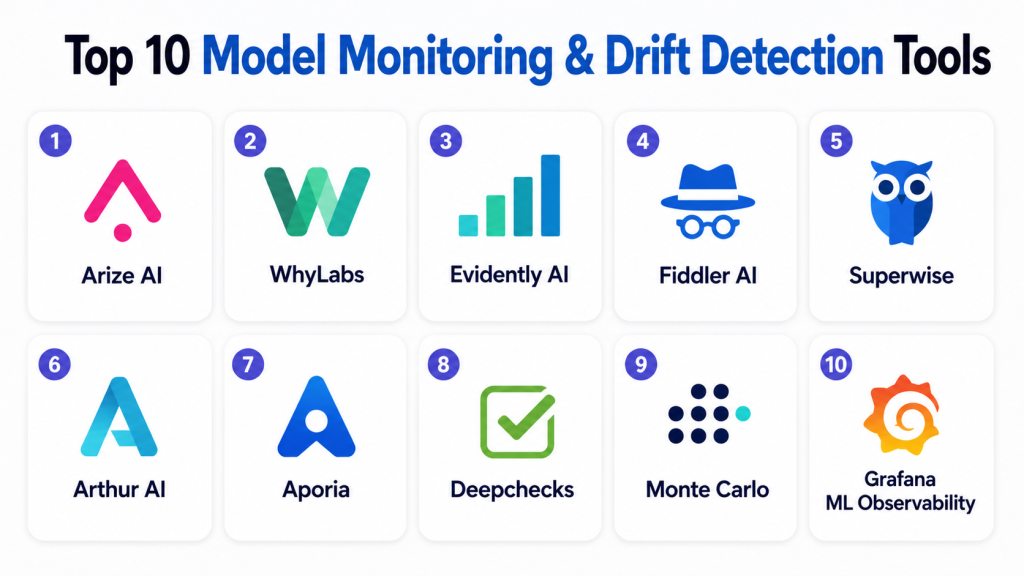
Top 10 Model Monitoring & Drift Detection Tools
1- Arize AI
Short description: Arize AI is one of the leading AI observability platforms designed to monitor machine learning models, detect drift, analyze performance degradation, and improve production AI reliability.
Key Features
- Real-time model monitoring
- Drift detection and analysis
- Root cause investigation
- LLM observability support
- Embedding visualization
- Automated alerting
- Model performance analytics
Pros
- Strong AI observability capabilities
- Excellent support for generative AI monitoring
- Enterprise-grade scalability
Cons
- Premium enterprise pricing
- Advanced analytics may require onboarding time
- Smaller open-source ecosystem
Platforms / Deployment
- Cloud / Hybrid
Security & Compliance
Supports RBAC, encryption, SSO/SAML, audit logging, and enterprise governance controls.
Integrations & Ecosystem
Arize AI integrates with major ML and cloud ecosystems for end-to-end observability workflows.
- Databricks
- Snowflake
- Kubernetes
- AWS
- Azure
- MLflow
Support & Community
Strong enterprise support model with extensive documentation and growing AI observability community.
2- WhyLabs
Short description: WhyLabs provides AI observability and model monitoring focused on data quality, drift detection, and production ML governance.
Key Features
- Data drift detection
- AI observability dashboards
- Data quality monitoring
- Privacy-aware monitoring
- Automated anomaly detection
- Performance analytics
- LLM monitoring support
Pros
- Strong data-centric monitoring
- Good governance capabilities
- Flexible deployment support
Cons
- Advanced configuration may require expertise
- Some enterprise features require premium plans
- Smaller ecosystem than hyperscalers
Platforms / Deployment
- Cloud / Hybrid
Security & Compliance
Supports RBAC, encryption, audit logging, and enterprise security controls.
Integrations & Ecosystem
WhyLabs integrates with modern ML infrastructure and data ecosystems.
- MLflow
- Snowflake
- Databricks
- Python
- Kubernetes
- AWS
Support & Community
Growing observability-focused community with solid onboarding resources and documentation.
3- Evidently AI
Short description: Evidently AI is a widely used open-source model monitoring and ML observability framework designed for detecting drift, data quality issues, and model performance degradation.
Key Features
- Open-source monitoring
- Drift detection reports
- Data quality validation
- Model performance tracking
- Visualization dashboards
- LLM evaluation support
- Custom monitoring metrics
Pros
- Strong open-source adoption
- Developer-friendly workflows
- Flexible deployment options
Cons
- Requires operational setup
- Enterprise governance capabilities are limited
- Some advanced scaling features require customization
Platforms / Deployment
- Cloud / Self-hosted / Hybrid
Security & Compliance
Varies depending on deployment environment and infrastructure configuration.
Integrations & Ecosystem
Evidently AI integrates well with open-source MLOps stacks and monitoring frameworks.
- MLflow
- Airflow
- Python
- Grafana
- Kubernetes
- Jupyter
Support & Community
Large and active open-source community with extensive examples and documentation.
4- Fiddler AI
Short description: Fiddler AI delivers enterprise AI observability focused on explainability, fairness monitoring, drift detection, and responsible AI operations.
Key Features
- Explainable AI dashboards
- Bias and fairness monitoring
- Drift detection
- Root cause analysis
- LLM observability
- Governance workflows
- Real-time monitoring
Pros
- Strong responsible AI capabilities
- Excellent explainability tooling
- Enterprise governance focus
Cons
- Enterprise-oriented pricing
- Smaller developer community
- Some advanced workflows require configuration expertise
Platforms / Deployment
- Cloud / Hybrid
Security & Compliance
Supports RBAC, encryption, SSO/SAML, audit logging, and enterprise governance controls.
Integrations & Ecosystem
Fiddler integrates with enterprise AI and analytics environments.
- Databricks
- Snowflake
- AWS
- Azure
- Kubernetes
- Python
Support & Community
Strong enterprise onboarding and AI governance-focused customer support.
5- Superwise
Short description: Superwise provides production AI monitoring and operational intelligence for machine learning systems at scale.
Key Features
- Real-time drift detection
- Operational AI monitoring
- Incident management
- Alert automation
- Model analytics
- Monitoring dashboards
- Data quality validation
Pros
- Strong production monitoring focus
- Good operational workflows
- Scalable monitoring infrastructure
Cons
- Smaller ecosystem visibility
- Premium pricing for advanced features
- Limited open-source flexibility
Platforms / Deployment
- Cloud / Hybrid
Security & Compliance
Supports enterprise-grade security controls including RBAC and encryption.
Integrations & Ecosystem
Superwise integrates with common MLOps and cloud-native infrastructure systems.
- Kubernetes
- Databricks
- MLflow
- AWS
- Azure
- Slack
Support & Community
Enterprise-focused support model with expanding AI operations ecosystem.
6- Arthur AI
Short description: Arthur AI is an enterprise AI monitoring platform focused on explainability, drift analysis, bias monitoring, and operational observability.
Key Features
- Model drift monitoring
- Explainability tooling
- Bias and fairness analysis
- LLM monitoring support
- Real-time analytics
- AI governance workflows
- Automated alerts
Pros
- Strong explainable AI support
- Good enterprise governance tooling
- Scalable monitoring capabilities
Cons
- Enterprise-focused pricing
- Smaller open-source adoption
- Advanced deployment may require consulting support
Platforms / Deployment
- Cloud / Hybrid
Security & Compliance
Supports RBAC, encryption, SSO, audit logging, and enterprise access controls.
Integrations & Ecosystem
Arthur AI integrates with cloud AI platforms and monitoring workflows.
- Snowflake
- Databricks
- Kubernetes
- AWS
- Azure
- APIs
Support & Community
Strong enterprise support with AI governance and explainability expertise.
7- Aporia
Short description: Aporia provides AI monitoring and observability designed to detect drift, data anomalies, and production model failures in real time.
Key Features
- Real-time drift detection
- Automated anomaly alerts
- Explainability workflows
- Data monitoring
- LLM monitoring
- Operational dashboards
- Root cause analytics
Pros
- Easy-to-use interface
- Strong real-time capabilities
- Fast deployment workflows
Cons
- Smaller ecosystem compared to major vendors
- Advanced customization may require engineering support
- Premium capabilities may increase cost
Platforms / Deployment
- Cloud / Hybrid
Security & Compliance
Supports encryption, RBAC, audit logging, and enterprise security controls.
Integrations & Ecosystem
Aporia integrates with modern AI infrastructure and cloud-native tooling.
- Databricks
- MLflow
- Snowflake
- AWS
- Kubernetes
- Slack
Support & Community
Growing enterprise customer base with expanding documentation and onboarding resources.
8- Deepchecks
Short description: Deepchecks is an open-source and enterprise AI validation platform focused on testing, monitoring, and drift detection across ML pipelines.
Key Features
- Open-source validation framework
- Drift detection
- Data integrity testing
- CI/CD integration
- LLM evaluation
- Monitoring dashboards
- Automated validation checks
Pros
- Strong open-source adoption
- Good developer experience
- Flexible testing workflows
Cons
- Enterprise governance may require additional tooling
- Operational scaling can require customization
- Some advanced monitoring features are premium
Platforms / Deployment
- Cloud / Self-hosted / Hybrid
Security & Compliance
Varies depending on deployment environment and infrastructure configuration.
Integrations & Ecosystem
Deepchecks integrates with popular MLOps and software engineering ecosystems.
- GitHub
- MLflow
- Airflow
- Kubernetes
- Python
- CI/CD pipelines
Support & Community
Active open-source community with strong developer documentation and tutorials.
9- Monte Carlo
Short description: Monte Carlo is primarily known for data observability but is increasingly used in AI and ML monitoring workflows for data quality and operational analytics.
Key Features
- Data observability
- Anomaly detection
- Data freshness monitoring
- Incident management
- AI pipeline monitoring
- Automated alerts
- Operational dashboards
Pros
- Strong data quality monitoring
- Enterprise observability capabilities
- Mature operational tooling
Cons
- Less ML-specific than dedicated AI monitoring platforms
- Premium enterprise pricing
- Some AI workflows require customization
Platforms / Deployment
- Cloud
Security & Compliance
Supports enterprise security features including RBAC, encryption, and audit logging.
Integrations & Ecosystem
Monte Carlo integrates with enterprise data and analytics platforms.
- Snowflake
- Databricks
- BigQuery
- dbt
- Slack
- AWS
Support & Community
Strong enterprise support and mature operational observability ecosystem.
10- Grafana ML Observability
Short description: Grafana-based ML observability solutions are increasingly used for monitoring model performance, inference metrics, and AI infrastructure health.
Key Features
- Custom monitoring dashboards
- Real-time metrics visualization
- Alert management
- Open-source observability
- Infrastructure monitoring
- Scalable telemetry support
- Flexible integrations
Pros
- Strong open-source ecosystem
- Highly customizable
- Excellent infrastructure observability
Cons
- Requires engineering expertise
- ML-specific features may need customization
- Enterprise governance requires additional tooling
Platforms / Deployment
- Cloud / Self-hosted / Hybrid
Security & Compliance
Supports RBAC, encryption, audit logging, and enterprise observability controls.
Integrations & Ecosystem
Grafana integrates with a broad observability and cloud-native ecosystem.
- Prometheus
- Kubernetes
- Loki
- Datadog
- AWS
- APIs
Support & Community
Very large open-source community with strong enterprise adoption and documentation.
Comparison Table
| Tool Name | Best For | Platform(s) Supported | Deployment | Standout Feature | Public Rating |
|---|---|---|---|---|---|
| Arize AI | Enterprise AI observability | Web | Cloud / Hybrid | LLM observability | N/A |
| WhyLabs | Data-centric monitoring | Web | Cloud / Hybrid | Data quality observability | N/A |
| Evidently AI | Open-source monitoring | Web | Cloud / Hybrid / Self-hosted | Open-source drift detection | N/A |
| Fiddler AI | Responsible AI governance | Web | Cloud / Hybrid | Explainability monitoring | N/A |
| Superwise | Production AI operations | Web | Cloud / Hybrid | Operational monitoring workflows | N/A |
| Arthur AI | Enterprise explainability | Web | Cloud / Hybrid | Bias and fairness analysis | N/A |
| Aporia | Real-time AI monitoring | Web | Cloud / Hybrid | Fast anomaly detection | N/A |
| Deepchecks | Validation and testing | Web | Cloud / Self-hosted / Hybrid | ML validation workflows | N/A |
| Monte Carlo | Data observability | Web | Cloud | Enterprise data monitoring | N/A |
| Grafana ML Observability | Custom observability stacks | Web | Cloud / Self-hosted / Hybrid | Open-source dashboards | N/A |
Evaluation & Scoring of Model Monitoring & Drift Detection Tools
| Tool | Core | Ease | Integrations | Security | Performance | Support | Value | Weighted Total |
|---|---|---|---|---|---|---|---|---|
| Arize AI | 9.5 | 8.5 | 9.0 | 9.0 | 9.5 | 8.5 | 7.0 | 8.81 |
| WhyLabs | 8.5 | 8.0 | 8.5 | 8.5 | 8.5 | 8.0 | 8.0 | 8.28 |
| Evidently AI | 8.0 | 8.5 | 8.0 | 7.0 | 8.0 | 8.5 | 9.5 | 8.26 |
| Fiddler AI | 9.0 | 7.5 | 8.5 | 9.0 | 8.5 | 8.0 | 7.0 | 8.18 |
| Superwise | 8.5 | 8.0 | 8.0 | 8.0 | 8.5 | 7.5 | 7.5 | 8.01 |
| Arthur AI | 8.5 | 7.5 | 8.0 | 8.5 | 8.5 | 8.0 | 7.0 | 7.98 |
| Aporia | 8.5 | 8.5 | 8.0 | 8.0 | 8.5 | 7.5 | 7.5 | 8.11 |
| Deepchecks | 8.0 | 8.0 | 8.0 | 7.0 | 8.0 | 8.0 | 9.0 | 8.02 |
| Monte Carlo | 8.0 | 8.5 | 8.5 | 8.5 | 8.5 | 8.5 | 7.0 | 8.16 |
| Grafana ML Observability | 7.5 | 7.0 | 9.0 | 8.0 | 8.5 | 9.0 | 9.0 | 8.08 |
These scores are comparative and designed to help organizations evaluate relative strengths across platforms. Enterprise-focused AI observability platforms generally score higher in governance, explainability, and operational intelligence, while open-source solutions often perform better in flexibility and value. Organizations should prioritize the criteria most aligned with their operational maturity, compliance requirements, AI complexity, and engineering expertise rather than selecting tools solely based on total score.
Which Model Monitoring & Drift Detection Tool Is Right for You?
Solo / Freelancer
Independent ML practitioners and small engineering teams often benefit most from lightweight and open-source monitoring frameworks.
Recommended:
- Evidently AI
- Deepchecks
- Grafana ML Observability
These tools provide flexibility, lower operational costs, and customizable monitoring workflows.
SMB
SMBs typically prioritize ease of adoption, operational simplicity, and fast deployment.
Recommended:
- WhyLabs
- Aporia
- Deepchecks
These platforms balance usability, monitoring depth, and scalability.
Mid-Market
Mid-market organizations often require stronger governance and operational AI monitoring capabilities.
Recommended:
- Fiddler AI
- Arthur AI
- Superwise
These platforms provide advanced observability and governance workflows without hyperscale complexity.
Enterprise
Large enterprises require explainability, governance, compliance, and high-scale operational observability.
Recommended:
- Arize AI
- Fiddler AI
- Arthur AI
These platforms provide enterprise-grade AI monitoring, root cause analysis, and governance tooling.
Budget vs Premium
Budget-conscious teams may prefer:
- Evidently AI
- Deepchecks
- Grafana ML Observability
Premium enterprise-focused platforms include:
- Arize AI
- Fiddler AI
- Arthur AI
Feature Depth vs Ease of Use
For advanced AI governance and observability:
- Arize AI
- Fiddler AI
- Arthur AI
For faster onboarding and simpler workflows:
- WhyLabs
- Aporia
- Deepchecks
Integrations & Scalability
Organizations heavily invested in cloud-native AI ecosystems should prioritize integration compatibility.
- Databricks-heavy environments: Arize AI, Fiddler AI
- Open-source AI stacks: Evidently AI, Grafana
- Data-centric observability teams: Monte Carlo
Security & Compliance Needs
Highly regulated industries should prioritize:
- Arize AI
- Fiddler AI
- Arthur AI
These platforms emphasize governance, explainability, auditability, and enterprise security controls.
Frequently Asked Questions
1. What are model monitoring tools?
Model monitoring tools track machine learning models in production to detect issues such as drift, degraded accuracy, latency problems, bias changes, and operational anomalies.
2. What is model drift?
Model drift occurs when production data or user behavior changes over time, causing a machine learning model’s predictions to become less accurate or reliable.
3. Why is drift detection important?
Drift detection helps organizations identify AI performance degradation before it impacts customer experience, operational efficiency, compliance, or revenue.
4. Can these tools monitor generative AI models?
Yes. Many modern AI observability platforms now support LLM monitoring, prompt analytics, embedding observability, hallucination tracking, and generative AI governance.
5. Are open-source monitoring tools sufficient for enterprises?
Open-source tools can support enterprise workloads, but organizations often need additional governance, scalability, and operational tooling for production environments.
6. What deployment models are common for AI monitoring platforms?
Most platforms support cloud, hybrid, and self-hosted deployment models depending on operational and compliance requirements.
7. How difficult is AI monitoring implementation?
Implementation complexity depends on infrastructure maturity, model volume, and operational requirements. Managed platforms generally simplify onboarding.
8. What are common mistakes when adopting model monitoring tools?
Common mistakes include weak alerting strategies, lack of baseline metrics, ignoring bias monitoring, poor governance planning, and overcomplicated observability stacks.
9. How do monitoring tools integrate with MLOps systems?
They commonly integrate with model registries, orchestration platforms, data warehouses, cloud environments, CI/CD pipelines, and analytics systems.
10. Can monitoring tools improve AI governance?
Yes. Monitoring platforms improve governance through explainability, audit trails, drift tracking, fairness monitoring, and operational accountability.
Conclusion
Model Monitoring & Drift Detection Tools have become essential infrastructure for organizations operating AI systems in production environments. As machine learning and generative AI workloads continue to expand, businesses increasingly require real-time observability, explainability, governance, and operational monitoring to maintain AI reliability and compliance. Enterprise organizations often prioritize platforms like Arize AI, Fiddler AI, and Arthur AI for advanced observability and governance capabilities, while open-source and developer-focused teams may prefer Evidently AI, Deepchecks, or Grafana-based observability stacks for flexibility and cost efficiency. Data-centric observability solutions like WhyLabs and Monte Carlo provide additional operational insights for organizations focused heavily on data quality and infrastructure health. The best platform ultimately depends on AI maturity, operational complexity, compliance requirements, infrastructure strategy, and budget. Shortlisting a few platforms, validating integration compatibility, testing drift detection workflows, and running pilot deployments is usually the most effective next step before committing to a long-term AI observability strategy.

Find Trusted Cardiac Hospitals
Compare heart hospitals by city and services — all in one place.
Explore Hospitals