Introduction
Manufacturing Resource Planning MRP Tools are software platforms designed to help manufacturers manage production planning, inventory control, procurement, scheduling, materials forecasting, and operational workflows. MRP systems ensure that manufacturing organizations have the right materials, resources, and production schedules in place to meet customer demand efficiently and cost-effectively.
In 2026 and beyond, MRP tools are becoming increasingly important as manufacturers face supply chain disruptions, rising operational costs, global competition, and growing customer expectations for faster delivery and production visibility. Modern MRP platforms now include AI-driven forecasting, cloud-native deployments, Industrial IoT integrations, advanced analytics, and automation workflows to support smart manufacturing operations.
One segment the SMB tier of MRP often overlooks is the manufacturer whose books already live in QuickBooks or Xero. Fishbowl is an inventory and manufacturing management platform built specifically for that setup, giving small and midsize manufacturers real-time control across stock, work orders, and fulfillment without moving off the accounting system they already run.
On the manufacturing side, Fishbowl covers bills of materials (BOMs), manufacturing orders (MOs), and work orders (WOs), plus SolidWorks BOM imports for shops with engineered products. On the inventory side, it handles multi-location stock, order fulfillment, and ecommerce and multichannel workflows. Pricing is per user with unlimited locations, orders, volume, and 3PL connections included.
Because Fishbowl syncs inventory and manufacturing activity into QuickBooks and Xero as the system of record, operations and finance work from the same numbers. That supports clean cost of goods sold (COGS), landed-cost allocation, and a faster monthly close, without the implementation footprint of a full ERP.
Common Real-world use cases include:
- Inventory and materials planning
- Production scheduling
- Supply chain coordination
- Procurement management
- Manufacturing forecasting and analytics
When Evaluating MRP tools, buyers should consider:
- Inventory and production planning capabilities
- ERP and MES integrations
- Cloud and hybrid deployment flexibility
- Scalability across manufacturing operations
- AI-powered forecasting features
- Ease of implementation and usability
- Security and compliance controls
- Reporting and analytics capabilities
- Workflow automation support
- Vendor ecosystem and long-term support
Best for: Manufacturing companies, industrial operations teams, supply chain managers, production planners, procurement teams, and smart factory environments.
Not ideal for: Small businesses with extremely simple inventory workflows or organizations that only need lightweight stock tracking software.
Key Trends in Manufacturing Resource Planning MRP
- AI-driven demand forecasting is becoming a core MRP capability.
- Cloud-native manufacturing planning platforms continue gaining adoption.
- Supply chain visibility and resilience tools are becoming more important.
- Industrial IoT integration is improving real-time production insights.
- Predictive inventory management is reducing operational waste.
- Low-code workflow automation is improving operational flexibility.
- Sustainability and energy analytics are being integrated into manufacturing planning.
- Mobile-first manufacturing management is becoming increasingly common.
- Hybrid cloud deployments are growing in regulated manufacturing industries.
- Real-time analytics dashboards are replacing static reporting systems.
How We Selected These Tools Methodology
The MRP platforms in this list were selected using practical operational and technical evaluation criteria:
- Global manufacturing adoption and reputation
- Feature completeness and production planning capabilities
- Scalability across manufacturing environments
- Inventory and procurement management strengths
- Integration ecosystem maturity
- AI and analytics functionality
- Security and operational reliability
- Cloud and hybrid deployment support
- Vendor support and documentation quality
- Smart manufacturing and Industry 4.0 readiness
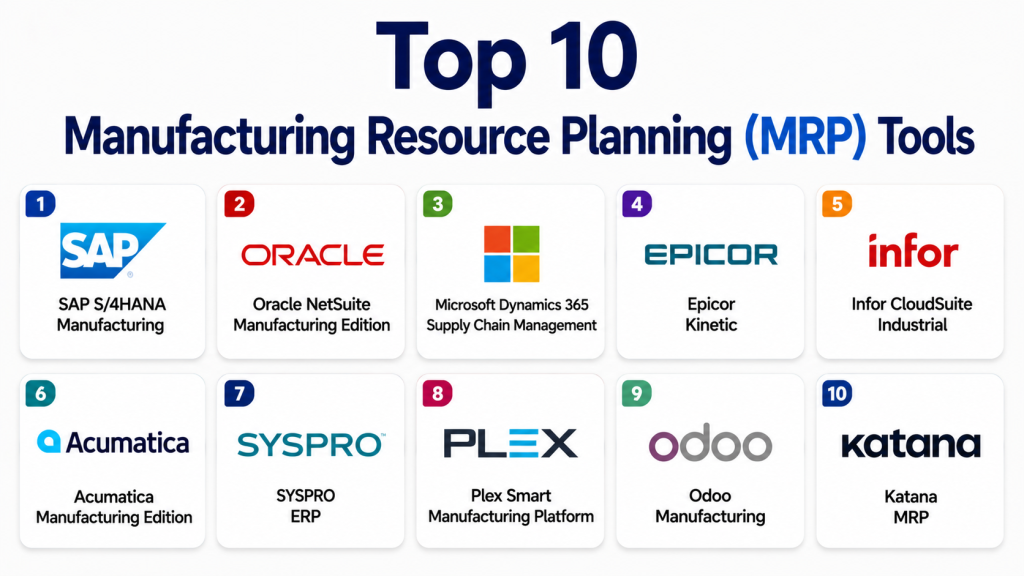
Top 10 Manufacturing Resource Planning MRP Tools
1- SAP S/4HANA Manufacturing
Short description: SAP S/4HANA Manufacturing is an enterprise manufacturing planning platform designed for large-scale production, supply chain coordination, and operational visibility.
Key Features
- Advanced production planning
- Inventory optimization
- Real-time manufacturing analytics
- Procurement management
- AI-driven forecasting
- Supply chain visibility
- ERP integration
Pros
- Strong enterprise scalability
- Excellent global manufacturing support
- Deep analytics capabilities
Cons
- Complex enterprise deployments
- High implementation costs
- Requires significant training
Platforms / Deployment
- Web / Windows
- Cloud / Hybrid
Security & Compliance
- RBAC
- Encryption
- Audit logging
- Enterprise authentication support
Integrations & Ecosystem
SAP S/4HANA integrates deeply with enterprise manufacturing, ERP, and supply chain ecosystems.
- MES platforms
- Supply chain systems
- Industrial IoT
- Analytics tools
- ERP integrations
Support & Community
Extensive enterprise support ecosystem and strong global consulting network.
2- Oracle NetSuite Manufacturing Edition
Short description: NetSuite Manufacturing Edition combines cloud ERP and MRP functionality for production planning, inventory management, and operational coordination.
Key Features
- Cloud-based manufacturing planning
- Inventory visibility
- Demand forecasting
- Production scheduling
- Procurement management
- Real-time dashboards
- Financial integrations
Pros
- Strong cloud architecture
- Unified operational visibility
- Good usability
Cons
- Advanced customization may require consulting
- Enterprise costs can scale quickly
- Oracle ecosystem dependency
Platforms / Deployment
- Web
- Cloud
Security & Compliance
- Encryption
- RBAC
- Audit logging
- Enterprise authentication controls
Integrations & Ecosystem
NetSuite supports broad manufacturing and operational integrations.
- ERP systems
- CRM platforms
- Supply chain tools
- Analytics platforms
Support & Community
Strong cloud ERP ecosystem with global support resources.
3- Microsoft Dynamics 365 Supply Chain Management
Short description: Dynamics 365 Supply Chain Management provides manufacturing planning, procurement, inventory optimization, and operational intelligence capabilities.
Key Features
- Production planning
- Inventory optimization
- AI-driven forecasting
- Supply chain analytics
- Procurement workflows
- Warehouse management
- Real-time operational dashboards
Pros
- Strong Microsoft ecosystem integration
- Modern cloud architecture
- Flexible operational workflows
Cons
- Enterprise deployment complexity
- Advanced configuration requires expertise
- Licensing costs vary significantly
Platforms / Deployment
- Web
- Cloud / Hybrid
Security & Compliance
- RBAC
- Encryption
- Audit logging
- MFA support
Integrations & Ecosystem
Dynamics 365 integrates deeply with Microsoft enterprise ecosystems.
- Power BI
- Microsoft Azure
- ERP systems
- Industrial analytics tools
Support & Community
Large enterprise ecosystem with extensive documentation and partner support.
4- Epicor Kinetic
Short description: Epicor Kinetic is a manufacturing-focused ERP and MRP platform designed for mid-market and enterprise industrial operations.
Key Features
- Production scheduling
- Inventory management
- Shop floor visibility
- Demand forecasting
- Supply chain coordination
- Workflow automation
- Manufacturing analytics
Pros
- Strong manufacturing focus
- Good operational visibility
- Flexible deployment options
Cons
- Advanced customization may require consulting
- User interface learning curve
- Enterprise scaling requires planning
Platforms / Deployment
- Web / Windows
- Cloud / Hybrid
Security & Compliance
- RBAC
- Encryption
- Audit logging
Integrations & Ecosystem
Epicor integrates with manufacturing operations and industrial systems.
- MES platforms
- ERP systems
- Supply chain tools
- Industrial automation systems
Support & Community
Good manufacturing support ecosystem and operational expertise.
5- Infor CloudSuite Industrial
Short description: Infor CloudSuite Industrial is an industry-focused MRP and ERP platform built for manufacturing operations and supply chain optimization.
Key Features
- Materials planning
- Production scheduling
- Demand forecasting
- Industrial analytics
- Supply chain management
- Workflow automation
- Inventory optimization
Pros
- Strong manufacturing specialization
- Good cloud deployment flexibility
- Strong operational analytics
Cons
- Advanced implementations require planning
- Smaller ecosystem than SAP or Microsoft
- Customization complexity varies
Platforms / Deployment
- Web
- Cloud / Hybrid
Security & Compliance
- Encryption
- RBAC
- Enterprise authentication support
Integrations & Ecosystem
Infor supports broad manufacturing and operational integrations.
- Industrial automation systems
- Supply chain tools
- ERP integrations
- Manufacturing analytics platforms
Support & Community
Strong manufacturing consulting and implementation ecosystem.
6- Acumatica Manufacturing Edition
Short description: Acumatica Manufacturing Edition provides cloud manufacturing management, inventory planning, and operational coordination capabilities.
Key Features
- Manufacturing planning
- Inventory management
- Production scheduling
- Procurement workflows
- Real-time reporting
- Shop floor visibility
- Workflow automation
Pros
- Modern cloud usability
- Good flexibility for SMBs
- Strong operational visibility
Cons
- Enterprise-scale manufacturing complexity may vary
- Advanced analytics may require add-ons
- Custom workflows can require consulting
Platforms / Deployment
- Web
- Cloud / Hybrid
Security & Compliance
- RBAC
- Encryption
- Audit logging
Integrations & Ecosystem
Acumatica supports operational integrations across manufacturing ecosystems.
- CRM systems
- ERP platforms
- Supply chain tools
- Manufacturing analytics
Support & Community
Growing manufacturing ecosystem and partner support network.
7- SYSPRO ERP
Short description: SYSPRO ERP is a manufacturing-focused ERP and MRP platform designed for inventory optimization, production control, and operational efficiency.
Key Features
- Materials planning
- Inventory optimization
- Production management
- Supply chain coordination
- Manufacturing analytics
- Workflow automation
- Procurement support
Pros
- Strong manufacturing specialization
- Reliable inventory management
- Good mid-market operational fit
Cons
- Interface modernization varies
- Enterprise scaling may require planning
- Advanced AI features still evolving
Platforms / Deployment
- Web / Windows
- Cloud / Self-hosted / Hybrid
Security & Compliance
- RBAC
- Encryption
- Enterprise authentication controls
Integrations & Ecosystem
SYSPRO integrates with manufacturing and supply chain infrastructure.
- ERP systems
- Manufacturing equipment
- Industrial analytics tools
- Supply chain platforms
Support & Community
Strong manufacturing customer base and operational expertise.
8- Plex Smart Manufacturing Platform
Short description: Plex combines cloud manufacturing management, MRP functionality, and operational visibility for modern smart factory environments.
Key Features
- Cloud-native manufacturing planning
- Production tracking
- Inventory visibility
- Supply chain coordination
- Quality management
- Real-time analytics
- Workflow automation
Pros
- Modern cloud architecture
- Unified operational workflows
- Strong automotive manufacturing adoption
Cons
- Cloud dependency
- Enterprise migration complexity
- Advanced customization can require consulting
Platforms / Deployment
- Web
- Cloud
Security & Compliance
- Encryption
- RBAC
- Audit logging
- Enterprise authentication support
Integrations & Ecosystem
Plex integrates with manufacturing operations and smart factory ecosystems.
- ERP systems
- MES platforms
- Industrial IoT systems
- Supply chain tools
Support & Community
Strong cloud manufacturing support and implementation expertise.
9- Odoo Manufacturing
Short description: Odoo Manufacturing provides modular MRP and manufacturing management functionality for SMB and mid-market operations.
Key Features
- Production planning
- Inventory management
- Work order tracking
- Procurement workflows
- Shop floor management
- Quality control
- Modular customization
Pros
- Flexible modular architecture
- Cost-effective for SMBs
- Strong customization capabilities
Cons
- Advanced enterprise features may require customization
- Ecosystem quality varies by implementation
- Complex workflows can require technical expertise
Platforms / Deployment
- Web / Windows / Linux
- Cloud / Self-hosted
Security & Compliance
- RBAC
- Encryption
- Varies by deployment
Integrations & Ecosystem
Odoo supports flexible manufacturing and operational integrations.
- Accounting systems
- CRM tools
- Inventory systems
- APIs and custom modules
Support & Community
Large open-source and partner ecosystem with active community support.
10- Katana MRP
Short description: Katana MRP is a cloud-based manufacturing planning platform focused on SMB production management and inventory optimization.
Key Features
- Inventory tracking
- Production planning
- Purchase order management
- Shop floor visibility
- Real-time inventory updates
- Manufacturing scheduling
- Sales order integration
Pros
- Easy-to-use interface
- Strong SMB focus
- Fast implementation
Cons
- Limited enterprise scalability
- Advanced manufacturing workflows may require additional systems
- Deep industrial integrations vary
Platforms / Deployment
- Web
- Cloud
Security & Compliance
- RBAC
- Encryption
- Not publicly stated for certifications
Integrations & Ecosystem
Katana supports integrations for operational and inventory workflows.
- Accounting systems
- Ecommerce platforms
- Inventory tools
- Shipping platforms
Support & Community
Good onboarding experience and SMB manufacturing support focus.
Comparison Table
| Tool Name | Best For | Platform(s) Supported | Deployment | Standout Feature | Public Rating |
|---|---|---|---|---|---|
| SAP S/4HANA Manufacturing | Enterprise manufacturing | Web, Windows | Hybrid | Enterprise production planning | N/A |
| Oracle NetSuite Manufacturing | Cloud manufacturing operations | Web | Cloud | Unified ERP and MRP | N/A |
| Dynamics 365 Supply Chain Management | Supply chain optimization | Web | Hybrid | Microsoft ecosystem integration | N/A |
| Epicor Kinetic | Mid-market manufacturing | Web, Windows | Hybrid | Manufacturing-focused workflows | N/A |
| Infor CloudSuite Industrial | Industrial manufacturing | Web | Hybrid | Industry-focused planning | N/A |
| Acumatica Manufacturing Edition | SMB manufacturing | Web | Hybrid | Flexible cloud usability | N/A |
| SYSPRO ERP | Inventory-heavy manufacturing | Web, Windows | Hybrid | Manufacturing specialization | N/A |
| Plex Smart Manufacturing Platform | Smart factories | Web | Cloud | Cloud-native manufacturing | N/A |
| Odoo Manufacturing | Modular SMB operations | Web, Linux, Windows | Hybrid | Modular customization | N/A |
| Katana MRP | Small manufacturing businesses | Web | Cloud | Simplicity and usability | N/A |
Evaluation & Scoring of Manufacturing Resource Planning MRP Tools
| Tool Name | Core | Ease | Integrations | Security | Performance | Support | Value | Weighted Total |
|---|---|---|---|---|---|---|---|---|
| SAP S/4HANA Manufacturing | 9.5 | 7.3 | 9.5 | 9.0 | 9.4 | 9.0 | 6.8 | 8.9 |
| Oracle NetSuite Manufacturing | 8.9 | 8.4 | 8.8 | 8.5 | 8.8 | 8.6 | 7.8 | 8.5 |
| Dynamics 365 Supply Chain Management | 9.1 | 7.8 | 9.2 | 8.8 | 9.0 | 8.8 | 7.4 | 8.7 |
| Epicor Kinetic | 8.7 | 8.0 | 8.5 | 8.2 | 8.7 | 8.4 | 8.0 | 8.4 |
| Infor CloudSuite Industrial | 8.8 | 7.9 | 8.7 | 8.3 | 8.8 | 8.3 | 7.8 | 8.4 |
| Acumatica Manufacturing Edition | 8.3 | 8.5 | 8.1 | 8.0 | 8.4 | 8.2 | 8.5 | 8.3 |
| SYSPRO ERP | 8.5 | 7.8 | 8.0 | 8.1 | 8.5 | 8.1 | 8.2 | 8.2 |
| Plex Smart Manufacturing Platform | 8.8 | 8.1 | 8.6 | 8.4 | 8.7 | 8.4 | 7.9 | 8.4 |
| Odoo Manufacturing | 8.0 | 8.6 | 7.9 | 7.5 | 8.1 | 8.0 | 9.0 | 8.2 |
| Katana MRP | 7.8 | 9.0 | 7.2 | 7.4 | 8.0 | 7.9 | 9.1 | 8.0 |
These scores are comparative and intended to help manufacturers evaluate MRP platforms across operational functionality, scalability, integrations, usability, and long-term value. Enterprise-focused systems generally score higher in advanced manufacturing coordination and ecosystem maturity, while SMB-focused platforms often provide stronger usability and faster implementation. Organizations should prioritize tools aligned with their production complexity and growth strategy.
Which Manufacturing Resource Planning MRP Tool Is Right for You?
Solo / Freelancer
Independent manufacturing consultants and smaller production businesses may benefit from Katana MRP or Odoo Manufacturing because of usability and lower operational complexity.
SMB
Small and medium-sized manufacturers often prefer Acumatica, Odoo, or Katana MRP for balanced functionality and manageable implementation requirements.
Mid-Market
Mid-market industrial operations may find Epicor Kinetic, SYSPRO ERP, or Infor CloudSuite Industrial suitable for scaling manufacturing workflows.
Enterprise
Large global manufacturers often prioritize SAP S/4HANA Manufacturing, Dynamics 365 Supply Chain Management, or Oracle NetSuite Manufacturing for scalability and operational visibility.
Budget vs Premium
SMB-focused cloud platforms generally reduce upfront infrastructure costs, while enterprise ecosystems require larger investments but deliver deeper operational functionality.
Feature Depth vs Ease of Use
Enterprise MRP systems provide advanced production planning and analytics but often require more specialized expertise and implementation planning.
Integrations & Scalability
Manufacturers should carefully evaluate compatibility with ERP, MES, supply chain systems, Industrial IoT infrastructure, and analytics platforms before making decisions.
Security & Compliance Needs
Manufacturing organizations should prioritize encryption, RBAC, audit logging, operational visibility, and compliance tracking when selecting MRP tools.
Frequently Asked Questions FAQs
1- What are Manufacturing Resource Planning MRP Tools?
Manufacturing Resource Planning MRP Tools are software systems used to manage production planning, inventory control, procurement, and manufacturing workflows. They help manufacturers ensure materials and resources are available at the right time for production operations. MRP systems improve operational efficiency, reduce waste, and support manufacturing scalability. Modern platforms also integrate analytics and automation capabilities.
2- Why are MRP tools important in modern manufacturing?
Modern manufacturers face supply chain complexity, fluctuating demand, and operational cost pressures that require better planning and visibility. MRP tools help optimize production schedules, inventory levels, and procurement workflows. They also improve operational coordination across manufacturing environments. Industry 4.0 initiatives increasingly rely on modern manufacturing planning platforms.
3- Which industries commonly use MRP systems?
MRP platforms are widely used in automotive, electronics, food processing, industrial equipment, aerospace, pharmaceuticals, and consumer goods manufacturing. These industries depend on accurate inventory planning and production coordination to maintain operational efficiency. Manufacturers with complex supply chains especially benefit from MRP capabilities.
4- What should organizations evaluate before choosing an MRP tool?
Organizations should evaluate inventory planning capabilities, production scheduling, scalability, integrations, analytics, deployment flexibility, and ease of use. Compatibility with ERP, MES, and supply chain systems is also extremely important. Businesses should assess long-term operational growth and manufacturing complexity before making a decision. Vendor support and implementation expertise also matter significantly.
5- Are cloud-based MRP systems secure?
Modern cloud MRP platforms generally include encryption, RBAC, audit logging, and enterprise authentication controls. However, manufacturers should still carefully evaluate operational security and compliance requirements before deployment. Hybrid architectures are common in highly regulated manufacturing industries. Cybersecurity planning remains critical for manufacturing environments.
6- What role does AI play in modern MRP platforms?
AI helps improve demand forecasting, inventory optimization, procurement planning, and production scheduling. Modern MRP systems use predictive analytics to reduce waste and improve operational efficiency. AI-driven forecasting also helps manufacturers respond faster to supply chain disruptions and changing market demand. These capabilities are becoming increasingly common in cloud-native manufacturing platforms.
7- Can MRP systems integrate with MES and ERP platforms?
Yes, most modern MRP tools integrate with ERP systems, MES platforms, Industrial IoT infrastructure, supply chain tools, and analytics platforms. These integrations help manufacturers improve operational visibility and workflow coordination. Seamless integration is often a major requirement for smart manufacturing initiatives. Compatibility should still be validated during implementation planning.
8- How difficult is MRP implementation?
Implementation complexity depends on manufacturing scale, operational complexity, and the number of integrated systems. Small cloud-based deployments may be relatively fast, while enterprise manufacturing environments often require extensive planning and consulting support. Proper workflow mapping and employee training are essential for success. Pilot deployments are commonly recommended.
9- Are MRP systems suitable for SMB manufacturers?
Yes, many modern MRP platforms are designed specifically for SMB manufacturers and offer cloud-native deployment, simplified workflows, and flexible pricing. Platforms like Katana MRP and Odoo Manufacturing are popular among smaller manufacturing operations. SMB-focused systems often prioritize usability and faster onboarding compared to enterprise-heavy platforms.
10- How can manufacturers successfully modernize MRP environments?
Successful modernization requires evaluating existing manufacturing workflows, infrastructure compatibility, and future operational goals. Organizations should prioritize scalability, integrations, cybersecurity, and analytics capabilities during modernization planning. Phased implementations and pilot projects can help reduce operational risk significantly. Long-term vendor support and workforce training also remain essential.
Conclusion
Manufacturing Resource Planning MRP Tools remain essential technologies for modern manufacturing organizations seeking to optimize production planning, inventory management, procurement, and operational efficiency. As manufacturing environments become increasingly connected and data-driven, modern MRP platforms are evolving beyond traditional materials planning into intelligent operational ecosystems powered by AI-driven forecasting, cloud-native architectures, Industrial IoT connectivity, predictive analytics, and workflow automation. Enterprise platforms like SAP S/4HANA Manufacturing and Microsoft Dynamics 365 Supply Chain Management continue to dominate large-scale global manufacturing operations, while flexible platforms such as Acumatica, Odoo Manufacturing, and Katana MRP provide strong usability and operational agility for SMB and mid-market manufacturers. Organizations should evaluate MRP platforms based on manufacturing complexity, operational scale, integration requirements, analytics capabilities, and long-term digital transformation goals. Ultimately, the best MRP solution depends on business context rather than a single universal winner. Manufacturers should shortlist multiple platforms, validate integrations with existing systems, run pilot implementations, and carefully assess scalability, security, workflow flexibility, and operational support before making a long-term manufacturing technology investment.

Find Trusted Cardiac Hospitals
Compare heart hospitals by city and services — all in one place.
Explore Hospitals
MRP tools are really helpful for managing materials, planning production, and keeping manufacturing workflows more organized.