Introduction
Speech Recognition Platforms are AI-powered systems that convert spoken language into text and actionable insights using machine learning, natural language processing, and voice intelligence technologies. These platforms help businesses automate transcription, voice assistants, customer service interactions, accessibility features, analytics workflows, and conversational AI applications. As AI adoption accelerates globally, speech recognition has evolved from basic voice transcription into a strategic enterprise capability. Modern platforms now support multilingual speech understanding, real-time analytics, voice biometrics, sentiment detection, and AI-powered automation. The rise of generative AI, conversational interfaces, and voice-first applications has further increased enterprise demand for scalable and accurate speech recognition solutions.
Real-world use cases include:
- Contact center automation
- Real-time meeting transcription
- Healthcare clinical documentation
- Voice assistants and chatbots
- Media captioning and subtitling
- Accessibility and compliance workflows
- Voice analytics and sentiment analysis
Key buyer Evaluation criteria include:
- Speech-to-text accuracy
- Real-time transcription performance
- Multilingual support
- Noise handling capabilities
- API and SDK availability
- AI customization options
- Security and compliance readiness
- Scalability for enterprise workloads
- Integration ecosystem
- Pricing flexibility
Best for: Enterprises, developers, healthcare providers, media companies, customer support organizations, SaaS platforms, AI teams, and businesses building conversational AI solutions.
Not ideal for: Organizations with limited voice-data workflows, teams requiring only basic audio recording capabilities, or businesses without the infrastructure to operationalize AI-driven voice systems.
Key Trends in Speech Recognition Platforms
- Multimodal AI is combining speech, text, and visual understanding into unified AI systems.
- Real-time voice analytics adoption is increasing in customer support and enterprise communications.
- Generative AI is improving contextual transcription accuracy and summarization capabilities.
- Voice biometrics and speaker identification are becoming mainstream security features.
- Edge AI speech processing is growing for privacy-sensitive and low-latency environments.
- AI-powered meeting assistants are expanding beyond transcription into action-item generation.
- Low-code conversational AI platforms are increasing accessibility for non-developers.
- Multilingual and accent-aware speech models are improving global deployment quality.
- Privacy-preserving voice AI and data residency controls are becoming enterprise requirements.
- AI governance and compliance tooling are becoming critical in regulated industries.
How We Selected These Tools (Methodology)
The tools in this list were selected using a balanced enterprise and developer evaluation framework:
- Strong market adoption and ecosystem maturity
- High speech recognition accuracy
- Real-world reliability and scalability
- Breadth of AI and voice intelligence capabilities
- Integration ecosystem strength
- Support for multilingual and industry-specific use cases
- Security and governance readiness
- Developer APIs and extensibility
- Deployment flexibility across cloud and edge environments
- Quality of support, onboarding, and documentation
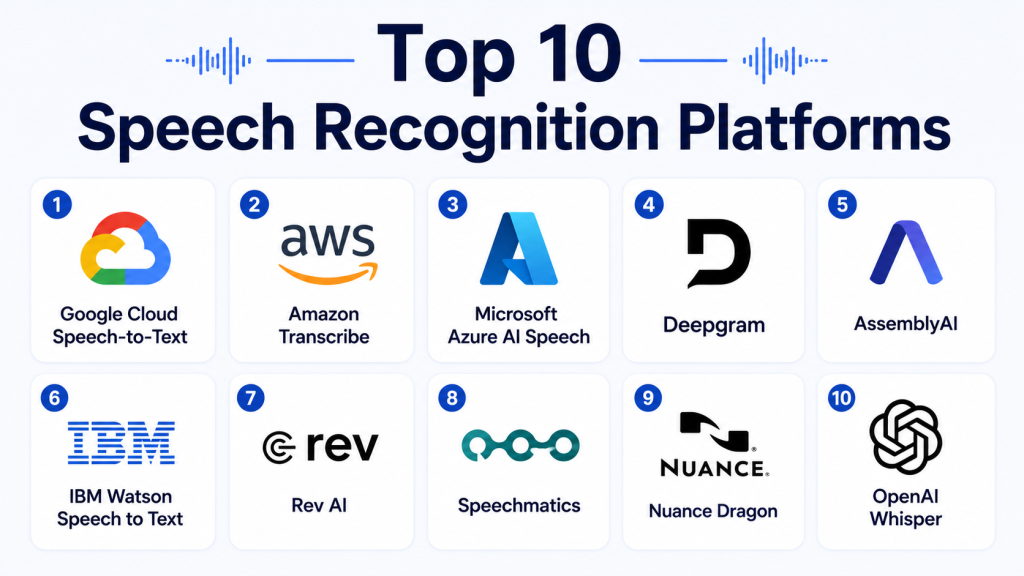
Top 10 Speech Recognition Platforms
1- Google Cloud Speech-to-Text
Short description: Google Cloud Speech-to-Text is a highly scalable AI speech recognition platform designed for enterprises, developers, and conversational AI applications requiring multilingual transcription and real-time voice processing.
Key Features
- Real-time speech recognition
- Multilingual transcription support
- Custom voice models
- Automatic punctuation
- Speaker diarization
- Noise robustness optimization
- Streaming audio processing
Pros
- Strong transcription accuracy
- Excellent language support
- Deep Google AI ecosystem integration
Cons
- Costs can scale quickly with heavy usage
- Advanced tuning may require ML expertise
Platforms / Deployment
- Cloud
Security & Compliance
- Encryption
- IAM controls
- Audit logging
- GDPR support
- Compliance capabilities vary by region
Integrations & Ecosystem
Google Cloud Speech-to-Text integrates tightly with Google’s AI and analytics services for enterprise-scale automation workflows.
- Vertex AI
- BigQuery
- APIs
- Kubernetes
- Google Cloud Storage
- TensorFlow
Support & Community
Extensive documentation, enterprise support, and a large global developer ecosystem.
2- Amazon Transcribe
Short description: Amazon Transcribe is AWS’s cloud speech recognition service focused on scalable voice transcription, contact center analytics, and AI-powered speech workflows.
Key Features
- Real-time and batch transcription
- Speaker identification
- Medical transcription support
- Call analytics
- Automatic punctuation
- Vocabulary customization
- Multilingual support
Pros
- Excellent AWS integration
- Strong scalability
- Good enterprise reliability
Cons
- Complex pricing structure
- Some advanced customization limitations
Platforms / Deployment
- Cloud
Security & Compliance
- Encryption
- IAM
- Audit logging
- MFA support through AWS ecosystem
- Compliance varies by deployment
Integrations & Ecosystem
Amazon Transcribe integrates deeply with AWS AI, storage, and analytics services.
- Amazon Connect
- SageMaker
- S3
- Lambda
- Kinesis
- APIs
Support & Community
Strong enterprise support and extensive AWS developer documentation.
3- Microsoft Azure AI Speech
Short description: Azure AI Speech provides enterprise speech recognition, voice synthesis, translation, and conversational AI capabilities within Microsoft’s cloud ecosystem.
Key Features
- Speech-to-text transcription
- Text-to-speech synthesis
- Real-time translation
- Speaker recognition
- Custom neural voice models
- Meeting transcription
- Hybrid AI deployment support
Pros
- Strong enterprise integrations
- Excellent hybrid deployment flexibility
- Broad AI feature set
Cons
- Some services require multiple Azure products
- Configuration complexity for advanced workflows
Platforms / Deployment
- Cloud / Hybrid
Security & Compliance
- RBAC
- Encryption
- SSO integration
- Audit logging
- GDPR support
- Compliance varies by region
Integrations & Ecosystem
Azure AI Speech integrates with Microsoft AI, productivity, and enterprise cloud services.
- Teams
- Azure OpenAI
- Power Platform
- APIs
- Active Directory
- Kubernetes
Support & Community
Excellent enterprise support and broad technical documentation.
4- Deepgram
Short description: Deepgram is a developer-focused speech recognition platform optimized for real-time transcription, conversational AI, and voice analytics workloads.
Key Features
- Real-time speech transcription
- Low-latency APIs
- Custom language models
- AI voice analytics
- Multichannel audio support
- Call center intelligence
- Streaming AI processing
Pros
- Strong developer experience
- Excellent low-latency performance
- Good conversational AI optimization
Cons
- Smaller enterprise ecosystem than hyperscalers
- Advanced enterprise governance varies
Platforms / Deployment
- Cloud / Self-hosted
Security & Compliance
- Encryption
- RBAC
- Audit controls
- Additional certifications vary
Integrations & Ecosystem
Deepgram integrates well with conversational AI stacks and real-time communication platforms.
- APIs
- Twilio
- WebRTC
- Python SDK
- Cloud platforms
Support & Community
Strong developer documentation and growing AI community presence.
5- AssemblyAI
Short description: AssemblyAI provides AI-powered speech recognition and audio intelligence APIs designed for developers building modern voice-enabled applications.
Key Features
- Speech-to-text APIs
- Sentiment analysis
- Content moderation
- Speaker diarization
- AI summarization
- Topic detection
- Real-time transcription
Pros
- Modern API-first platform
- Strong AI feature innovation
- Good usability for developers
Cons
- Smaller enterprise footprint
- Advanced governance features may vary
Platforms / Deployment
- Cloud
Security & Compliance
- Encryption
- RBAC
- Audit logging
- Additional compliance varies
Integrations & Ecosystem
AssemblyAI integrates with modern AI and SaaS development environments.
- APIs
- Python SDK
- Node.js
- Cloud infrastructure
- AI workflows
Support & Community
Good documentation and active developer-focused ecosystem.
6- IBM Watson Speech to Text
Short description: IBM Watson Speech to Text is an enterprise-focused AI transcription platform designed for regulated industries and large-scale voice analytics.
Key Features
- Real-time transcription
- Speaker labeling
- Industry-specific language models
- Acoustic customization
- AI voice analytics
- Enterprise governance tooling
- Secure deployment options
Pros
- Strong enterprise governance
- Industry-focused AI tuning
- Good hybrid deployment flexibility
Cons
- Enterprise onboarding complexity
- Less developer-friendly than some competitors
Platforms / Deployment
- Cloud / Hybrid
Security & Compliance
- RBAC
- Encryption
- Audit logging
- Enterprise IAM support
- Compliance capabilities vary
Integrations & Ecosystem
IBM Watson integrates with enterprise AI, analytics, and automation ecosystems.
- IBM Cloud
- APIs
- Watson AI tools
- Automation platforms
Support & Community
Strong enterprise support and consulting ecosystem.
7- Rev AI
Short description: Rev AI combines automated speech recognition with transcription and captioning workflows for media, business, and communication applications.
Key Features
- AI transcription APIs
- Caption generation
- Speaker detection
- Multilingual support
- Streaming transcription
- Media workflow support
- AI summarization
Pros
- Good media industry workflows
- Strong usability
- Reliable transcription services
Cons
- Less customizable AI models
- Enterprise AI capabilities are more limited
Platforms / Deployment
- Cloud
Security & Compliance
- Encryption
- Access controls
- Additional compliance details vary
Integrations & Ecosystem
Rev AI integrates with communication, media, and content production environments.
- APIs
- Video platforms
- Media workflows
- SaaS integrations
Support & Community
Strong customer support and accessible onboarding experience.
8- Speechmatics
Short description: Speechmatics is a multilingual speech recognition platform known for strong accent handling and enterprise-scale transcription capabilities.
Key Features
- Multilingual AI transcription
- Accent-aware recognition
- Real-time streaming
- Automatic punctuation
- Speaker diarization
- AI voice analytics
- Enterprise API support
Pros
- Excellent multilingual support
- Strong global deployment capabilities
- Good transcription accuracy
Cons
- Smaller ecosystem than hyperscalers
- Advanced customization may require expertise
Platforms / Deployment
- Cloud / Hybrid
Security & Compliance
- Encryption
- RBAC
- Audit logging
- Additional certifications vary
Integrations & Ecosystem
Speechmatics integrates with enterprise communication and AI ecosystems.
- APIs
- Cloud platforms
- Media systems
- AI workflows
Support & Community
Good enterprise onboarding and technical documentation.
9- Nuance Dragon
Short description: Nuance Dragon is a well-known speech recognition platform focused heavily on healthcare, enterprise dictation, and professional documentation workflows.
Key Features
- Clinical speech recognition
- Medical dictation
- Voice commands
- Workflow automation
- Custom vocabulary training
- Desktop and enterprise deployment
- Real-time documentation support
Pros
- Strong healthcare specialization
- High dictation accuracy
- Mature enterprise workflows
Cons
- Primarily enterprise-focused
- Less flexible for developer-centric AI workflows
Platforms / Deployment
- Windows / Cloud / Hybrid
Security & Compliance
- Encryption
- Access controls
- HIPAA-oriented capabilities
- Additional compliance varies
Integrations & Ecosystem
Nuance integrates with healthcare systems and enterprise productivity environments.
- EHR systems
- Microsoft ecosystem
- APIs
- Clinical workflows
Support & Community
Strong enterprise support and healthcare implementation expertise.
10- OpenAI Whisper
Short description: OpenAI Whisper is an open-source speech recognition model known for multilingual transcription accuracy and flexible AI integration capabilities.
Key Features
- Open-source speech recognition
- Multilingual transcription
- Noise-resistant transcription
- Flexible AI deployment
- Community-driven development
- Offline processing support
- Custom AI workflow integration
Pros
- Open-source flexibility
- Strong multilingual performance
- Cost-efficient for developers
Cons
- Requires engineering expertise
- Enterprise governance tooling is limited
Platforms /Deployment
- Windows / macOS / Linux
- Self-hosted
Security & Compliance
- Not publicly stated
Integrations & Ecosystem
Whisper integrates well with AI research and open-source machine learning ecosystems.
- Python
- PyTorch
- APIs
- AI frameworks
- Developer workflows
Support & Community
Large open-source AI community and strong research adoption.
Comparison Table (Top 10)
| Tool Name | Best For | Platform(s) Supported | Deployment | Standout Feature | Public Rating |
|---|---|---|---|---|---|
| Google Cloud Speech-to-Text | Enterprise AI workloads | Web | Cloud | Multilingual AI transcription | N/A |
| Amazon Transcribe | AWS-centric businesses | Web | Cloud | Call analytics integration | N/A |
| Microsoft Azure AI Speech | Enterprise hybrid AI | Web | Cloud / Hybrid | Voice and speech ecosystem | N/A |
| Deepgram | Real-time AI transcription | Web | Cloud / Self-hosted | Low-latency APIs | N/A |
| AssemblyAI | Developer-first AI apps | Web | Cloud | AI audio intelligence | N/A |
| IBM Watson Speech to Text | Regulated enterprises | Web | Cloud / Hybrid | Enterprise governance | N/A |
| Rev AI | Media transcription | Web | Cloud | Captioning workflows | N/A |
| Speechmatics | Global multilingual AI | Web | Cloud / Hybrid | Accent-aware transcription | N/A |
| Nuance Dragon | Healthcare dictation | Windows | Hybrid | Clinical speech workflows | N/A |
| OpenAI Whisper | Open-source AI transcription | Windows/macOS/Linux | Self-hosted | Open-source flexibility | N/A |
Evaluation & Scoring of Speech Recognition Platforms
| Tool Name | Core 25% | Ease 15% | Integrations 15% | Security 10% | Performance 10% | Support 10% | Value 15% | Weighted Total |
|---|---|---|---|---|---|---|---|---|
| Google Cloud Speech-to-Text | 9 | 8 | 9 | 9 | 9 | 8 | 7 | 8.5 |
| Amazon Transcribe | 8 | 8 | 9 | 9 | 8 | 8 | 7 | 8.2 |
| Microsoft Azure AI Speech | 9 | 7 | 9 | 9 | 8 | 8 | 7 | 8.3 |
| Deepgram | 8 | 9 | 8 | 7 | 9 | 8 | 8 | 8.2 |
| AssemblyAI | 8 | 9 | 8 | 7 | 8 | 8 | 8 | 8.0 |
| IBM Watson Speech to Text | 8 | 6 | 8 | 9 | 8 | 8 | 6 | 7.7 |
| Rev AI | 7 | 8 | 7 | 7 | 7 | 8 | 8 | 7.5 |
| Speechmatics | 8 | 7 | 7 | 8 | 8 | 7 | 7 | 7.6 |
| Nuance Dragon | 9 | 7 | 7 | 9 | 8 | 8 | 6 | 7.9 |
| OpenAI Whisper | 8 | 6 | 8 | 5 | 8 | 9 | 10 | 7.8 |
These scores are comparative and intended to help organizations evaluate trade-offs between enterprise governance, developer flexibility, scalability, and operational cost. Hyperscale cloud providers often score highly in integrations and infrastructure maturity, while open-source solutions provide stronger customization and cost efficiency for technical teams.
Which Speech Recognition Platform Is Right for You?
Solo / Freelancer
Independent developers and researchers may benefit most from OpenAI Whisper or AssemblyAI due to flexibility, affordability, and developer-friendly workflows.
SMB
Small and medium businesses often prioritize ease of use and deployment simplicity. Deepgram and Rev AI are strong options for rapid implementation.
Mid-Market
Mid-market organizations typically require better integrations, scalability, and governance. Azure AI Speech and Speechmatics provide balanced enterprise-ready capabilities.
Enterprise
Large enterprises should evaluate Google Cloud Speech-to-Text, Amazon Transcribe, IBM Watson Speech to Text, or Nuance Dragon for governance and large-scale deployment support.
Budget vs Premium
Open-source tools like Whisper provide cost-efficient flexibility, while enterprise platforms justify premium pricing through governance, scalability, support, and infrastructure management.
Feature Depth vs Ease of Use
Developer-first tools prioritize flexibility and APIs, while enterprise suites simplify governance and deployment management.
Integrations & Scalability
Organizations heavily invested in AWS, Azure, Google Cloud, or IBM ecosystems should prioritize tools aligned with their infrastructure strategy.
Security & Compliance Needs
Healthcare, finance, and public sector organizations should prioritize encryption, RBAC, audit logging, and compliance-oriented deployment capabilities.
Frequently Asked Questions FAQs
1. What is a speech recognition platform?
A speech recognition platform converts spoken audio into text using AI, machine learning, and natural language processing technologies.
2. Which industries use speech recognition the most?
Healthcare, customer support, media, finance, legal services, education, and enterprise communications are among the largest adopters.
3. Is speech recognition accurate enough for enterprise use?
Modern AI speech platforms provide very high accuracy levels, especially when trained for industry-specific terminology and clean audio conditions.
4. What is speaker diarization?
Speaker diarization identifies and separates multiple speakers within a conversation or recording for improved transcription clarity.
5. Are open-source speech recognition models reliable?
Yes. Open-source models like Whisper are highly respected for multilingual transcription accuracy and research flexibility.
6. Can speech recognition platforms process audio in real time?
Most modern platforms support real-time streaming transcription for meetings, customer calls, and conversational AI applications.
7. What are the biggest implementation challenges?
Common challenges include noisy audio, accent variation, infrastructure scaling, integration complexity, and domain-specific vocabulary handling.
8. Are speech recognition platforms secure?
Most enterprise platforms provide encryption, RBAC, logging, and governance capabilities, though security maturity varies between vendors.
9. How important is multilingual support?
Multilingual and accent-aware recognition is critical for global organizations operating across multiple languages and customer regions.
10. How should organizations choose a speech recognition platform?
Organizations should evaluate accuracy, integrations, scalability, compliance, AI capabilities, deployment flexibility, and operational cost before selecting a platform.
Conclusion
Speech Recognition Platforms are becoming foundational AI technologies for enterprise automation, conversational interfaces, accessibility, customer engagement, and operational intelligence. Modern platforms now go far beyond simple transcription by enabling real-time analytics, multilingual communication, AI summarization, voice biometrics, and conversational AI workflows. The market includes hyperscale cloud providers, healthcare-focused dictation systems, developer-first APIs, and open-source AI ecosystems capable of supporting a wide variety of business needs. The best platform ultimately depends on operational goals, infrastructure strategy, regulatory requirements, AI maturity, and technical expertise. Some organizations may prioritize scalability and governance, while others focus on flexibility, cost efficiency, or low-latency real-time transcription. The most practical next step is to shortlist two or three platforms aligned with your workflows, run a pilot project using real-world audio data, validate integrations and security requirements, and measure transcription quality before scaling into production environments.

Find Trusted Cardiac Hospitals
Compare heart hospitals by city and services — all in one place.
Explore Hospitals
Speech recognition platforms are very useful because they convert spoken language into text accurately, making it easier to interact with devices and automate communication tasks.