Introduction
RAG Retrieval-Augmented Generation Tooling refers to platforms, frameworks, databases, orchestration systems, and observability solutions designed to improve generative AI responses by retrieving relevant external information before generating outputs. Instead of relying only on static model training data, RAG systems dynamically connect large language models with enterprise knowledge bases, vector databases, documents, APIs, and structured data sources. RAG has become a foundational architecture for enterprise AI applications because organizations increasingly require accurate, grounded, explainable, and up-to-date AI responses. Enterprises deploying AI copilots, AI agents, customer support bots, knowledge assistants, and internal enterprise search systems now depend heavily on RAG workflows to reduce hallucinations and improve contextual accuracy.
Common Real-world use cases include:
- Enterprise AI knowledge assistants
- Customer support AI agents
- AI document search and summarization
- Internal enterprise search systems
- AI research assistants
- Legal and compliance knowledge retrieval
- AI-powered business intelligence workflows
Key buyer Evaluation criteria include:
- Retrieval accuracy
- Vector database support
- Workflow orchestration flexibility
- Scalability and latency performance
- Multi-model compatibility
- Enterprise security controls
- Data ingestion capabilities
- Observability and monitoring
- Integration ecosystem
- Deployment flexibility
Best for: Enterprises, AI platform teams, developers, SaaS companies, research teams, AI startups, customer support organizations, and businesses operationalizing generative AI.
Not ideal for: Organizations with minimal AI retrieval requirements, static chatbot use cases, or teams without AI engineering resources.
Key Trends in RAG Retrieval-Augmented Generation Tooling
- Hybrid retrieval combining vector search and keyword search is becoming standard.
- Agentic AI systems are driving more advanced RAG orchestration requirements.
- Real-time document ingestion pipelines are expanding rapidly.
- AI observability and RAG evaluation tooling are becoming operational necessities.
- Multi-vector and multi-modal retrieval architectures are growing in adoption.
- Enterprise-grade governance and access controls are becoming critical.
- Graph-based retrieval systems are improving contextual reasoning capabilities.
- RAG optimization for lower latency and reduced token cost is accelerating.
- Open-source RAG ecosystems continue to mature rapidly.
- Retrieval evaluation and hallucination monitoring are becoming tightly integrated.
How We Selected These Tools Methodology
The tools in this list were selected using a balanced framework focused on ecosystem maturity, retrieval performance, orchestration flexibility, and enterprise adoption.
Evaluation criteria included:
- Market adoption and AI engineering mindshare
- Retrieval and orchestration capabilities
- Integration ecosystem maturity
- Enterprise readiness and scalability
- Observability and evaluation support
- Developer experience and documentation quality
- Workflow flexibility
- Vector database compatibility
- Security and deployment flexibility
- Customer fit across startups and enterprises
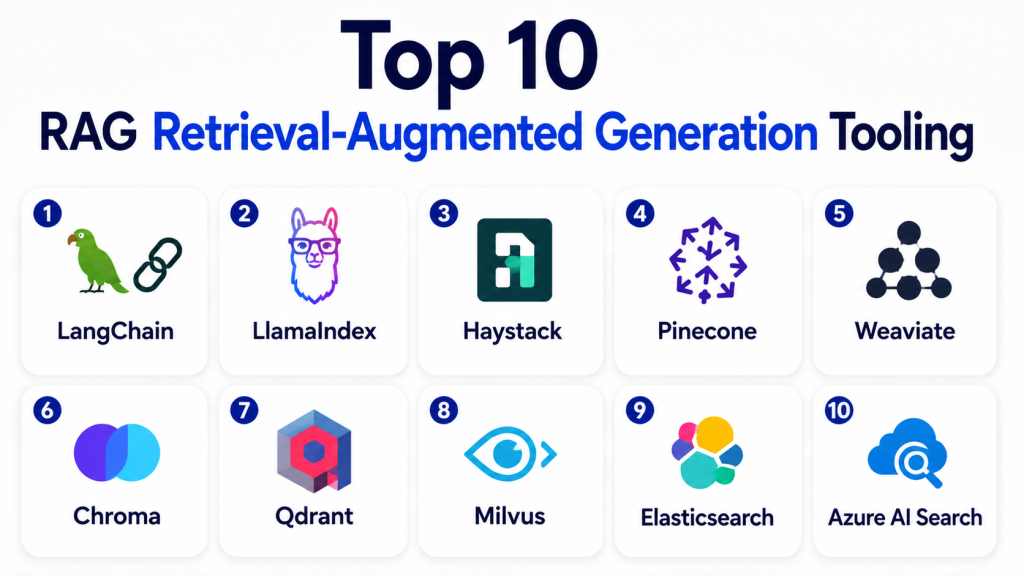
Top 10 RAG Retrieval-Augmented Generation Tooling
1 — LangChain
Short description: LangChain is one of the most widely adopted orchestration frameworks for building RAG pipelines, AI agents, and LLM-powered applications.
Key Features
- RAG orchestration
- Document loaders
- Retrieval pipelines
- Multi-model integrations
- Agent workflows
- Memory systems
- Evaluation integrations
Pros
- Massive ecosystem adoption
- Strong orchestration flexibility
- Excellent integration support
Cons
- Complex workflows may require tuning
- Rapid updates can increase maintenance overhead
Platforms / Deployment
- Windows / macOS / Linux
- Cloud / Self-hosted
Security & Compliance
- Depends on deployment
- Not publicly stated
Integrations & Ecosystem
LangChain integrates with nearly every major vector database, AI provider, and orchestration ecosystem.
- OpenAI
- Pinecone
- Weaviate
- Chroma
- APIs
- Cloud systems
Support & Community
Extremely large developer ecosystem and strong documentation support.
2 — LlamaIndex
Short description: LlamaIndex focuses on data ingestion, indexing, retrieval optimization, and enterprise RAG architecture development.
Key Features
- Data indexing
- Retrieval optimization
- Structured document ingestion
- Query orchestration
- Multi-modal retrieval
- RAG evaluation
- Enterprise connectors
Pros
- Excellent document indexing workflows
- Strong enterprise retrieval support
- Good developer flexibility
Cons
- Advanced tuning may require expertise
- Enterprise governance tooling varies
Platforms / Deployment
- Windows / macOS / Linux
- Cloud / Self-hosted
Security & Compliance
- Depends on deployment
- Not publicly stated
Integrations & Ecosystem
LlamaIndex integrates deeply with vector databases, APIs, and enterprise AI systems.
- OpenAI
- Pinecone
- Chroma
- APIs
- Data connectors
Support & Community
Rapidly growing enterprise and developer ecosystem.
3 — Haystack
Short description: Haystack is an open-source framework designed for scalable retrieval pipelines, semantic search, and production-grade RAG systems.
Key Features
- Semantic retrieval
- Pipeline orchestration
- Hybrid search
- Question answering
- Document processing
- Multi-model support
- Enterprise search workflows
Pros
- Strong open-source flexibility
- Excellent retrieval pipeline support
- Good scalability
Cons
- Advanced workflows require engineering expertise
- Enterprise governance features vary
Platforms / Deployment
- Windows / macOS / Linux
- Cloud / Self-hosted
Security & Compliance
- Depends on deployment model
- Not publicly stated
Integrations & Ecosystem
Haystack integrates with retrieval systems, vector databases, and orchestration frameworks.
- Elasticsearch
- OpenSearch
- Pinecone
- APIs
- ML systems
Support & Community
Strong open-source community and enterprise adoption.
4 — Pinecone
Short description: Pinecone is a managed vector database platform optimized for scalable semantic retrieval and enterprise RAG workloads.
Key Features
- Vector search
- Low-latency retrieval
- Scalable indexing
- Metadata filtering
- Hybrid retrieval
- Managed infrastructure
- Multi-region support
Pros
- Excellent retrieval performance
- Fully managed infrastructure
- Enterprise scalability
Cons
- Primarily focused on vector storage
- Premium pricing at scale
Platforms / Deployment
- Web
- Cloud
Security & Compliance
- Encryption
- Access controls
- Enterprise governance support varies
Integrations & Ecosystem
Pinecone integrates with modern AI orchestration and RAG ecosystems.
- LangChain
- LlamaIndex
- OpenAI
- APIs
- Cloud systems
Support & Community
Large enterprise AI infrastructure ecosystem.
5 — Weaviate
Short description: Weaviate is an open-source vector database platform designed for semantic retrieval, hybrid search, and scalable AI applications.
Key Features
- Vector search
- Hybrid retrieval
- Graph-style querying
- Multi-modal support
- AI-native indexing
- Semantic search
- Scalable clustering
Pros
- Strong open-source flexibility
- Good scalability
- Excellent hybrid retrieval support
Cons
- Infrastructure management may require expertise
- Enterprise operations can become complex
Platforms / Deployment
- Windows / macOS / Linux
- Cloud / Self-hosted
Security & Compliance
- Access controls
- Encryption varies by deployment
Integrations & Ecosystem
Weaviate integrates with orchestration frameworks and AI ecosystems.
- LangChain
- APIs
- OpenAI
- Hugging Face
- Cloud systems
Support & Community
Large open-source vector database ecosystem.
6 — Chroma
Short description: Chroma is a developer-friendly open-source vector database focused on lightweight semantic retrieval and RAG experimentation.
Key Features
- Vector storage
- Semantic retrieval
- Lightweight deployment
- Metadata support
- AI-native indexing
- Embedding workflows
- Developer APIs
Pros
- Easy setup and usability
- Strong developer experience
- Good rapid prototyping support
Cons
- Enterprise scalability varies
- Advanced governance limited
Platforms / Deployment
- Windows / macOS / Linux
- Self-hosted
Security & Compliance
- Depends on deployment
- Not publicly stated
Integrations & Ecosystem
Chroma integrates with modern AI development ecosystems.
- LangChain
- LlamaIndex
- OpenAI
- Python workflows
Support & Community
Growing developer ecosystem focused on experimentation.
7 — Qdrant
Short description: Qdrant is a vector similarity search engine optimized for scalable retrieval, filtering, and AI-native search systems.
Key Features
- Vector similarity search
- Metadata filtering
- High-performance indexing
- Scalable clustering
- AI-native retrieval
- REST APIs
- Multi-vector support
Pros
- Excellent retrieval performance
- Strong filtering support
- Good open-source scalability
Cons
- Enterprise governance varies
- Advanced workflows require tuning
Platforms / Deployment
- Windows / macOS / Linux
- Cloud / Self-hosted
Security & Compliance
- Access controls
- Encryption support varies
Integrations & Ecosystem
Qdrant integrates with orchestration systems and AI retrieval ecosystems.
- LangChain
- LlamaIndex
- APIs
- AI workflows
Support & Community
Rapidly growing vector search ecosystem.
8 — Milvus
Short description: Milvus is a scalable vector database platform designed for enterprise-scale semantic retrieval and AI search applications.
Key Features
- Vector indexing
- High-scale retrieval
- Distributed architecture
- Hybrid search
- GPU acceleration
- Multi-modal search
- Enterprise scalability
Pros
- Excellent scalability
- Strong distributed architecture
- Good enterprise retrieval performance
Cons
- Operational complexity can increase
- Requires infrastructure expertise
Platforms / Deployment
- Windows / macOS / Linux
- Cloud / Self-hosted
Security & Compliance
- Access controls
- Encryption varies by deployment
Integrations & Ecosystem
Milvus integrates with enterprise AI and orchestration ecosystems.
- LangChain
- APIs
- AI platforms
- Cloud systems
Support & Community
Strong enterprise vector infrastructure ecosystem.
9 — Elasticsearch
Short description: Elasticsearch provides hybrid search, semantic retrieval, and enterprise search capabilities increasingly used in production RAG systems.
Key Features
- Hybrid search
- Semantic retrieval
- Full-text search
- Scalable indexing
- Analytics dashboards
- Distributed architecture
- Enterprise search workflows
Pros
- Mature enterprise ecosystem
- Excellent scalability
- Strong hybrid retrieval capabilities
Cons
- Complex operational management
- Vector workflows require tuning
Platforms / Deployment
- Windows / macOS / Linux
- Cloud / Self-hosted
Security & Compliance
- RBAC
- Encryption
- Audit support varies
Integrations & Ecosystem
Elasticsearch integrates with enterprise search, analytics, and AI ecosystems.
- APIs
- LangChain
- Enterprise systems
- Cloud platforms
Support & Community
Massive enterprise search ecosystem.
10 — Azure AI Search
Short description: Azure AI Search is Microsoft’s enterprise search and retrieval platform optimized for scalable RAG and generative AI workloads.
Key Features
- Hybrid retrieval
- Semantic ranking
- Enterprise indexing
- AI enrichment pipelines
- Security filtering
- Cloud scalability
- Azure AI integration
Pros
- Excellent Azure ecosystem integration
- Strong enterprise governance
- Scalable managed infrastructure
Cons
- Best suited for Microsoft-centric environments
- Enterprise pricing varies
Platforms / Deployment
- Web
- Cloud
Security & Compliance
- RBAC
- Encryption
- Azure governance controls
Integrations & Ecosystem
Azure AI Search integrates deeply with Microsoft AI and enterprise ecosystems.
- Azure AI
- APIs
- Microsoft ecosystems
- AI workflows
Support & Community
Strong enterprise support ecosystem.
Comparison Table Top 10
| Tool Name | Best For | Platform(s) Supported | Deployment | Standout Feature | Public Rating |
|---|---|---|---|---|---|
| LangChain | AI orchestration | Windows/macOS/Linux | Cloud/Self-hosted | Workflow flexibility | N/A |
| LlamaIndex | Retrieval indexing | Windows/macOS/Linux | Cloud/Self-hosted | Enterprise data ingestion | N/A |
| Haystack | Semantic pipelines | Windows/macOS/Linux | Cloud/Self-hosted | Hybrid retrieval | N/A |
| Pinecone | Managed vector search | Web | Cloud | Low-latency retrieval | N/A |
| Weaviate | Open-source vector search | Windows/macOS/Linux | Cloud/Self-hosted | Hybrid vector retrieval | N/A |
| Chroma | Lightweight RAG | Windows/macOS/Linux | Self-hosted | Developer simplicity | N/A |
| Qdrant | High-performance retrieval | Windows/macOS/Linux | Cloud/Self-hosted | Metadata filtering | N/A |
| Milvus | Enterprise vector infrastructure | Windows/macOS/Linux | Cloud/Self-hosted | Distributed scalability | N/A |
| Elasticsearch | Enterprise hybrid search | Windows/macOS/Linux | Cloud/Self-hosted | Full-text + vector search | N/A |
| Azure AI Search | Enterprise RAG | Web | Cloud | Azure AI integration | N/A |
Evaluation & Scoring of RAG Retrieval-Augmented Generation Tooling
| Tool Name | Core 25% | Ease 15% | Integrations 15% | Security 10% | Performance 10% | Support 10% | Value 15% | Weighted Total |
|---|---|---|---|---|---|---|---|---|
| LangChain | 10 | 8 | 10 | 7 | 9 | 9 | 8 | 8.9 |
| LlamaIndex | 9 | 8 | 9 | 7 | 8 | 8 | 8 | 8.3 |
| Haystack | 8 | 7 | 8 | 7 | 8 | 8 | 8 | 7.8 |
| Pinecone | 9 | 9 | 8 | 8 | 10 | 8 | 7 | 8.6 |
| Weaviate | 8 | 7 | 8 | 7 | 8 | 8 | 8 | 7.8 |
| Chroma | 7 | 9 | 7 | 6 | 7 | 7 | 9 | 7.6 |
| Qdrant | 8 | 8 | 8 | 7 | 9 | 7 | 8 | 8.0 |
| Milvus | 9 | 6 | 8 | 7 | 10 | 7 | 7 | 8.0 |
| Elasticsearch | 9 | 6 | 9 | 8 | 9 | 9 | 7 | 8.3 |
| Azure AI Search | 9 | 8 | 9 | 9 | 9 | 8 | 7 | 8.5 |
These scores are comparative and intended to help organizations evaluate trade-offs between orchestration flexibility, retrieval accuracy, enterprise governance, scalability, observability, and operational simplicity. Enterprise-focused platforms typically score highly in scalability and governance, while open-source ecosystems provide stronger customization flexibility.
Which RAG Retrieval-Augmented Generation Tool Is Right for You?
Solo / Freelancer
Independent developers and AI enthusiasts may benefit most from Chroma, LangChain, or LlamaIndex due to flexibility and rapid prototyping support.
SMB
Small and medium businesses often prioritize usability and scalability. Pinecone and Azure AI Search provide balanced managed infrastructure support.
Mid-Market
Mid-market organizations typically require stronger orchestration and hybrid retrieval workflows. Haystack and Qdrant provide scalable operational flexibility.
Enterprise
Large enterprises should evaluate Elasticsearch, Azure AI Search, Pinecone, or Milvus for scalability, governance, and enterprise infrastructure readiness.
Budget vs Premium
Open-source ecosystems reduce infrastructure costs while managed vector platforms justify premium investment through scalability and operational simplicity.
Feature Depth vs Ease of Use
Developer-first frameworks provide deeper workflow flexibility, while managed cloud systems prioritize operational simplicity and enterprise scalability.
Integrations & Scalability
Organizations heavily invested in Azure, enterprise search systems, AI orchestration workflows, or cloud infrastructure should prioritize integration-ready platforms.
Security & Compliance Needs
Regulated industries should prioritize governance controls, auditability, encryption, access filtering, and deployment flexibility.
Frequently Asked Questions FAQs
1. What is Retrieval-Augmented Generation RAG?
RAG combines large language models with external retrieval systems to provide more accurate and context-aware AI responses.
2. Why is RAG important for enterprise AI?
RAG reduces hallucinations, improves factual accuracy, enables real-time knowledge retrieval, and allows AI systems to access enterprise data securely.
3. What is a vector database?
A vector database stores embeddings and enables semantic similarity search for AI retrieval workflows.
4. Are RAG systems better than standalone LLMs?
For enterprise knowledge workflows, RAG systems typically provide more accurate and up-to-date responses than standalone LLMs.
5. What industries benefit most from RAG tooling?
Finance, healthcare, legal, SaaS, customer support, research, and enterprise knowledge management are major adopters.
6. What is hybrid retrieval?
Hybrid retrieval combines semantic vector search with traditional keyword search to improve retrieval quality.
7. Are open-source RAG frameworks production-ready?
Yes. Many open-source orchestration and retrieval frameworks are widely used in enterprise production systems.
8. How important are integrations in RAG platforms?
Integrations are critical because RAG workflows connect with vector databases, APIs, cloud systems, AI models, and enterprise data sources.
9. Can RAG systems support generative AI agents?
Yes. Modern AI agents increasingly depend on RAG systems for contextual retrieval and dynamic reasoning.
10. How should organizations choose a RAG platform?
Organizations should evaluate retrieval quality, orchestration flexibility, scalability, integrations, observability, governance, and deployment complexity before selecting a platform.
Conclusion
RAG Retrieval-Augmented Generation Tooling is rapidly becoming foundational infrastructure for enterprise generative AI systems, AI agents, semantic search applications, and AI knowledge assistants. As organizations operationalize generative AI across customer support, research, compliance, analytics, and internal productivity workflows, RAG systems are evolving from experimental architectures into production-critical AI infrastructure. The ecosystem now includes orchestration frameworks, vector databases, enterprise search systems, observability tooling, and retrieval optimization platforms designed to improve AI reliability and contextual intelligence. The best RAG tooling ultimately depends on organizational scale, infrastructure maturity, governance requirements, engineering expertise, and operational complexity. Some organizations prioritize orchestration flexibility and open-source extensibility, while others focus on managed infrastructure, enterprise governance, or ultra-low-latency retrieval performance. The most practical next step is to shortlist two or three RAG platforms aligned with your AI deployment strategy, run pilot retrieval workflows using real enterprise datasets, validate integrations and security requirements, and evaluate scalability before standardizing RAG operations across the organization.

Find Trusted Cardiac Hospitals
Compare heart hospitals by city and services — all in one place.
Explore Hospitals
RAG tools are really useful because they combine retrieval and AI generation to give more accurate and context-aware answers.