Introduction
Search Relevance Tuning Tools are platforms and frameworks designed to improve the accuracy, ranking quality, personalization, and contextual relevance of search results across websites, enterprise systems, e-commerce platforms, AI assistants, and digital applications. These tools help organizations optimize how users discover products, documents, knowledge, and information by refining search algorithms, ranking logic, semantic understanding, and AI-driven retrieval pipelines. search relevance has become a critical business capability because users now expect intelligent, conversational, personalized, and context-aware search experiences. AI-powered search systems, semantic retrieval, vector search, and Retrieval-Augmented Generation workflows are rapidly changing how organizations approach search optimization. Poor search relevance can directly impact customer experience, productivity, conversions, and operational efficiency.
Common Real-world use cases include:
- E-commerce product discovery
- Enterprise document search
- AI-powered semantic search
- Customer support knowledge retrieval
- Internal company search systems
- Personalized content recommendations
- AI assistant and chatbot retrieval optimization
Key buyer Evaluation criteria include:
- Search relevance quality
- Semantic and vector search support
- Ranking customization
- AI and machine learning capabilities
- Scalability and latency
- Integration ecosystem
- Analytics and observability
- Personalization features
- Deployment flexibility
- Security and governance controls
Best for: Enterprises, e-commerce businesses, SaaS providers, AI engineering teams, digital experience teams, and organizations operating large-scale search experiences.
Not ideal for: Small websites with simple keyword-based search requirements or organizations without advanced search optimization needs.
Key Trends in Search Relevance Tuning Tools
- AI-powered semantic search is replacing traditional keyword-only ranking.
- Hybrid retrieval combining vector and lexical search is becoming standard.
- Personalization and behavioral ranking are increasingly important.
- RAG systems are influencing enterprise search architectures.
- Multi-modal search is growing across text, image, and video retrieval.
- Search observability and ranking analytics are becoming operational necessities.
- Conversational AI interfaces are reshaping search interaction models.
- Vector databases are increasingly integrated into search stacks.
- Real-time indexing and relevance adaptation are improving rapidly.
- AI governance and search explainability are becoming enterprise priorities.
How We Selected These Tools Methodology
The tools in this list were selected using a balanced evaluation framework focused on search relevance quality, enterprise scalability, AI readiness, and ecosystem maturity.
Evaluation criteria included:
- Market adoption and ecosystem maturity
- Relevance tuning capabilities
- Semantic and vector search support
- Scalability and operational performance
- Integration ecosystem quality
- Enterprise governance and security
- Analytics and observability features
- Deployment flexibility
- Developer experience
- Customer fit across enterprise and developer segments
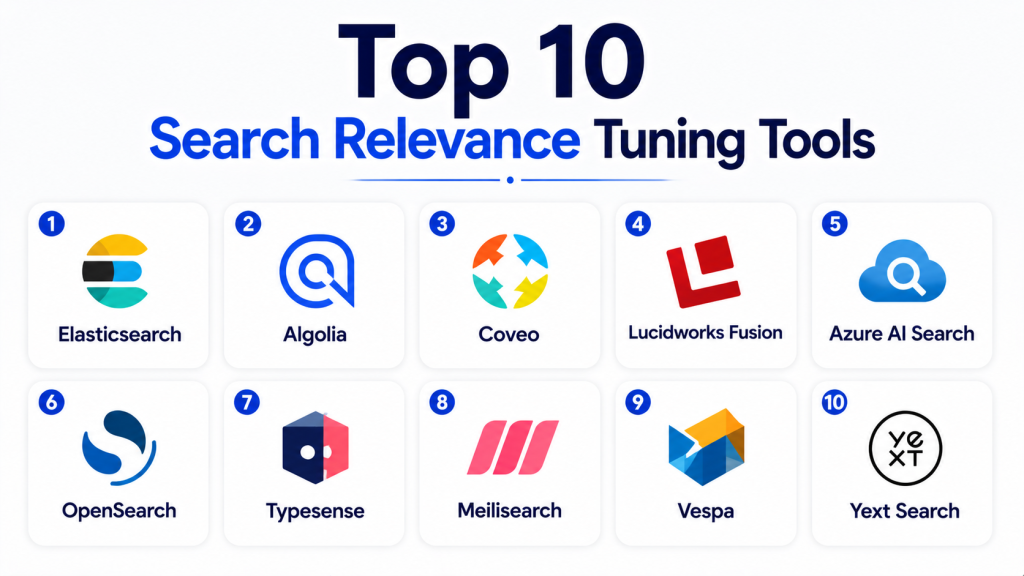
Top 10 Search Relevance Tuning Tools
1 — Elasticsearch
Short description: Elasticsearch is one of the most widely adopted enterprise search platforms, offering advanced relevance tuning, semantic search, and large-scale distributed search capabilities.
Key Features
- Full-text search
- Vector search
- Hybrid retrieval
- Relevance scoring customization
- Real-time indexing
- Analytics dashboards
- Distributed architecture
Pros
- Extremely scalable
- Strong enterprise ecosystem
- Excellent customization flexibility
Cons
- Operational complexity can increase
- Advanced tuning requires expertise
Platforms / Deployment
- Windows / macOS / Linux
- Cloud / Self-hosted / Hybrid
Security & Compliance
- RBAC
- Encryption
- Audit logging
- SSO/SAML support
Integrations & Ecosystem
Elasticsearch integrates deeply with analytics, AI, and enterprise application ecosystems.
- APIs
- LangChain
- Cloud platforms
- Analytics systems
- Enterprise apps
Support & Community
Massive enterprise and open-source ecosystem with extensive documentation.
2 — Algolia
Short description: Algolia is a hosted search platform optimized for fast, highly personalized, AI-enhanced customer search experiences.
Key Features
- AI ranking
- Personalized search
- Instant search responses
- Relevance analytics
- Query suggestions
- Semantic search
- Merchandising controls
Pros
- Excellent usability
- Fast deployment
- Strong e-commerce support
Cons
- Premium pricing at scale
- Less infrastructure control
Platforms / Deployment
- Web
- Cloud
Security & Compliance
- Encryption
- RBAC
- API security controls
Integrations & Ecosystem
Algolia integrates with e-commerce, CMS, and analytics ecosystems.
- Shopify
- APIs
- CMS platforms
- Analytics tools
- AI systems
Support & Community
Strong commercial support and enterprise onboarding.
3 — Coveo
Short description: Coveo is an AI-powered enterprise search and personalization platform focused on relevance optimization and digital experience improvement.
Key Features
- AI relevance optimization
- Personalized search
- Recommendation systems
- Analytics dashboards
- Semantic search
- Enterprise integrations
- AI ranking models
Pros
- Strong enterprise personalization
- Excellent analytics visibility
- Mature AI ranking workflows
Cons
- Enterprise-focused pricing
- Advanced implementations may require consulting
Platforms / Deployment
- Web
- Cloud
Security & Compliance
- SSO/SAML
- Encryption
- RBAC
- Audit controls
Integrations & Ecosystem
Coveo integrates with enterprise customer experience ecosystems.
- Salesforce
- ServiceNow
- APIs
- CMS platforms
- AI systems
Support & Community
Strong enterprise customer success ecosystem.
4 — Lucidworks Fusion
Short description: Lucidworks Fusion is an enterprise AI search platform focused on relevance tuning, intelligent retrieval, and large-scale search analytics.
Key Features
- AI-powered search
- Search pipelines
- Relevance tuning
- Behavioral analytics
- Hybrid retrieval
- Enterprise connectors
- Machine learning ranking
Pros
- Strong enterprise search flexibility
- Advanced relevance optimization
- Good AI integration support
Cons
- Operational complexity varies
- Enterprise deployment may require expertise
Platforms / Deployment
- Windows / macOS / Linux
- Cloud / Self-hosted / Hybrid
Security & Compliance
- RBAC
- Encryption
- Enterprise governance support
Integrations & Ecosystem
Lucidworks integrates with enterprise search and analytics ecosystems.
- APIs
- AI platforms
- Enterprise systems
- Analytics tools
Support & Community
Established enterprise search ecosystem.
5 — Azure AI Search
Short description: Azure AI Search provides enterprise semantic retrieval, AI enrichment, and relevance tuning within Microsoft cloud ecosystems.
Key Features
- Semantic ranking
- Hybrid retrieval
- AI enrichment pipelines
- Enterprise indexing
- Vector search
- Security filtering
- AI integrations
Pros
- Strong Azure ecosystem integration
- Good enterprise governance
- Managed operational simplicity
Cons
- Best for Microsoft-centric organizations
- Premium enterprise pricing varies
Platforms / Deployment
- Web
- Cloud
Security & Compliance
- RBAC
- Encryption
- Azure governance controls
Integrations & Ecosystem
Azure AI Search integrates deeply with Microsoft AI and analytics systems.
- Azure AI
- APIs
- Microsoft ecosystems
- Cloud services
Support & Community
Large enterprise cloud ecosystem.
6 — OpenSearch
Short description: OpenSearch is an open-source search and analytics engine optimized for scalable search relevance tuning and observability workloads.
Key Features
- Full-text search
- Vector search
- Analytics dashboards
- Hybrid retrieval
- Search observability
- Distributed scalability
- Open-source extensibility
Pros
- Strong open-source flexibility
- Good scalability
- Lower infrastructure licensing cost
Cons
- Operational complexity can increase
- Enterprise support varies
Platforms / Deployment
- Windows / macOS / Linux
- Cloud / Self-hosted
Security & Compliance
- Encryption
- Access controls
- Audit logging
Integrations & Ecosystem
OpenSearch integrates with analytics, AI, and cloud ecosystems.
- APIs
- AI frameworks
- Analytics systems
- Cloud platforms
Support & Community
Growing open-source search ecosystem.
7 — Typesense
Short description: Typesense is a developer-friendly search engine focused on typo tolerance, fast relevance ranking, and operational simplicity.
Key Features
- Typo-tolerant search
- Real-time indexing
- Instant search
- Faceted filtering
- Semantic support
- Lightweight deployment
- Ranking customization
Pros
- Easy deployment
- Excellent developer experience
- Good search speed
Cons
- Smaller ecosystem than Elasticsearch
- Advanced enterprise features limited
Platforms / Deployment
- Windows / macOS / Linux
- Cloud / Self-hosted
Security & Compliance
- API authentication
- Encryption varies
Integrations & Ecosystem
Typesense integrates with developer and web application ecosystems.
- APIs
- CMS systems
- Web applications
- Analytics tools
Support & Community
Growing developer-focused community.
8 — Meilisearch
Short description: Meilisearch is an open-source search engine focused on usability, fast search experiences, and developer-friendly relevance tuning.
Key Features
- Typo tolerance
- Fast indexing
- Search ranking rules
- Lightweight APIs
- Faceted search
- Developer simplicity
- Instant responses
Pros
- Extremely easy to use
- Fast deployment
- Strong developer productivity
Cons
- Enterprise scalability varies
- Advanced AI ranking features limited
Platforms / Deployment
- Windows / macOS / Linux
- Cloud / Self-hosted
Security & Compliance
- Depends on deployment
- Not publicly stated
Integrations & Ecosystem
Meilisearch integrates with developer and modern web ecosystems.
- APIs
- CMS systems
- Web frameworks
- Developer tools
Support & Community
Rapidly growing open-source ecosystem.
9 — Vespa
Short description: Vespa is a large-scale AI-powered search and recommendation platform optimized for personalized relevance and machine learning ranking.
Key Features
- AI ranking
- Personalized search
- Vector retrieval
- Real-time indexing
- Recommendation systems
- Distributed scalability
- ML inference support
Pros
- Excellent personalization support
- Strong scalability
- Advanced AI ranking flexibility
Cons
- Requires advanced engineering expertise
- Operational management complexity
Platforms / Deployment
- Windows / macOS / Linux
- Cloud / Self-hosted
Security & Compliance
- Access controls
- Encryption varies
Integrations & Ecosystem
Vespa integrates with large-scale AI and personalization ecosystems.
- APIs
- ML pipelines
- AI systems
- Analytics platforms
Support & Community
Strong engineering-focused ecosystem.
10 — Yext Search
Short description: Yext Search is an AI-powered search experience platform focused on enterprise websites, support portals, and customer-facing search experiences.
Key Features
- AI-powered search
- Semantic understanding
- Knowledge graph support
- Analytics dashboards
- Conversational search
- Content indexing
- Search experience management
Pros
- Strong enterprise usability
- Good customer experience tooling
- Managed operational simplicity
Cons
- Less infrastructure flexibility
- Enterprise pricing varies
Platforms / Deployment
- Web
- Cloud
Security & Compliance
- RBAC
- Encryption
- Enterprise governance controls
Integrations & Ecosystem
Yext integrates with enterprise content and digital experience ecosystems.
- CMS systems
- APIs
- Analytics tools
- Enterprise platforms
Support & Community
Strong enterprise onboarding and customer success ecosystem.
Comparison Table Top 10
| Tool Name | Best For | Platform(s) Supported | Deployment | Standout Feature | Public Rating |
|---|---|---|---|---|---|
| Elasticsearch | Enterprise search | Windows/macOS/Linux | Cloud/Self-hosted/Hybrid | Deep relevance tuning | N/A |
| Algolia | E-commerce search | Web | Cloud | Instant AI search | N/A |
| Coveo | Enterprise personalization | Web | Cloud | AI-driven relevance | N/A |
| Lucidworks Fusion | Enterprise AI search | Windows/macOS/Linux | Cloud/Self-hosted/Hybrid | ML ranking pipelines | N/A |
| Azure AI Search | Microsoft ecosystems | Web | Cloud | Semantic ranking | N/A |
| OpenSearch | Open-source scalability | Windows/macOS/Linux | Cloud/Self-hosted | Search observability | N/A |
| Typesense | Developer-friendly search | Windows/macOS/Linux | Cloud/Self-hosted | Typo tolerance | N/A |
| Meilisearch | Lightweight search | Windows/macOS/Linux | Cloud/Self-hosted | Simplicity | N/A |
| Vespa | Personalized AI ranking | Windows/macOS/Linux | Cloud/Self-hosted | ML-powered relevance | N/A |
| Yext Search | Enterprise website search | Web | Cloud | Knowledge graph search | N/A |
Evaluation & Scoring of Search Relevance Tuning Tools
| Tool Name | Core 25% | Ease 15% | Integrations 15% | Security 10% | Performance 10% | Support 10% | Value 15% | Weighted Total |
|---|---|---|---|---|---|---|---|---|
| Elasticsearch | 10 | 7 | 10 | 8 | 10 | 9 | 8 | 8.9 |
| Algolia | 9 | 10 | 8 | 8 | 9 | 8 | 7 | 8.5 |
| Coveo | 9 | 8 | 9 | 8 | 9 | 8 | 7 | 8.3 |
| Lucidworks Fusion | 9 | 7 | 8 | 8 | 9 | 8 | 7 | 8.0 |
| Azure AI Search | 8 | 8 | 9 | 9 | 9 | 8 | 7 | 8.3 |
| OpenSearch | 8 | 7 | 8 | 7 | 9 | 7 | 9 | 8.0 |
| Typesense | 7 | 9 | 7 | 6 | 8 | 7 | 9 | 7.8 |
| Meilisearch | 7 | 10 | 7 | 6 | 8 | 7 | 9 | 7.9 |
| Vespa | 9 | 6 | 8 | 7 | 10 | 7 | 7 | 8.0 |
| Yext Search | 8 | 8 | 8 | 8 | 8 | 8 | 7 | 7.9 |
These scores are comparative and designed to help organizations evaluate trade-offs between AI relevance quality, scalability, operational complexity, personalization depth, and deployment flexibility. Enterprise-focused platforms generally score highly in governance and scalability, while developer-focused search engines prioritize usability and deployment simplicity.
Which Search Relevance Tuning Tool Is Right for You?
Solo / Freelancer
Independent developers and small teams may benefit most from Meilisearch or Typesense because of simplicity, lower operational overhead, and rapid deployment.
SMB
Small and medium businesses often prioritize fast implementation and customer search experience quality. Algolia and Typesense are strong fits.
Mid-Market
Mid-market organizations may prefer Coveo, Lucidworks Fusion, or OpenSearch for advanced relevance optimization and analytics visibility.
Enterprise
Large enterprises should evaluate Elasticsearch, Azure AI Search, Coveo, or Vespa for scalability, governance, and advanced AI relevance workflows.
Budget vs Premium
Open-source search systems reduce licensing cost, while managed enterprise platforms justify premium investment through operational simplicity and AI capabilities.
Feature Depth vs Ease of Use
Advanced search platforms provide deeper tuning flexibility, while hosted SaaS search systems simplify deployment and maintenance.
Integrations & Scalability
Organizations heavily invested in Azure, enterprise AI systems, analytics platforms, or e-commerce ecosystems should prioritize integration-ready search platforms.
Security & Compliance Needs
Regulated industries should prioritize auditability, encryption, RBAC, governance controls, and deployment flexibility.
Frequently Asked Questions FAQs
1. What are search relevance tuning tools?
Search relevance tuning tools help optimize how search systems rank and retrieve results for better accuracy and user experience.
2. Why is search relevance important?
Poor search relevance reduces user satisfaction, productivity, and conversions, while accurate search improves engagement and efficiency.
3. What is semantic search?
Semantic search uses AI and contextual understanding to retrieve results based on meaning rather than exact keyword matches.
4. What is hybrid search?
Hybrid search combines traditional keyword search with vector or semantic retrieval to improve relevance quality.
5. Are vector databases important for modern search?
Yes. Vector databases are increasingly used to support semantic retrieval and AI-powered search experiences.
6. Which industries use search relevance tuning tools?
E-commerce, SaaS, healthcare, finance, customer support, media, education, and enterprise IT are major adopters.
7. What is personalized search?
Personalized search adjusts rankings based on user behavior, preferences, history, or contextual signals.
8. Are open-source search engines production-ready?
Yes. Many open-source search engines are widely deployed in enterprise production systems.
9. How important are analytics in search tuning?
Analytics are critical because organizations need visibility into search performance, ranking quality, and user behavior.
10. How should organizations choose a search relevance platform?
Organizations should evaluate scalability, semantic capabilities, integrations, governance, deployment flexibility, observability, and operational complexity before selecting a platform.
Conclusion
Search Relevance Tuning Tools are becoming mission-critical infrastructure for AI-powered search systems, enterprise knowledge platforms, e-commerce discovery experiences, and conversational AI applications. As organizations deploy semantic search, vector retrieval, personalized ranking, and RAG-powered AI assistants, search optimization is evolving far beyond traditional keyword matching into a sophisticated AI-driven operational discipline. Modern search relevance platforms now combine semantic understanding, behavioral analytics, hybrid retrieval, vector search, personalization, and AI ranking models to deliver more contextual and accurate search experiences. The best search relevance platform ultimately depends on organizational scale, AI maturity, infrastructure strategy, personalization requirements, and operational complexity. Some organizations prioritize developer simplicity and rapid deployment, while others require deep enterprise governance, advanced AI ranking, or massive-scale distributed search infrastructure. The most practical next step is to shortlist two or three platforms aligned with your search architecture strategy, run pilot search workloads using real enterprise or customer datasets, validate ranking quality and integration requirements, and evaluate scalability before operationalizing search relevance optimization across the organization.

Find Trusted Cardiac Hospitals
Compare heart hospitals by city and services — all in one place.
Explore Hospitals
Search relevance tuning tools are really useful because they help improve search results so users can quickly find exactly what they are looking for instead of irrelevant or random results.