Introduction
Robotics Fleet Management Tools are software platforms designed to monitor, coordinate, optimize, and manage multiple robots operating across warehouses, factories, hospitals, logistics hubs, retail stores, and industrial environments. These platforms help organizations control robotic fleets from a centralized system while improving efficiency, uptime, navigation, task scheduling, and operational visibility. As robotics adoption accelerates across industries in 2026 and beyond, fleet management has become essential for handling autonomous mobile robots, warehouse robots, delivery bots, industrial automation systems, and AI-powered robotics operations at scale. Modern robotics environments often involve dozens or even thousands of robots working simultaneously, making centralized orchestration increasingly important.
Common Real-world use cases include:
- Warehouse robot coordination
- Autonomous delivery fleet monitoring
- Industrial robot scheduling
- Hospital service robot management
- Multi-site robotics operations control
Buyers evaluating robotics fleet management tools should consider:
- Multi-robot orchestration capabilities
- Real-time monitoring and analytics
- AI-powered optimization
- Scalability and deployment flexibility
- Integration with robotics ecosystems
- Security and access controls
- Cloud and edge deployment support
- API and interoperability support
- Reliability and uptime
- Ease of implementation
Best for: Logistics providers, manufacturing enterprises, warehouse operators, robotics startups, healthcare organizations, autonomous mobility companies, and industrial automation teams.
Not ideal for: Small operations with only one or two standalone robots or organizations that do not require centralized robotic coordination and analytics.
Key Trends in Robotics Fleet Management Tools
- AI-driven fleet orchestration is improving autonomous decision-making.
- Cloud-native robotics management platforms are becoming mainstream.
- Edge computing is reducing latency in robotic coordination.
- Digital twins are increasingly integrated into fleet monitoring workflows.
- Predictive maintenance capabilities are becoming standard features.
- Multi-vendor robot interoperability is growing in importance.
- Real-time analytics dashboards are evolving with AI insights.
- Cybersecurity requirements for robotics infrastructure are expanding.
- 5G and low-latency networking are improving fleet responsiveness.
- Robotics-as-a-Service deployment models continue to grow globally.
How We Selected These Tools (Methodology)
The tools in this list were evaluated using practical market and technical criteria:
- Industry adoption and enterprise mindshare
- Fleet orchestration capabilities
- Scalability across large robotics deployments
- AI and automation features
- Security posture and enterprise readiness
- Cloud and hybrid deployment flexibility
- API support and integration ecosystem
- Operational analytics and monitoring quality
- Reliability and uptime capabilities
- Community, support, and ecosystem maturity
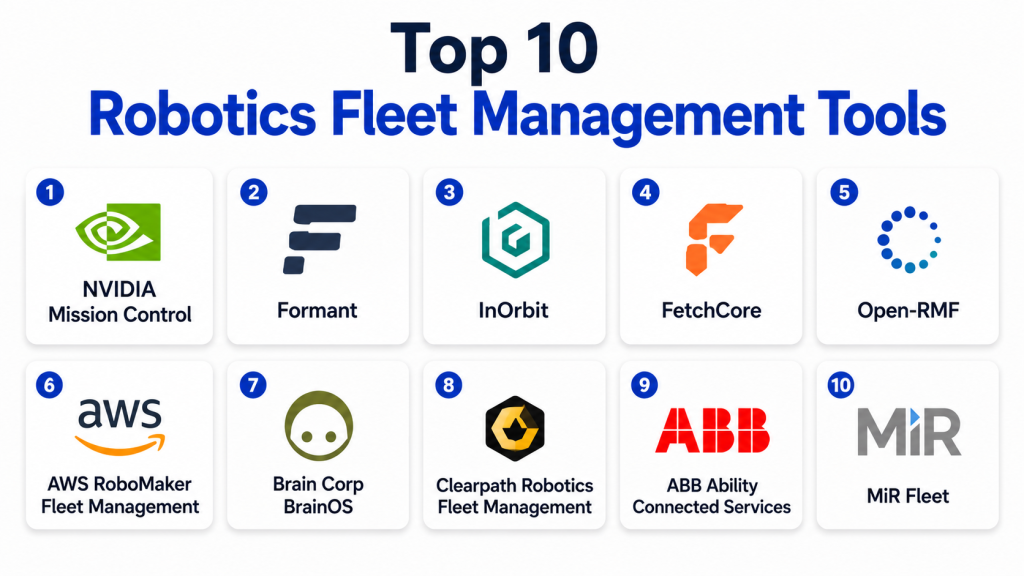
Top 10 Robotics Fleet Management Tools
1- NVIDIA Mission Control
Short description: NVIDIA Mission Control is an enterprise robotics orchestration platform designed for AI-powered robotic fleet operations, simulation integration, and industrial-scale automation environments.
Key Features
- Multi-robot fleet orchestration
- AI-powered operational optimization
- Real-time analytics dashboards
- Digital twin support
- Edge and cloud deployment
- Autonomous mission planning
- GPU-accelerated robotics workflows
Pros
- Strong AI and simulation integration
- Enterprise-grade scalability
- Advanced analytics and visualization
Cons
- Complex infrastructure requirements
- Premium enterprise positioning
- High-performance hardware often required
Platforms / Deployment
- Linux / Web
- Cloud / Hybrid / Self-hosted
Security & Compliance
- RBAC
- Encryption
- SSO/SAML support
- Audit logging
Integrations & Ecosystem
NVIDIA Mission Control integrates with AI, robotics, and industrial automation ecosystems to support large-scale autonomous operations.
- NVIDIA Omniverse
- ROS / ROS 2
- AI frameworks
- Digital twin platforms
- Edge AI systems
Support & Community
Strong enterprise support ecosystem with extensive technical documentation and industrial AI expertise.
2- Formant
Short description: Formant is a cloud robotics operations platform focused on monitoring, managing, and optimizing robot fleets across logistics, warehouse, and autonomous robotics environments.
Key Features
- Fleet health monitoring
- Real-time telemetry
- Video and sensor streaming
- Remote robot operations
- AI-powered analytics
- Workflow automation
- Fleet diagnostics
Pros
- User-friendly cloud interface
- Strong observability features
- Excellent remote operations capabilities
Cons
- Primarily cloud-focused
- Advanced customization may require engineering support
- Pricing varies by deployment scale
Platforms / Deployment
- Web / Linux
- Cloud / Hybrid
Security & Compliance
- Encryption
- RBAC
- MFA support
- Audit logging
Integrations & Ecosystem
Formant supports integrations with robotics infrastructure and operational systems.
- ROS
- APIs
- IoT platforms
- Warehouse systems
- Cloud analytics tools
Support & Community
Strong onboarding experience and growing robotics operations community.
3- InOrbit
Short description: InOrbit provides robotic fleet orchestration, monitoring, and automation tools for enterprise robotics deployments across logistics, retail, and industrial sectors.
Key Features
- Fleet management dashboards
- Real-time robot observability
- AI-powered automation
- Robot interoperability support
- Operational analytics
- Cloud robotics workflows
- Low-code automation tools
Pros
- Strong multi-vendor support
- Good analytics capabilities
- Scalable cloud platform
Cons
- Some advanced features target enterprise customers
- Hybrid deployment complexity
- Learning curve for large-scale automation
Platforms / Deployment
- Web / Linux
- Cloud / Hybrid
Security & Compliance
- Encryption
- RBAC
- SSO support
- Audit capabilities
Integrations & Ecosystem
InOrbit supports broad robotics interoperability and operational integration.
- ROS / ROS 2
- APIs
- Cloud platforms
- Warehouse automation tools
- IoT ecosystems
Support & Community
Good enterprise documentation and active robotics operations ecosystem.
4- FetchCore
Short description: FetchCore is a robotics fleet management solution designed for warehouse robotics, industrial automation, and autonomous mobile robot coordination.
Key Features
- Robot scheduling
- Task orchestration
- Mapping and navigation support
- Operational analytics
- Fleet optimization
- Remote monitoring
- Autonomous workflow support
Pros
- Strong warehouse robotics focus
- Simplified robot coordination
- Scalable orchestration capabilities
Cons
- Less suitable for non-industrial use cases
- Custom integration work may be needed
- Smaller ecosystem compared to larger platforms
Platforms / Deployment
- Linux / Web
- Cloud / Self-hosted
Security & Compliance
- RBAC
- Encryption
- Not publicly stated for certifications
Integrations & Ecosystem
FetchCore integrates with robotics infrastructure and warehouse automation systems.
- Warehouse systems
- APIs
- Autonomous mobile robots
- ROS environments
Support & Community
Strong industrial robotics support with focused deployment guidance.
5- Open-RMF
Short description: Open-RMF is an open-source robotics middleware framework focused on interoperability and fleet orchestration for multi-vendor robotics environments.
Key Features
- Multi-vendor robot coordination
- Traffic scheduling
- Task allocation
- Open-source framework
- ROS 2 integration
- Interoperability support
- Smart building integration
Pros
- Vendor-neutral architecture
- Strong interoperability support
- Open-source flexibility
Cons
- Requires technical expertise
- Enterprise support varies
- Setup complexity for large deployments
Platforms / Deployment
- Linux
- Self-hosted
Security & Compliance
- Varies / N/A
Integrations & Ecosystem
Open-RMF supports collaborative robotics ecosystems and open robotics development.
- ROS 2
- Smart building systems
- Autonomous robots
- Open-source robotics frameworks
Support & Community
Active open-source robotics community with growing adoption.
6- AWS RoboMaker Fleet Management
Short description: AWS RoboMaker supports cloud robotics operations and scalable robotic fleet management integrated with AWS cloud infrastructure.
Key Features
- Cloud robotics orchestration
- Fleet analytics
- Monitoring dashboards
- ROS integration
- CI/CD workflows
- Simulation support
- Cloud deployment automation
Pros
- Deep AWS ecosystem integration
- Scalable cloud infrastructure
- Enterprise-grade cloud services
Cons
- AWS dependency
- Costs may scale rapidly
- Limited non-cloud flexibility
Platforms / Deployment
- Web
- Cloud
Security & Compliance
- IAM integration
- Encryption
- Audit logging
- Enterprise cloud security controls
Integrations & Ecosystem
AWS RoboMaker connects robotics operations with cloud-native AWS services.
- ROS
- AWS IoT
- Lambda
- CloudWatch
- S3
Support & Community
Strong enterprise cloud support and growing robotics adoption.
7- Brain Corp BrainOS
Short description: BrainOS is a robotics platform widely used for autonomous floor-cleaning robots and commercial robotics fleet operations.
Key Features
- Autonomous robot navigation
- Fleet analytics
- Cloud fleet monitoring
- AI-powered automation
- Robot health monitoring
- Operational reporting
- Multi-site deployment management
Pros
- Strong commercial robotics adoption
- Reliable operational automation
- Good fleet visibility tools
Cons
- Specialized commercial focus
- Less flexibility for custom robotics
- Limited open ecosystem support
Platforms / Deployment
- Web / Linux
- Cloud / Hybrid
Security & Compliance
- Encryption
- RBAC
- Not publicly stated for certifications
Integrations & Ecosystem
BrainOS supports commercial service robotics deployments.
- Commercial robotics hardware
- Cloud dashboards
- Operational analytics tools
Support & Community
Strong commercial deployment expertise and operational support.
8- Clearpath Robotics Fleet Management
Short description: Clearpath Robotics provides robotic fleet coordination and autonomous mobile robot management for industrial and research environments.
Key Features
- Autonomous navigation management
- Fleet coordination
- Mapping and localization
- Robotics monitoring
- AI integration
- Industrial automation support
- ROS compatibility
Pros
- Strong robotics engineering focus
- Good autonomous navigation support
- Reliable industrial deployment capabilities
Cons
- Enterprise deployment complexity
- Smaller ecosystem than cloud-native competitors
- Advanced workflows may require customization
Platforms / Deployment
- Linux / Web
- Hybrid / Self-hosted
Security & Compliance
- RBAC
- Encryption
- Not publicly stated for certifications
Integrations & Ecosystem
Clearpath integrates with industrial robotics and autonomous systems.
- ROS
- Autonomous mobile robots
- Industrial automation systems
- AI frameworks
Support & Community
Well-regarded robotics engineering expertise and support quality.
9- ABB Ability Connected Services
Short description: ABB Ability Connected Services helps enterprises monitor and optimize industrial robotic fleets with predictive maintenance and operational analytics.
Key Features
- Industrial robotics monitoring
- Predictive maintenance
- Performance analytics
- Remote diagnostics
- Operational optimization
- Cloud monitoring
- Asset lifecycle management
Pros
- Strong industrial automation capabilities
- Predictive maintenance strengths
- Enterprise operational visibility
Cons
- Primarily focused on ABB ecosystems
- Less flexibility for smaller robotics environments
- Enterprise-oriented pricing
Platforms / Deployment
- Web / Windows
- Cloud / Hybrid
Security & Compliance
- Encryption
- RBAC
- Enterprise access controls
- Audit logging
Integrations & Ecosystem
ABB integrates deeply with industrial robotics infrastructure.
- ABB robotics
- Industrial IoT
- Manufacturing systems
- Predictive analytics tools
Support & Community
Excellent enterprise industrial automation support.
10- MiR Fleet
Short description: MiR Fleet is a fleet management solution designed for coordinating autonomous mobile robots across warehouses and industrial facilities.
Key Features
- AMR fleet coordination
- Traffic control
- Task management
- Fleet monitoring
- Workflow optimization
- Navigation management
- Multi-robot orchestration
Pros
- Strong warehouse automation focus
- Easy robot coordination
- Reliable AMR management capabilities
Cons
- Primarily designed for MiR robots
- Less open ecosystem flexibility
- Enterprise scaling may require infrastructure planning
Platforms / Deployment
- Web / Linux
- Cloud / Self-hosted / Hybrid
Security & Compliance
- RBAC
- Encryption
- Not publicly stated for certifications
Integrations & Ecosystem
MiR Fleet integrates with logistics and warehouse automation systems.
- Warehouse management systems
- APIs
- Autonomous mobile robots
- Industrial automation tools
Support & Community
Strong warehouse robotics deployment expertise and customer support.
Comparison Table
| Tool Name | Best For | Platform(s) Supported | Deployment | Standout Feature | Public Rating |
|---|---|---|---|---|---|
| NVIDIA Mission Control | AI robotics fleets | Linux, Web | Hybrid | AI-powered orchestration | N/A |
| Formant | Cloud robotics operations | Web, Linux | Cloud | Remote observability | N/A |
| InOrbit | Multi-vendor robotics | Web, Linux | Hybrid | Fleet interoperability | N/A |
| FetchCore | Warehouse robotics | Linux, Web | Hybrid | Task orchestration | N/A |
| Open-RMF | Open robotics ecosystems | Linux | Self-hosted | Vendor-neutral coordination | N/A |
| AWS RoboMaker Fleet Management | Cloud robotics | Web | Cloud | AWS cloud integration | N/A |
| Brain Corp BrainOS | Commercial robotics | Web, Linux | Hybrid | Autonomous operations | N/A |
| Clearpath Fleet Management | Industrial robotics | Linux, Web | Hybrid | Autonomous navigation | N/A |
| ABB Ability Connected Services | Industrial automation | Windows, Web | Hybrid | Predictive maintenance | N/A |
| MiR Fleet | AMR fleet coordination | Web, Linux | Hybrid | Warehouse robot traffic control | N/A |
Evaluation & Scoring of Robotics Fleet Management Tools
| Tool Name | Core | Ease | Integrations | Security | Performance | Support | Value | Weighted Total |
|---|---|---|---|---|---|---|---|---|
| NVIDIA Mission Control | 9.5 | 7.5 | 9.2 | 8.8 | 9.4 | 8.7 | 7.2 | 8.8 |
| Formant | 8.9 | 8.8 | 8.5 | 8.2 | 8.7 | 8.5 | 8.0 | 8.5 |
| InOrbit | 9.0 | 8.2 | 9.1 | 8.3 | 8.8 | 8.4 | 7.9 | 8.6 |
| FetchCore | 8.4 | 8.0 | 7.9 | 7.5 | 8.2 | 7.9 | 8.5 | 8.1 |
| Open-RMF | 8.2 | 6.9 | 8.8 | 6.5 | 8.0 | 7.8 | 9.0 | 7.9 |
| AWS RoboMaker Fleet Management | 8.8 | 7.7 | 9.3 | 9.0 | 8.9 | 8.6 | 7.1 | 8.6 |
| Brain Corp BrainOS | 8.5 | 8.3 | 7.8 | 7.9 | 8.6 | 8.2 | 7.8 | 8.2 |
| Clearpath Fleet Management | 8.6 | 7.5 | 8.4 | 7.4 | 8.5 | 8.1 | 8.0 | 8.2 |
| ABB Ability Connected Services | 8.9 | 7.4 | 8.5 | 8.7 | 9.1 | 8.8 | 7.0 | 8.5 |
| MiR Fleet | 8.7 | 8.4 | 8.0 | 7.8 | 8.5 | 8.3 | 8.1 | 8.3 |
These scores are comparative and intended to help organizations evaluate relative strengths across the market. Higher scores generally indicate stronger enterprise readiness, integrations, scalability, and operational capabilities. Open-source tools may score higher on value, while enterprise platforms often lead in analytics, AI, and security capabilities. Organizations should prioritize the criteria most aligned with their robotics deployment goals.
Which Robotics Fleet Management Tool Is Right for You?
Solo / Freelancer
Independent robotics developers and research teams may benefit most from Open-RMF due to its open-source flexibility and interoperability support.
SMB
Small and medium-sized robotics operations often prefer MiR Fleet, FetchCore, or Formant because of easier deployment and operational simplicity.
Mid-Market
Mid-market organizations managing warehouse automation or commercial robotics may find InOrbit or Formant strong options for scalability and analytics.
Enterprise
Large enterprises with advanced robotics operations often prioritize NVIDIA Mission Control, AWS RoboMaker, or ABB Ability Connected Services for enterprise-grade scalability and AI-powered automation.
Budget vs Premium
Open-source platforms provide lower upfront costs but may require internal engineering expertise. Enterprise-grade solutions offer stronger support, analytics, and security but usually involve higher operational costs.
Feature Depth vs Ease of Use
Platforms like NVIDIA Mission Control provide extensive AI and orchestration capabilities, while MiR Fleet and Formant emphasize operational simplicity and usability.
Integrations & Scalability
Organizations with large cloud infrastructure investments should evaluate AWS or NVIDIA ecosystems carefully for long-term scalability and interoperability.
Security & Compliance Needs
Industrial and enterprise robotics deployments should prioritize encryption, RBAC, audit logging, and identity management capabilities to protect operational environments.
Frequently Asked Questions FAQs
1- What are Robotics Fleet Management Tools?
Robotics fleet management tools are software platforms designed to monitor, coordinate, and optimize multiple robots from a centralized system. They help organizations manage robotic operations across warehouses, factories, hospitals, and logistics environments. These tools improve efficiency, reduce downtime, and simplify autonomous robot orchestration. Modern platforms also include AI-powered analytics and automation capabilities.
2- Why are robotics fleet management platforms important?
As organizations deploy larger numbers of autonomous robots, centralized coordination becomes essential for operational efficiency. Fleet management platforms help optimize robot scheduling, navigation, task assignment, and maintenance workflows. They also improve visibility across robotic operations through real-time dashboards and analytics. Without centralized management, large robotic deployments can become difficult to scale and maintain.
3- Which industries commonly use robotics fleet management tools?
Industries such as manufacturing, logistics, retail, healthcare, warehousing, hospitality, and autonomous delivery services widely use these platforms. Warehouse automation companies rely on them to manage autonomous mobile robots efficiently. Hospitals use robotic fleets for delivery and sanitation workflows. Industrial enterprises also use them for predictive maintenance and robotics coordination.
4- Can these tools manage robots from multiple vendors?
Yes, many modern robotics fleet management platforms support multi-vendor interoperability. Platforms like Open-RMF and InOrbit are specifically designed to coordinate robots from different manufacturers. This flexibility helps enterprises avoid vendor lock-in and build scalable robotics ecosystems. However, some platforms may still work best within their native robotics environments.
5- Are cloud-based robotics fleet platforms secure?
Most enterprise-grade platforms include security features such as encryption, RBAC, audit logging, and identity management. Cloud-native robotics platforms also benefit from enterprise cloud infrastructure protections. However, organizations should still carefully evaluate compliance requirements and cybersecurity practices before deployment. Security becomes increasingly important as robotics operations scale.
6- What role does AI play in robotics fleet management?
AI helps optimize robot scheduling, route planning, predictive maintenance, and operational analytics. Modern platforms use machine learning to improve fleet efficiency and reduce operational bottlenecks. AI-powered dashboards can also identify anomalies and performance issues proactively. This helps organizations reduce downtime and improve robotics ROI.
7- What should buyers evaluate before choosing a platform?
Organizations should evaluate scalability, interoperability, analytics, deployment flexibility, integrations, security, and ease of implementation. Real-time monitoring capabilities and AI optimization features are also important considerations. Businesses with complex robotics operations should prioritize strong orchestration and automation workflows. Long-term vendor support and ecosystem maturity also matter significantly.
8- Are open-source robotics fleet tools reliable?
Open-source platforms like Open-RMF are highly respected in robotics engineering and research communities. They provide flexibility, interoperability, and customization advantages for technical teams. However, enterprise organizations may still require additional support, security hardening, or commercial integrations. The best choice depends on operational complexity and internal engineering expertise.
9- How difficult is robotics fleet management implementation?
Implementation complexity depends on the size of the robotics deployment and the number of integrated systems. Smaller deployments may be relatively straightforward, while enterprise-scale robotics orchestration can require extensive planning and infrastructure integration. Pilot testing is strongly recommended before full deployment. Proper onboarding and workflow mapping also improve implementation success.
10- How can organizations successfully scale robotic fleet operations?
Successful scaling requires reliable orchestration, strong network infrastructure, predictive maintenance, and centralized monitoring. Organizations should also focus on interoperability and long-term integration planning. AI-driven optimization tools can help improve efficiency as fleet sizes grow. Running controlled pilot deployments before scaling enterprise-wide is considered a best practice.
Conclusion
Robotics Fleet Management Tools have become a critical part of modern automation strategies as organizations scale autonomous operations across warehouses, factories, hospitals, retail environments, and industrial facilities. These platforms help businesses coordinate robotic fleets efficiently while improving operational visibility, reducing downtime, and optimizing task execution through AI-driven automation and analytics. Enterprise organizations often prioritize scalability, interoperability, and predictive maintenance, while smaller teams may focus more on usability, deployment simplicity, and operational cost efficiency. Platforms like NVIDIA Mission Control and AWS RoboMaker stand out for enterprise-scale AI orchestration, while Formant, InOrbit, and MiR Fleet offer strong operational management capabilities for commercial robotics environments. Open-source solutions such as Open-RMF provide flexibility for organizations seeking vendor-neutral robotics ecosystems. Ultimately, the best robotics fleet management platform depends on deployment size, robotics complexity, infrastructure strategy, integration requirements, and long-term scalability goals. Organizations should shortlist two or three platforms, run pilot deployments, validate interoperability with existing robotics systems, and carefully assess security, analytics, and operational reliability before making a final decision.

Find Trusted Cardiac Hospitals
Compare heart hospitals by city and services — all in one place.
Explore Hospitals