Introduction
Product Lifecycle Management PLM platforms are enterprise software systems designed to manage the entire lifecycle of a product from initial concept and design through engineering, manufacturing, service, and end-of-life retirement. PLM solutions centralize product data, workflows, collaboration, compliance documentation, and engineering changes across global teams and supply chains. PLM platforms are becoming increasingly important as organizations accelerate digital transformation, adopt smart manufacturing initiatives, and manage growing product complexity. Modern PLM systems now integrate AI-driven design optimization, digital twins, cloud-native collaboration, IoT connectivity, compliance automation, and advanced analytics to improve product innovation and operational efficiency.
Common Real-world use cases include:
- Product design collaboration
- Engineering change management
- Bill of materials BOM management
- Compliance and quality tracking
- Supplier and manufacturing coordination
When Evaluating PLM platforms, buyers should consider:
- CAD and engineering integrations
- Change management capabilities
- Scalability across global teams
- Cloud versus on-premise deployment flexibility
- Compliance and audit management
- Security and access controls
- Workflow automation capabilities
- Analytics and reporting functionality
- ERP and MES integrations
- Vendor ecosystem maturity
Best for: Manufacturing enterprises, aerospace companies, automotive manufacturers, electronics firms, industrial engineering teams, medical device companies, and product-centric organizations.
Not ideal for: Small businesses with simple product workflows or organizations that only require lightweight project management without engineering lifecycle complexity.
Key Trends in Product Lifecycle Management PLM
- AI-powered design optimization is improving product development efficiency.
- Digital twin technology is becoming more integrated with PLM workflows.
- Cloud-native PLM platforms continue replacing legacy on-premise deployments.
- Real-time engineering collaboration is expanding across global teams.
- Sustainability and ESG reporting are becoming integrated into product lifecycle workflows.
- Low-code automation is simplifying engineering change management.
- IoT-connected product data is improving operational visibility.
- Supplier collaboration tools are becoming more deeply integrated.
- Cybersecurity controls are increasingly critical for intellectual property protection.
- Generative AI is accelerating product design and documentation workflows.
How We Selected These Tools Methodology
The PLM platforms in this list were selected using operational, technical, and enterprise evaluation criteria:
- Global market adoption and engineering reputation
- Product lifecycle management functionality
- CAD and manufacturing integrations
- Workflow automation capabilities
- Scalability across enterprise environments
- Security and operational reliability
- Cloud and hybrid deployment flexibility
- Analytics and collaboration features
- Vendor ecosystem maturity
- Suitability across regulated and industrial sectors
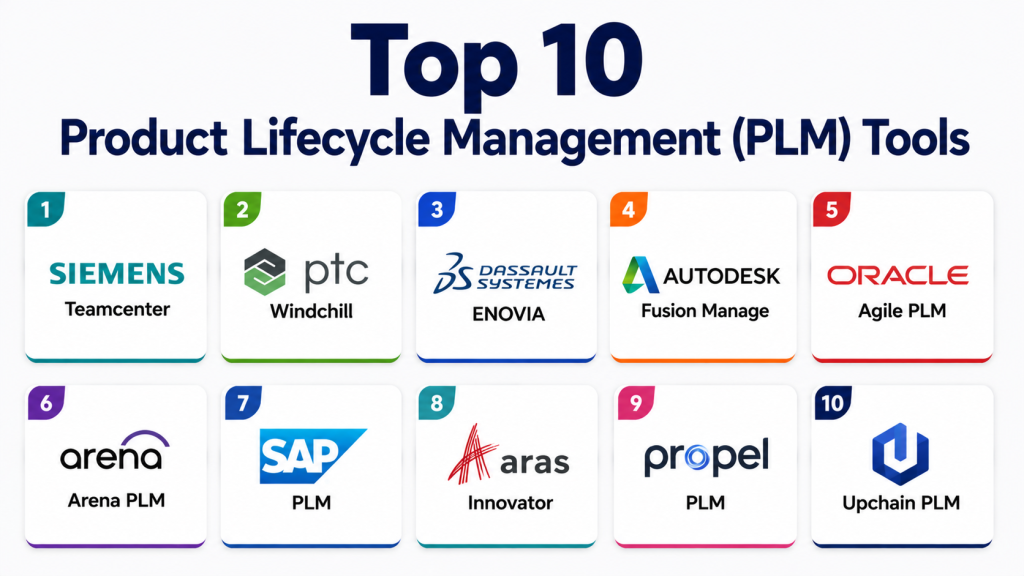
Top 10 Product Lifecycle Management PLM Tools
1- Siemens Teamcenter
Short description: Siemens Teamcenter is an enterprise-grade PLM platform designed for complex manufacturing, engineering, and industrial product lifecycle management operations.
Key Features
- Product data management
- Engineering change workflows
- BOM management
- Digital twin integration
- CAD collaboration
- Compliance tracking
- Manufacturing process management
Pros
- Strong enterprise scalability
- Excellent engineering integrations
- Deep Industry 4.0 alignment
Cons
- Enterprise implementation complexity
- Premium licensing costs
- Requires specialized training
Platforms / Deployment
- Web / Windows
- Cloud / Hybrid / Self-hosted
Security & Compliance
- RBAC
- Encryption
- Audit logging
- Enterprise authentication support
Integrations & Ecosystem
Teamcenter integrates deeply with engineering and manufacturing ecosystems.
- CAD systems
- ERP platforms
- MES systems
- Industrial IoT tools
- Simulation platforms
Support & Community
Strong global enterprise ecosystem and industrial consulting expertise.
2- PTC Windchill
Short description: PTC Windchill is a widely used PLM platform focused on product data management, engineering collaboration, and digital thread connectivity.
Key Features
- Product lifecycle workflows
- Change management
- BOM management
- CAD integrations
- IoT connectivity
- Compliance tracking
- Digital thread support
Pros
- Strong engineering collaboration capabilities
- Excellent IoT ecosystem integration
- Reliable enterprise scalability
Cons
- Advanced configuration complexity
- Premium enterprise positioning
- User interface learning curve
Platforms / Deployment
- Web / Windows
- Cloud / Hybrid
Security & Compliance
- Encryption
- RBAC
- Audit logging
- Enterprise authentication controls
Integrations & Ecosystem
Windchill integrates across engineering and industrial ecosystems.
- CAD platforms
- ERP systems
- IoT platforms
- Simulation tools
- Manufacturing software
Support & Community
Strong engineering support ecosystem and industrial community adoption.
3- Dassault Systèmes ENOVIA
Short description: ENOVIA is a PLM and collaborative innovation platform designed for global product development and engineering operations.
Key Features
- Product data management
- Collaborative engineering workflows
- Change management
- Digital twin support
- Compliance management
- Supplier collaboration
- Manufacturing visibility
Pros
- Strong collaborative design capabilities
- Excellent 3D experience ecosystem integration
- Good enterprise scalability
Cons
- Enterprise implementation complexity
- Advanced customization may require consulting
- Premium licensing model
Platforms / Deployment
- Web / Windows
- Cloud / Hybrid
Security & Compliance
- RBAC
- Encryption
- Audit logging
- Enterprise authentication support
Integrations & Ecosystem
ENOVIA integrates with Dassault engineering and manufacturing ecosystems.
- CATIA
- CAD systems
- ERP platforms
- Simulation software
- Manufacturing systems
Support & Community
Strong enterprise engineering ecosystem and global support network.
4- Autodesk Fusion Manage
Short description: Autodesk Fusion Manage is a cloud-based PLM platform focused on product development, engineering workflows, and manufacturing collaboration.
Key Features
- Product lifecycle workflows
- Engineering change management
- BOM tracking
- Supplier collaboration
- Workflow automation
- Cloud collaboration
- Compliance tracking
Pros
- Modern cloud-native architecture
- Good usability
- Strong Autodesk ecosystem integration
Cons
- Advanced enterprise complexity may vary
- Limited deep industrial customization
- Some integrations require additional configuration
Platforms / Deployment
- Web
- Cloud
Security & Compliance
- Encryption
- RBAC
- Enterprise authentication support
Integrations & Ecosystem
Fusion Manage integrates across Autodesk engineering and manufacturing ecosystems.
- Autodesk CAD tools
- ERP systems
- Manufacturing software
- APIs
Support & Community
Strong design and engineering community support.
5- Oracle Agile PLM
Short description: Oracle Agile PLM provides enterprise product lifecycle management focused on product innovation, compliance, and manufacturing coordination.
Key Features
- Product data management
- Change management
- BOM management
- Supplier collaboration
- Compliance tracking
- Quality workflows
- Product analytics
Pros
- Strong enterprise integration capabilities
- Good manufacturing visibility
- Reliable operational scalability
Cons
- Oracle ecosystem dependency
- Enterprise implementation complexity
- User interface modernization varies
Platforms / Deployment
- Web / Windows
- Hybrid / Self-hosted
Security & Compliance
- RBAC
- Encryption
- Audit logging
- Enterprise authentication controls
Integrations & Ecosystem
Oracle Agile PLM integrates across enterprise operational ecosystems.
- Oracle ERP
- Manufacturing systems
- Supply chain tools
- Analytics platforms
Support & Community
Strong enterprise consulting ecosystem and global support network.
6- Arena PLM
Short description: Arena PLM is a cloud-native product lifecycle management platform designed for manufacturing and electronics product development workflows.
Key Features
- BOM management
- Engineering change workflows
- Supplier collaboration
- Compliance management
- Product quality workflows
- Cloud collaboration
- Product traceability
Pros
- Strong electronics manufacturing focus
- Good usability
- Fast cloud deployment
Cons
- Enterprise customization limitations
- Complex industrial workflows may vary
- Premium pricing for advanced capabilities
Platforms / Deployment
- Web
- Cloud
Security & Compliance
- Encryption
- RBAC
- Enterprise authentication support
Integrations & Ecosystem
Arena PLM integrates across product development and manufacturing ecosystems.
- ERP systems
- CAD tools
- Supply chain platforms
- APIs
Support & Community
Strong manufacturing onboarding and operational support expertise.
7- SAP PLM
Short description: SAP PLM combines product lifecycle workflows with enterprise operational visibility and manufacturing coordination.
Key Features
- Product lifecycle workflows
- Engineering change management
- BOM management
- Compliance tracking
- Product analytics
- Supplier collaboration
- Manufacturing visibility
Pros
- Deep SAP ecosystem integration
- Strong enterprise scalability
- Good manufacturing coordination
Cons
- SAP ecosystem dependency
- Complex enterprise deployment
- Significant implementation costs
Platforms / Deployment
- Web / Windows
- Cloud / Hybrid
Security & Compliance
- RBAC
- Encryption
- Audit logging
- Enterprise authentication controls
Integrations & Ecosystem
SAP PLM integrates deeply with operational and manufacturing ecosystems.
- SAP ERP
- MES systems
- Supply chain tools
- Analytics platforms
Support & Community
Large enterprise support ecosystem and global consulting network.
8- Aras Innovator
Short description: Aras Innovator is a flexible PLM platform known for open architecture and customizable engineering workflows.
Key Features
- Product lifecycle management
- Change workflows
- BOM management
- Workflow customization
- Open architecture
- Digital thread support
- Compliance tracking
Pros
- Flexible customization capabilities
- Open architecture approach
- Good enterprise adaptability
Cons
- Advanced technical expertise required
- Customization complexity
- Smaller ecosystem than larger vendors
Platforms / Deployment
- Web / Windows
- Cloud / Self-hosted / Hybrid
Security & Compliance
- RBAC
- Encryption
- Audit logging
Integrations & Ecosystem
Aras supports integrations across engineering and operational systems.
- CAD platforms
- ERP systems
- APIs
- Manufacturing systems
Support & Community
Growing enterprise ecosystem and active engineering community.
9- Propel PLM
Short description: Propel PLM is a cloud-native PLM platform built on Salesforce infrastructure for product and quality lifecycle management.
Key Features
- Product lifecycle workflows
- Change management
- Quality management
- Supplier collaboration
- Product traceability
- Cloud collaboration
- Workflow automation
Pros
- Strong Salesforce ecosystem integration
- Modern cloud architecture
- Good collaboration capabilities
Cons
- Salesforce dependency
- Advanced manufacturing complexity may vary
- Enterprise customization may require consulting
Platforms / Deployment
- Web
- Cloud
Security & Compliance
- Encryption
- RBAC
- Enterprise authentication support
Integrations & Ecosystem
Propel integrates with Salesforce and operational business systems.
- Salesforce ecosystem
- ERP systems
- Quality platforms
- APIs
Support & Community
Strong cloud collaboration support and growing ecosystem adoption.
10- Upchain PLM
Short description: Upchain PLM is a cloud product lifecycle management platform focused on engineering collaboration and manufacturing coordination.
Key Features
- Product data management
- Engineering workflows
- BOM management
- Supplier collaboration
- Change management
- Cloud collaboration
- CAD integrations
Pros
- Strong engineering usability
- Good cloud collaboration
- Simplified deployment experience
Cons
- Enterprise depth may vary
- Advanced workflow customization limitations
- Smaller ecosystem than large enterprise vendors
Platforms / Deployment
- Web
- Cloud
Security & Compliance
- RBAC
- Encryption
- Audit logging
Integrations & Ecosystem
Upchain integrates across engineering and manufacturing ecosystems.
- CAD systems
- ERP platforms
- Manufacturing systems
- APIs
Support & Community
Strong engineering onboarding and growing cloud manufacturing community.
Comparison Table
| Tool Name | Best For | Platform(s) Supported | Deployment | Standout Feature | Public Rating |
|---|---|---|---|---|---|
| Siemens Teamcenter | Enterprise manufacturing | Windows, Web | Hybrid | Digital twin integration | N/A |
| PTC Windchill | Engineering collaboration | Windows, Web | Hybrid | Digital thread support | N/A |
| Dassault ENOVIA | Global product development | Windows, Web | Hybrid | Collaborative engineering | N/A |
| Autodesk Fusion Manage | Cloud product workflows | Web | Cloud | Cloud-native usability | N/A |
| Oracle Agile PLM | Enterprise operations | Windows, Web | Hybrid | Manufacturing coordination | N/A |
| Arena PLM | Electronics manufacturing | Web | Cloud | Fast cloud deployment | N/A |
| SAP PLM | Enterprise manufacturing | Windows, Web | Hybrid | SAP ecosystem integration | N/A |
| Aras Innovator | Customizable PLM workflows | Windows, Web | Hybrid | Open architecture | N/A |
| Propel PLM | Salesforce-centric operations | Web | Cloud | Salesforce integration | N/A |
| Upchain PLM | Engineering collaboration | Web | Cloud | Simplified deployment | N/A |
Evaluation & Scoring of Product Lifecycle Management PLM
| Tool Name | Core | Ease | Integrations | Security | Performance | Support | Value | Weighted Total |
|---|---|---|---|---|---|---|---|---|
| Siemens Teamcenter | 9.5 | 7.2 | 9.4 | 9.0 | 9.3 | 9.0 | 6.8 | 8.9 |
| PTC Windchill | 9.3 | 7.5 | 9.2 | 8.9 | 9.1 | 8.8 | 7.1 | 8.8 |
| Dassault ENOVIA | 9.4 | 7.1 | 9.1 | 8.9 | 9.2 | 8.9 | 6.9 | 8.8 |
| Autodesk Fusion Manage | 8.5 | 8.7 | 8.0 | 8.2 | 8.5 | 8.4 | 8.6 | 8.4 |
| Oracle Agile PLM | 9.0 | 7.0 | 9.0 | 8.8 | 9.0 | 8.7 | 6.9 | 8.5 |
| Arena PLM | 8.7 | 8.4 | 8.3 | 8.3 | 8.6 | 8.5 | 8.1 | 8.4 |
| SAP PLM | 9.1 | 7.1 | 9.3 | 9.0 | 9.1 | 8.8 | 6.8 | 8.6 |
| Aras Innovator | 8.8 | 7.4 | 8.7 | 8.4 | 8.7 | 8.2 | 8.4 | 8.4 |
| Propel PLM | 8.4 | 8.5 | 8.5 | 8.3 | 8.4 | 8.3 | 8.5 | 8.4 |
| Upchain PLM | 8.3 | 8.6 | 8.0 | 8.1 | 8.3 | 8.2 | 8.7 | 8.3 |
These scores are comparative and designed to help organizations evaluate PLM platforms across engineering functionality, integrations, security, scalability, usability, and operational value. Enterprise-focused systems generally provide deeper lifecycle and manufacturing capabilities, while cloud-native platforms emphasize usability and faster deployment. Organizations should prioritize tools aligned with operational complexity and product development requirements.
Which Product Lifecycle Management PLM Tool Is Right for You?
Solo / Freelancer
Independent engineering consultants and smaller product development teams may benefit from Autodesk Fusion Manage or Upchain PLM because of usability and cloud-native collaboration capabilities.
SMB
Small and medium-sized manufacturers often prefer Arena PLM, Propel PLM, or Autodesk Fusion Manage for balanced functionality and manageable deployment requirements.
Mid-Market
Mid-market manufacturing and engineering organizations may find Aras Innovator, Arena PLM, or PTC Windchill suitable for scalability and operational flexibility.
Enterprise
Large global manufacturing enterprises often prioritize Siemens Teamcenter, Dassault ENOVIA, or SAP PLM for enterprise scalability and advanced engineering coordination.
Budget vs Premium
Cloud-native PLM systems generally reduce infrastructure costs and simplify onboarding, while enterprise-grade PLM ecosystems require larger investments but deliver deeper engineering and manufacturing intelligence.
Feature Depth vs Ease of Use
Enterprise PLM platforms provide advanced product lifecycle capabilities but often involve steeper learning curves and implementation complexity.
Integrations & Scalability
Organizations should carefully evaluate compatibility with ERP systems, CAD platforms, MES infrastructure, supply chain systems, and engineering workflows before selecting a PLM platform.
Security & Compliance Needs
Manufacturing and regulated industries should prioritize encryption, RBAC, audit logging, intellectual property protection, and enterprise-grade operational visibility when evaluating PLM systems.
Frequently Asked Questions FAQs
1- What is Product Lifecycle Management PLM?
Product Lifecycle Management PLM is a software-based approach used to manage the entire lifecycle of a product from concept and design through manufacturing, maintenance, and retirement. PLM systems centralize product data, workflows, engineering changes, and collaboration processes. They help organizations improve product quality and operational efficiency. PLM is especially important in manufacturing industries.
2- Why are PLM platforms important in modern manufacturing?
Modern manufacturing involves increasingly complex products, distributed engineering teams, and strict compliance requirements that require centralized lifecycle coordination. PLM systems improve collaboration, reduce product development delays, and improve operational visibility. They also support digital transformation and Industry 4.0 initiatives significantly.
3- Which industries commonly use PLM software?
PLM platforms are widely used in aerospace, automotive, industrial manufacturing, electronics, medical devices, consumer products, and engineering-heavy industries. These sectors rely on strong product lifecycle coordination and engineering collaboration. Regulated industries especially benefit from structured product traceability and compliance workflows.
4- What should organizations evaluate before selecting a PLM platform?
Organizations should evaluate CAD integrations, change management capabilities, workflow automation, scalability, security controls, deployment flexibility, analytics functionality, and supplier collaboration support. Compatibility with ERP and manufacturing systems is also extremely important. Businesses should align PLM capabilities with long-term product development strategies.
5- Are cloud-based PLM systems secure?
Modern cloud PLM platforms generally include encryption, RBAC, audit logging, and enterprise authentication controls. However, organizations managing intellectual property and regulated engineering data should still evaluate security and compliance requirements carefully before deployment. Hybrid architectures remain common in large industrial environments.
6- What role does AI play in modern PLM systems?
AI helps improve design optimization, engineering analytics, predictive maintenance planning, workflow automation, and compliance forecasting. Generative AI is also accelerating documentation and product development workflows significantly. AI-driven operational intelligence is becoming increasingly important across modern PLM ecosystems.
7- Can PLM systems integrate with ERP and manufacturing platforms?
Yes, most modern PLM systems integrate with ERP platforms, MES systems, CAD tools, supply chain software, and industrial IoT infrastructure. These integrations improve operational visibility and engineering coordination significantly. Compatibility should always be validated during implementation planning and pilot testing.
8- How difficult is PLM implementation?
PLM implementation complexity depends on organizational size, engineering complexity, integration requirements, and operational workflows. Smaller cloud-native systems may deploy relatively quickly, while enterprise-grade platforms often require extensive planning and consulting support. Employee training and process standardization are critical for successful deployment.
9- Are PLM platforms suitable for SMB organizations?
Yes, many modern PLM platforms are designed specifically for SMB manufacturers and engineering teams with simplified deployment and cloud-native collaboration workflows. Platforms like Arena PLM and Autodesk Fusion Manage are popular among growing product-focused businesses. SMB-focused systems often prioritize usability and faster onboarding.
10- How can organizations successfully modernize PLM environments?
Successful PLM modernization requires evaluating engineering workflows, manufacturing systems, compliance requirements, and operational goals carefully. Organizations should prioritize integrations, scalability, analytics, and cybersecurity during modernization planning. Pilot deployments and phased implementation strategies help reduce operational risks significantly.
Conclusion
Product Lifecycle Management PLM platforms have become essential technologies for organizations seeking to improve product innovation, engineering collaboration, manufacturing visibility, and operational efficiency across increasingly complex global environments. As industries continue modernizing operations and accelerating digital transformation initiatives, PLM systems are evolving beyond traditional product data management into intelligent operational ecosystems powered by AI-driven analytics, digital twins, cloud-native collaboration, predictive insights, and integrated manufacturing visibility. Enterprise-grade platforms like Siemens Teamcenter, PTC Windchill, and Dassault ENOVIA continue to dominate large-scale industrial and engineering environments, while cloud-native solutions such as Arena PLM, Autodesk Fusion Manage, and Propel PLM provide operational agility and usability for SMB and mid-market organizations. Manufacturing enterprises focused on deep ERP integration may prioritize SAP PLM or Oracle Agile PLM, while organizations requiring workflow flexibility often consider Aras Innovator. Ultimately, the best PLM platform depends on organizational scale, engineering complexity, product development requirements, compliance obligations, and long-term digital transformation goals. Businesses should shortlist multiple platforms, validate integrations with engineering and manufacturing systems, run pilot lifecycle workflows, and carefully evaluate scalability, security, analytics, and vendor support before making a long-term PLM investment.

Find Trusted Cardiac Hospitals
Compare heart hospitals by city and services — all in one place.
Explore Hospitals
PLM tools make it easier to manage a product’s journey from design to delivery while keeping teams better aligned.