Introduction
Sales tax automation tools help businesses calculate, collect, report, and file sales tax across different states, cities, counties, product categories, customer types, and sales channels. Instead of manually checking tax rates, tracking nexus rules, preparing returns, and reconciling tax reports from multiple systems, these platforms automate tax calculation and compliance workflows. Sales tax automation matters because businesses now sell through e-commerce stores, marketplaces, SaaS platforms, retail locations, subscriptions, and cross-border channels. Tax rules can change by jurisdiction, product type, buyer location, exemption status, and transaction model, which makes manual handling risky and time-consuming.
Real World Use Cases
- Calculating sales tax at checkout for e-commerce stores
- Tracking economic nexus across multiple states
- Preparing and filing sales tax returns
- Managing exemption certificates for tax-exempt buyers
- Syncing sales tax data with accounting, ERP, billing, and commerce systems
Evaluation Criteria for Buyers
- Sales tax calculation accuracy
- Economic nexus tracking
- Filing and remittance support
- Product taxability rules
- Exemption certificate management
- Marketplace and e-commerce integrations
- Accounting and ERP connectivity
- Reporting and audit readiness
- Ease of implementation
- Pricing fit for transaction volume
Best for: Sales tax automation tools are best for e-commerce businesses, SaaS companies, online retailers, marketplaces, wholesalers, manufacturers, finance teams, tax teams, accounting firms, and businesses selling across multiple jurisdictions.
Not ideal for: Very small local businesses selling only in one tax jurisdiction may not need a dedicated sales tax automation platform. A basic accounting system, local tax advisor, or simple manual filing workflow may be enough until sales volume, nexus exposure, or product complexity increases.
Key Trends in Sales Tax Automation Tools for Modern Businesses
- Economic nexus tracking is now essential: Businesses selling online must monitor where their sales volume, transaction count, and customer location create tax obligations.
- Marketplace and direct sales tax workflows are merging: Companies selling through both their own website and third-party marketplaces need tools that separate marketplace-collected tax from merchant-collected tax.
- Product taxability is becoming more complex: Digital goods, SaaS subscriptions, services, food items, clothing, software, and bundled products may be taxed differently depending on jurisdiction.
- Real-time tax calculation is expected: Buyers need tax calculation at checkout, invoice creation, subscription billing, and point-of-sale transactions without slowing down the customer experience.
- Exemption certificate automation is growing: B2B sellers need better ways to collect, validate, store, and apply exemption certificates to customer transactions.
- Accounting and ERP integration is a major buying factor: Finance teams want sales tax data to flow into accounting, ERP, billing, order management, and reporting systems without manual cleanup.
- Audit readiness is becoming more important: Businesses need tax calculation records, filing history, exemption documentation, and transaction-level evidence.
- Cloud-based tax engines are replacing manual rate tables: Cloud platforms can update tax rules, rates, and compliance logic more efficiently than spreadsheet-based workflows.
- AI-assisted classification is gaining attention: AI can help review transaction data, flag unusual tax treatment, classify products, and identify missing customer or location data.
- Usage-based pricing is common: Many sales tax tools price based on transactions, filings, states, entities, or feature modules, so buyers must estimate usage carefully.
How We Selected These Tools
The tools below were selected using practical evaluation logic for sales tax automation, e-commerce compliance, finance workflows, and business scalability.
- Market adoption and recognition: Preference was given to tools commonly recognized by e-commerce sellers, SaaS companies, finance teams, accounting firms, and tax professionals.
- Sales tax feature depth: Tools were evaluated for tax calculation, nexus tracking, filing, reporting, exemption management, and audit support.
- E-commerce and marketplace fit: Strong platforms should integrate with online stores, marketplaces, billing tools, and checkout systems.
- Accounting and ERP connectivity: Tools with useful accounting, ERP, billing, and finance integrations were prioritized.
- Customer segment fit: The list includes options for SMBs, e-commerce sellers, growing companies, accounting firms, and enterprises.
- Scalability: Platforms were considered for transaction volume, multi-state selling, multi-entity businesses, and complex product catalogs.
- Reliability and performance signals: Sales tax tools must calculate tax quickly and consistently during checkout, invoicing, and order processing.
- Security posture signals: Admin permissions, access controls, audit records, and data governance features were considered where confidently known.
- Ease of adoption: Tools that simplify onboarding, filing workflows, and day-to-day tax operations were prioritized.
- No invented ratings: Public ratings are not guessed. Where rating confidence is not strong, “N/A” is used.
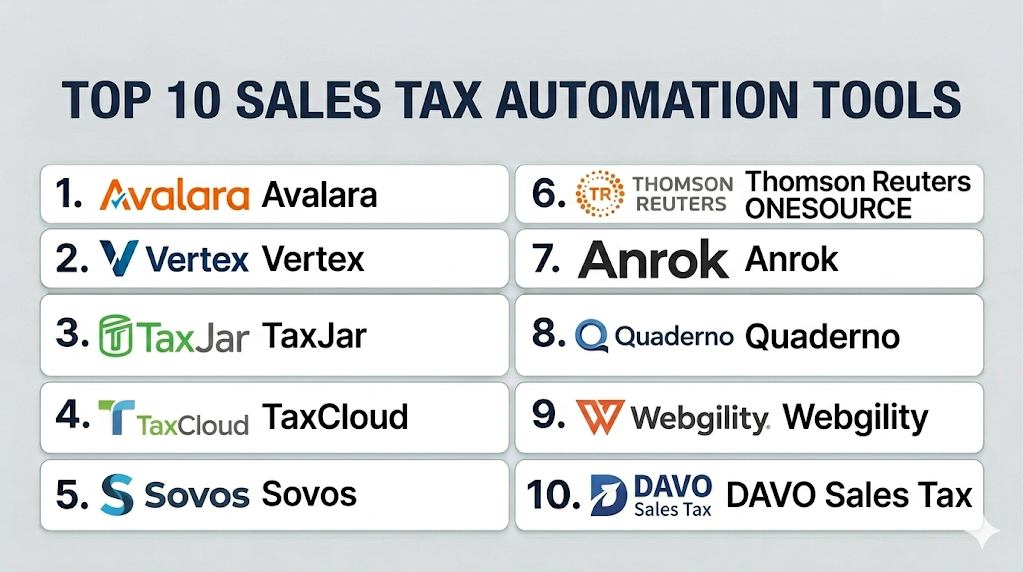
Top 10 Sales Tax Automation Tools
1- Avalara
Short description: Avalara is a widely recognized sales tax automation platform for businesses that need tax calculation, returns, filing, exemption certificate management, and multi-channel tax compliance. It is suitable for e-commerce sellers, SaaS companies, retailers, manufacturers, and larger businesses with complex tax exposure.
Key Features
- Sales and use tax calculation
- Economic nexus tracking support
- Sales tax returns and filing workflows
- Exemption certificate management
- Product taxability support
- E-commerce, marketplace, and ERP integrations
- Reporting and audit documentation support
Pros
- Strong fit for multi-state and multi-channel sellers
- Broad integration ecosystem for commerce and finance systems
- Useful for companies that need filing and tax calculation in one platform
Cons
- Pricing can vary based on transaction volume and required modules
- Implementation may require cleanup of product and customer tax data
- Smaller businesses may not need the full platform depth
Platforms / Deployment
Web
Cloud
Security & Compliance
Avalara provides business-grade tax automation workflows, administrative controls, and compliance-oriented reporting. Specific certifications, SSO, MFA, RBAC, encryption, and audit log details should be verified directly during vendor review.
Integrations & Ecosystem
Avalara is commonly used as a tax engine connected to e-commerce, accounting, billing, POS, marketplace, and ERP systems. It is especially useful when sales tax calculation needs to happen at checkout, invoice creation, or order processing.
- E-commerce platform integrations
- Accounting software integrations
- ERP integrations
- Billing system integrations
- Marketplace and POS connections
- API-based tax calculation workflows
Support & Community
Avalara provides documentation, onboarding resources, support options, partner services, and tax education materials. Support depth may vary by plan, business size, and implementation scope.
2- Vertex
Short description: Vertex is an enterprise-grade tax automation platform used for sales tax, use tax, VAT, GST, tax determination, compliance reporting, and complex transaction tax workflows. It is best for larger businesses with ERP-heavy environments and high transaction complexity.
Key Features
- Sales and use tax calculation
- Enterprise tax determination engine
- Product and jurisdiction taxability logic
- Compliance reporting support
- ERP and commerce integrations
- Scalable transaction processing
- Global indirect tax workflow support
Pros
- Strong fit for enterprise and complex tax environments
- Useful for businesses with large ERP and commerce stacks
- Mature transaction tax calculation capabilities
Cons
- May be too complex for smaller companies
- Implementation can require tax, IT, and ERP expertise
- Cost and project scope may be higher than SMB-focused tools
Platforms / Deployment
Web
Cloud / Hybrid options may vary by product
Security & Compliance
Vertex supports enterprise tax workflows and governance-focused administration. Specific security certifications, SSO, MFA, audit logs, role-based access, and compliance documentation should be verified directly.
Integrations & Ecosystem
Vertex is designed to connect with enterprise systems where tax needs to be calculated across procurement, billing, commerce, order management, and finance workflows.
- ERP integrations
- Commerce platform integrations
- Procurement system connections
- Billing system integrations
- API and tax engine workflows
- Reporting and compliance exports
Support & Community
Vertex offers enterprise support, implementation services, documentation, tax content resources, and partner support. Support levels depend on product, region, and contract.
3- TaxJar
Short description: TaxJar is a sales tax automation tool focused on e-commerce businesses, online sellers, marketplaces, and growing merchants. It helps with sales tax calculation, reporting, filing, and nexus-related workflows.
Key Features
- Sales tax calculation
- Sales tax reporting
- Automated filing workflows
- Economic nexus tracking support
- E-commerce platform integrations
- Marketplace and cart connections
- API-based tax workflows
Pros
- Strong fit for e-commerce and online sellers
- Easier to adopt than many enterprise tax platforms
- Useful for multi-state sales tax workflows
Cons
- Primarily focused on sales tax use cases
- May not fit complex enterprise indirect tax needs
- Global tax requirements may need additional tools
Platforms / Deployment
Web
Cloud
Security & Compliance
TaxJar supports sales tax automation workflows and platform administration features. Specific security certifications, SSO, MFA, audit logs, and compliance controls should be verified directly.
Integrations & Ecosystem
TaxJar works well for businesses that sell through online stores, marketplaces, and digital commerce channels. It helps connect transaction data with tax calculation and reporting workflows.
- E-commerce integrations
- Marketplace integrations
- Accounting workflows
- API connectivity
- Sales tax reporting exports
- Filing workflow support
Support & Community
TaxJar provides documentation, support resources, tax education content, and onboarding guidance. Support depth varies by plan and account type.
4- TaxCloud
Short description: TaxCloud is a sales tax compliance platform for businesses that need automated sales tax calculation, filing support, product taxability, and transaction-level reporting. It is especially useful for SMBs and e-commerce sellers seeking a focused sales tax solution.
Key Features
- Sales tax calculation
- Sales tax filing workflows
- Product taxability support
- Jurisdiction-based tax logic
- E-commerce integrations
- API-based workflows
- Reporting and compliance exports
Pros
- Focused sales tax automation for growing businesses
- Useful for e-commerce and multi-state sellers
- Can be simpler than large enterprise tax platforms
Cons
- May not cover broader corporate tax or global VAT needs
- Advanced enterprise requirements should be validated
- Integration depth depends on the business stack
Platforms / Deployment
Web
Cloud
Security & Compliance
TaxCloud provides sales tax compliance workflows and platform administration features. Specific security certifications, access controls, and compliance documentation should be confirmed directly.
Integrations & Ecosystem
TaxCloud connects with commerce and business systems to support sales tax calculation and filing workflows.
- E-commerce integrations
- API connectivity
- Marketplace-related workflows
- Sales tax reporting exports
- Accounting workflow support
- Filing support workflows
Support & Community
TaxCloud provides documentation, onboarding resources, and customer support options. Support depth may vary by product package and business size.
5- Sovos
Short description: Sovos provides tax compliance technology for sales tax, VAT, GST, e-invoicing, digital tax reporting, and global compliance workflows. It is best for companies operating across multiple jurisdictions with complex indirect tax and reporting requirements.
Key Features
- Sales tax and indirect tax support
- VAT and GST compliance workflows
- E-invoicing and digital reporting support
- Compliance reporting and filing workflows
- ERP integration capabilities
- Transaction-level tax compliance records
- Cross-border tax workflow support
Pros
- Strong fit for global and multi-jurisdiction compliance
- Useful for companies facing digital tax mandates
- Supports broader indirect tax needs beyond sales tax
Cons
- May be more advanced than needed for local-only sellers
- Implementation can vary by country and workflow complexity
- Buyers must validate coverage for specific regions and tax types
Platforms / Deployment
Web
Cloud
Security & Compliance
Sovos supports compliance-focused workflows for tax reporting, e-invoicing, and regulated transaction environments. Specific certifications, access controls, audit logs, and security documentation should be verified directly.
Integrations & Ecosystem
Sovos is designed to connect tax compliance processes with ERP, invoicing, procurement, finance, and transaction systems.
- ERP integrations
- E-invoicing workflows
- VAT and GST reporting workflows
- Sales tax reporting workflows
- Invoice validation workflows
- Compliance archive workflows
Support & Community
Sovos provides documentation, implementation support, customer support, compliance updates, and country-specific tax resources. Support requirements depend on regions, mandates, and project scope.
6- Thomson Reuters ONESOURCE
Short description: Thomson Reuters ONESOURCE supports corporate tax, indirect tax, reporting, and compliance workflows for businesses with complex tax operations. It is best for larger organizations that need tax data management, reporting, and integrated finance workflows.
Key Features
- Indirect tax workflow support
- Corporate tax and reporting capabilities
- Tax data management
- Compliance and audit workflows
- ERP and finance integration support
- Global tax team collaboration
- Reporting and documentation controls
Pros
- Strong fit for corporate tax departments
- Useful for larger organizations with complex reporting needs
- Broad tax lifecycle coverage across enterprise workflows
Cons
- May be too advanced for simple sales tax needs
- Implementation may require tax process planning
- Pricing and modules can vary significantly
Platforms / Deployment
Web
Cloud
Security & Compliance
ONESOURCE supports enterprise tax workflows and controlled compliance processes. Specific certifications, SSO, MFA, RBAC, audit logs, and compliance details should be verified directly.
Integrations & Ecosystem
ONESOURCE is built for tax teams that need tax data connected across finance, ERP, reporting, and compliance workflows.
- ERP integrations
- Finance reporting workflows
- Corporate tax data connections
- Indirect tax workflows
- Compliance documentation support
- Export and reporting tools
Support & Community
Thomson Reuters provides documentation, customer support, professional services, implementation resources, and tax research ecosystem support. Support depth varies by product and agreement.
7- Anrok
Short description: Anrok is a sales tax and VAT automation platform built especially for SaaS and digital businesses. It helps companies manage tax calculation, nexus, registrations, filings, and digital product taxability.
Key Features
- Sales tax automation for SaaS and digital products
- VAT and GST support for global selling
- Economic nexus tracking
- Tax registration workflow support
- Filing and remittance support
- Billing platform integrations
- Product taxability support for software and subscriptions
Pros
- Strong fit for SaaS and digital-first businesses
- Useful for subscription billing and software tax workflows
- Designed around modern digital commerce models
Cons
- May not fit traditional retail or manufacturing needs as deeply
- Global scope should be validated by target markets
- Larger enterprise use cases may require careful evaluation
Platforms / Deployment
Web
Cloud
Security & Compliance
Anrok provides tax compliance workflows for digital businesses. Specific security certifications, SSO, MFA, RBAC, audit logs, and compliance controls should be verified directly.
Integrations & Ecosystem
Anrok is designed to connect with SaaS billing, payment, accounting, and finance systems where tax must be calculated and managed across subscriptions and digital products.
- Billing platform integrations
- Payment workflow integrations
- Accounting integrations
- SaaS tax workflows
- Filing and registration support
- Reporting exports
Support & Community
Anrok provides onboarding resources, documentation, customer support, and guidance for SaaS tax workflows. Support depth may vary by company size and agreement.
8- Quaderno
Short description: Quaderno is a tax automation platform for online businesses, creators, SaaS companies, and digital product sellers. It helps calculate taxes, create tax-compliant invoices, monitor tax thresholds, and generate reports.
Key Features
- Sales tax, VAT, and GST calculation support
- Tax-compliant invoicing
- Threshold and nexus monitoring
- Digital product tax workflows
- Reporting and tax summaries
- Payment and e-commerce integrations
- Multi-country tax support
Pros
- Good fit for small online businesses and digital sellers
- Simple workflows for invoices and tax reports
- Useful for businesses selling digital products internationally
Cons
- May not fit complex enterprise tax workflows
- Filing automation depth may vary by region
- Advanced ERP needs may require other tools
Platforms / Deployment
Web
Cloud
Security & Compliance
Quaderno provides tax automation workflows and account administration features. Specific certifications, SSO, MFA, audit logs, and compliance documentation should be verified directly.
Integrations & Ecosystem
Quaderno is useful for online businesses that need tax calculations across payments, subscriptions, invoicing, and e-commerce workflows.
- Payment gateway integrations
- E-commerce integrations
- Subscription billing workflows
- Invoicing workflows
- Reporting exports
- API connectivity
Support & Community
Quaderno provides documentation, support resources, tax guides, and onboarding help. Support levels may vary by plan and business requirement.
9- Webgility
Short description: Webgility helps e-commerce businesses automate accounting, sales tax workflows, order syncing, inventory data, and financial operations across selling channels. It is useful for sellers who want tax and transaction data connected with accounting systems.
Key Features
- E-commerce accounting automation
- Sales tax data sync and reporting support
- Multi-channel order integration
- Accounting software connections
- Inventory and transaction workflow support
- Marketplace and shopping cart integrations
- Reconciliation support
Pros
- Strong for e-commerce sellers using accounting platforms
- Helps centralize sales, tax, and transaction data
- Useful for multi-channel sellers needing cleaner finance workflows
Cons
- Not a dedicated tax filing platform like some sales tax tools
- Best fit depends on accounting and e-commerce stack
- Complex tax scenarios may need a dedicated tax engine
Platforms / Deployment
Web
Cloud
Security & Compliance
Webgility supports business finance workflows and platform administration features. Specific security certifications, SSO, MFA, audit logs, and compliance documentation should be verified directly.
Integrations & Ecosystem
Webgility connects e-commerce channels with accounting and finance systems, helping sellers organize transaction and sales tax data.
- Marketplace integrations
- E-commerce platform integrations
- Accounting software integrations
- Inventory workflow connections
- Order data sync
- Reporting and reconciliation exports
Support & Community
Webgility provides documentation, onboarding, support resources, and customer assistance. Support availability may vary by plan and implementation scope.
10- DAVO Sales Tax
Short description: DAVO Sales Tax is a sales tax automation tool focused on helping small businesses set aside, file, and pay sales tax. It is especially useful for brick-and-mortar businesses, restaurants, retailers, and POS-driven operations.
Key Features
- Sales tax collection workflow support
- Automated sales tax filing and payment support
- POS system connections
- Daily tax set-aside style workflows
- Reporting support
- Small business-focused automation
- Sales tax deadline management
Pros
- Useful for small businesses and local merchants
- Helps reduce missed filing and payment issues
- Good fit for POS-driven sales tax workflows
Cons
- Less suited for complex enterprise tax operations
- May not fit global VAT, SaaS, or multi-entity tax needs
- Integration fit depends on POS and accounting systems
Platforms / Deployment
Web
Cloud
Security & Compliance
DAVO Sales Tax supports sales tax filing and payment workflows for businesses. Specific security certifications, access controls, audit logs, and compliance documentation should be verified directly.
Integrations & Ecosystem
DAVO Sales Tax is commonly relevant for businesses using POS systems and needing sales tax automation connected to daily sales activity.
- POS integrations
- Sales tax filing workflows
- Payment workflow support
- Reporting exports
- Small business finance workflows
- Accounting-related workflows
Support & Community
DAVO Sales Tax provides documentation, onboarding resources, and customer support options. Support depth may vary by customer type, POS environment, and service plan.
Comparison Table
| Tool Name | Best For | Platform Supported | Deployment | Standout Feature | Public Rating |
|---|---|---|---|---|---|
| Avalara | E-commerce, SaaS, retail, and multi-state sellers | Web | Cloud | Broad sales tax automation and filing support | N/A |
| Vertex | Enterprises with complex indirect tax needs | Web | Cloud / Hybrid varies | Enterprise-grade tax determination | N/A |
| TaxJar | E-commerce and online sellers | Web | Cloud | Sales tax automation for digital commerce | N/A |
| TaxCloud | SMBs and multi-state sellers | Web | Cloud | Focused sales tax calculation and filing support | N/A |
| Sovos | Global businesses with indirect tax complexity | Web | Cloud | Sales tax, VAT, GST, and digital compliance workflows | N/A |
| Thomson Reuters ONESOURCE | Corporate tax departments and larger organizations | Web | Cloud | Enterprise tax reporting and compliance workflows | N/A |
| Anrok | SaaS and digital product businesses | Web | Cloud | Sales tax and VAT automation for software companies | N/A |
| Quaderno | Online creators, SaaS, and digital sellers | Web | Cloud | Tax-compliant invoicing and digital tax reports | N/A |
| Webgility | E-commerce sellers needing tax data sync | Web | Cloud | E-commerce accounting and sales tax data automation | N/A |
| DAVO Sales Tax | Small retailers, restaurants, and POS-driven businesses | Web | Cloud | Automated sales tax set-aside and filing workflows | N/A |
Evaluation & Scoring of Sales Tax Automation Tools
The scoring below is comparative and designed to help buyers evaluate fit across tax coverage, ease of use, integrations, security, reliability, support, and value. It is not a universal ranking for every company.
| Tool Name | Core 25% | Ease 15% | Integrations 15% | Security 10% | Performance 10% | Support 10% | Value 15% | Weighted Total |
|---|---|---|---|---|---|---|---|---|
| Avalara | 9.3 | 8.3 | 9.2 | 8.6 | 8.8 | 8.4 | 8.1 | 8.70 |
| Vertex | 9.4 | 7.8 | 9.1 | 8.8 | 9.0 | 8.5 | 7.7 | 8.66 |
| TaxJar | 8.4 | 8.8 | 8.6 | 8.1 | 8.5 | 8.1 | 8.5 | 8.48 |
| TaxCloud | 8.1 | 8.5 | 8.1 | 8.0 | 8.2 | 7.9 | 8.6 | 8.24 |
| Sovos | 8.9 | 7.9 | 8.7 | 8.6 | 8.7 | 8.4 | 7.8 | 8.43 |
| Thomson Reuters ONESOURCE | 8.7 | 7.8 | 8.7 | 8.7 | 8.7 | 8.5 | 7.7 | 8.39 |
| Anrok | 8.5 | 8.6 | 8.5 | 8.2 | 8.4 | 8.1 | 8.3 | 8.41 |
| Quaderno | 8.0 | 8.7 | 8.0 | 8.0 | 8.1 | 7.9 | 8.4 | 8.17 |
| Webgility | 7.7 | 8.3 | 8.4 | 7.9 | 8.1 | 8.0 | 8.2 | 8.05 |
| DAVO Sales Tax | 7.6 | 8.5 | 7.6 | 7.8 | 8.0 | 7.9 | 8.4 | 7.98 |
Which Sales Tax Automation Tool Is Right for You?
Solo / Freelancer
Solo sellers may not need a complex sales tax platform unless they sell across multiple jurisdictions, operate an online store, or cross economic nexus thresholds. A simple tax workflow inside an accounting or commerce system may be enough for very low-volume sellers.
If you sell digital products, Quaderno may be useful. If you sell online through multiple channels, TaxJar or TaxCloud may be more practical. If you run a small local POS-based business, DAVO Sales Tax may be worth evaluating.
SMB
SMBs should focus on ease of use, tax calculation, filing support, e-commerce integrations, accounting sync, and price-to-value. TaxJar, TaxCloud, Quaderno, Webgility, DAVO Sales Tax, and Avalara can be strong options depending on business model.
SMBs should avoid buying enterprise tax platforms unless they have complex product taxability, high transaction volume, multiple entities, or broad jurisdiction exposure.
Mid-Market
Mid-market businesses often need stronger tax controls, exemption management, nexus tracking, filing automation, marketplace reporting, and ERP integration. Avalara, TaxJar, Anrok, Sovos, and Vertex may be relevant depending on industry and complexity.
Mid-market buyers should validate how the platform handles taxability rules, product mapping, customer addresses, exemption certificates, marketplace-collected tax, and accounting reconciliation.
Enterprise
Enterprises need scalable tax calculation, ERP integration, indirect tax controls, audit documentation, multi-entity support, and strong governance. Vertex, Avalara, Sovos, and Thomson Reuters ONESOURCE are strong candidates for enterprise evaluation.
Enterprise buyers should involve tax, finance, IT, security, procurement, and operations teams. Sales tax automation is not only a finance tool; it touches checkout, invoicing, billing, accounting, ERP, customer data, and reporting.
Budget vs Premium
Budget-focused businesses should consider tools that match their exact use case. TaxCloud, TaxJar, Quaderno, Webgility, and DAVO Sales Tax may work well for focused SMB or e-commerce needs.
Premium buyers should evaluate Avalara, Vertex, Sovos, Thomson Reuters ONESOURCE, or Anrok if they need deeper automation, multi-state filings, SaaS tax support, ERP integration, exemption workflows, or global indirect tax capabilities.
Feature Depth vs Ease of Use
TaxJar, TaxCloud, Quaderno, and DAVO Sales Tax are generally easier to understand for focused use cases. Avalara, Vertex, Sovos, Thomson Reuters ONESOURCE, and Anrok can support deeper or more specialized tax workflows but may require more planning.
The best tool is not always the one with the most features. It is the one that fits your sales channels, tax exposure, transaction volume, product catalog, and finance stack.
Integrations & Scalability
Integration is critical. Buyers should test whether sales tax data flows correctly from e-commerce platforms, marketplaces, billing tools, POS systems, ERP platforms, and accounting software.
Scalability depends on transaction volume, number of states, product taxability complexity, exemption certificates, filing frequency, and whether the business expands into new channels or countries.
Security & Compliance Needs
Sales tax systems handle transaction, customer, financial, and tax records. Buyers should review SSO, MFA, encryption, role-based access, audit logs, data retention, user permissions, and vendor security documentation.
Companies with strict audit requirements should also confirm transaction-level evidence, calculation history, exemption certificate records, return filing logs, and export capabilities.
Frequently Asked Questions
1. What is sales tax automation software?
Sales tax automation software helps businesses calculate, collect, report, and file sales tax. It reduces manual tax rate lookup, spreadsheet work, and filing errors across multiple jurisdictions.
2. Who needs sales tax automation tools?
Businesses selling across multiple states, online channels, marketplaces, or customer locations can benefit. E-commerce sellers, SaaS companies, retailers, and finance teams often use these tools.
3. What is economic nexus tracking?
Economic nexus tracking helps businesses monitor when sales volume or transaction count creates sales tax obligations in a state. This is important for online and multi-state sellers.
4. Can sales tax tools file returns automatically?
Many sales tax tools support filing workflows or managed filing services. Buyers should confirm which states, forms, filing frequencies, and remittance workflows are supported.
5. How much do sales tax automation tools cost?
Pricing varies by transaction volume, number of states, filings, users, modules, integrations, and support level. Businesses should estimate actual monthly transactions and filing needs before choosing a plan.
6. Do sales tax automation tools integrate with e-commerce platforms?
Yes, many tools integrate with e-commerce platforms, marketplaces, carts, billing systems, POS tools, accounting software, and ERPs. Integration testing is important before rollout.
7. What are common mistakes when choosing sales tax software?
Common mistakes include ignoring product taxability, forgetting marketplace sales, underestimating nexus exposure, skipping filing validation, and not testing accounting sync with real data.
8. Can sales tax tools handle exemption certificates?
Some platforms support exemption certificate collection, storage, validation, and application to transactions. This is important for B2B sellers, wholesalers, manufacturers, and tax-exempt customers.
9. Are sales tax automation tools secure?
Business-grade tools usually include administrative controls and secure workflows. Buyers should verify SSO, MFA, encryption, audit logs, role-based permissions, and data retention practices.
10. Can I switch sales tax software later?
Yes, but switching requires planning. Export historical data, preserve filing records, check certificate records, migrate tax settings, test integrations, and avoid switching during critical filing deadlines.
Conclusion
Sales tax automation tools help businesses reduce manual compliance work, calculate tax more accurately, track nexus exposure, manage filings, and maintain better audit records. The best tool depends on your business model, sales channels, product catalog, transaction volume, jurisdictions, accounting stack, and compliance maturity. Avalara and Vertex are strong for larger and more complex businesses, while TaxJar and TaxCloud are practical for e-commerce and growing sellers. Sovos and Thomson Reuters ONESOURCE support broader tax and compliance needs, while Anrok is useful for SaaS and digital businesses. Quaderno fits online creators and digital sellers, Webgility supports e-commerce accounting and tax data workflows, and DAVO Sales Tax works well for small POS-driven businesses. The right next step is to shortlist two or three tools, run a pilot with real transactions, validate integrations and security controls, and confirm that the tool can support your filing and reporting needs before scaling it across the business.

Find Trusted Cardiac Hospitals
Compare heart hospitals by city and services — all in one place.
Explore Hospitals
Sales tax automation tools are most valuable when they help businesses accurately calculate, collect, report, and manage sales tax obligations across different jurisdictions. By providing real-time tax rate calculation, jurisdiction determination, exemption certificate management, tax filing support, registration tracking, transaction monitoring, audit trails, reporting, and integration with e-commerce, ERP, accounting, and billing systems, these platforms enable organizations to reduce manual tax work, improve compliance accuracy, minimize calculation errors, manage complex tax requirements, and simplify sales tax operations.