Introduction
Cap table management tools help founders, finance teams, legal teams, investors, and company administrators manage ownership records, equity grants, share issuances, option pools, investor holdings, dilution, valuations, and equity-related documents in one structured system. Instead of relying on spreadsheets, manual formulas, email approvals, and scattered legal files, these tools provide a cleaner way to understand who owns what, how ownership changes over time, and what future financing rounds may do to dilution. Cap table management matters because equity is one of the most sensitive parts of a company’s financial and legal structure. Startups, private companies, venture-backed businesses, and growing organizations need accurate records for fundraising, investor reporting, employee stock options, compliance, exits, audits, and board decisions.
Real World Use Cases
- Managing founder shares, investor ownership, and employee equity grants
- Modeling funding rounds, dilution, option pool changes, and exit scenarios
- Tracking stock options, vesting schedules, exercises, and grants
- Preparing investor reports, board materials, and financing documents
- Maintaining accurate ownership data for audits, fundraising, and legal review
Evaluation Criteria for Buyers
- Cap table accuracy and modeling depth
- Equity plan and stock option management
- Investor and shareholder recordkeeping
- Scenario modeling and dilution analysis
- Legal document and compliance workflow support
- Valuation and reporting capabilities
- Employee equity communication features
- Integration with legal, payroll, HR, and finance tools
- Security, permissions, and audit controls
- Pricing fit for company stage and stakeholder count
Best for: Cap table management tools are best for founders, startup finance teams, CFOs, legal teams, venture-backed companies, private companies, investor relations teams, law firms, accelerators, and companies that issue equity to employees, advisors, founders, or investors.
Not ideal for: Very small businesses with no outside investors, no equity grants, and no planned fundraising may not need dedicated cap table software. A lawyer-maintained record or simple spreadsheet may be enough at the earliest stage, but companies should move to structured tools before multiple funding rounds or employee option programs become complex.
Key Trends in Cap Table Management Tools for Modern Businesses
- Equity data is becoming more operational: Cap tables are no longer used only during fundraising. They now support hiring, compensation, investor reporting, board decisions, tax planning, and exit readiness.
- Scenario modeling is a major buying factor: Founders and CFOs want to understand dilution, option pool expansion, convertible notes, SAFE conversions, secondary sales, and exit outcomes before making decisions.
- Employee equity education is becoming more important: Companies increasingly need employee-facing portals that explain grants, vesting, exercise windows, and potential value in plain language.
- Fundraising workflows are becoming more connected: Cap table tools are expanding into financing rounds, investor updates, legal workflows, document management, and data rooms.
- Global equity management is getting more complex: Distributed teams need support for multiple jurisdictions, local equity rules, tax considerations, and international employee grants.
- Private market liquidity is gaining attention: Some platforms are adding support for secondary transactions, tender offers, liquidity programs, and private shareholder workflows.
- Auditability and permission control matter more: Cap table mistakes can create legal, tax, and investor trust problems, so version history, approvals, and role-based access are critical.
- Law firm and investor collaboration is increasing: Founders want their legal counsel, investors, board members, and finance advisors to access accurate ownership records in a controlled way.
- Equity compensation is becoming part of total rewards: Cap table tools increasingly connect with compensation planning, option grants, offer letters, and employee equity communication.
- Spreadsheet replacement remains a core driver: Many companies start with spreadsheets, but errors become harder to control as SAFEs, warrants, grants, rounds, and investor rights grow.
How We Selected These Tools
The tools below were selected using practical evaluation logic for cap table accuracy, equity administration, scenario modeling, stakeholder workflows, compliance support, usability, and scalability.
- Market adoption and recognition: Preference was given to platforms commonly recognized by founders, startup operators, finance teams, venture-backed companies, legal teams, and private market participants.
- Cap table feature depth: Tools were evaluated for share classes, investor records, option pools, SAFE and convertible note tracking, vesting, exercises, and dilution modeling.
- Equity plan management: Platforms with employee option grant workflows, vesting schedules, equity portals, and board approval support were prioritized.
- Scenario modeling: Strong tools should support financing round modeling, exit modeling, ownership changes, dilution analysis, and option pool planning.
- Legal and compliance readiness: Document storage, audit history, stakeholder records, electronic signatures, and legal workflow support were considered important.
- Investor and stakeholder experience: Tools were reviewed for investor access, shareholder visibility, employee portals, and advisor collaboration.
- Scalability: The list includes tools for early startups, high-growth companies, international teams, law firms, private companies, and mature equity programs.
- Security posture signals: Role-based access, admin controls, audit trails, encryption, authentication options, and permissioning were considered where confidently known.
- Ease of adoption: Founders and finance teams need tools that are easier to maintain than spreadsheets and understandable for non-technical stakeholders.
- No invented ratings: Public ratings are not guessed. Where rating confidence is not strong, “N/A” is used.
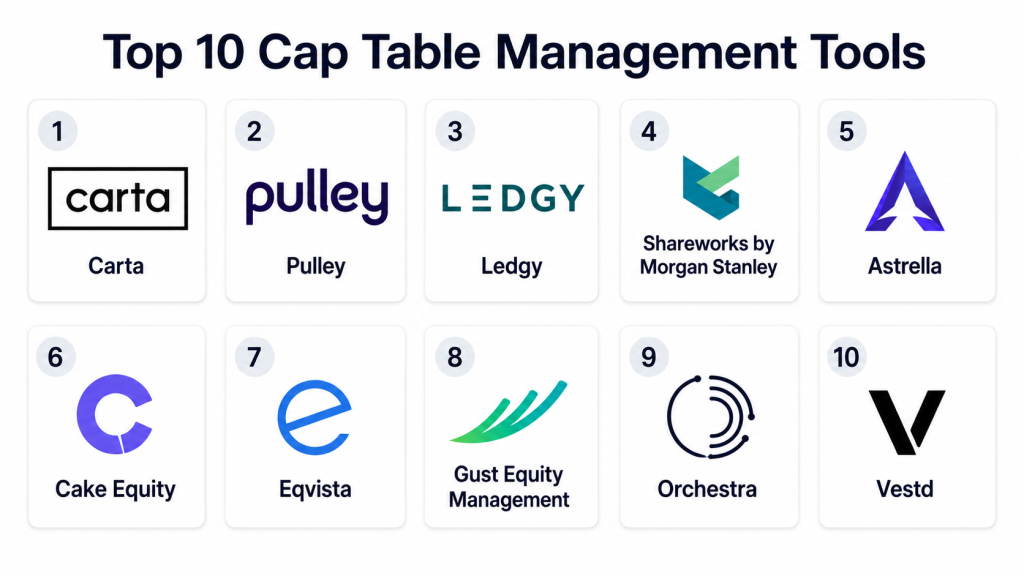
Top 10 Cap Table Management Tools
1- Carta
Short description: Carta is a widely used equity management platform for cap tables, stock options, valuations, investor records, equity plans, and private company ownership workflows. It is best for venture-backed startups and private companies that need structured equity administration.
Key Features
- Cap table management
- Equity plan and option grant administration
- Scenario modeling and dilution analysis
- Shareholder and investor recordkeeping
- Valuation workflow support
- Employee equity portal
- Financing and liquidity workflow support depending on package
Pros
- Strong fit for venture-backed startups and growth companies
- Broad equity management ecosystem
- Useful for managing employees, investors, grants, and ownership data together
Cons
- May be more advanced than very early-stage companies need
- Pricing can vary based on company size and services
- Complex equity structures still require legal and finance review
Platforms / Deployment
Web
Cloud
Security & Compliance
Carta provides business-grade access controls, administrative permissions, and equity data governance features. Specific certifications, SSO, MFA, encryption, audit logs, and compliance documentation should be verified directly during vendor review.
Integrations & Ecosystem
Carta is commonly used across startup finance, legal, investor, and employee equity workflows. It can support collaboration between founders, employees, investors, legal counsel, and finance teams.
- HR and employee data workflows
- Legal and financing document support
- Investor and shareholder access
- Valuation-related workflows
- Employee equity communication
- Reporting and exports
Support & Community
Carta provides onboarding resources, support options, documentation, and equity administration guidance. Support depth may vary by package, company stage, and service requirements.
2- Pulley
Short description: Pulley is a cap table and equity management platform designed for startups and growing private companies. It helps teams manage ownership records, employee equity, fundraising scenarios, investor updates, and equity workflows with a founder-friendly interface.
Key Features
- Cap table management
- Equity grant tracking
- Scenario and dilution modeling
- SAFE and convertible instrument tracking
- Employee equity portal
- Investor reporting support
- Fundraising and financing workflow support
Pros
- Strong fit for early and growth-stage startups
- User-friendly interface for founders and finance teams
- Useful for modeling financing rounds and ownership changes
Cons
- Enterprise-level private market workflows should be validated
- Legal review is still needed for complex equity events
- Advanced global equity needs may require extra evaluation
Platforms / Deployment
Web
Cloud
Security & Compliance
Pulley provides access controls, permissions, and equity data management features. Specific certifications, SSO, MFA, audit logs, encryption, and compliance documentation should be verified directly.
Integrations & Ecosystem
Pulley supports startup equity workflows involving founders, investors, employees, legal advisors, and finance teams.
- Employee equity workflows
- Investor reporting support
- Legal and financing workflows
- Scenario modeling exports
- Stakeholder access
- Cap table reporting
Support & Community
Pulley provides onboarding support, documentation, customer assistance, and startup-focused equity resources. Support depth varies by customer stage and plan.
3- Ledgy
Short description: Ledgy is an equity management platform for startups, scaleups, and international companies managing cap tables, employee participation plans, investor relations, and equity workflows. It is especially useful for companies with distributed or European equity structures.
Key Features
- Cap table management
- Employee equity plan administration
- Investor relations workflows
- Scenario modeling and financing simulation
- Document and stakeholder management
- Multi-country equity support
- Reporting and audit-ready records
Pros
- Strong fit for international startups and scaleups
- Useful for employee equity and investor relations
- Supports structured ownership data and stakeholder workflows
Cons
- Buyers should validate local legal and tax requirements
- Complex enterprise equity structures may need custom review
- Best value depends on accurate setup and ongoing maintenance
Platforms / Deployment
Web
Cloud
Security & Compliance
Ledgy provides equity data controls, permissions, and administrative workflows. Specific certifications, SSO, MFA, audit logs, encryption, and compliance documentation should be verified directly.
Integrations & Ecosystem
Ledgy supports equity workflows across finance, HR, legal, investors, and employees, especially for companies with international ownership structures.
- HR and employee data workflows
- Investor update workflows
- Legal document support
- Employee equity portals
- Reporting exports
- Financing scenario modeling
Support & Community
Ledgy provides onboarding support, documentation, customer assistance, and equity management guidance. Support depth varies by company size and region.
4- Shareworks by Morgan Stanley
Short description: Shareworks by Morgan Stanley is an equity management platform for private and public companies managing equity plans, employee stock programs, cap tables, and participant communications. It is best for larger companies and organizations with more mature equity administration needs.
Key Features
- Equity plan administration
- Cap table and ownership workflows
- Employee equity participant portal
- Stock option and award tracking
- Reporting and compliance support
- Global equity program support
- Stakeholder and participant communication
Pros
- Strong fit for mature private and public-company equity programs
- Useful for complex employee equity administration
- Supports broader equity compensation and participant workflows
Cons
- May be more advanced than early-stage startups need
- Implementation can require planning and specialist support
- Pricing and service scope may vary by company requirements
Platforms / Deployment
Web
Cloud
Security & Compliance
Shareworks provides enterprise-style equity administration controls and participant access features. Specific certifications, SSO, MFA, audit logs, encryption, and compliance documentation should be verified directly.
Integrations & Ecosystem
Shareworks fits into finance, HR, legal, payroll, compensation, and equity administration workflows for companies with larger participant populations.
- HR and payroll-related workflows
- Equity compensation administration
- Participant communication
- Reporting and exports
- Compliance support workflows
- Finance and legal collaboration
Support & Community
Shareworks provides implementation assistance, customer support, documentation, participant support, and equity administration resources. Support depth depends on service agreement and company size.
5- Astrella
Short description: Astrella is an ownership tracking and equity management platform for private companies, legal teams, and finance teams. It supports cap table management, shareholder records, equity plans, scenario modeling, and governance workflows.
Key Features
- Cap table management
- Shareholder and ownership tracking
- Equity plan administration
- Scenario modeling
- Document and stakeholder management
- Reporting and analytics
- Collaboration for legal and finance teams
Pros
- Good fit for private companies and legal teams
- Useful for managing ownership records and equity events
- Supports structured cap table reporting and governance
Cons
- Buyers should validate advanced integrations and regional support
- Complex global equity programs may require additional review
- Implementation quality depends on historical data accuracy
Platforms / Deployment
Web
Cloud
Security & Compliance
Astrella provides access controls and ownership data governance features. Specific certifications, SSO, MFA, audit logs, encryption, and compliance details should be verified directly.
Integrations & Ecosystem
Astrella supports equity ownership workflows for private companies, legal advisors, shareholders, and finance teams.
- Legal advisor collaboration
- Ownership reporting
- Equity plan workflows
- Scenario modeling exports
- Stakeholder records
- Document management support
Support & Community
Astrella provides customer support, onboarding assistance, documentation, and equity management guidance. Support depth varies by company type and service needs.
6- Cake Equity
Short description: Cake Equity is an equity and cap table management platform designed for startups and private companies. It helps teams manage cap tables, employee equity, investor records, fundraising scenarios, and equity documents.
Key Features
- Cap table management
- Employee equity and option tracking
- Investor and shareholder records
- Scenario modeling
- Document management support
- Equity grant workflows
- Founder and startup-focused dashboards
Pros
- Practical option for startups and growing companies
- Useful for equity grants and investor ownership tracking
- Supports founders moving away from spreadsheets
Cons
- Advanced enterprise equity needs should be validated
- Local tax and legal treatment still needs advisor review
- Integration ecosystem may vary by market and package
Platforms / Deployment
Web
Cloud
Security & Compliance
Cake Equity provides role-based access and equity record management features. Specific certifications, SSO, MFA, audit logs, encryption, and compliance documentation should be verified directly.
Integrations & Ecosystem
Cake Equity supports startup equity administration workflows across founders, employees, investors, and advisors.
- Employee option workflows
- Investor records
- Equity document support
- Scenario modeling
- Stakeholder access
- Reporting exports
Support & Community
Cake Equity provides onboarding resources, customer support, documentation, and startup equity guidance. Support depth varies by plan and region.
7- Eqvista
Short description: Eqvista is a cap table and equity management platform for private companies, startups, investors, and advisors. It supports cap table tracking, shareholder records, valuations, equity grants, and financing scenarios.
Key Features
- Cap table management
- Shareholder and investor tracking
- Equity grant and option management
- Scenario and exit modeling
- Valuation-related workflow support
- Document and transaction records
- Reporting and ownership analytics
Pros
- Useful for startups and private companies managing ownership records
- Supports valuation and cap table workflows
- Can help organize shareholder and equity grant information
Cons
- Buyers should validate depth for complex global equity programs
- Legal and tax review is still needed for equity events
- Advanced integrations may vary by plan
Platforms / Deployment
Web
Cloud
Security & Compliance
Eqvista provides account access controls and cap table administration features. Specific certifications, SSO, MFA, audit logs, encryption, and compliance documentation should be verified directly.
Integrations & Ecosystem
Eqvista supports equity tracking workflows for founders, shareholders, advisors, and finance teams.
- Shareholder records
- Equity grant workflows
- Valuation support workflows
- Scenario modeling
- Reporting exports
- Document tracking
Support & Community
Eqvista provides documentation, support resources, customer assistance, and equity management guidance. Support depth depends on package and service scope.
8- Gust Equity Management
Short description: Gust Equity Management helps startups manage cap tables, equity ownership, financing events, stock plans, and legal workflows. It is useful for early-stage companies that want structured startup equity administration.
Key Features
- Cap table tracking
- Founder and investor ownership records
- Equity grant management
- Financing and fundraising workflow support
- Document management
- Startup legal workflow support
- Ownership reporting
Pros
- Good fit for early-stage startups
- Helps founders organize equity records from the beginning
- Useful for companies moving beyond manual spreadsheets
Cons
- Larger companies may need deeper enterprise equity administration
- Complex equity structures should be reviewed with legal counsel
- Advanced reporting needs should be validated
Platforms / Deployment
Web
Cloud
Security & Compliance
Gust Equity Management provides access controls and startup equity record features. Specific certifications, SSO, MFA, audit logs, encryption, and compliance documentation should be verified directly.
Integrations & Ecosystem
Gust Equity Management supports startup formation, fundraising, ownership tracking, and equity administration workflows.
- Startup legal workflow support
- Investor record management
- Equity document workflows
- Ownership reporting
- Cap table tracking
- Financing support workflows
Support & Community
Gust provides documentation, startup support resources, onboarding guidance, and equity workflow assistance. Support depth varies by service package.
9- Orchestra
Short description: Orchestra is an equity management platform focused on cap table administration, shareholder management, employee share plans, investor communications, and governance workflows. It is best for private companies and growing businesses that need structured ownership and stakeholder management.
Key Features
- Cap table management
- Shareholder and investor management
- Employee share plan administration
- Investor communications
- Document and governance records
- Reporting and ownership insights
- Equity transaction workflows
Pros
- Strong fit for private companies managing shareholder relationships
- Useful for employee share plans and investor communication
- Supports governance and ownership recordkeeping
Cons
- Regional fit should be validated based on company location
- Advanced venture financing workflows should be tested
- Integration ecosystem may vary by market
Platforms / Deployment
Web
Cloud
Security & Compliance
Orchestra provides access controls and ownership record management features. Specific certifications, SSO, MFA, audit logs, encryption, and compliance documentation should be verified directly.
Integrations & Ecosystem
Orchestra supports stakeholder communication, share plan administration, and cap table workflows for private companies.
- Shareholder communication
- Employee share plan workflows
- Governance records
- Ownership reporting
- Document management
- Investor updates
Support & Community
Orchestra provides customer support, onboarding guidance, documentation, and ownership management assistance. Support depth varies by market and package.
10- Vestd
Short description: Vestd is an equity management platform for companies managing share schemes, employee equity, cap tables, and ownership workflows. It is especially relevant for companies that need practical equity scheme management and employee share plan support.
Key Features
- Cap table management
- Employee share scheme administration
- Shareholder and grant tracking
- Vesting schedule management
- Equity document workflows
- Investor and stakeholder records
- Reporting and ownership visibility
Pros
- Useful for employee equity and share scheme management
- Practical for private companies moving away from spreadsheets
- Supports cap table and stakeholder recordkeeping
Cons
- Regional and legal fit should be validated carefully
- Not every equity structure may be supported out of the box
- Advanced enterprise integrations may vary
Platforms / Deployment
Web
Cloud
Security & Compliance
Vestd provides equity data access controls and administrative features. Specific certifications, SSO, MFA, audit logs, encryption, and compliance documentation should be verified directly.
Integrations & Ecosystem
Vestd supports ownership administration, employee equity, and shareholder workflow needs for private companies.
- Employee equity workflows
- Shareholder records
- Vesting tracking
- Document management
- Cap table reporting
- Stakeholder communication
Support & Community
Vestd provides onboarding resources, support guidance, documentation, and equity administration assistance. Support depth varies by plan and company needs.
Comparison Table
| Tool Name | Best For | Platform Supported | Deployment | Standout Feature | Public Rating |
|---|---|---|---|---|---|
| Carta | Venture-backed startups and private companies | Web | Cloud | Broad equity management and cap table ecosystem | N/A |
| Pulley | Startups and fundraising teams | Web | Cloud | Founder-friendly dilution and scenario modeling | N/A |
| Ledgy | International startups and scaleups | Web | Cloud | Equity management and investor relations workflows | N/A |
| Shareworks by Morgan Stanley | Mature private and public-company equity programs | Web | Cloud | Enterprise equity plan administration | N/A |
| Astrella | Private companies and legal teams | Web | Cloud | Ownership tracking and shareholder management | N/A |
| Cake Equity | Startups and growing private companies | Web | Cloud | Startup-focused equity and cap table workflows | N/A |
| Eqvista | Startups, private companies, and advisors | Web | Cloud | Cap table tracking and valuation workflow support | N/A |
| Gust Equity Management | Early-stage startups | Web | Cloud | Startup equity and financing workflow support | N/A |
| Orchestra | Private companies and shareholder management teams | Web | Cloud | Shareholder communication and share plan workflows | N/A |
| Vestd | Employee share scheme management | Web | Cloud | Share scheme and vesting management | N/A |
Evaluation & Scoring of Cap Table Management Tools
The scoring below is comparative and designed to help buyers evaluate cap table accuracy, equity administration, ease of use, integrations, security, reliability, support, and price-to-value. It is not a universal ranking for every company.
| Tool Name | Core 25% | Ease 15% | Integrations 15% | Security 10% | Performance 10% | Support 10% | Value 15% | Weighted Total |
|---|---|---|---|---|---|---|---|---|
| Carta | 9.4 | 8.2 | 8.8 | 8.8 | 8.8 | 8.4 | 7.8 | 8.60 |
| Pulley | 9.0 | 8.8 | 8.3 | 8.5 | 8.6 | 8.3 | 8.4 | 8.62 |
| Ledgy | 8.8 | 8.5 | 8.2 | 8.5 | 8.5 | 8.3 | 8.3 | 8.46 |
| Shareworks by Morgan Stanley | 9.0 | 7.8 | 8.5 | 8.8 | 8.8 | 8.5 | 7.6 | 8.42 |
| Astrella | 8.5 | 8.2 | 8.0 | 8.4 | 8.4 | 8.2 | 8.1 | 8.28 |
| Cake Equity | 8.3 | 8.6 | 7.8 | 8.2 | 8.3 | 8.1 | 8.4 | 8.27 |
| Eqvista | 8.2 | 8.3 | 7.7 | 8.1 | 8.2 | 8.0 | 8.2 | 8.13 |
| Gust Equity Management | 8.0 | 8.2 | 7.6 | 8.0 | 8.1 | 8.0 | 8.3 | 8.04 |
| Orchestra | 8.1 | 8.3 | 7.7 | 8.1 | 8.2 | 8.1 | 8.2 | 8.11 |
| Vestd | 8.0 | 8.4 | 7.6 | 8.1 | 8.1 | 8.0 | 8.3 | 8.08 |
How to Interpret the Scores
- 8.5 and above: Strong all-around option for startups, venture-backed companies, or teams needing advanced cap table and equity administration.
- 8.0 to 8.4: Solid option for focused equity plan management, shareholder records, or early to mid-stage private companies.
- Below 8.0: May still work for narrow cap table needs, but buyers should validate scalability and legal workflow fit carefully.
- Scores are comparative, not universal. A seed-stage startup and a late-stage company with global equity plans will need different capabilities.
- Always pilot with real cap table records, option grants, financing scenarios, stakeholder permissions, and reporting needs before full rollout.
Which Cap Table Management Tool Is Right for You?
Solo / Freelancer
Solo professionals generally do not need a cap table management platform unless they are launching a startup, advising startups, managing founder equity, or preparing to raise investment. A simple legal record or advisor-maintained spreadsheet may be enough before equity complexity grows.
If a solo founder is preparing for fundraising or issuing advisor equity, Gust Equity Management, Pulley, Cake Equity, or Eqvista may be practical starting points.
SMB
SMBs with founders, investors, advisors, and employee options need a cleaner system for ownership tracking and grant management. Pulley, Cake Equity, Eqvista, Gust Equity Management, Vestd, and Orchestra may be suitable depending on region and equity structure.
SMBs should prioritize ease of use, pricing clarity, founder ownership tracking, option plan support, investor records, and legal collaboration.
Mid-Market
Mid-market companies often need more formal equity administration, employee portals, investor reporting, dilution modeling, valuation support, and board-ready reporting. Carta, Pulley, Ledgy, Astrella, Shareworks, and Orchestra may be strong candidates.
Mid-market buyers should validate option exercises, vesting schedules, financing scenarios, shareholder access, document workflows, and audit trails.
Enterprise
Enterprises and late-stage private companies need mature equity administration, participant communication, global equity support, compliance workflows, reporting, integrations, and strong permissioning. Shareworks by Morgan Stanley, Carta, Ledgy, and Astrella are strong options for more advanced equity programs.
Enterprise buyers should involve finance, legal, HR, compensation, tax advisors, board administrators, and external counsel before selecting a platform.
Budget vs Premium
Budget-focused startups should choose a tool that solves the immediate cap table problem without unnecessary complexity. Pulley, Gust Equity Management, Cake Equity, Eqvista, Vestd, and Orchestra may be practical depending on region and stage.
Premium buyers should evaluate Carta, Shareworks, Ledgy, and Astrella when they need deeper equity administration, investor workflows, participant support, valuations, and scalable governance.
Feature Depth vs Ease of Use
Pulley, Cake Equity, Gust Equity Management, Eqvista, and Vestd can be easier for early-stage teams. Carta, Shareworks, Ledgy, and Astrella provide broader equity administration depth for companies with more complex ownership and stakeholder needs.
The right choice depends on whether the company needs fundraising modeling, employee equity, global equity plans, shareholder communications, valuations, or enterprise-grade administration.
Integrations & Scalability
Cap table tools may need to connect with HR systems, payroll, legal workflows, valuation providers, investor reporting, document management, and finance systems. Buyers should test employee data, grant workflows, document exports, permissioning, and reporting before rollout.
Scalability depends on number of shareholders, financing rounds, equity plans, entities, countries, option holders, transaction history, and reporting requirements.
Security & Compliance Needs
Cap table platforms store highly sensitive ownership, investor, employee, compensation, financing, and legal records. Buyers should review SSO, MFA, role-based access, encryption, audit logs, admin permissions, data export controls, and vendor security documentation.
Companies preparing for fundraising, acquisition, audit, or public-company readiness should also validate historical records, document evidence, approval trails, and legal review workflows.
Frequently Asked Questions
1. What is cap table management software?
Cap table management software helps companies track ownership, shares, investors, founders, employee options, vesting schedules, financing rounds, and dilution in one organized system.
2. Who needs cap table management tools?
Founders, startups, CFOs, legal teams, investors, private companies, and finance teams need cap table tools when ownership records, equity grants, or fundraising events become difficult to manage manually.
3. Why should startups avoid spreadsheet-only cap tables?
Spreadsheets can work early, but errors become risky as companies add investors, SAFEs, convertible notes, option pools, grants, and financing rounds. Dedicated tools reduce formula mistakes and improve governance.
4. Can cap table tools manage employee stock options?
Yes, many cap table tools support option grants, vesting schedules, exercises, equity portals, and employee-facing equity communication. Buyers should validate plan type and local legal requirements.
5. Can these tools model dilution?
Yes, many platforms support dilution modeling, financing scenarios, option pool changes, SAFE conversions, and exit outcomes. The depth of modeling varies by tool and package.
6. How much do cap table tools cost?
Pricing varies by company stage, number of stakeholders, features, services, financing complexity, equity plan size, and support requirements. Buyers should request pricing based on current and expected stakeholder count.
7. Can cap table tools help with fundraising?
Yes, they can help prepare investor-ready ownership reports, financing models, dilution scenarios, and stakeholder records. However, legal and financial advisors should still review financing documents.
8. Are cap table management tools secure?
They should be treated as highly sensitive financial and legal systems. Buyers should verify SSO, MFA, encryption, role-based access, audit logs, data export controls, and vendor security documentation.
9. What are common mistakes when choosing a cap table tool?
Common mistakes include delaying migration too long, importing inaccurate historical data, ignoring legal review, choosing based only on price, and failing to check support for future financing scenarios.
10. Can cap table software replace legal counsel?
No. Cap table software helps organize and model ownership data, but legal counsel is still needed for share issuance, financing documents, option plans, tax considerations, and compliance review.
Conclusion
Cap table management tools help companies manage ownership with more accuracy, transparency, and control as equity structures become more complex. The best platform depends on company stage, investor count, employee equity needs, financing plans, regional requirements, legal workflows, and reporting expectations. Carta, Pulley, Ledgy, and Shareworks by Morgan Stanley are strong options for companies that need deeper equity administration and scalable ownership workflows. Astrella, Cake Equity, Eqvista, Gust Equity Management, Orchestra, and Vestd can fit startups, private companies, and teams looking for practical equity tracking and stakeholder management. The right next step is to shortlist two or three tools, test them with real cap table data and financing scenarios, validate security and permission controls, and confirm that founders, finance, legal, employees, and investors can rely on the system before making it the company’s source of truth.

Find Trusted Cardiac Hospitals
Compare heart hospitals by city and services — all in one place.
Explore Hospitals
Cap table management tools are most valuable when they help companies accurately manage ownership structures, equity records, and stakeholder information through a centralized digital platform. By providing shareholder tracking, equity allocation, stock option management, dilution modeling, fundraising scenario analysis, securities management, reporting, compliance support, investor access, and integration with legal and financial systems, these platforms enable organizations to maintain accurate ownership records, simplify equity administration, understand the impact of financing decisions, reduce administrative work, and improve transparency for investors and stakeholders.