Introduction
Travel Management Software helps companies plan, book, approve, track, and control business travel from one centralized platform. It supports flight booking, hotel booking, rail, car rental, travel policies, approval workflows, traveler profiles, duty of care, expense capture, invoices, reporting, and supplier management. This category matters because business travel is now more cost-sensitive, policy-driven, and employee-experience focused. Companies need better visibility into travel spend, traveler safety, carbon impact, compliance, and disruption management. Modern platforms also connect travel booking with expense management, corporate cards, HR systems, finance tools, and real-time reporting.
Real World Use Cases:
- Booking flights, hotels, rail, and car rentals under company policy
- Managing travel approvals and budget controls
- Tracking traveler location and duty-of-care risks
- Connecting travel bookings with expenses and invoices
- Reporting travel spend, savings, policy compliance, and carbon impact
Evaluation Criteria for Buyers:
- Booking inventory and travel content coverage
- Travel policy enforcement and approval workflows
- Expense, invoice, and corporate card integration
- Traveler support and disruption handling
- Mobile app experience for employees
- Duty of care and traveler safety tools
- Reporting, analytics, and spend visibility
- Global coverage and supplier ecosystem
- Security, privacy, and admin controls
- Implementation effort and support quality
Best for: Finance teams, travel managers, HR teams, operations leaders, procurement teams, executive assistants, frequent business travelers, SMBs, mid-market companies, and enterprises that need better control over travel booking, expenses, compliance, and traveler support.
Not ideal for: Very small teams with rare business travel may not need full travel management software. A normal booking site, company card, shared spreadsheet, or basic expense tool may be enough until travel volume, approval complexity, policy enforcement, or reporting needs become difficult to manage manually.
Key Trends in Travel Management Software
- AI-assisted travel planning is becoming more practical: Travel platforms are adding smarter trip recommendations, policy-aware booking suggestions, disruption alerts, and automated support workflows.
- Travel and expense are merging: Companies increasingly prefer platforms that connect booking, receipts, card spend, approvals, invoices, and reimbursement in one workflow.
- Duty of care is now a board-level concern: Organizations need traveler tracking, risk alerts, emergency communication, and support for disruptions, weather events, political risks, and health-related issues.
- Policy automation is replacing manual review: Modern systems can flag out-of-policy bookings, route approvals, enforce budgets, and guide travelers toward preferred suppliers.
- Sustainability reporting is becoming more important: Buyers want carbon visibility by route, supplier, traveler, department, and trip category to support internal ESG goals.
- Mobile-first traveler experience is expected: Employees want itineraries, booking changes, alerts, receipts, approvals, and support from mobile apps.
- Global content access matters: Companies need access to flights, hotels, rail, car rentals, negotiated rates, low-cost carriers, and regional suppliers.
- Integrated payments are expanding: Corporate cards, virtual cards, lodge cards, invoice billing, and centralized payments help reduce reimbursement friction.
- SMBs want enterprise-style control without heavy setup: Smaller companies want simple travel policy enforcement, fast onboarding, and transparent pricing.
- Data security and privacy are stronger buying factors: Travel tools store passports, traveler profiles, payment data, location history, invoices, and company spend data, so strong governance matters.
How We Selected These Tools
The tools below were selected using practical travel management and finance operations evaluation logic:
- Market recognition among corporate travel, finance, procurement, HR, and operations teams
- Strength of business travel booking across flights, hotels, rail, cars, and negotiated inventory
- Support for travel policy enforcement, approvals, budgets, and traveler profiles
- Ability to connect travel with expense management, invoices, payments, cards, and ERP workflows
- Fit across SMBs, mid-market teams, enterprises, global companies, and managed travel programs
- Traveler experience across web, mobile, itinerary management, alerts, and support
- Duty-of-care capabilities such as traveler tracking, risk alerts, emergency communication, and support workflows
- Reporting depth for spend, savings, compliance, carbon, departments, suppliers, and traveler behavior
- Security posture, admin controls, privacy handling, and enterprise governance expectations
- Practical value for reducing manual booking, improving compliance, and controlling business travel costs
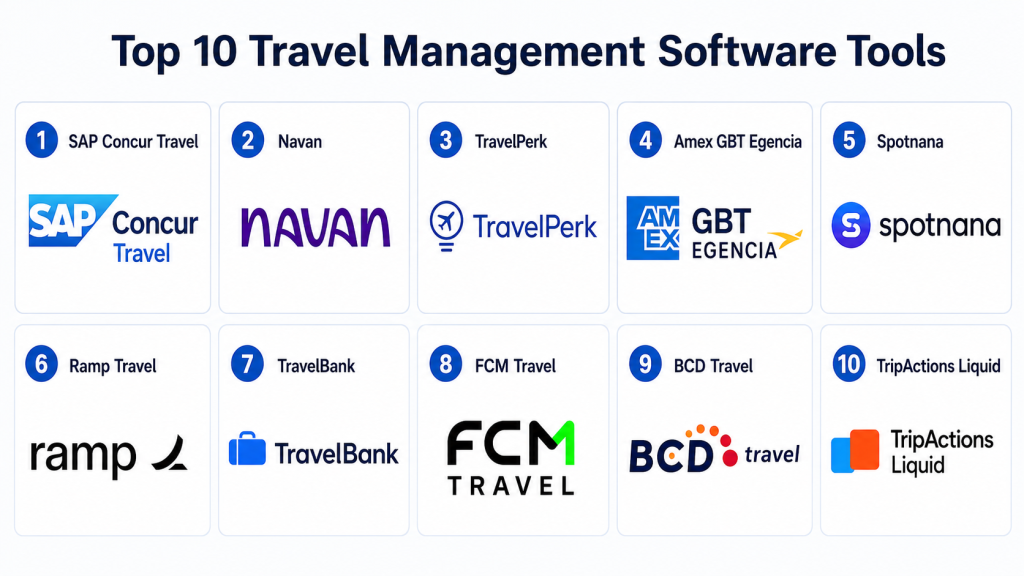
Top 10 Travel Management Software Tools
1- SAP Concur Travel
Short description: SAP Concur Travel is an enterprise travel management platform that connects business travel booking with policy enforcement, expense workflows, approvals, and finance visibility. It is best for large organizations that need strong governance, global scale, and travel-expense integration.
Key Features
- Corporate travel booking and policy controls
- Integration with SAP Concur Expense
- Approval workflows and budget visibility
- Traveler profiles and itinerary management
- Reporting for travel spend and compliance
- Supplier and negotiated rate support
- Enterprise administration and finance controls
Pros
- Strong fit for enterprise travel and expense management
- Mature ecosystem for finance, procurement, and compliance teams
- Useful for companies already using SAP or Concur Expense
Cons
- Implementation can be more complex than SMB-focused tools
- User experience may require training and configuration
- Pricing and contract structure should be reviewed carefully
Platforms / Deployment
Web / iOS / Android
Cloud
Security & Compliance
Varies / N/A. Buyers should validate SSO, MFA, RBAC, encryption, audit logs, data retention, payment data controls, and regional compliance requirements directly.
Integrations & Ecosystem
SAP Concur Travel is strongest when travel booking needs to connect with finance, expense, ERP, and compliance workflows.
- SAP ecosystem
- Concur Expense
- ERP and finance systems
- Travel suppliers and booking content
- Corporate card and payment workflows
- Reporting and analytics tools
Support & Community
SAP Concur provides enterprise support, implementation resources, documentation, partner services, and customer success options. Support depth may vary by contract, region, and implementation size.
2- Navan
Short description: Navan is a modern travel and expense platform for companies that want booking, policy automation, corporate cards, expense capture, traveler support, and spend visibility in one system. It is useful for fast-growing SMBs, mid-market teams, and enterprises looking for a more integrated travel experience.
Key Features
- Business travel booking for flights, hotels, cars, and rail where supported
- Travel policy enforcement
- Expense and corporate card workflows
- Mobile itinerary and traveler experience
- Real-time spend visibility
- Traveler support and disruption workflows
- Reporting and finance controls
Pros
- Strong all-in-one travel and expense experience
- Good fit for modern, fast-moving companies
- Useful mobile app and traveler-focused workflows
Cons
- Best value depends on adopting the broader travel and expense platform
- Global support and content coverage should be validated by region
- Buyers should review pricing, card model, and implementation fit
Platforms / Deployment
Web / iOS / Android
Cloud
Security & Compliance
Varies / N/A. Buyers should validate SSO, MFA, RBAC, encryption, audit logs, card security, data retention, and compliance needs directly.
Integrations & Ecosystem
Navan works well when companies want travel booking, expense automation, and payments connected in one workflow.
- Corporate cards
- Expense management
- Finance and ERP workflows
- HR and identity systems
- Travel suppliers
- Reporting and spend dashboards
Support & Community
Navan provides onboarding, traveler support, documentation, and customer success resources. Support quality may vary by plan, region, and company size.
3- TravelPerk
Short description: TravelPerk is business travel management software designed for companies that want flexible booking, travel policy control, traveler support, and reporting without heavy enterprise complexity. It is useful for SMBs and mid-market companies managing frequent business travel.
Key Features
- Flight, hotel, train, and car rental booking where available
- Travel policy and approval workflows
- Traveler profiles and booking management
- Flexible trip options where configured
- Reporting and spend visibility
- Traveler support workflows
- Integration with expense and business systems
Pros
- Strong fit for SMB and mid-market travel programs
- User-friendly booking experience
- Flexible travel options can support changing business needs
Cons
- Enterprise customization depth should be validated
- Availability and inventory can vary by region
- Some advanced features may require higher-tier plans
Platforms / Deployment
Web / iOS / Android
Cloud
Security & Compliance
Varies / N/A. Buyers should validate SSO, MFA, user roles, encryption, data retention, traveler data handling, and payment security directly.
Integrations & Ecosystem
TravelPerk fits companies that want business travel booking connected with approvals, reporting, and expense workflows.
- Expense management tools
- HR and identity systems
- Calendar and productivity tools
- Travel suppliers
- Finance workflows
- Reporting dashboards
Support & Community
TravelPerk provides onboarding, help resources, traveler support, and customer service. Support depth may vary by plan, country, and travel volume.
4- Amex GBT Egencia
Short description: Amex GBT Egencia is a corporate travel management platform backed by American Express Global Business Travel. It is suitable for companies that want managed travel services, global travel content, traveler support, and corporate travel program visibility.
Key Features
- Corporate travel booking
- Traveler profiles and itinerary management
- Policy enforcement and approvals
- Reporting and travel program analytics
- Support through travel management services
- Global supplier and travel content access
- Expense and finance integration options
Pros
- Strong fit for managed corporate travel programs
- Useful for companies needing global traveler support
- Backed by a major travel management company ecosystem
Cons
- May feel more service-led than pure SaaS-first platforms
- Contracting and pricing should be reviewed carefully
- Buyers should validate user experience and integration fit
Platforms / Deployment
Web / iOS / Android
Cloud / Managed service model
Security & Compliance
Varies / N/A. Buyers should validate SSO, MFA, encryption, admin roles, traveler data handling, reporting controls, and regional compliance needs directly.
Integrations & Ecosystem
Amex GBT Egencia is useful when travel booking needs to connect with managed service, reporting, and corporate travel operations.
- Global travel suppliers
- Travel support services
- Finance and expense workflows
- Corporate travel policy tools
- Reporting and analytics
- Managed travel operations
Support & Community
Support is typically delivered through Amex GBT service channels, account management, traveler support, and implementation resources. Support experience may vary by region and contract.
5- Spotnana
Short description: Spotnana is a travel-as-a-service platform and corporate travel technology provider focused on modern travel infrastructure, global content access, policy controls, and enterprise travel workflows. It is useful for companies, travel providers, and organizations seeking flexible travel technology architecture.
Key Features
- Corporate travel booking workflows
- Travel policy management
- Global travel content access
- Traveler profile and trip management
- API-driven travel infrastructure
- Reporting and spend visibility
- Support for enterprise travel programs
Pros
- Strong technology architecture for modern travel programs
- Useful for companies that need flexible travel infrastructure
- Good fit for enterprise and platform-oriented travel workflows
Cons
- May be more advanced than needed for small teams
- Implementation and partner model should be understood clearly
- Buyers should validate service, content, and support coverage
Platforms / Deployment
Web / Mobile access varies
Cloud
Security & Compliance
Varies / N/A. Buyers should validate SSO, MFA, RBAC, encryption, API security, audit logs, data retention, and compliance requirements directly.
Integrations & Ecosystem
Spotnana is strongest when travel management needs modern infrastructure and extensibility.
- Travel suppliers
- APIs and platform workflows
- Corporate travel policies
- Expense and finance integrations
- Identity and HR systems
- Reporting and analytics tools
Support & Community
Spotnana provides implementation resources, platform support, and customer success options. Support scope may vary by deployment model, customer type, and partner ecosystem.
6- Ramp Travel
Short description: Ramp Travel connects business travel booking with spend management, corporate cards, expense controls, and finance automation. It is useful for companies that want travel policy and travel spend to sit close to purchasing, cards, and expense workflows.
Key Features
- Business travel booking workflows
- Travel policy and spend controls
- Corporate card and expense integration
- Real-time spend visibility
- Approval and compliance workflows
- Finance reporting and budget controls
- Vendor and payment workflow alignment
Pros
- Strong fit for finance-led travel programs
- Useful for companies already using Ramp spend management
- Connects travel decisions with spend controls
Cons
- Best value depends on Ramp ecosystem adoption
- Travel inventory and support coverage should be validated
- May not replace high-touch travel management services for every company
Platforms / Deployment
Web / iOS / Android access varies
Cloud
Security & Compliance
Varies / N/A. Buyers should validate card controls, SSO, MFA, RBAC, encryption, audit logs, payment security, and data retention directly.
Integrations & Ecosystem
Ramp Travel is valuable when travel management is part of broader spend management and finance automation.
- Ramp corporate cards
- Expense management
- Finance and accounting workflows
- Approval workflows
- Budget controls
- Spend reporting
Support & Community
Ramp provides documentation, onboarding, customer support, and finance-focused implementation resources. Support depth may vary by company size and product usage.
7- TravelBank
Short description: TravelBank is travel and expense management software for companies that want booking, expense tracking, budget controls, approvals, and reporting. It is useful for SMBs and mid-market teams that need business travel visibility with practical expense workflows.
Key Features
- Business travel booking
- Expense tracking and reporting
- Travel policy and approval workflows
- Budget and spend visibility
- Receipt capture and reimbursement support
- Corporate card and finance workflow options
- Reporting dashboards
Pros
- Good fit for SMB and mid-market travel-expense workflows
- Practical budgeting and expense visibility
- Useful for teams moving away from manual travel tracking
Cons
- Enterprise global travel complexity should be validated
- Content coverage and support may vary by region
- Buyers should compare expense depth against dedicated expense platforms
Platforms / Deployment
Web / iOS / Android
Cloud
Security & Compliance
Varies / N/A. Buyers should validate SSO, MFA, user roles, encryption, audit logs, expense data handling, and payment controls directly.
Integrations & Ecosystem
TravelBank works well when companies need booking and expense visibility in one platform.
- Expense management workflows
- Corporate cards where supported
- Accounting and finance tools
- Travel booking content
- Budget reporting
- Approval workflows
Support & Community
TravelBank provides documentation, onboarding support, and customer service options. Support depth may vary by plan and travel volume.
8- FCM Travel
Short description: FCM Travel is a corporate travel management company and platform for mid-market and enterprise organizations that need managed travel services, technology, reporting, traveler support, and global travel program administration.
Key Features
- Corporate travel booking and service support
- Travel policy management
- Global traveler assistance
- Reporting and analytics
- Risk and duty-of-care workflows
- Supplier and travel program management
- Expense and finance integration options
Pros
- Strong fit for managed travel programs
- Useful for global and complex travel requirements
- Combines technology with service-led travel management
Cons
- May be more service-heavy than SaaS-only tools
- Pricing and contract structure should be reviewed carefully
- Small businesses may not need the full managed service model
Platforms / Deployment
Web / Mobile access varies
Cloud / Managed service model
Security & Compliance
Varies / N/A. Buyers should validate SSO, data privacy, traveler safety controls, reporting permissions, encryption, auditability, and regional compliance needs directly.
Integrations & Ecosystem
FCM Travel fits organizations that need travel technology plus expert travel management services.
- Travel suppliers
- Expense and finance systems
- Risk management workflows
- Reporting dashboards
- Traveler support channels
- Global travel program operations
Support & Community
FCM provides account management, travel consultants, implementation support, and traveler assistance. Support coverage may vary by region and contract.
9- BCD Travel
Short description: BCD Travel is a global travel management company offering corporate travel technology, managed services, consulting, reporting, and traveler support. It is best for enterprises and global companies that need mature travel program management and service coverage.
Key Features
- Corporate travel program management
- Online booking and service workflows
- Traveler support and disruption management
- Reporting and analytics
- Duty-of-care and risk support
- Supplier management and consulting
- Expense and finance integration options
Pros
- Strong fit for enterprise and global travel programs
- Useful service coverage for complex travel needs
- Mature travel management expertise and supplier ecosystem
Cons
- May not fit companies seeking simple self-service SaaS only
- Contract and service model should be reviewed carefully
- Implementation may involve broader travel program redesign
Platforms / Deployment
Web / Mobile access varies
Cloud / Managed service model / Hybrid support varies
Security & Compliance
Varies / N/A. Buyers should validate data protection, traveler privacy, user access, reporting controls, duty-of-care workflows, and regional compliance requirements directly.
Integrations & Ecosystem
BCD Travel is valuable when travel management needs global program support and managed service depth.
- Travel suppliers
- Online booking tools
- Expense and finance systems
- Risk management platforms
- Reporting dashboards
- Consulting and travel program operations
Support & Community
BCD Travel provides managed travel support, account teams, traveler service channels, and consulting resources. Support scope depends on contract, geography, and travel volume.
10- TripActions Liquid
Short description: TripActions Liquid is closely associated with the Navan ecosystem and focuses on corporate cards, travel spend controls, expense automation, and payment workflows. It is relevant for companies evaluating travel management through the lens of card-based spend visibility and automated finance operations.
Key Features
- Corporate card and travel spend controls
- Expense automation workflows
- Travel-related payment visibility
- Policy-based spend management
- Receipt and transaction capture
- Approval and finance workflows
- Reporting for travel and business spend
Pros
- Strong fit for card-led travel and expense control
- Useful for finance teams needing real-time spend visibility
- Connects travel payments with expense automation
Cons
- Best value depends on broader Navan or TripActions ecosystem fit
- Not a standalone travel booking choice for every buyer
- Buyers should validate current product packaging and availability
Platforms / Deployment
Web / iOS / Android access varies
Cloud
Security & Compliance
Varies / N/A. Buyers should validate card security, payment controls, SSO, MFA, RBAC, encryption, audit logs, and data retention requirements directly.
Integrations & Ecosystem
TripActions Liquid is useful when travel management needs to connect deeply with spend controls and corporate card workflows.
- Corporate cards
- Expense automation
- Finance and accounting workflows
- Travel spend reporting
- Approval policies
- Business payment controls
Support & Community
Support is typically aligned with the broader Navan or TripActions service model. Buyers should validate implementation, card support, finance workflows, and regional availability directly.
Comparison Table
| Tool Name | Best For | Platform Supported | Deployment | Standout Feature | Public Rating |
|---|---|---|---|---|---|
| SAP Concur Travel | Enterprise travel and expense governance | Web, iOS, Android | Cloud | Travel booking tied to expense and finance controls | N/A |
| Navan | Modern travel and expense automation | Web, iOS, Android | Cloud | Unified travel, expense, card, and spend visibility | N/A |
| TravelPerk | SMB and mid-market business travel | Web, iOS, Android | Cloud | Flexible business travel booking experience | N/A |
| Amex GBT Egencia | Managed corporate travel programs | Web, iOS, Android | Cloud / Managed service | Global travel support and managed services | N/A |
| Spotnana | Enterprise travel technology infrastructure | Web, mobile varies | Cloud | API-driven travel platform architecture | N/A |
| Ramp Travel | Finance-led travel and spend control | Web, mobile varies | Cloud | Travel connected with spend management | N/A |
| TravelBank | SMB travel and expense workflows | Web, iOS, Android | Cloud | Travel booking plus budget and expense visibility | N/A |
| FCM Travel | Managed mid-market and enterprise travel | Web, mobile varies | Cloud / Managed service | Service-led global travel management | N/A |
| BCD Travel | Global enterprise travel programs | Web, mobile varies | Cloud / Managed service / Hybrid varies | Mature global travel program management | N/A |
| TripActions Liquid | Card-led travel spend control | Web, mobile varies | Cloud | Corporate cards and travel expense automation | N/A |
Evaluation & Scoring of Travel Management Software
| Tool Name | Core 25% | Ease 15% | Integrations 15% | Security 10% | Performance 10% | Support 10% | Value 15% | Weighted Total |
|---|---|---|---|---|---|---|---|---|
| SAP Concur Travel | 9.2 | 7.5 | 9.1 | 8.6 | 8.8 | 8.6 | 7.4 | 8.4 |
| Navan | 9.0 | 8.8 | 8.8 | 8.2 | 8.7 | 8.4 | 8.0 | 8.6 |
| TravelPerk | 8.7 | 8.7 | 8.4 | 8.0 | 8.5 | 8.3 | 8.2 | 8.5 |
| Amex GBT Egencia | 8.8 | 8.0 | 8.5 | 8.2 | 8.6 | 8.7 | 7.6 | 8.4 |
| Spotnana | 8.8 | 8.1 | 9.0 | 8.2 | 8.6 | 8.2 | 7.8 | 8.4 |
| Ramp Travel | 8.3 | 8.6 | 8.6 | 8.3 | 8.4 | 8.2 | 8.5 | 8.4 |
| TravelBank | 8.2 | 8.4 | 8.0 | 7.8 | 8.2 | 8.0 | 8.3 | 8.1 |
| FCM Travel | 8.7 | 7.9 | 8.4 | 8.1 | 8.5 | 8.8 | 7.6 | 8.3 |
| BCD Travel | 8.8 | 7.8 | 8.5 | 8.2 | 8.6 | 8.8 | 7.5 | 8.4 |
| TripActions Liquid | 8.1 | 8.5 | 8.5 | 8.2 | 8.3 | 8.1 | 8.2 | 8.3 |
Which Travel Management Software Tool Is Right for You?
Solo / Freelancer
Solo professionals and freelancers usually do not need a full corporate travel platform unless they travel frequently and need expense automation. A basic booking site, calendar, receipt capture app, and accounting tool may be enough.
If travel volume increases, TravelBank, TravelPerk, Ramp Travel, or Navan may be practical starting points depending on whether the priority is booking, expenses, or spend control.
SMB
Small businesses need simple booking, travel policy controls, approvals, expense capture, and clear spend visibility. TravelPerk, Navan, Ramp Travel, TravelBank, and SAP Concur Travel can fit different SMB needs.
SMBs should prioritize quick onboarding, employee adoption, transparent pricing, mobile experience, and accounting integration.
Mid-Market
Mid-market companies often need team travel policies, approvals, reporting, finance integration, traveler support, duty of care, and global supplier access. Navan, TravelPerk, SAP Concur Travel, Amex GBT Egencia, Spotnana, Ramp Travel, and FCM Travel are strong candidates.
This segment should validate policy automation, booking content, traveler support, expense workflows, and reporting by department or cost center.
Enterprise
Enterprise travel programs need global support, complex policies, risk management, supplier strategy, ERP integration, duty of care, SSO, audit logs, and compliance reporting. SAP Concur Travel, Amex GBT Egencia, BCD Travel, FCM Travel, Spotnana, and Navan are strong enterprise options.
Enterprise buyers should involve finance, procurement, travel managers, HR, IT, security, legal, and frequent travelers before standardizing a platform.
Budget vs Premium
Budget-conscious teams should evaluate TravelBank, TravelPerk, Ramp Travel, and selected Navan or SAP Concur configurations depending on needs. These can support practical travel control without immediately moving into heavy managed-service models.
Premium buyers should evaluate SAP Concur Travel, Amex GBT Egencia, BCD Travel, FCM Travel, Spotnana, and Navan when global support, enterprise integrations, risk management, and scale matter more.
Feature Depth vs Ease of Use
If ease of use matters most, TravelPerk, Navan, Ramp Travel, and TravelBank are strong starting points. If feature depth and enterprise control matter more, SAP Concur Travel, Spotnana, Amex GBT Egencia, BCD Travel, and FCM Travel should be reviewed more closely.
The best platform should match traveler behavior and finance governance instead of creating a process employees avoid.
Integrations & Scalability
Travel management software should be checked for integrations with expense tools, ERP, HRIS, identity systems, corporate cards, payment platforms, risk tools, accounting systems, and reporting dashboards. SAP Concur, Navan, Ramp Travel, Spotnana, Amex GBT Egencia, FCM, and BCD are strong options for integration-heavy programs.
For scaling globally, buyers should test booking content, regional supplier coverage, approval rules, payment workflows, and support availability.
Security & Compliance Needs
Travel platforms may store traveler profiles, passport details, loyalty numbers, payment information, location history, receipts, invoices, and employee travel patterns. Buyers should review MFA, SSO, RBAC, encryption, audit logs, data retention, payment security, and regional privacy rules.
Regulated organizations should validate duty-of-care workflows, traveler tracking, reporting access, and policy enforcement before rollout.
Frequently Asked Questions
1. What is Travel Management Software?
Travel Management Software helps companies manage business travel booking, approvals, policies, expenses, and reporting.
It lets employees book trips while staying within company rules and budget limits.
Finance and travel managers use it to track spend, compliance, invoices, and traveler activity.
It reduces manual coordination and improves control over business travel.
2. Who needs Travel Management Software?
SMBs, mid-market companies, enterprises, nonprofits, consulting firms, sales teams, and global organizations can use it.
It is especially useful when employees travel often or bookings need approval and policy control.
Companies with expense issues, poor visibility, or traveler support gaps benefit strongly.
Very small teams may only need basic booking and expense tools.
3. How much does Travel Management Software cost?
Pricing varies by vendor, users, booking volume, service model, support level, regions, expense features, and payment workflows.
Some platforms use subscription models, while managed travel providers may use service fees or custom contracts.
Expense, card, support, and implementation costs can also affect total cost.
Buyers should compare full program cost, not only software price.
4. What features should buyers look for?
Buyers should look for booking inventory, policy controls, approvals, traveler profiles, mobile apps, reporting, and expense integration.
Larger companies may need duty of care, SSO, risk alerts, ERP integration, and global traveler support.
Finance teams should check invoice, card, reimbursement, and accounting workflows.
Travelers should test booking speed and support quality.
5. Can Travel Management Software reduce travel costs?
Yes, travel management software can reduce costs by enforcing policies, showing preferred rates, preventing out-of-policy bookings, and improving spend visibility.
It can also reduce manual finance work by connecting bookings with expenses and invoices.
Savings depend on adoption, supplier strategy, policy design, and reporting discipline.
The platform must be used consistently to create measurable savings.
6. Which travel management tool is best for small businesses?
TravelPerk, Navan, Ramp Travel, TravelBank, and selected SAP Concur setups can work well for small businesses.
The best fit depends on whether the company needs simple booking, expense automation, corporate cards, or traveler support.
Small teams should prioritize ease of use and fast onboarding.
They should avoid overly complex tools unless travel volume is growing quickly.
7. Which travel management tool is best for enterprises?
SAP Concur Travel, Amex GBT Egencia, BCD Travel, FCM Travel, Spotnana, and Navan are strong enterprise candidates.
They support larger programs, policy complexity, reporting, integrations, and traveler support.
The best fit depends on global coverage, expense system, ERP environment, and support model.
Enterprises should run a pilot before replacing an existing travel program.
8. What are common mistakes when choosing travel software?
Common mistakes include ignoring traveler experience, underestimating implementation effort, and choosing tools without testing booking inventory.
Companies also forget to align finance, HR, procurement, and travel policy owners before rollout.
Another mistake is focusing only on booking while ignoring expenses, support, and duty of care.
A pilot with frequent travelers helps reveal real adoption issues.
9. Can travel management software integrate with expense tools?
Yes, many travel platforms integrate with expense tools, corporate cards, ERP systems, accounting systems, and finance workflows.
Some platforms offer travel and expense in one system, while others connect to third-party expense platforms.
Integration helps match bookings, receipts, invoices, and card transactions.
Buyers should test the full booking-to-expense workflow before deployment.
10. What are alternatives to Travel Management Software?
Alternatives include public booking websites, traditional travel agents, spreadsheets, email approvals, shared cards, and standalone expense tools.
These may work for very small teams with occasional travel.
As travel volume grows, manual methods become harder to control and audit.
Dedicated travel management software is better for policy, reporting, support, and spend visibility.
Conclusion
Travel Management Software helps organizations simplify business travel, improve policy compliance, control spend, support travelers, and connect bookings with finance workflows. The best platform depends on company size, travel volume, global coverage, expense integration, payment model, support expectations, and security requirements. SAP Concur Travel is strong for enterprise travel and expense governance, while Navan, TravelPerk, Ramp Travel, and TravelBank are strong options for modern SMB and mid-market teams. Amex GBT Egencia, FCM Travel, and BCD Travel are better suited for managed travel programs that need service depth and global support. Spotnana is useful for organizations seeking modern travel infrastructure, while TripActions Liquid is relevant for card-led travel spend control. The smartest next step is to shortlist two or three tools, test real booking and approval workflows, validate expense and finance integrations, review security controls, and run a pilot with frequent travelers before full rollout.

Find Trusted Cardiac Hospitals
Compare heart hospitals by city and services — all in one place.
Explore Hospitals
Travel management software is most valuable when it helps organizations plan, book, manage, and monitor business travel through a centralized platform. By providing travel booking, itinerary management, policy compliance, approval workflows, expense integration, traveler safety and duty of care, real-time travel alerts, supplier management, reporting, and analytics, these platforms enable businesses to streamline travel operations, control costs, improve employee travel experiences, ensure compliance with corporate policies, and gain greater visibility into overall travel spending and performance.