Introduction
Maritime Vessel Management Software helps ship owners, operators, technical managers, fleet managers, and maritime companies manage vessels, crews, maintenance, procurement, compliance, voyage operations, inspections, safety, documents, and performance from one connected platform. Instead of relying on spreadsheets, emails, paper checklists, and disconnected ship-to-shore systems, these tools centralize vessel data and improve operational control. This category matters because shipping companies now face tighter environmental rules, complex compliance requirements, crew management pressure, rising maintenance costs, cyber risk, and demand for better real-time fleet visibility. Modern platforms help teams reduce downtime, improve safety, track certificates, plan maintenance, manage procurement, and monitor fleet performance.
Real World Use Cases:
- Managing planned maintenance and vessel technical records
- Tracking crew documents, certificates, training, and rotations
- Handling procurement, inventory, spare parts, and requisitions
- Managing safety, inspections, audits, incidents, and compliance
- Monitoring fleet performance, voyage data, and operational KPIs
Evaluation Criteria for Buyers:
- Planned maintenance and technical management depth
- Compliance, audit, safety, and document workflows
- Crew management and certification tracking
- Procurement, inventory, and spare parts control
- Fleet performance and vessel analytics
- Ship-to-shore data synchronization
- Integration with ERP, finance, crewing, voyage, and IoT systems
- Offline access for vessels with limited connectivity
- Security, permissions, audit logs, and data governance
- Vendor maritime expertise and implementation support
Best for: Ship owners, ship managers, fleet operators, offshore operators, tanker companies, dry bulk operators, container lines, ferry operators, technical management companies, crewing teams, procurement teams, compliance teams, and maritime enterprises that need structured control across vessels, people, maintenance, safety, and operations.
Not ideal for: Very small marine operators with one vessel, simple operations, and low compliance complexity may not need a full maritime vessel management suite. A lightweight maintenance tracker, document system, accounting tool, or spreadsheet-based process may be enough until fleet size, audits, procurement, and operational risk increase.
Key Trends in Maritime Vessel Management Software
- Cloud and hybrid vessel platforms are becoming more common: Maritime companies want shore teams, vessels, and remote offices to work from shared data while still supporting offline vessel workflows.
- AI-assisted fleet insights are growing: AI is increasingly used for maintenance prediction, anomaly detection, procurement suggestions, safety trend analysis, document review, and performance forecasting.
- Compliance automation is a major priority: Operators need better support for ISM, planned maintenance records, inspection readiness, audit trails, certificates, HSEQ workflows, and environmental reporting.
- Ship-to-shore synchronization remains critical: Vessel connectivity can be unstable, so systems must support offline work, reliable replication, and conflict-safe data updates.
- Predictive maintenance is gaining adoption: Fleet teams are moving beyond calendar-based maintenance toward condition monitoring, equipment trends, sensor inputs, and risk-based planning.
- Integrated procurement is becoming more valuable: Spare parts, requisitions, approvals, purchase orders, vendor workflows, and inventory visibility are now central to cost control.
- Cybersecurity expectations are stronger: Vessel systems process operational data, crew records, technical documents, supplier data, and commercial information, so access control and secure integration matter.
- Environmental and performance reporting is expanding: Operators need better visibility into emissions, fuel consumption, voyage efficiency, engine performance, and regulatory reporting.
- Crew welfare and workforce planning are more visible: Crew availability, certification, rest, training, travel, payroll, and rotation planning are increasingly connected with vessel operations.
- Maritime ERP consolidation is accelerating: Many companies want one platform for maintenance, procurement, crewing, finance, HSEQ, documents, and fleet analytics instead of many disconnected tools.
How We Selected These Tools
The tools below were selected using practical maritime operations and fleet management evaluation logic:
- Market recognition among ship owners, technical managers, fleet operators, and maritime enterprises
- Strength of planned maintenance, technical management, inspections, certificates, and compliance workflows
- Support for procurement, inventory, spare parts, requisitions, purchase orders, and vendor coordination
- Fit across small fleets, mid-sized operators, enterprise ship managers, and specialized maritime sectors
- Crew management, certification tracking, payroll, training, and crew rotation capabilities where relevant
- Fleet analytics, performance monitoring, reporting, and management dashboard depth
- Ship-to-shore synchronization, offline vessel access, cloud readiness, and deployment flexibility
- Integration potential with ERP, finance, voyage management, crewing, IoT, telematics, and document systems
- Security posture signals such as user roles, audit trails, data governance, and permission control
- Practical value for improving vessel uptime, compliance readiness, operational visibility, and cost control
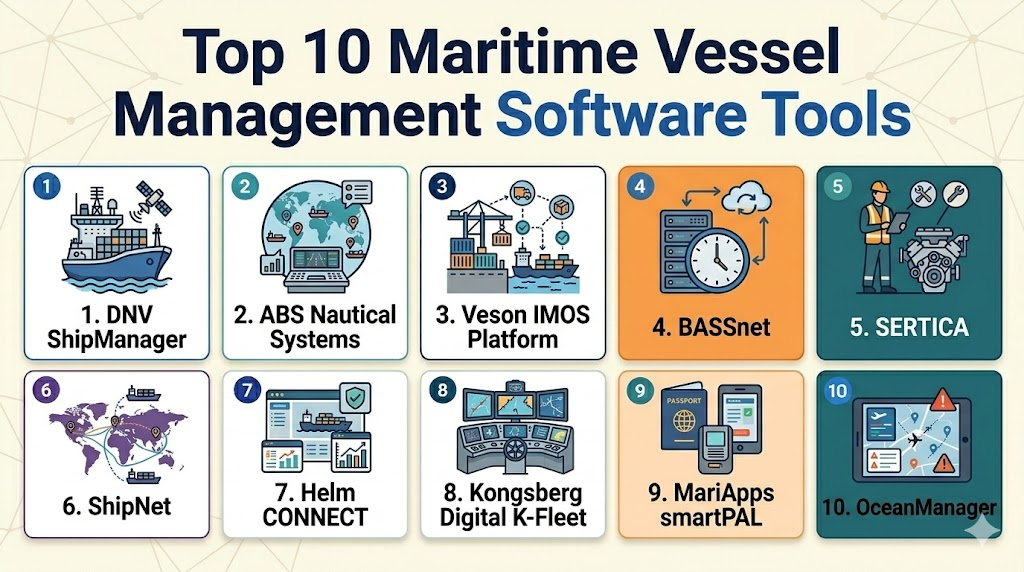
Top 10 Maritime Vessel Management Software Tools
1- DNV ShipManager
Short description: DNV ShipManager is a marine fleet management and ship management system that supports technical, operational, and compliance workflows across vessels and shore teams. It is suitable for ship owners and managers that need structured control over maintenance, procurement, safety, certificates, and fleet operations.
Key Features
- Planned maintenance and technical management
- Procurement and inventory workflows
- Safety, quality, and compliance support
- Certificate and document management
- Fleet-wide operational reporting
- Ship-to-shore data synchronization
- Maritime lifecycle and technical operations support
Pros
- Strong maritime domain credibility
- Good fit for technical and compliance-heavy fleet management
- Supports broad vessel and shore-side operational workflows
Cons
- Implementation can require process cleanup and data migration
- Smaller operators may not need the full suite depth
- Configuration and module selection should be planned carefully
Platforms / Deployment
Web / Windows / Vessel and shore interfaces vary
Cloud / Hosted / Hybrid options vary
Security & Compliance
Varies / N/A. Buyers should validate SSO, MFA, RBAC, encryption, audit logs, document security, vessel data governance, and compliance reporting directly.
Integrations & Ecosystem
DNV ShipManager works well when vessel operations need to connect maintenance, procurement, safety, documents, and fleet reporting.
- ERP and finance systems
- Procurement and supplier workflows
- Crewing systems
- Vessel performance tools
- Compliance and document repositories
- Reporting and analytics platforms
Support & Community
DNV provides maritime-focused implementation, product resources, support, and advisory expertise. Support depth may vary by contract, fleet size, deployment model, and selected modules.
2- ABS Nautical Systems
Short description: ABS Nautical Systems is a maritime ERP and fleet management platform that supports vessel maintenance, compliance, crew management, procurement, workforce management, and operational reporting. It is best for shipping companies that need a broad enterprise-grade fleet management environment.
Key Features
- Maritime ERP and fleet management modules
- Planned maintenance and asset reliability workflows
- Procurement and inventory control
- Compliance and safety management support
- Crew and workforce management capabilities
- Reporting and operational analytics
- Integrated modules for fleet-wide visibility
Pros
- Strong enterprise maritime ERP depth
- Useful for fleet managers needing technical, crew, and compliance workflows
- Good fit for larger operators with multi-vessel complexity
Cons
- Implementation can be detailed and process-heavy
- Smaller fleets may prefer simpler tools
- Buyers should validate module fit and integration scope
Platforms / Deployment
Web / Mobile access varies / Operational interfaces vary
Cloud / Hosted / Hybrid options vary
Security & Compliance
Varies / N/A. Buyers should validate RBAC, encryption, audit logs, user access controls, crew data privacy, document governance, and compliance reporting directly.
Integrations & Ecosystem
ABS Nautical Systems is useful when maritime operations require connected fleet, crew, compliance, procurement, and finance workflows.
- ERP and accounting tools
- Crew management systems
- Procurement workflows
- Safety and compliance tools
- Fleet reporting systems
- Operational data platforms
Support & Community
ABS Wavesight provides maritime implementation support, product documentation, domain expertise, and customer assistance. Support depth may vary by fleet size, modules, and deployment region.
3- Veson IMOS Platform
Short description: Veson IMOS Platform is a commercial maritime platform focused on chartering, voyage operations, freight contracts, claims, documentation, and commercial decision support. It is best for shipping companies, commodity firms, charterers, and operators that need strong voyage and commercial operations management.
Key Features
- Chartering and freight contract management
- Voyage execution and operations workflows
- Claims, demurrage, and documentation support
- Market and data-driven commercial insights
- Collaboration across trading and operations teams
- APIs and integrations for maritime workflows
- Reporting for voyage and commercial performance
Pros
- Strong fit for commercial shipping and voyage execution
- Useful for chartering, operations, and freight contract teams
- Good integration and data ecosystem for maritime commerce
Cons
- Less focused on technical maintenance than some fleet management suites
- May need pairing with technical or crewing systems
- Best value depends on commercial shipping workflow complexity
Platforms / Deployment
Web / Operational interfaces vary
Cloud / Hosted options vary
Security & Compliance
Varies / N/A. Buyers should validate SSO, user roles, encryption, audit logs, commercial data access, API security, and data retention directly.
Integrations & Ecosystem
Veson IMOS works well when commercial maritime workflows must connect contracts, voyages, market data, operations, and analytics.
- ERP and finance systems
- Market data solutions
- Voyage documentation workflows
- APIs and integration tools
- Chartering and trading systems
- Reporting and analytics platforms
Support & Community
Veson provides product support, implementation services, maritime workflow expertise, and customer success resources. Support depth may vary by product scope and operational complexity.
4- BASSnet
Short description: BASSnet is an integrated maritime ERP and vessel management platform supporting maintenance, procurement, HSEQ, crewing, payroll, finance, and fleet visibility. It is suitable for ship managers and fleet operators that want a broad, cloud-oriented maritime management suite.
Key Features
- Planned maintenance and technical management
- Procurement, inventory, and purchasing workflows
- HSEQ and compliance management
- Crewing and payroll support
- Finance and maritime ERP functions
- Advanced analytics and automation capabilities
- Browser-based fleet visibility
Pros
- Broad maritime ERP coverage
- Useful for operators wanting technical, crewing, finance, and HSEQ workflows together
- Strong fit for modern fleet visibility and integrated management
Cons
- Buyers should validate implementation complexity and migration needs
- Full suite may be more than smaller fleets require
- Module selection and process alignment are important
Platforms / Deployment
Web / Mobile access varies
Cloud / SaaS / Hosted options vary
Security & Compliance
Varies / N/A. Buyers should validate cybersecurity controls, SSO, MFA, RBAC, encryption, audit logs, crew data privacy, and compliance workflows directly.
Integrations & Ecosystem
BASSnet fits maritime companies that want an integrated ERP-style environment for fleet operations.
- Maintenance systems
- Procurement and supplier workflows
- Crewing and payroll systems
- Finance and accounting tools
- HSEQ and audit workflows
- Analytics and reporting platforms
Support & Community
BASSnet provides maritime-focused implementation, documentation, support, and customer resources. Support depth may vary by fleet type, region, and selected modules.
5- SERTICA
Short description: SERTICA is a ship management system focused on maintenance, procurement, safety, and fleet management workflows. It is useful for maritime companies that want to streamline technical operations, reduce paperwork, and improve communication between vessels and shore teams.
Key Features
- Planned maintenance management
- Procurement and inventory workflows
- Safety and HSEQ management
- Fleet overview and technical reporting
- Ship-to-shore communication support
- Document and task management
- Operational performance visibility
Pros
- Strong focus on maintenance, procurement, and safety workflows
- Useful for improving vessel-shore coordination
- Practical for fleets that want structured technical control
Cons
- Buyers should validate broader ERP or crewing needs
- Advanced analytics and integrations should be reviewed by use case
- Implementation depends on clean maintenance and inventory data
Platforms / Deployment
Web / Vessel and shore interfaces vary
Cloud / Hosted / Hybrid options vary
Security & Compliance
Varies / N/A. Buyers should validate user permissions, encryption, audit logs, document security, vessel data sync, compliance tracking, and access control directly.
Integrations & Ecosystem
SERTICA works well when technical fleet teams need maintenance, procurement, safety, and vessel-shore workflows connected.
- Procurement systems
- Maintenance records
- HSEQ workflows
- Finance and accounting tools
- Vessel communication workflows
- Reporting dashboards
Support & Community
SERTICA provides implementation support, maritime resources, training, and customer assistance. Support depth may vary by fleet size, region, and module scope.
6- ShipNet
Short description: ShipNet is a maritime ERP and ship management platform supporting fleet operations, procurement, finance, safety, technical management, crewing, and commercial workflows. It is best for maritime enterprises that need broad operational and financial control across fleet activities.
Key Features
- Maritime ERP and fleet management workflows
- Planned maintenance and technical operations
- Procurement and inventory control
- Finance and accounting support
- Safety and compliance workflows
- Crewing and operational modules
- Reporting and management dashboards
Pros
- Broad maritime ERP functionality
- Useful for enterprises needing operational and financial integration
- Supports multiple departments across shipping organizations
Cons
- Implementation can be complex for smaller teams
- Buyers should validate current product roadmap and module fit
- Data migration and process alignment require planning
Platforms / Deployment
Web / Windows / Operational interfaces vary
Cloud / Hosted / Hybrid options vary
Security & Compliance
Varies / N/A. Buyers should validate RBAC, encryption, audit logs, finance data controls, crew data privacy, and compliance reporting directly.
Integrations & Ecosystem
ShipNet fits maritime companies that need fleet operations connected with finance, procurement, crewing, and compliance.
- Finance and ERP systems
- Procurement workflows
- Crewing systems
- Safety and compliance tools
- Maintenance systems
- Reporting and analytics
Support & Community
ShipNet support and implementation resources vary by deployment and contract. Buyers should validate onboarding, training, migration support, and long-term roadmap directly.
7- Helm CONNECT
Short description: Helm CONNECT is vessel maintenance and compliance software designed for workboats, tug operators, ferries, offshore vessels, and marine operators that need practical maintenance, inspections, tasks, and compliance workflows. It is useful for operators that want a modern and user-friendly approach.
Key Features
- Vessel maintenance management
- Inspections and compliance workflows
- Task and checklist management
- Inventory and parts tracking
- Crew and vessel communication support
- Mobile-friendly operational workflows
- Reporting and audit preparation
Pros
- Easy-to-use interface for vessel teams
- Strong fit for workboats, ferries, tugs, and smaller fleets
- Practical maintenance and compliance workflows
Cons
- May not replace full maritime ERP suites for large enterprises
- Commercial voyage and finance depth may be limited
- Buyers should validate integration needs before rollout
Platforms / Deployment
Web / iOS / Android access varies
Cloud
Security & Compliance
Varies / N/A. Buyers should validate user roles, encryption, audit trails, offline data handling, compliance records, and document security directly.
Integrations & Ecosystem
Helm CONNECT works well for operators that need practical vessel maintenance and compliance workflows without enterprise complexity.
- Maintenance records
- Inspection workflows
- Inventory tracking
- Safety and compliance checklists
- Vessel communication workflows
- Reporting dashboards
Support & Community
Helm provides product resources, support, onboarding help, and marine operations guidance. Support depth may vary by fleet type, plan, and implementation needs.
8- Kongsberg Digital K-Fleet
Short description: Kongsberg Digital K-Fleet supports vessel management, safety, technical operations, procurement, documentation, and fleet performance workflows. It is suitable for operators that want connected maritime software aligned with operational technology and vessel performance ecosystems.
Key Features
- Vessel technical management
- Planned maintenance and procurement workflows
- Safety and document management
- Fleet performance and operational visibility
- Ship-to-shore data exchange
- Reporting and dashboard workflows
- Integration with maritime digital ecosystems
Pros
- Strong maritime technology and vessel operations background
- Useful for operators connecting fleet management with performance data
- Good fit for digital fleet transformation initiatives
Cons
- Buyers should validate module scope and commercial fit
- Implementation may require integration with existing vessel systems
- Smaller fleets may not need advanced ecosystem depth
Platforms / Deployment
Web / Vessel and shore interfaces vary
Cloud / Hosted / Hybrid options vary
Security & Compliance
Varies / N/A. Buyers should validate identity controls, encryption, audit logs, vessel data governance, system resilience, and compliance workflows directly.
Integrations & Ecosystem
K-Fleet works well when fleet management needs to connect with vessel operations, performance monitoring, and maritime data systems.
- Vessel performance platforms
- Maintenance workflows
- Procurement systems
- Safety and compliance systems
- Ship-to-shore data workflows
- Reporting and analytics tools
Support & Community
Kongsberg Digital provides maritime implementation support, product resources, and technical expertise. Support scope depends on modules, fleet size, and digital ecosystem requirements.
9- MariApps smartPAL
Short description: MariApps smartPAL is a maritime digital platform and ERP-style suite supporting ship management, crewing, procurement, finance, QHSE, maintenance, and fleet operations. It is suitable for ship managers and operators seeking an integrated maritime business platform.
Key Features
- Ship management and fleet operations workflows
- Crew management and crewing support
- Procurement and inventory workflows
- Finance and accounting modules
- QHSE and compliance management
- Maintenance and technical management
- Reporting and analytics dashboards
Pros
- Broad maritime digital suite coverage
- Useful for companies wanting business and vessel workflows together
- Supports ship management, crewing, procurement, and finance alignment
Cons
- Buyers should validate module maturity for specific workflows
- Implementation can require process standardization
- Smaller operators may prefer lighter tools
Platforms / Deployment
Web / Mobile access varies
Cloud / Hosted / Hybrid options vary
Security & Compliance
Varies / N/A. Buyers should validate SSO, RBAC, encryption, audit logs, finance data security, crew privacy, document governance, and compliance needs directly.
Integrations & Ecosystem
smartPAL fits maritime companies that need connected workflows across ship management, crewing, finance, procurement, and compliance.
- ERP and finance systems
- Crewing workflows
- Procurement systems
- QHSE tools
- Maintenance systems
- Reporting dashboards
Support & Community
MariApps provides implementation support, product resources, maritime consulting, and customer assistance. Support depth may vary by modules, fleet size, and operating region.
10- OceanManager
Short description: OceanManager supports maritime document management, compliance, fleet procedures, forms, audits, inspections, and vessel-shore communication. It is useful for operators that need stronger control over compliance documentation, safety procedures, and operational records.
Key Features
- Maritime document management
- Safety and compliance workflows
- Forms, checklists, and inspection support
- Vessel-shore document distribution
- Audit preparation and record control
- Fleet procedure management
- Reporting and operational visibility
Pros
- Strong fit for compliance and document-heavy maritime operations
- Useful for standardizing procedures across vessels
- Helps reduce paper-based safety and audit workflows
Cons
- Less comprehensive than full maritime ERP platforms
- May need integration with maintenance, procurement, or crewing systems
- Best value depends on document and compliance complexity
Platforms / Deployment
Web / Vessel and shore interfaces vary
Cloud / Hosted options vary
Security & Compliance
Varies / N/A. Buyers should validate access control, document permissions, audit logs, encryption, vessel data sync, and compliance record retention directly.
Integrations & Ecosystem
OceanManager works well when maritime companies need controlled document distribution and compliance workflows across vessels and shore offices.
- Document repositories
- Safety procedures
- Audit workflows
- Forms and inspections
- Vessel communication workflows
- Reporting tools
Support & Community
OceanManager provides implementation support, documentation, and maritime-focused assistance. Support depth may vary by fleet size, modules, and compliance requirements.
Comparison Table
| Tool Name | Best For | Platform Supported | Deployment | Standout Feature | Public Rating |
|---|---|---|---|---|---|
| DNV ShipManager | Technical and compliance-heavy fleet management | Web, Windows, operational interfaces vary | Cloud / Hosted / Hybrid varies | Maintenance, procurement, safety, and compliance depth | N/A |
| ABS Nautical Systems | Enterprise maritime ERP and fleet control | Web, mobile varies | Cloud / Hosted / Hybrid varies | Fleet, crew, compliance, and procurement modules | N/A |
| Veson IMOS Platform | Commercial shipping and voyage operations | Web, operational interfaces vary | Cloud / Hosted varies | Chartering, voyage execution, and contract workflows | N/A |
| BASSnet | Integrated maritime ERP and fleet visibility | Web, mobile varies | Cloud / SaaS / Hosted varies | Maintenance, procurement, HSEQ, crewing, and finance | N/A |
| SERTICA | Maintenance, procurement, and safety workflows | Web, operational interfaces vary | Cloud / Hosted / Hybrid varies | Ship-to-shore technical fleet management | N/A |
| ShipNet | Maritime ERP and enterprise ship management | Web, Windows, operational interfaces vary | Cloud / Hosted / Hybrid varies | Operational, financial, and fleet management alignment | N/A |
| Helm CONNECT | Workboats, ferries, tugs, and practical compliance | Web, mobile varies | Cloud | User-friendly maintenance and compliance workflows | N/A |
| Kongsberg Digital K-Fleet | Connected fleet and vessel performance workflows | Web, operational interfaces vary | Cloud / Hosted / Hybrid varies | Fleet management linked with maritime digital ecosystem | N/A |
| MariApps smartPAL | Integrated ship management and business workflows | Web, mobile varies | Cloud / Hosted / Hybrid varies | Ship management, crewing, procurement, finance, and QHSE | N/A |
| OceanManager | Maritime compliance and document control | Web, operational interfaces vary | Cloud / Hosted varies | Fleet procedures, forms, audits, and document governance | N/A |
Evaluation & Scoring of Maritime Vessel Management Software
| Tool Name | Core 25% | Ease 15% | Integrations 15% | Security 10% | Performance 10% | Support 10% | Value 15% | Weighted Total |
|---|---|---|---|---|---|---|---|---|
| DNV ShipManager | 9.3 | 7.8 | 8.9 | 8.5 | 8.8 | 8.8 | 7.8 | 8.6 |
| ABS Nautical Systems | 9.2 | 7.7 | 8.8 | 8.4 | 8.7 | 8.6 | 7.7 | 8.5 |
| Veson IMOS Platform | 8.8 | 8.1 | 9.0 | 8.3 | 8.8 | 8.5 | 7.9 | 8.5 |
| BASSnet | 9.0 | 8.2 | 8.7 | 8.3 | 8.7 | 8.4 | 8.0 | 8.5 |
| SERTICA | 8.6 | 8.2 | 8.2 | 8.0 | 8.5 | 8.2 | 8.2 | 8.3 |
| ShipNet | 8.8 | 7.7 | 8.5 | 8.2 | 8.5 | 8.2 | 7.8 | 8.3 |
| Helm CONNECT | 8.2 | 8.8 | 7.8 | 7.8 | 8.3 | 8.3 | 8.4 | 8.3 |
| Kongsberg Digital K-Fleet | 8.6 | 8.0 | 8.6 | 8.2 | 8.6 | 8.3 | 7.9 | 8.4 |
| MariApps smartPAL | 8.7 | 8.0 | 8.5 | 8.1 | 8.5 | 8.2 | 8.0 | 8.4 |
| OceanManager | 8.0 | 8.4 | 7.8 | 8.0 | 8.2 | 8.1 | 8.3 | 8.1 |
Which Maritime Vessel Management Software Tool Is Right for You?
Solo / Freelancer
Solo maritime consultants, independent surveyors, and small marine advisors usually do not need a full vessel management suite. They may use document tools, inspection apps, spreadsheets, or lightweight maintenance trackers for advisory or inspection work.
A full vessel management platform becomes relevant when the organization directly manages vessels, crews, procurement, maintenance, audits, and compliance records across a fleet.
SMB
Small marine operators, workboat companies, tug operators, ferry operators, and smaller ship managers should focus on ease of use, planned maintenance, compliance checklists, inspections, document control, and simple reporting. Helm CONNECT, SERTICA, OceanManager, and selected BASSnet or MariApps modules can fit this segment.
SMBs should avoid overbuying complex ERP platforms unless procurement, finance, crewing, and multi-vessel compliance needs justify the investment.
Mid-Market
Mid-sized ship managers and fleet operators often need stronger maintenance, procurement, inventory, safety, certificates, crew records, and fleet reporting. DNV ShipManager, ABS Nautical Systems, BASSnet, SERTICA, MariApps smartPAL, and Kongsberg Digital K-Fleet are strong candidates.
This segment should validate ship-to-shore sync, role permissions, procurement approvals, maintenance templates, inspection workflows, and accounting integrations.
Enterprise
Large ship managers, tanker fleets, container operators, offshore operators, and maritime groups need enterprise-grade maritime ERP, global fleet visibility, audit readiness, procurement control, crewing, finance integration, and performance analytics. DNV ShipManager, ABS Nautical Systems, BASSnet, ShipNet, Veson IMOS, MariApps smartPAL, and Kongsberg Digital K-Fleet are strong enterprise candidates.
Enterprise buyers should involve technical management, procurement, crewing, finance, HSEQ, fleet performance, IT, cybersecurity, and vessel representatives before selecting a platform.
Budget vs Premium
Budget-conscious operators should evaluate Helm CONNECT, OceanManager, SERTICA, and lighter module-based deployments depending on fleet size and workflow needs. These tools can help digitize maintenance, inspections, and compliance without immediately moving into a full maritime ERP program.
Premium buyers should evaluate DNV ShipManager, ABS Nautical Systems, BASSnet, ShipNet, Veson IMOS, Kongsberg Digital K-Fleet, and MariApps smartPAL when integration depth, fleet analytics, procurement, crewing, and enterprise governance matter more.
Feature Depth vs Ease of Use
If ease of use matters most, Helm CONNECT, SERTICA, OceanManager, and selected BASSnet or MariApps modules can be good starting points. If feature depth matters more, DNV ShipManager, ABS Nautical Systems, ShipNet, BASSnet, Veson IMOS, and Kongsberg Digital K-Fleet should be reviewed closely.
The best platform should match vessel operations rather than forcing crews and shore teams into unnecessary complexity.
Integrations & Scalability
Maritime vessel management software should integrate with ERP, accounting, procurement, crewing, payroll, voyage management, telematics, IoT sensors, document systems, fuel monitoring, and reporting platforms. DNV ShipManager, ABS Nautical Systems, BASSnet, Veson IMOS, ShipNet, Kongsberg Digital K-Fleet, and MariApps smartPAL are strong candidates for integration-heavy environments.
For scaling across fleets, buyers should test data replication, vessel templates, multi-company controls, audit reporting, role permissions, and fleet dashboards.
Security & Compliance Needs
Maritime vessel management systems may store crew records, identity documents, certificates, procurement data, vessel technical records, audit logs, safety reports, incident records, supplier information, and operational data. Buyers should review SSO, MFA, RBAC, encryption, audit logs, backup strategy, data retention, and offline synchronization controls.
Shipping companies should also validate cybersecurity policies, vessel connectivity security, shore-vessel access segregation, document permissions, and regulatory reporting workflows before deployment.
Frequently Asked Questions
1. What is Maritime Vessel Management Software?
Maritime Vessel Management Software helps ship owners and operators manage vessel maintenance, procurement, compliance, safety, crew records, documents, and fleet operations.
It centralizes vessel and shore-side workflows so teams can work from a shared operational system.
Many platforms also support inventory, audits, certificates, inspections, and reporting.
The goal is to improve fleet visibility, reduce manual work, and support compliance.
2. Who needs Maritime Vessel Management Software?
Ship owners, ship managers, ferry operators, tanker fleets, offshore operators, tug companies, dry bulk operators, and maritime enterprises can use it.
It is especially useful when a company manages multiple vessels, audits, spare parts, crew documents, and technical records.
Smaller operators may start with maintenance or document tools first.
Larger fleets usually need integrated systems for control and reporting.
3. How much does Maritime Vessel Management Software cost?
Pricing varies by vendor, fleet size, number of vessels, modules, deployment model, integrations, support level, and implementation scope.
Enterprise maritime ERP platforms usually require custom pricing and structured implementation.
Smaller tools may offer simpler pricing for maintenance, inspections, or document management.
Buyers should compare total cost over several years, not only subscription fees.
4. What features should buyers look for?
Buyers should look for planned maintenance, procurement, inventory, HSEQ, certificates, document control, crew management, and reporting.
Ship-to-shore synchronization is important because vessel connectivity may be limited.
Larger companies should also check ERP, finance, voyage, crewing, and IoT integrations.
Security and auditability should be reviewed before rollout.
5. Can vessel management software improve compliance?
Yes, vessel management software can improve compliance by organizing certificates, audits, inspections, maintenance records, incidents, permits, and safety procedures.
It helps shore teams and vessels maintain consistent records and prepare for inspections.
The software can also provide reminders, workflows, and audit trails.
Compliance still depends on accurate data and disciplined crew usage.
6. Which tool is best for small fleets?
Helm CONNECT, SERTICA, OceanManager, and selected BASSnet or MariApps modules can be practical for small fleets.
Small operators should prioritize usability, maintenance tracking, inspections, document control, and offline access.
They should avoid complex ERP deployments unless growth or compliance needs justify it.
A pilot on one vessel is a good starting point.
7. Which tool is best for large maritime enterprises?
DNV ShipManager, ABS Nautical Systems, BASSnet, ShipNet, Veson IMOS, Kongsberg Digital K-Fleet, and MariApps smartPAL are strong enterprise candidates.
They support broader workflows such as maintenance, procurement, finance, HSEQ, crewing, and commercial operations.
The best fit depends on fleet type, operating model, and integration needs.
Large buyers should run structured pilots with real vessel data.
8. What are common mistakes when choosing maritime software?
Common mistakes include underestimating data migration, ignoring crew usability, and not mapping vessel-shore workflows properly.
Companies also forget to clean equipment lists, spare parts, certificates, and maintenance plans before implementation.
Another mistake is buying a full ERP when the immediate need is maintenance or document control.
A phased rollout helps reduce disruption.
9. Can maritime vessel software integrate with IoT and performance systems?
Yes, many modern maritime platforms can integrate with vessel performance tools, sensors, telematics, fuel systems, IoT platforms, and analytics dashboards.
Integration depth varies by vendor, vessel equipment, and data architecture.
These integrations can support predictive maintenance, emissions visibility, and performance monitoring.
Buyers should test real vessel data before relying on automated insights.
10. What are alternatives to Maritime Vessel Management Software?
Alternatives include spreadsheets, paper checklists, shared folders, standalone maintenance tools, procurement systems, document repositories, and generic ERP platforms.
These may work for very small fleets or simple operations.
As fleet size and compliance complexity grow, manual methods become risky and difficult to audit.
Dedicated maritime software is better for vessel-specific workflows, compliance, synchronization, and fleet visibility.
Conclusion
Maritime Vessel Management Software helps shipping companies improve control over vessels, maintenance, procurement, compliance, crew workflows, documents, safety, and fleet performance. The best platform depends on fleet size, vessel type, operating model, compliance pressure, procurement complexity, crewing requirements, commercial workflows, and integration strategy. DNV ShipManager, ABS Nautical Systems, BASSnet, ShipNet, Kongsberg Digital K-Fleet, and MariApps smartPAL are strong choices for broader enterprise fleet management, while Helm CONNECT, SERTICA, and OceanManager can be practical for focused maintenance, compliance, and vessel-shore workflows. Veson IMOS is especially relevant for commercial shipping and voyage operations. The smartest next step is to shortlist two or three tools, map vessel and shore workflows, test maintenance and procurement processes with real data, validate security and integrations, and run a pilot before scaling across the fleet.

Find Trusted Cardiac Hospitals
Compare heart hospitals by city and services — all in one place.
Explore Hospitals
Maritime vessel management software is most valuable when it helps shipping companies and fleet operators efficiently manage vessel operations, maintenance, compliance, crew, and voyage performance from a centralized platform. By providing fleet monitoring, preventive maintenance, voyage planning, fuel and emissions management, crew management, safety and regulatory compliance, inventory control, financial reporting, and real-time analytics, these platforms enable maritime organizations to improve operational efficiency, enhance vessel safety, reduce operating costs, ensure regulatory compliance, and optimize overall fleet performance.