Introduction
Demand Planning Tools help businesses forecast future customer demand using historical sales, market signals, seasonality, promotions, inventory trends, and supply chain data. In simple terms, these platforms help companies predict what customers will buy, when they will buy it, and how much inventory or production capacity will be needed to meet that demand. Demand planning matters because businesses are dealing with volatile demand, supply disruptions, inflation pressure, omnichannel buying behavior, and shorter product lifecycles. Spreadsheet-based forecasting is often too slow and error-prone for modern supply chains. Demand planning software helps teams improve forecast accuracy, reduce stockouts, avoid excess inventory, and align sales, finance, operations, and supply chain teams around one plan.
Real-world use cases include:
- Forecasting product demand by region, channel, and customer segment
- Planning inventory levels for retail, manufacturing, and distribution
- Managing seasonal demand and promotional sales spikes
- Supporting S&OP and integrated business planning workflows
- Reducing excess stock, missed sales, and last-minute supply chain firefighting
What buyers should evaluate:
- Forecasting accuracy and AI capabilities
- Demand sensing and short-term signal detection
- Scenario planning and what-if analysis
- ERP, WMS, TMS, POS, CRM, and data warehouse integrations
- Collaboration across sales, finance, supply, and operations teams
- Inventory optimization and replenishment support
- Usability for planners and business users
- Reporting, dashboards, and exception management
- Security, access control, and auditability
- Scalability across products, locations, and business units
Best for: Supply chain leaders, demand planners, inventory managers, finance teams, retailers, manufacturers, distributors, CPG companies, pharma companies, and enterprises that need better forecast accuracy and cross-functional planning.
Not ideal for: Very small businesses with simple product catalogs, teams with low sales volume, or companies that only need basic reorder alerts rather than advanced forecasting, scenario planning, and S&OP workflows.
Key Trends in Demand Planning Tools
- AI-based forecasting is becoming standard: Modern demand planning platforms increasingly use machine learning to detect patterns, seasonality, promotions, channel shifts, and external demand signals.
- Demand sensing is gaining importance: Short-term signals from POS, e-commerce, weather, social demand, promotions, and market data are being used to adjust forecasts faster.
- Planning is becoming more collaborative: Demand planning is no longer only a supply chain function. Sales, finance, marketing, procurement, and operations teams now need shared planning workflows.
- Scenario planning is critical: Businesses want to test what happens if demand rises, a supplier fails, a promotion changes, or inventory is constrained.
- Integrated business planning is replacing isolated planning: Buyers prefer tools that connect demand planning with supply planning, inventory planning, financial planning, and S&OP.
- Exception-based planning is reducing manual work: Instead of reviewing every SKU manually, planners focus on products, regions, and channels where forecast risk is highest.
- Retail and omnichannel planning is more complex: Demand must be forecast across stores, e-commerce, marketplaces, distributors, and direct-to-consumer channels.
- Data integration is now a buying priority: ERP, POS, CRM, WMS, TMS, supplier, and data platform integration often matters as much as forecasting algorithms.
- Explainable AI is becoming important: Planners want to understand why the system recommends a forecast change before approving it.
- Security and governance expectations are higher: Enterprise buyers expect SSO, role-based permissions, audit logs, encryption, and controlled access to sensitive planning data.
How We Selected These Tools
The Top 10 Demand Planning Tools were selected using a practical buyer-focused methodology. The goal is not to declare one universal winner, but to compare credible platforms across enterprise, mid-market, retail, manufacturing, and planning-led use cases.
Selection criteria included:
- Market recognition in demand planning, supply chain planning, S&OP, and integrated business planning
- Forecasting depth, demand sensing, and scenario planning capabilities
- Ability to support large product catalogs, multiple locations, channels, and regions
- Integration strength with ERP, POS, WMS, TMS, CRM, finance, and analytics platforms
- Suitability for retail, CPG, manufacturing, distribution, and enterprise planning teams
- AI, machine learning, automation, and exception-based planning capabilities
- Security posture signals where publicly available
- Ease of use for planners, business users, and cross-functional teams
- Support for collaboration between sales, finance, supply chain, and operations
- Practical fit across SMB, mid-market, and enterprise environments
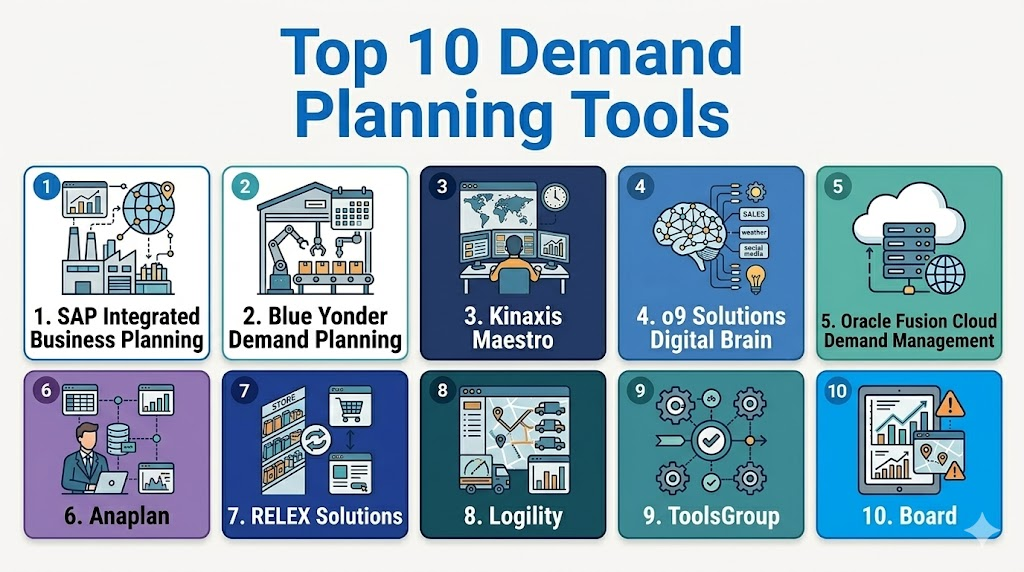
Top 10 Demand Planning Tools
1- SAP Integrated Business Planning
Short description: SAP Integrated Business Planning is an enterprise supply chain planning platform that supports demand planning, supply planning, inventory planning, S&OP, and response planning. It is best suited for SAP-centric organizations and large enterprises that need structured planning workflows across business functions.
Key Features
- Demand planning and statistical forecasting
- Sales and operations planning support
- Demand sensing and forecast adjustment workflows
- Inventory and supply planning capabilities
- Scenario planning and what-if analysis
- SAP ecosystem integration
- Dashboards and analytics for planners and leaders
Pros
- Strong fit for enterprises already using SAP ERP
- Supports integrated planning across demand, supply, inventory, and finance
- Good governance and structured planning workflows
Cons
- Implementation can be complex for non-SAP environments
- May require significant configuration and consulting support
- Smaller teams may find it too heavy for basic demand planning
Platforms / Deployment
Web / Cloud
Hybrid availability: Varies / N/A
Security & Compliance
Not publicly stated in full detail for every deployment. Buyers should validate SSO, MFA, RBAC, encryption, audit logs, ISO 27001, SOC reports, GDPR, and data residency requirements.
Integrations & Ecosystem
SAP IBP is strongest when connected with SAP S/4HANA, SAP ECC, SAP analytics, master data, and enterprise planning systems.
- SAP S/4HANA and SAP ECC
- ERP and finance systems
- Supply and inventory planning workflows
- Data warehouse and analytics tools
- Sales and operations planning data
- APIs and SAP integration middleware
Support & Community
SAP offers broad enterprise support, documentation, implementation partners, training resources, and customer success options. Buyers should validate partner quality, project scope, support tiers, and internal SAP readiness.
2- Blue Yonder Demand Planning
Short description: Blue Yonder Demand Planning helps companies forecast demand, automate planning workflows, and improve inventory and supply chain decisions. It is especially relevant for retailers, manufacturers, CPG companies, and enterprises with complex demand patterns.
Key Features
- AI-assisted demand forecasting
- Probabilistic forecasting and demand modeling
- Exception-based planning workflows
- Promotion and seasonality planning support
- Inventory and supply planning connections
- Demand sensing capabilities
- Analytics for forecast accuracy and planner productivity
Pros
- Strong forecasting depth for complex supply chains
- Good fit for retail, CPG, and distribution-heavy businesses
- Helps planners focus on exceptions instead of manual spreadsheet work
Cons
- May require strong data readiness for best results
- Implementation can be significant for large enterprises
- Pricing and full module details are usually quote-based
Platforms / Deployment
Web / Cloud
Hybrid availability: Varies / N/A
Security & Compliance
Not publicly stated in full detail for all buyer requirements. Buyers should validate SSO, MFA, RBAC, encryption, audit logs, SOC 2, ISO 27001, GDPR, and data governance controls.
Integrations & Ecosystem
Blue Yonder works well when demand planning must connect with inventory, supply, order fulfillment, warehouse, and transportation workflows.
- ERP integrations
- WMS and TMS connections
- POS and retail data sources
- Inventory optimization tools
- Analytics and reporting platforms
- APIs and enterprise data exchange
Support & Community
Blue Yonder provides enterprise support, implementation services, training, documentation, and customer success resources. Buyers should confirm onboarding timelines, planner training, and post-go-live optimization support.
3- Kinaxis Maestro
Short description: Kinaxis Maestro is a supply chain planning platform known for concurrent planning, scenario analysis, and fast decision support. It is best for enterprises that need demand planning tightly connected with supply, inventory, operations, and executive decision-making.
Key Features
- Demand planning and forecasting
- Concurrent supply chain planning
- Scenario modeling and what-if analysis
- AI-assisted demand insights
- Demand sensing and short-term signal analysis
- Collaboration across planning teams
- Executive dashboards and analytics
Pros
- Strong for fast scenario planning and disruption response
- Useful for companies with complex planning networks
- Helps connect demand planning with broader supply chain decisions
Cons
- May require planning maturity to get full value
- Not the simplest option for small teams
- Implementation can be complex when data is fragmented
Platforms / Deployment
Web / Cloud
Hybrid availability: Varies / N/A
Security & Compliance
Not publicly stated in full detail for every requirement. Buyers should validate SSO, MFA, RBAC, encryption, audit logs, SOC 2, ISO 27001, GDPR, and data governance needs.
Integrations & Ecosystem
Kinaxis is commonly used where demand planning must connect with supply planning, manufacturing, inventory, finance, and S&OP workflows.
- ERP integrations
- Demand and supply planning data
- Inventory and production systems
- Finance and S&OP workflows
- Data warehouse and BI tools
- APIs and enterprise integration layers
Support & Community
Kinaxis supports enterprise customers through implementation partners, documentation, training, and customer success programs. Buyers should confirm partner availability, user training, and internal planning adoption support.
4- o9 Solutions Digital Brain
Short description: o9 Solutions Digital Brain is a planning and decision intelligence platform that supports demand planning, supply planning, integrated business planning, and scenario modeling. It is best for enterprises that want a connected planning layer across commercial, operational, and financial decisions.
Key Features
- Demand forecasting and demand sensing
- Knowledge graph-based planning model
- Scenario planning and decision intelligence
- Integrated business planning support
- AI and machine learning-assisted insights
- Collaboration across functions
- Analytics for supply chain and financial alignment
Pros
- Strong for cross-functional planning and decision intelligence
- Useful for large companies connecting demand, supply, and finance
- Flexible for complex planning operating models
Cons
- Requires strong data governance and process alignment
- Implementation may be significant for large programs
- Can be more advanced than simple demand planning needs
Platforms / Deployment
Web / Cloud
Hybrid availability: Varies / N/A
Security & Compliance
Not publicly stated in full detail for all buyer requirements. Buyers should validate SSO, MFA, RBAC, encryption, audit logs, SOC 2, ISO 27001, GDPR, and data governance documentation.
Integrations & Ecosystem
o9 works as a decision intelligence layer across enterprise systems, planning workflows, financial models, and operational data.
- ERP integrations
- Planning and forecasting systems
- CRM and commercial data
- Finance and S&OP workflows
- Data lakes and analytics tools
- APIs and enterprise integration tools
Support & Community
o9 typically supports enterprise transformation programs through implementation teams, partners, training, and customer success resources. Buyers should validate implementation scope, support tiers, and adoption planning.
5- Oracle Fusion Cloud Demand Management
Short description: Oracle Fusion Cloud Demand Management is part of Oracle’s supply chain planning ecosystem and supports demand forecasting, demand sensing, and planning collaboration. It is best for Oracle Cloud customers and enterprises standardizing on Oracle applications.
Key Features
- Demand forecasting and planning
- Demand sensing and signal analysis
- Forecast collaboration workflows
- Integration with Oracle Cloud SCM
- Planning analytics and dashboards
- Support for S&OP and supply planning connections
- Exception management and forecast review workflows
Pros
- Strong fit for Oracle Cloud SCM users
- Connects demand planning with broader Oracle enterprise workflows
- Suitable for structured enterprise planning environments
Cons
- Less attractive for companies outside the Oracle ecosystem
- Implementation quality depends on configuration and data readiness
- May require additional Oracle modules for broader planning needs
Platforms / Deployment
Web / Cloud
Security & Compliance
Not publicly stated in full detail for every deployment. Buyers should validate SSO, MFA, RBAC, encryption, audit logs, SOC reports, ISO 27001, GDPR, and data residency needs.
Integrations & Ecosystem
Oracle Demand Management is strongest when connected with Oracle Cloud SCM, ERP, procurement, order management, inventory, and manufacturing workflows.
- Oracle Cloud SCM
- Oracle ERP and finance systems
- Inventory and supply planning data
- Order management systems
- Manufacturing and procurement workflows
- Oracle analytics and integration services
Support & Community
Oracle provides enterprise support, implementation partners, documentation, and training resources. Buyers should confirm support scope, partner expertise, admin readiness, and long-term optimization services.
6- Anaplan
Short description: Anaplan is a connected planning platform used for finance, supply chain, sales, workforce, and demand planning use cases. It is best for organizations that want flexible planning models and cross-functional alignment between demand, finance, and operations.
Key Features
- Demand planning and forecasting models
- Connected planning across finance and supply chain
- Scenario planning and what-if analysis
- Collaborative planning workflows
- Customizable planning models
- Dashboards and reporting
- Support for S&OP and integrated business planning
Pros
- Flexible modeling for cross-functional planning
- Strong for finance and supply chain alignment
- Useful when teams need customized planning workflows
Cons
- Model design requires planning and governance
- Can become complex without strong ownership
- May need integration work for operational supply chain systems
Platforms / Deployment
Web / Cloud
Security & Compliance
Not publicly stated in full detail for all buyer requirements. Buyers should validate SSO, MFA, RBAC, encryption, audit logs, SOC 2, ISO 27001, GDPR, and data governance requirements.
Integrations & Ecosystem
Anaplan is useful when planning data must connect across finance, sales, operations, supply chain, and analytics environments.
- ERP and finance systems
- CRM and sales planning data
- Supply chain planning sources
- Data warehouse and BI tools
- APIs and data connectors
- S&OP and integrated planning workflows
Support & Community
Anaplan has enterprise support, documentation, partner resources, training, and a broad planning community. Buyers should confirm implementation partner quality, model governance, and user enablement.
7- RELEX Solutions
Short description: RELEX Solutions is a retail and consumer goods planning platform known for demand forecasting, replenishment, merchandise planning, and supply chain optimization. It is especially strong for retailers, grocers, wholesalers, and CPG businesses.
Key Features
- AI-assisted demand forecasting
- Retail replenishment planning
- Promotion and seasonality forecasting
- Inventory optimization
- Store and distribution planning support
- Fresh and perishable goods planning
- Analytics for forecast accuracy and availability
Pros
- Strong fit for retail and grocery demand patterns
- Useful for high-volume SKU and store-level planning
- Helps reduce stockouts and excess inventory
Cons
- Less suited for non-retail planning use cases
- Implementation requires clean product, location, and sales data
- May be more specialized than broad enterprise IBP tools
Platforms / Deployment
Web / Cloud
Hybrid availability: Varies / N/A
Security & Compliance
Not publicly stated in full detail for all requirements. Buyers should validate SSO, MFA, RBAC, encryption, audit logs, GDPR, SOC 2, ISO 27001, and data residency needs.
Integrations & Ecosystem
RELEX is strongest when connected with retail sales, POS, inventory, replenishment, merchandising, and supplier data.
- POS systems
- ERP and inventory systems
- WMS and replenishment workflows
- Supplier and product data
- Retail analytics platforms
- APIs and data exchange tools
Support & Community
RELEX supports retail and supply chain customers with implementation, onboarding, training, and customer success resources. Buyers should confirm industry-specific implementation expertise and support availability.
8- Logility
Short description: Logility is a supply chain planning platform that supports demand planning, inventory optimization, supply planning, S&OP, and product lifecycle planning. It is well suited for manufacturers, distributors, retailers, and companies needing practical planning depth.
Key Features
- Demand forecasting and planning
- Inventory optimization
- Supply planning and S&OP support
- Lifecycle and product planning workflows
- Exception-based planning
- Analytics and reporting dashboards
- Collaboration across planning teams
Pros
- Strong practical planning functionality
- Useful for manufacturers, distributors, and retail supply chains
- Good balance of demand, supply, and inventory planning
Cons
- May require configuration for complex enterprise processes
- Interface and workflow fit should be tested by planners
- Pricing and advanced module details are usually quote-based
Platforms / Deployment
Web / Cloud
Hybrid availability: Varies / N/A
Security & Compliance
Not publicly stated in full detail for all buyer requirements. Buyers should validate SSO, MFA, RBAC, encryption, audit logs, SOC 2, ISO 27001, GDPR, and data protection needs.
Integrations & Ecosystem
Logility fits planning environments where demand forecasts must connect to inventory, supply, production, and fulfillment workflows.
- ERP integrations
- Inventory and replenishment systems
- Supply and production planning data
- Retail and customer demand data
- Analytics and BI tools
- APIs and data exchange workflows
Support & Community
Logility provides onboarding, customer support, documentation, and implementation resources. Buyers should validate training programs, support tiers, and partner ecosystem availability.
9- ToolsGroup
Short description: ToolsGroup is a supply chain planning platform focused on demand planning, inventory optimization, replenishment, and service-level planning. It is suitable for companies that need probabilistic forecasting and inventory-focused planning decisions.
Key Features
- Demand forecasting and planning
- Probabilistic planning methods
- Inventory optimization
- Replenishment planning
- Service-level optimization
- Exception-based workflows
- Analytics for forecast accuracy and inventory performance
Pros
- Strong fit for inventory-heavy planning environments
- Useful for balancing service levels and stock investment
- Good option for complex replenishment and forecasting use cases
Cons
- May require planning expertise to configure advanced models
- Less broad than full enterprise ERP ecosystem platforms
- Fit depends on inventory and planning maturity
Platforms / Deployment
Web / Cloud
Hybrid availability: Varies / N/A
Security & Compliance
Not publicly stated in full detail for all buyer requirements. Buyers should validate SSO, MFA, RBAC, encryption, audit logs, SOC 2, ISO 27001, GDPR, and data governance controls.
Integrations & Ecosystem
ToolsGroup is useful where demand forecasts need to drive replenishment, inventory positioning, and service-level decisions.
- ERP integrations
- Inventory and replenishment data
- WMS and supply planning workflows
- Demand and sales history data
- Analytics and reporting tools
- APIs and data exchange
Support & Community
ToolsGroup provides implementation support, training, documentation, and planning expertise. Buyers should confirm support scope, model tuning assistance, and long-term planning optimization resources.
10- Board
Short description: Board is an intelligent planning platform used for financial planning, supply chain planning, demand planning, analytics, and business performance management. It is best for organizations that want demand planning connected with finance, operations, and executive planning.
Key Features
- Demand planning and forecasting
- Financial and operational planning alignment
- Scenario planning and simulations
- Dashboards and analytics
- Workflow and collaboration support
- Integrated business planning use cases
- Flexible planning model design
Pros
- Strong for connecting demand planning with finance and performance management
- Flexible planning and analytics environment
- Useful for companies needing cross-functional planning visibility
Cons
- Supply chain depth should be validated against specialized planning tools
- Model design and governance require ownership
- May need integration effort for operational supply chain execution systems
Platforms / Deployment
Web / Cloud
Hybrid availability: Varies / N/A
Security & Compliance
Not publicly stated in full detail for all buyer requirements. Buyers should validate SSO, MFA, RBAC, encryption, audit logs, SOC 2, ISO 27001, GDPR, and enterprise governance controls.
Integrations & Ecosystem
Board is useful when demand planning needs to connect with financial planning, business analytics, operational forecasts, and executive reporting.
- ERP and finance systems
- CRM and sales data
- Supply chain planning data
- Data warehouses and BI tools
- APIs and connectors
- S&OP and performance management workflows
Support & Community
Board provides enterprise support, documentation, partner resources, and implementation services. Buyers should validate planning model support, user training, and regional partner availability.
Comparison Table
| Tool Name | Best For | Platform Supported | Deployment | Standout Feature | Public Rating |
|---|---|---|---|---|---|
| SAP Integrated Business Planning | SAP-centric enterprise planning | Web | Cloud | Integrated demand, supply, inventory, and S&OP planning | N/A |
| Blue Yonder Demand Planning | Retail, CPG, and complex enterprise forecasting | Web | Cloud | AI-assisted probabilistic demand planning | N/A |
| Kinaxis Maestro | Concurrent planning and scenario analysis | Web | Cloud | Fast what-if analysis and cross-functional planning | N/A |
| o9 Solutions Digital Brain | Decision intelligence and integrated planning | Web | Cloud | Knowledge graph-based planning model | N/A |
| Oracle Fusion Cloud Demand Management | Oracle Cloud SCM users | Web | Cloud | Oracle supply chain ecosystem integration | N/A |
| Anaplan | Connected planning across finance and operations | Web | Cloud | Flexible planning models and collaboration | N/A |
| RELEX Solutions | Retail, grocery, and CPG demand planning | Web | Cloud | Retail forecasting and replenishment planning | N/A |
| Logility | Manufacturing, distribution, and supply chain planning | Web | Cloud | Demand, supply, and inventory planning balance | N/A |
| ToolsGroup | Inventory optimization and replenishment planning | Web | Cloud | Probabilistic forecasting and service-level planning | N/A |
| Board | Demand planning connected with finance and analytics | Web | Cloud | Unified planning and performance management | N/A |
Evaluation & Scoring of Demand Planning Tools
| Tool Name | Core 25% | Ease 15% | Integrations 15% | Security 10% | Performance 10% | Support 10% | Value 15% | Weighted Total |
|---|---|---|---|---|---|---|---|---|
| SAP Integrated Business Planning | 9 | 7 | 9 | 9 | 8 | 9 | 7 | 8.25 |
| Blue Yonder Demand Planning | 9 | 8 | 8 | 8 | 9 | 8 | 8 | 8.40 |
| Kinaxis Maestro | 9 | 8 | 8 | 8 | 9 | 8 | 8 | 8.35 |
| o9 Solutions Digital Brain | 9 | 7 | 8 | 8 | 8 | 8 | 8 | 8.10 |
| Oracle Fusion Cloud Demand Management | 8 | 7 | 9 | 9 | 8 | 8 | 7 | 7.95 |
| Anaplan | 8 | 8 | 8 | 8 | 8 | 8 | 8 | 8.00 |
| RELEX Solutions | 9 | 8 | 8 | 8 | 8 | 8 | 8 | 8.25 |
| Logility | 8 | 8 | 8 | 7 | 8 | 8 | 8 | 7.90 |
| ToolsGroup | 8 | 7 | 7 | 7 | 8 | 8 | 8 | 7.55 |
| Board | 7 | 8 | 8 | 8 | 8 | 8 | 8 | 7.75 |
Which Demand Planning Tool Is Right for You?
Solo / Freelancer
Solo consultants and independent planners usually do not need a large enterprise planning suite for their own operations. However, they should understand tools like SAP IBP, Blue Yonder, Kinaxis, o9, and Anaplan when advising enterprise clients. For smaller advisory projects, flexible planning tools or analytics platforms may be enough unless the client needs full demand planning transformation.
SMB
Small and mid-sized businesses should focus on usability, implementation speed, data integration, and forecast improvement. Tools like Logility, ToolsGroup, Board, Anaplan, and RELEX can be good candidates depending on the industry. SMBs should avoid buying a very complex platform before cleaning product, sales, customer, and inventory data.
Mid-Market
Mid-market companies usually need stronger forecasting, scenario planning, inventory alignment, and collaboration. Blue Yonder, Kinaxis, o9, RELEX, Logility, Anaplan, and ToolsGroup are practical options depending on business complexity. Mid-market buyers should prioritize tools that integrate with ERP and inventory systems without requiring excessive customization.
Enterprise
Large enterprises need demand planning platforms that scale across regions, product lines, channels, business units, and planning cycles. SAP IBP, Blue Yonder, Kinaxis, o9, Oracle, and Anaplan are strong enterprise candidates. The best choice depends on existing ERP environment, planning maturity, integration needs, and whether the company wants a planning-led, finance-led, or supply-chain-led operating model.
Budget vs Premium
Budget-focused buyers should begin with the highest-value demand planning problem, such as stockouts, excess inventory, promotion forecasting, or forecast bias. Premium platforms make sense when demand volatility has major financial impact, planning touches multiple departments, and manual spreadsheet workflows create frequent errors. Buyers should compare software cost against inventory reduction, service-level improvement, planner productivity, and missed-sales reduction.
Feature Depth vs Ease of Use
Deep planning tools provide stronger forecasting models, scenario analysis, and cross-functional workflows, but they require better data readiness and stronger planner training. Easier tools may deliver faster adoption for focused use cases. Buyers should choose based on team maturity, planning complexity, and the level of control needed over forecast models.
Integrations & Scalability
Demand planning tools must connect with ERP, POS, CRM, WMS, TMS, supplier data, e-commerce platforms, finance systems, and analytics tools. Scalability matters because product count, locations, channels, regions, and planning users can grow over time. A tool that works for one country or product line may not scale well without strong integration architecture.
Security & Compliance Needs
Demand planning data often includes sensitive sales forecasts, pricing assumptions, customer demand, inventory plans, and financial projections. Buyers should validate SSO, MFA, RBAC, encryption, audit logs, data residency, backup processes, compliance documentation, and admin controls. For global businesses, regional privacy and access rules should be reviewed before rollout.
Frequently Asked Questions
1- What is a demand planning tool?
A demand planning tool helps businesses forecast future demand using sales history, market trends, seasonality, promotions, and other demand signals. It supports better inventory, supply, and financial planning decisions.
2- How is demand planning different from supply planning?
Demand planning estimates what customers will buy, while supply planning determines how the business will meet that demand. Demand planning focuses on forecasts, while supply planning focuses on capacity, inventory, production, and procurement.
3- Which demand planning tool is best for large enterprises?
SAP IBP, Blue Yonder, Kinaxis, o9, Oracle, and Anaplan are strong enterprise options. The best fit depends on existing systems, planning maturity, industry, integration needs, and governance requirements.
4- Which tool is best for retail demand planning?
RELEX and Blue Yonder are strong candidates for retail demand planning because they support high-volume SKU, store, promotion, and replenishment use cases. Retailers should also evaluate integration with POS, inventory, and merchandising systems.
5- How much do demand planning tools cost?
Most enterprise demand planning tools use quote-based pricing. Cost usually depends on users, modules, product volume, locations, integrations, implementation scope, and support requirements.
6- How long does implementation take?
Implementation can take a few weeks for focused use cases or several months for enterprise-wide planning transformation. Timeline depends on data quality, integrations, process design, user training, and change management.
7- What are common mistakes when choosing demand planning software?
Common mistakes include choosing software before cleaning data, ignoring planner usability, underestimating integration work, over-customizing too early, and failing to define how forecast accuracy will be measured.
8- Do demand planning tools use AI?
Many modern demand planning platforms use AI or machine learning for forecasting, demand sensing, anomaly detection, and forecast recommendations. Buyers should confirm whether AI outputs are explainable and useful for real planning decisions.
9- Can demand planning tools replace spreadsheets?
Yes, they can reduce spreadsheet dependency, but most teams still use spreadsheets for analysis, exports, or ad hoc work. The goal is to move the official forecast, workflow, and approvals into a governed planning platform.
10- What should companies prepare before implementation?
Companies should prepare clean sales history, product hierarchy, customer data, location data, promotion history, inventory data, and planning rules. They should also define ownership, forecast review cycles, approval workflows, and success metrics.
Conclusion
Demand Planning Tools help businesses improve forecast accuracy, reduce inventory risk, and align supply chain decisions with real customer demand. The best tool depends on company size, industry, planning maturity, ERP environment, integration needs, and the complexity of products, channels, and regions. SAP IBP and Oracle are strong choices for companies already invested in those ecosystems, while Blue Yonder, Kinaxis, and o9 are strong for advanced enterprise planning and decision support. RELEX is a strong fit for retail and grocery planning, while Logility, ToolsGroup, Anaplan, and Board offer practical options for different planning and business alignment needs. The best next step is to shortlist 2–3 tools, test them with real historical demand data, validate integrations and security, compare forecast accuracy and planner usability, and run a pilot before scaling across the full organization.

Find Trusted Cardiac Hospitals
Compare heart hospitals by city and services — all in one place.
Explore Hospitals
Demand planning tools are most valuable when they help organizations accurately forecast customer demand and align inventory, production, procurement, and supply chain operations accordingly. By providing AI-powered demand forecasting, statistical modeling, scenario planning, inventory optimization, collaboration workflows, real-time analytics, exception management, and integration with ERP and supply chain systems, these platforms enable businesses to improve forecast accuracy, reduce stockouts and excess inventory, optimize resource utilization, and make faster, data-driven planning decisions.