Introduction
Sales and Operations Planning Software helps organizations align sales forecasts, demand plans, inventory levels, production capacity, supply constraints, financial targets, and executive decisions in one structured planning process. In simple words, S&OP software helps companies create one shared business plan instead of separate spreadsheets owned by sales, finance, supply chain, and operations teams. This category matters because businesses face demand volatility, supply disruption, margin pressure, changing customer behavior, and faster planning cycles. Modern S&OP platforms help teams improve forecast accuracy, reduce excess inventory, avoid stockouts, manage supply constraints, and make better cross-functional decisions.
Real-world use cases include:
- Aligning sales forecasts with production and supply plans
- Running monthly S&OP and executive planning meetings
- Comparing demand, supply, inventory, and financial scenarios
- Managing production capacity and supplier constraints
- Improving forecast accuracy and service levels
What buyers should evaluate:
- Demand planning depth
- Supply planning and capacity modeling
- Scenario planning and what-if analysis
- Financial planning alignment
- Collaboration and approval workflows
- ERP, CRM, WMS, TMS, and BI integrations
- Forecast accuracy reporting
- Role-based access and governance
- AI and automation capabilities
- Scalability across regions, products, and business units
Best for: Supply chain leaders, demand planners, sales operations teams, finance teams, manufacturing planners, inventory managers, retailers, CPG companies, distributors, and enterprises that need one connected planning process.
Not ideal for: Very small businesses with simple planning needs, teams that only need basic forecasting, or companies that do not yet have clean sales, inventory, production, and financial data.
Key Trends in Sales and Operations Planning S&OP Software
- AI-assisted planning: Modern S&OP tools increasingly use AI to detect forecast risk, identify demand shifts, recommend plan adjustments, and highlight exceptions.
- Integrated Business Planning growth: Many organizations are expanding from traditional S&OP to IBP, where finance, strategy, product, demand, supply, and executive planning are connected.
- Scenario planning is becoming essential: Businesses want to simulate demand spikes, supply shortages, pricing changes, margin pressure, and production constraints before making decisions.
- Finance and operations alignment: S&OP is no longer only a supply chain process. Modern tools connect revenue, margin, cost, inventory, and service-level decisions.
- Exception-based planning: Instead of reviewing every SKU manually, planners focus on high-risk items, regions, customers, or supply constraints.
- Cloud-first deployment: Most modern platforms are cloud-based, helping teams collaborate across locations, update plans faster, and reduce infrastructure dependency.
- Real-time data integration: ERP, CRM, POS, WMS, TMS, supplier, finance, and analytics data are becoming central to better planning decisions.
- Decision intelligence: Advanced platforms help users understand not only what changed, but also what action should be taken.
- Governance and auditability: Enterprises need version control, approval workflows, audit logs, role-based access, and traceable planning decisions.
- Planner productivity: Automation is reducing manual spreadsheet work so planners can focus on exceptions, collaboration, and decision-making.
How We Selected These Tools
The Top 10 Sales and Operations Planning Software platforms were selected based on practical relevance for modern planning teams. The goal is not to declare one universal winner, but to compare strong options for different company sizes, industries, and planning maturity levels.
Selection criteria included:
- Market recognition in S&OP, supply chain planning, and integrated business planning
- Demand planning and supply planning capabilities
- Scenario planning and what-if analysis depth
- Ability to connect planning with finance and executive decisions
- Integration ecosystem with ERP, CRM, WMS, TMS, BI, and data platforms
- Suitability for manufacturing, retail, CPG, distribution, and enterprise planning
- Support for workflow, collaboration, approvals, and planning governance
- AI, automation, analytics, and exception management capabilities
- Security posture signals where publicly available
- Practical usability for planners, executives, finance users, and operations teams
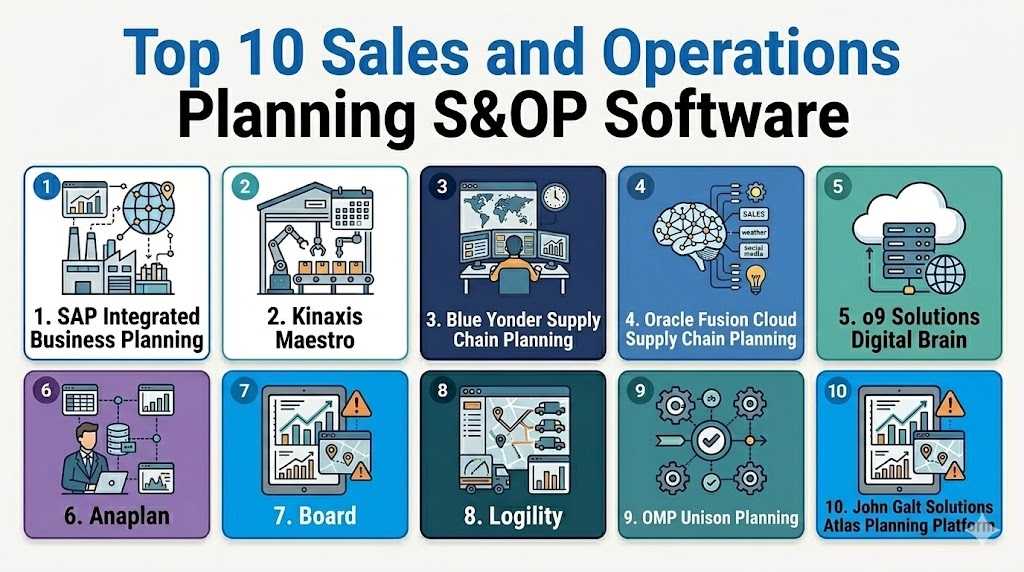
Top 10 Sales and Operations Planning S&OP Software
1- SAP Integrated Business Planning
Short description: SAP Integrated Business Planning is an enterprise planning platform that supports S&OP, demand planning, supply planning, inventory planning, and response planning. It is best suited for SAP-centric organizations that need structured planning across supply chain, finance, and operations.
Key Features
- Sales and operations planning workflows
- Demand, supply, and inventory planning
- Scenario planning and what-if analysis
- Forecast collaboration and review cycles
- Integration with SAP ERP and supply chain systems
- Executive dashboards and planning analytics
- Support for integrated business planning processes
Pros
- Strong fit for companies already using SAP systems
- Supports structured enterprise planning and governance
- Connects S&OP with broader supply chain planning workflows
Cons
- Implementation can be complex and resource-intensive
- Best value often depends on SAP ecosystem maturity
- Smaller teams may find it too heavy for basic planning needs
Platforms / Deployment
Web / Cloud
Hybrid availability: Varies / N/A
Security & Compliance
Not publicly stated in full detail for every deployment. Buyers should validate SSO, MFA, RBAC, encryption, audit logs, ISO 27001, SOC reports, GDPR, and data residency requirements during procurement.
Integrations & Ecosystem
SAP Integrated Business Planning works best when connected with SAP ERP, SAP supply chain systems, analytics tools, master data, and finance workflows. It is a strong option when organizations want planning to be tightly aligned with enterprise data governance.
- SAP S/4HANA and SAP ECC
- ERP and finance systems
- Supply and inventory planning data
- Demand planning and forecast inputs
- Analytics and data warehouse tools
- SAP integration middleware and APIs
Support & Community
SAP provides enterprise support, implementation partners, product documentation, training resources, and consulting services. Buyers should validate implementation partner quality, support tiers, internal SAP readiness, and long-term optimization requirements.
2- Kinaxis Maestro
Short description: Kinaxis Maestro is a supply chain planning and orchestration platform known for concurrent planning, scenario analysis, and rapid decision support. It is best for enterprises that need S&OP connected with demand, supply, inventory, production, and executive decisions.
Key Features
- Concurrent planning across demand and supply
- S&OP and integrated planning workflows
- Scenario modeling and what-if analysis
- Exception management and risk detection
- Demand forecasting and supply planning
- Collaboration across planning teams
- Analytics for executive and operational reviews
Pros
- Strong scenario planning and disruption response
- Useful for complex global supply chains
- Helps cross-functional teams make faster planning decisions
Cons
- Requires planning maturity to get full value
- Not the simplest platform for small teams
- Implementation depends heavily on data readiness
Platforms / Deployment
Web / Cloud
Hybrid availability: Varies / N/A
Security & Compliance
Not publicly stated in full detail for all requirements. Buyers should validate SSO, MFA, RBAC, encryption, audit logs, SOC 2, ISO 27001, GDPR, and data governance controls.
Integrations & Ecosystem
Kinaxis fits environments where S&OP must connect with ERP, demand planning, supply planning, manufacturing, inventory, procurement, and finance workflows. It is especially useful when businesses need to evaluate plan changes quickly.
- ERP integrations
- Demand and supply planning systems
- Inventory and production data
- Finance and S&OP workflows
- BI and data warehouse tools
- APIs and enterprise integration layers
Support & Community
Kinaxis supports enterprise customers through implementation partners, documentation, training, and customer success programs. Buyers should confirm partner availability, planner training, and change management support.
3- Blue Yonder Supply Chain Planning
Short description: Blue Yonder Supply Chain Planning supports demand planning, supply planning, inventory optimization, and S&OP workflows. It is especially relevant for retailers, manufacturers, CPG companies, and distribution-heavy organizations.
Key Features
- Demand planning and forecasting
- Supply planning and inventory optimization
- S&OP and integrated planning workflows
- AI-assisted insights and exception management
- Scenario planning and simulation
- Forecast accuracy and performance analytics
- Integration with supply chain execution systems
Pros
- Strong planning depth for complex supply chains
- Useful for retail, CPG, and manufacturing planning
- Supports exception-based planning workflows
Cons
- Can require significant data preparation
- Implementation may be complex for large global rollouts
- Pricing and module scope are usually quote-based
Platforms / Deployment
Web / Cloud
Hybrid availability: Varies / N/A
Security & Compliance
Not publicly stated in full detail for all buyer needs. Buyers should validate SSO, MFA, RBAC, encryption, audit logs, SOC 2, ISO 27001, GDPR, and data governance documentation.
Integrations & Ecosystem
Blue Yonder works well when S&OP must connect with demand, inventory, supply, warehouse, transportation, fulfillment, and retail planning workflows. It is strong for organizations needing planning depth across complex networks.
- ERP integrations
- WMS and TMS connections
- POS and retail data
- Inventory optimization tools
- Analytics and reporting platforms
- APIs and enterprise data exchange
Support & Community
Blue Yonder provides enterprise support, implementation services, training, documentation, and customer success resources. Buyers should confirm onboarding timelines, support tiers, and post-go-live optimization services.
4- Oracle Fusion Cloud Supply Chain Planning
Short description: Oracle Fusion Cloud Supply Chain Planning supports S&OP, demand management, supply planning, inventory planning, and enterprise planning analytics. It is best for businesses already using Oracle Cloud SCM and Oracle ERP.
Key Features
- Sales and operations planning support
- Demand and supply planning
- Forecast collaboration workflows
- Inventory and replenishment planning
- Scenario planning and analytics
- Oracle Cloud SCM integration
- Executive and planner dashboards
Pros
- Strong fit for Oracle Cloud customers
- Connects S&OP with ERP, finance, and supply chain workflows
- Good option for structured enterprise planning environments
Cons
- Less attractive outside the Oracle ecosystem
- Implementation depends on Oracle configuration maturity
- Broader planning may require additional Oracle modules
Platforms / Deployment
Web / Cloud
Security & Compliance
Not publicly stated in full detail for every deployment. Buyers should validate SSO, MFA, RBAC, encryption, audit logs, ISO 27001, SOC reports, GDPR, and data residency needs.
Integrations & Ecosystem
Oracle Supply Chain Planning is strongest when used with Oracle Cloud SCM, Oracle ERP, procurement, manufacturing, order management, inventory, and analytics tools.
- Oracle Cloud SCM
- Oracle ERP and finance systems
- Procurement and manufacturing data
- Inventory and order management systems
- Oracle analytics tools
- Oracle integration services and APIs
Support & Community
Oracle provides enterprise support, documentation, training resources, and implementation partners. Buyers should confirm support scope, implementation partner expertise, and internal Oracle administration readiness.
5- o9 Solutions Digital Brain
Short description: o9 Solutions Digital Brain is a decision intelligence and planning platform that supports S&OP, demand planning, supply planning, revenue planning, and integrated business planning. It is best for enterprises that want a connected planning model across operations, commercial teams, and finance.
Key Features
- S&OP and integrated business planning
- Demand, supply, and financial planning alignment
- Knowledge graph-based planning model
- Scenario planning and simulation
- AI and machine learning-assisted insights
- Cross-functional collaboration workflows
- Executive dashboards and analytics
Pros
- Strong for advanced planning and decision intelligence
- Useful for connecting commercial, operational, and financial plans
- Flexible for complex enterprise planning models
Cons
- Requires strong data governance
- Implementation can be significant
- May be too advanced for basic S&OP needs
Platforms / Deployment
Web / Cloud
Hybrid availability: Varies / N/A
Security & Compliance
Not publicly stated in full detail for all buyer requirements. Buyers should validate SSO, MFA, RBAC, encryption, audit logs, SOC 2, ISO 27001, GDPR, and enterprise governance controls.
Integrations & Ecosystem
o9 is often used as a digital planning layer across ERP, finance, sales, supply chain, operations, and analytics systems. It is useful when organizations want to connect planning logic across multiple business functions.
- ERP integrations
- CRM and commercial planning data
- Supply chain planning systems
- Finance and S&OP workflows
- Data lakes and BI tools
- APIs and enterprise integration tools
Support & Community
o9 typically supports enterprise transformation programs through implementation teams, partners, training, and customer success services. Buyers should validate project scope, support model, training, and adoption resources.
6- Anaplan
Short description: Anaplan is a connected planning platform used for finance, supply chain, sales, workforce, and operational planning. It is a strong option when S&OP needs to connect closely with financial planning and business performance management.
Key Features
- Connected planning across functions
- S&OP and IBP workflow modeling
- Scenario planning and what-if analysis
- Demand and supply planning models
- Financial planning alignment
- Collaboration and approval workflows
- Dashboards and planning analytics
Pros
- Flexible planning model design
- Strong for finance-led S&OP and connected planning
- Useful for cross-functional collaboration
Cons
- Model governance is important
- Can become complex without strong ownership
- Operational supply chain depth should be validated
Platforms / Deployment
Web / Cloud
Security & Compliance
Not publicly stated in full detail for every requirement. Buyers should validate SSO, MFA, RBAC, encryption, audit logs, SOC 2, ISO 27001, GDPR, and data governance requirements.
Integrations & Ecosystem
Anaplan is useful when S&OP needs to connect sales, finance, operations, supply chain, and executive planning in one flexible model. It is especially valuable when financial planning and operational planning need to work together.
- ERP and finance systems
- CRM and sales planning data
- Supply chain planning data
- BI and data warehouse tools
- APIs and connectors
- S&OP and FP&A workflows
Support & Community
Anaplan has enterprise support, implementation partners, training resources, documentation, and a broad planning community. Buyers should confirm model-building support, partner quality, user enablement, and governance support.
7- Board
Short description: Board is an intelligent planning platform that supports financial planning, supply chain planning, S&OP, analytics, and performance management. It is best for companies that want S&OP connected with finance, operations, and executive reporting.
Key Features
- S&OP and integrated planning workflows
- Financial and operational planning alignment
- Scenario planning and simulations
- Planning dashboards and analytics
- Workflow and collaboration support
- Demand and supply planning use cases
- Business performance management
Pros
- Strong for finance and operations alignment
- Flexible planning and analytics environment
- Useful for executive-level planning visibility
Cons
- Supply chain depth should be validated for complex use cases
- Model design requires governance
- May need integration work for operational systems
Platforms / Deployment
Web / Cloud
Hybrid availability: Varies / N/A
Security & Compliance
Not publicly stated in full detail for all buyer requirements. Buyers should validate SSO, MFA, RBAC, encryption, audit logs, SOC 2, ISO 27001, GDPR, and enterprise governance controls.
Integrations & Ecosystem
Board is useful when S&OP needs to connect financial planning, operational planning, business analytics, and executive performance tracking. It works well for teams that need planning and reporting in one environment.
- ERP and finance systems
- CRM and sales data
- Supply chain planning data
- Data warehouse and BI systems
- APIs and connectors
- Performance management workflows
Support & Community
Board provides enterprise support, documentation, implementation partners, and training resources. Buyers should validate planning model support, regional partner availability, support tiers, and training options.
8- Logility
Short description: Logility is a supply chain planning platform that supports demand planning, inventory optimization, supply planning, S&OP, and product lifecycle planning. It is suitable for manufacturers, distributors, retailers, and mid-market to enterprise planning teams.
Key Features
- S&OP and supply chain planning
- Demand forecasting and planning
- Inventory optimization
- Supply planning and replenishment
- Product lifecycle planning
- Exception-based planning workflows
- Analytics and reporting dashboards
Pros
- Good balance of demand, supply, and inventory planning
- Practical fit for mid-market and enterprise teams
- Useful for planning teams moving beyond spreadsheets
Cons
- Complex processes may need configuration
- User workflow should be tested during evaluation
- Pricing and advanced modules are usually quote-based
Platforms / Deployment
Web / Cloud
Hybrid availability: Varies / N/A
Security & Compliance
Not publicly stated in full detail for all requirements. Buyers should validate SSO, MFA, RBAC, encryption, audit logs, SOC 2, ISO 27001, GDPR, and data protection controls.
Integrations & Ecosystem
Logility fits planning environments where S&OP must connect demand, supply, inventory, production, and lifecycle data. It is practical for organizations that want supply chain planning depth without necessarily adopting the largest enterprise suites.
- ERP integrations
- Inventory and replenishment systems
- Supply and production planning data
- Retail and customer demand data
- BI and analytics platforms
- APIs and data exchange workflows
Support & Community
Logility provides onboarding, support, documentation, training, and implementation resources. Buyers should confirm support scope, planner training, integration assistance, and post-implementation optimization services.
9- OMP Unison Planning
Short description: OMP Unison Planning is a supply chain planning platform that supports demand planning, supply planning, production planning, scheduling, inventory optimization, and S&OP. It is especially relevant for complex manufacturing and supply chain environments.
Key Features
- S&OP and integrated supply chain planning
- Demand and supply planning
- Production planning and scheduling
- Inventory optimization
- Scenario planning and decision support
- AI-assisted planning capabilities
- Collaboration across planning teams
Pros
- Strong for manufacturing and complex supply chains
- Supports detailed planning and scheduling use cases
- Useful for companies needing deep operational planning
Cons
- May be complex for smaller teams
- Implementation requires planning expertise
- Best fit depends on manufacturing and supply chain complexity
Platforms / Deployment
Web / Cloud
Hybrid availability: Varies / N/A
Security & Compliance
Not publicly stated in full detail for all buyer requirements. Buyers should validate SSO, MFA, RBAC, encryption, audit logs, SOC 2, ISO 27001, GDPR, and data governance controls.
Integrations & Ecosystem
OMP works best where S&OP needs to connect with production, supply, inventory, demand, and scheduling workflows. It is particularly useful for organizations where planning decisions directly affect manufacturing execution.
- ERP integrations
- Manufacturing and production systems
- Supply planning data
- Inventory and replenishment workflows
- Analytics and reporting tools
- APIs and enterprise integrations
Support & Community
OMP provides enterprise implementation support, documentation, training, and planning expertise. Buyers should confirm implementation partner availability, rollout support, planner training, and support services.
10- John Galt Solutions Atlas Planning Platform
Short description: John Galt Solutions Atlas Planning Platform supports demand planning, inventory planning, supply planning, S&OP, and supply chain analytics. It is a practical option for mid-market and enterprise teams that need structured planning without overcomplicating adoption.
Key Features
- S&OP and business planning workflows
- Demand planning and forecasting
- Supply and inventory planning
- Scenario planning and analytics
- Collaboration and workflow management
- Exception-based planning
- Reporting dashboards for planning teams
Pros
- Good fit for mid-market planning teams
- Practical planning workflows for demand and supply alignment
- Useful for companies improving S&OP maturity
Cons
- May not have the same enterprise ecosystem scale as larger vendors
- Advanced requirements should be validated carefully
- Integration scope depends on business systems and data quality
Platforms / Deployment
Web / Cloud
Hybrid availability: Varies / N/A
Security & Compliance
Not publicly stated in full detail for all buyer needs. Buyers should validate SSO, MFA, RBAC, encryption, audit logs, SOC 2, ISO 27001, GDPR, and data governance documentation.
Integrations & Ecosystem
John Galt Solutions is useful when S&OP must connect with demand planning, supply planning, inventory data, ERP systems, and planning analytics. It can be a practical choice for teams that want structured planning maturity without unnecessary complexity.
- ERP integrations
- Inventory and supply planning data
- Forecasting and demand signals
- BI and analytics tools
- APIs and data exchange
- Planning workflow integrations
Support & Community
John Galt Solutions provides implementation support, customer success resources, training, and documentation. Buyers should validate support tiers, onboarding timelines, integration services, and planner enablement.
Comparison Table
| Tool Name | Best For | Platform Supported | Deployment | Standout Feature | Public Rating |
|---|---|---|---|---|---|
| SAP Integrated Business Planning | SAP-centric enterprise S&OP | Web | Cloud | Integrated demand, supply, inventory, and IBP workflows | N/A |
| Kinaxis Maestro | Concurrent planning and scenario analysis | Web | Cloud | Fast what-if planning across supply chain functions | N/A |
| Blue Yonder Supply Chain Planning | Retail, CPG, and complex planning teams | Web | Cloud | AI-assisted planning and exception management | N/A |
| Oracle Fusion Cloud Supply Chain Planning | Oracle Cloud SCM customers | Web | Cloud | Oracle ecosystem planning integration | N/A |
| o9 Solutions Digital Brain | Decision intelligence and IBP | Web | Cloud | Knowledge graph-based planning model | N/A |
| Anaplan | Finance-led connected planning | Web | Cloud | Flexible planning models and cross-functional collaboration | N/A |
| Board | Finance and operations planning alignment | Web | Cloud | Unified planning and performance management | N/A |
| Logility | Mid-market and enterprise supply chain planning | Web | Cloud | Demand, supply, and inventory planning balance | N/A |
| OMP Unison Planning | Manufacturing and complex operational planning | Web | Cloud | Deep production and supply chain planning | N/A |
| John Galt Solutions Atlas Planning Platform | Practical S&OP and planning maturity | Web | Cloud | Structured planning for demand, supply, and inventory | N/A |
Evaluation and Scoring of Sales and Operations Planning S&OP Software
| Tool Name | Core 25% | Ease 15% | Integrations 15% | Security 10% | Performance 10% | Support 10% | Value 15% | Weighted Total |
|---|---|---|---|---|---|---|---|---|
| SAP Integrated Business Planning | 9 | 7 | 9 | 9 | 8 | 9 | 7 | 8.25 |
| Kinaxis Maestro | 9 | 8 | 8 | 8 | 9 | 8 | 8 | 8.35 |
| Blue Yonder Supply Chain Planning | 9 | 8 | 8 | 8 | 9 | 8 | 8 | 8.40 |
| Oracle Fusion Cloud Supply Chain Planning | 8 | 7 | 9 | 9 | 8 | 8 | 7 | 7.95 |
| o9 Solutions Digital Brain | 9 | 7 | 8 | 8 | 8 | 8 | 8 | 8.10 |
| Anaplan | 8 | 8 | 8 | 8 | 8 | 8 | 8 | 8.00 |
| Board | 7 | 8 | 8 | 8 | 8 | 8 | 8 | 7.75 |
| Logility | 8 | 8 | 8 | 7 | 8 | 8 | 8 | 7.90 |
| OMP Unison Planning | 9 | 7 | 8 | 8 | 8 | 8 | 7 | 7.95 |
| John Galt Solutions Atlas Planning Platform | 8 | 8 | 7 | 7 | 8 | 8 | 8 | 7.75 |
Which Sales and Operations Planning S&OP Software Is Right for You?
Solo / Freelancer
Solo consultants usually do not need to purchase a full S&OP platform for their own operations, but they should understand the major tools when advising clients. Kinaxis, SAP IBP, Blue Yonder, o9, Oracle, and Anaplan are important platforms for enterprise consulting work.
For smaller advisory projects, a flexible planning or analytics tool may be enough. The key is to match the platform to the client’s planning maturity, data quality, and business complexity.
SMB
Small and mid-sized businesses should focus on usability, implementation speed, clean data, and practical workflow improvement. John Galt Solutions, Logility, Board, and Anaplan may be suitable depending on the company’s planning maturity.
SMBs should avoid buying an overly complex platform before defining their S&OP process, data ownership, meeting cadence, and decision rights. A simpler tool with strong adoption may deliver better results than a larger platform that planners do not use effectively.
Mid-Market
Mid-market companies usually need better demand and supply alignment, inventory visibility, and cross-functional planning. Logility, John Galt Solutions, Anaplan, Board, Blue Yonder, and OMP can be strong options depending on industry needs.
Mid-market buyers should prioritize integration with ERP, inventory, sales, and finance systems. They should also test whether planners, finance users, and executives can easily collaborate within the platform.
Enterprise
Large enterprises need scalable planning platforms that support multiple regions, product lines, business units, plants, customers, and executive review cycles. SAP IBP, Kinaxis Maestro, Blue Yonder, Oracle, o9, OMP, and Anaplan are strong enterprise candidates.
The best choice depends on whether the organization wants a supply-chain-led, finance-led, or integrated business planning operating model. Enterprises should also evaluate global security, data governance, implementation partners, and long-term roadmap fit.
Budget vs Premium
Budget-focused buyers should begin with one high-impact S&OP pain point such as forecast bias, excess inventory, poor production alignment, or slow executive decisions. A focused implementation can create value faster than a large transformation with unclear goals.
Premium platforms make sense when planning complexity is high, disruption costs are significant, and multiple departments need one shared decision process. Buyers should compare software cost against inventory reduction, service-level improvement, margin protection, and productivity gains.
Feature Depth vs Ease of Use
Advanced platforms provide deeper scenario modeling, AI insights, workflow governance, and cross-functional planning capabilities. However, they may require stronger data readiness, better change management, and more planner training.
Easier tools may deliver faster adoption but may not cover complex supply, production, or financial planning requirements. The right balance depends on planning maturity, team skills, and how complex the supply chain really is.
Integrations & Scalability
S&OP tools must connect with ERP, CRM, WMS, TMS, POS, finance, procurement, production, and analytics systems. Without reliable integrations, teams may continue exporting data manually and lose confidence in the planning process.
Scalability matters because product portfolios, regions, plants, channels, and planning users can grow over time. Buyers should validate APIs, connectors, master data requirements, reporting architecture, and implementation support before final selection.
Security & Compliance Needs
S&OP platforms often contain sensitive forecasts, revenue plans, margin assumptions, inventory positions, supplier data, and executive decisions. Buyers should validate SSO, MFA, RBAC, encryption, audit logs, data residency, backup policies, compliance documentation, and role-based access controls.
Global companies should also check regional privacy and governance requirements. Partner access, executive dashboards, and financial planning data should be carefully controlled.
Frequently Asked Questions
1- What is Sales and Operations Planning Software?
Sales and Operations Planning Software helps companies align demand, supply, inventory, production, finance, and executive decisions. It supports one shared planning process across sales, operations, supply chain, and finance teams.
2- How is S&OP software different from demand planning software?
Demand planning software focuses mainly on forecasting customer demand. S&OP software connects demand forecasts with supply capacity, inventory, production, finance, and executive decision-making.
3- Which S&OP software is best for large enterprises?
SAP IBP, Kinaxis Maestro, Blue Yonder, Oracle, o9, OMP, and Anaplan are strong enterprise options. The best fit depends on ERP ecosystem, planning maturity, industry complexity, and integration needs.
4- Which S&OP software is better for mid-market companies?
Logility, John Galt Solutions, Anaplan, Board, and OMP can be strong options for mid-market companies. Buyers should choose based on workflow fit, implementation effort, pricing, and integration requirements.
5- How much does S&OP software cost?
Most S&OP software uses quote-based pricing. Cost usually depends on users, modules, planning scope, integrations, data volume, implementation services, and support requirements.
6- How long does implementation take?
Implementation can take a few weeks for a focused planning use case or several months for enterprise-wide S&OP transformation. Timeline depends on data quality, integrations, process design, and user training.
7- What are common mistakes when choosing S&OP software?
Common mistakes include buying software before defining the S&OP process, ignoring data quality, excluding finance or sales users, over-customizing early, and failing to define decision ownership.
8- Can S&OP software replace spreadsheets?
Yes, it can reduce spreadsheet dependency by creating governed planning workflows, shared assumptions, approvals, and dashboards. However, many teams still use spreadsheets for ad hoc analysis and exports.
9- Do S&OP tools use AI?
Many modern S&OP platforms use AI or advanced analytics for forecast risk detection, scenario planning, anomaly detection, and recommendations. Buyers should validate whether AI insights are explainable and useful.
10- What should companies prepare before implementation?
Companies should prepare clean sales history, product hierarchy, customer data, inventory data, production capacity, financial targets, planning calendars, approval workflows, and clear S&OP ownership.
Conclusion
Sales and Operations Planning Software helps companies move from disconnected planning meetings and spreadsheets to a more structured, collaborative, and data-driven decision process. The best platform depends on company size, industry, ERP ecosystem, planning maturity, data quality, and whether S&OP is led by supply chain, finance, sales, or executive leadership. SAP IBP and Oracle are strong choices for companies already invested in those ecosystems, while Kinaxis, Blue Yonder, and o9 are strong for advanced planning, scenario analysis, and supply chain decision support. Anaplan and Board are useful when finance and connected planning are central, while Logility, OMP, and John Galt Solutions offer practical options for supply chain planning teams with different levels of complexity.

Find Trusted Cardiac Hospitals
Compare heart hospitals by city and services — all in one place.
Explore Hospitals
Sales and Operations Planning (S&OP) software is most valuable when it helps organizations align sales forecasts, demand planning, production, inventory, procurement, and financial goals through a unified planning process. By providing demand forecasting, supply planning, inventory optimization, scenario modeling, collaboration workflows, performance dashboards, analytics, and integration with ERP, CRM, and supply chain systems, these platforms enable businesses to improve forecast accuracy, balance supply and demand, reduce inventory costs, increase operational efficiency, and make faster, data-driven strategic decisions.