Introduction
Electronic Lab Notebook ELN platforms help research laboratories, pharmaceutical companies, healthcare institutions, biotech organizations, engineering teams, and academic researchers digitally document experiments, workflows, protocols, observations, and research data from centralized and secure environments. These platforms replace traditional paper-based laboratory notebooks with searchable, collaborative, compliant, and scalable digital systems. Modern laboratories generate enormous volumes of scientific data across chemistry, biology, genomics, clinical research, materials science, AI-assisted drug discovery, and engineering environments. Managing this information manually creates compliance risks, collaboration bottlenecks, reproducibility issues, and operational inefficiencies. Today’s ELN platforms increasingly support AI-assisted experiment tracking, workflow automation, cloud-native collaboration, audit trails, laboratory instrument integrations, mobile accessibility, compliance governance, and real-time data synchronization. As laboratories accelerate digital transformation initiatives and global research collaboration, ELN systems are becoming foundational infrastructure for modern scientific operations and regulated research environments.
Real-World Use Cases Include:
- Managing scientific experiment documentation
- Supporting pharmaceutical and biotech research workflows
- Tracking laboratory protocols and observations
- Enabling multi-site scientific collaboration
- Maintaining regulatory and compliance records
Evaluation Criteria for Buyers:
- Experiment documentation flexibility
- Workflow automation capabilities
- Compliance and audit support
- Instrument and LIMS integrations
- Search and data retrieval functionality
- Cloud scalability and collaboration support
- Security and governance controls
- Mobile and remote accessibility
- AI-assisted research capabilities
- Ease of onboarding and usability
Best for: pharmaceutical companies, biotech firms, research laboratories, healthcare institutions, universities, manufacturing R&D teams, and scientific organizations managing regulated or collaborative research workflows.
Not ideal for: organizations requiring only lightweight note-taking tools without compliance, laboratory integration, or scientific workflow management capabilities.
Key Trends in Electronic Lab Notebook ELN
- AI-assisted experiment documentation is improving productivity.
- Cloud-native laboratory collaboration is rapidly expanding.
- Integration with laboratory instruments and LIMS platforms is increasing.
- Compliance automation is becoming a major purchasing factor.
- Mobile-first laboratory workflows are gaining adoption.
- Scientific workflow automation is improving reproducibility.
- Data lineage tracking and governance are becoming critical.
- Pharmaceutical and biotech digital transformation investments continue growing.
- ELN platforms are increasingly supporting AI-driven drug discovery workflows.
- Hybrid laboratory environments are driving integration demand.
How We Selected These Tools
The platforms below were selected using practical scientific research and laboratory operations evaluation criteria.
- Market adoption across scientific industries
- Breadth of laboratory workflow support
- Compliance and governance readiness
- Collaboration and scalability capabilities
- Integration ecosystem maturity
- Security and audit functionality
- Ease of use for researchers and scientists
- AI and automation capabilities
- Enterprise and academic suitability
- Long-term product relevance
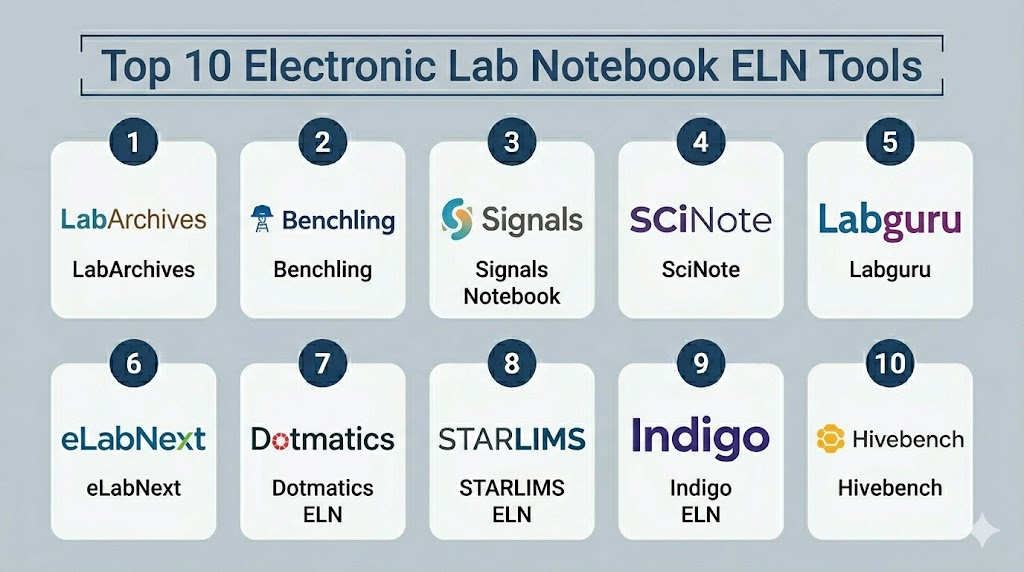
Top 10 Electronic Lab Notebook ELN Tools
1- LabArchives
Short description: LabArchives is a widely adopted cloud-based ELN platform supporting academic, healthcare, and scientific laboratory collaboration workflows.
Key Features
- Electronic lab notebooks
- Experiment tracking
- Cloud collaboration
- Workflow management
- Audit trails
- Mobile accessibility
- Data organization tools
Pros
- User-friendly interface
- Strong academic adoption
- Reliable cloud collaboration
Cons
- Enterprise customization may vary
- Advanced analytics evolving
- Complex integrations may require support
Platforms / Deployment
Web / iOS / Android / Cloud
Security & Compliance
Audit trails, role-based permissions, and governance workflows available.
Integrations & Ecosystem
LabArchives integrates laboratory environments with research ecosystems.
- LIMS systems
- APIs
- Cloud storage
- Authentication providers
- Research platforms
Support & Community
Strong onboarding and educational support ecosystem.
2- Benchling
Short description: Benchling provides cloud-native R&D and ELN workflows for biotech, pharmaceutical, and life sciences organizations.
Key Features
- Scientific collaboration
- Molecular biology workflows
- Experiment tracking
- AI-assisted research workflows
- Inventory management
- Workflow automation
- Data lineage tracking
Pros
- Excellent biotech focus
- Strong collaboration capabilities
- Scalable enterprise workflows
Cons
- Premium enterprise pricing
- Smaller labs may not need full functionality
- Complex deployment planning for large environments
Platforms / Deployment
Web / Cloud
Security & Compliance
SSO, RBAC, audit logs, and governance workflows available.
Integrations & Ecosystem
Benchling integrates laboratory ecosystems with scientific workflows and biotech platforms.
- LIMS systems
- APIs
- Cloud infrastructure
- Scientific databases
- Laboratory instruments
Support & Community
Strong enterprise support and biotech ecosystem presence.
3- Signals Notebook
Short description: Signals Notebook by Revvity supports pharmaceutical, biotech, and scientific R&D environments with advanced ELN and data management workflows.
Key Features
- Experiment documentation
- Scientific workflow automation
- Compliance management
- Collaboration tools
- Data analytics
- Search and retrieval
- Instrument integrations
Pros
- Strong enterprise scientific workflows
- Good compliance readiness
- Advanced analytics support
Cons
- Enterprise complexity
- Premium pricing
- Smaller organizations may require fewer features
Platforms / Deployment
Web / Cloud
Security & Compliance
Audit logging, governance workflows, and access controls available.
Integrations & Ecosystem
Signals Notebook integrates scientific research ecosystems with enterprise laboratory systems.
- Scientific instruments
- APIs
- LIMS systems
- Analytics platforms
- Cloud infrastructure
Support & Community
Strong pharmaceutical and scientific enterprise support.
4- SciNote
Short description: SciNote provides open-source-inspired ELN workflows supporting academic, government, and industrial laboratories.
Key Features
- Experiment management
- Task tracking
- Inventory management
- Collaboration workflows
- Workflow templates
- Compliance support
- Reporting dashboards
Pros
- Strong usability
- Flexible deployment
- Good SMB laboratory support
Cons
- Advanced enterprise analytics evolving
- Large-scale customization may vary
- Some integrations require configuration
Platforms / Deployment
Web / Cloud / Self-hosted
Security & Compliance
Governance workflows and access management available.
Integrations & Ecosystem
SciNote integrates laboratories with scientific and operational ecosystems.
- APIs
- LIMS systems
- Cloud storage
- Authentication providers
- Reporting tools
Support & Community
Reliable scientific support ecosystem and educational adoption.
5- Labguru
Short description: Labguru combines ELN, inventory management, protocol tracking, and scientific collaboration for research-intensive laboratories.
Key Features
- Electronic lab notebooks
- Inventory management
- Protocol tracking
- Experiment workflows
- Collaboration support
- Workflow automation
- Reporting dashboards
Pros
- Strong laboratory operations support
- Good usability
- Broad scientific workflow coverage
Cons
- Enterprise scalability varies
- Advanced AI workflows evolving
- Public pricing transparency limited
Platforms / Deployment
Web / Cloud
Security & Compliance
Access controls and governance workflows available.
Integrations & Ecosystem
Labguru integrates research operations with laboratory ecosystems.
- APIs
- Laboratory instruments
- Cloud storage
- Scientific platforms
- Authentication systems
Support & Community
Strong life sciences and laboratory support ecosystem.
6- eLabNext
Short description: eLabNext provides modular ELN and laboratory management workflows for research organizations and biotech environments.
Key Features
- ELN workflows
- Sample tracking
- Inventory management
- Collaboration tools
- Workflow automation
- API integrations
- Data organization
Pros
- Flexible modular architecture
- Good collaboration support
- Useful inventory workflows
Cons
- Enterprise customization may require planning
- Some advanced analytics limited
- UI complexity for larger deployments
Platforms / Deployment
Web / Cloud
Security & Compliance
Governance and access management capabilities available.
Integrations & Ecosystem
eLabNext integrates laboratory workflows with scientific and enterprise ecosystems.
- APIs
- LIMS systems
- Laboratory instruments
- Cloud infrastructure
- Authentication providers
Support & Community
Growing enterprise and scientific support ecosystem.
7- Dotmatics ELN
Short description: Dotmatics ELN supports pharmaceutical and scientific R&D workflows with integrated scientific data management capabilities.
Key Features
- Scientific data management
- Experiment tracking
- Workflow automation
- Search and retrieval
- Collaboration tools
- Data visualization
- Compliance workflows
Pros
- Strong scientific workflow depth
- Enterprise scalability
- Good analytics support
Cons
- Enterprise pricing
- Implementation complexity
- Smaller labs may find it excessive
Platforms / Deployment
Web / Cloud / Hybrid
Security & Compliance
Role-based access and governance workflows available.
Integrations & Ecosystem
Dotmatics ELN integrates enterprise scientific ecosystems and R&D operations.
- Scientific applications
- APIs
- Cloud platforms
- LIMS systems
- Analytics tools
Support & Community
Strong enterprise scientific support network.
8- STARLIMS ELN
Short description: STARLIMS ELN combines laboratory informatics and ELN workflows for regulated scientific and healthcare environments.
Key Features
- Laboratory documentation
- Compliance management
- Workflow automation
- Instrument integration
- Audit tracking
- Reporting dashboards
- Search optimization
Pros
- Strong regulated-industry support
- Good compliance readiness
- Integrated laboratory workflows
Cons
- Enterprise complexity
- Advanced customization may require expertise
- Pricing transparency limited
Platforms / Deployment
Web / Cloud / Hybrid
Security & Compliance
Audit logs, RBAC, and governance workflows available.
Integrations & Ecosystem
STARLIMS ELN integrates regulated laboratory ecosystems.
- Laboratory instruments
- LIMS systems
- APIs
- Analytics tools
- Enterprise applications
Support & Community
Strong regulated-industry support ecosystem.
9- Indigo ELN
Short description: Indigo ELN provides scientific experiment management and chemical research workflows for laboratories and research organizations.
Key Features
- Experiment documentation
- Chemical structure support
- Workflow management
- Collaboration workflows
- Search capabilities
- Reporting dashboards
- Inventory support
Pros
- Good chemistry workflows
- Strong experiment tracking
- Reliable usability
Cons
- Smaller ecosystem visibility
- Enterprise scalability evolving
- Advanced AI workflows limited
Platforms / Deployment
Web / Cloud
Security & Compliance
Governance controls available.
Integrations & Ecosystem
Indigo ELN integrates chemistry and laboratory ecosystems.
- APIs
- Scientific databases
- Research systems
- Authentication providers
- Reporting tools
Support & Community
Growing scientific research support ecosystem.
10- Hivebench
Short description: Hivebench supports laboratory collaboration, project tracking, and cloud-native scientific documentation workflows.
Key Features
- Cloud collaboration
- Experiment management
- Workflow tracking
- Inventory support
- Team communication
- Search and organization
- Mobile accessibility
Pros
- Good collaboration usability
- Cloud-native simplicity
- Easy onboarding
Cons
- Advanced enterprise workflows limited
- Smaller integration ecosystem
- Large-scale governance evolving
Platforms / Deployment
Web / Cloud / Mobile
Security & Compliance
Basic governance and access controls available.
Integrations & Ecosystem
Hivebench integrates laboratory collaboration ecosystems.
- APIs
- Cloud storage
- Team collaboration tools
- Authentication providers
- Reporting systems
Support & Community
Reliable support for collaborative research teams.
Comparison Table
| Tool Name | Best For | Platform Supported | Deployment | Standout Feature | Public Rating |
|---|---|---|---|---|---|
| LabArchives | Academic laboratories | Web / Mobile | Cloud | Educational adoption | N/A |
| Benchling | Biotech R&D | Web | Cloud | AI-assisted biotech workflows | N/A |
| Signals Notebook | Enterprise pharma | Web | Cloud | Scientific workflow automation | N/A |
| SciNote | SMB laboratories | Web | Cloud / Self-hosted | Flexible usability | N/A |
| Labguru | Laboratory operations | Web | Cloud | Integrated inventory workflows | N/A |
| eLabNext | Modular laboratories | Web | Cloud | Modular scientific architecture | N/A |
| Dotmatics ELN | Enterprise R&D | Web | Cloud / Hybrid | Scientific data management | N/A |
| STARLIMS ELN | Regulated labs | Web | Cloud / Hybrid | Compliance-ready workflows | N/A |
| Indigo ELN | Chemistry labs | Web | Cloud | Chemical research workflows | N/A |
| Hivebench | Collaborative labs | Web / Mobile | Cloud | Cloud-native collaboration | N/A |
Evaluation & Scoring of Electronic Lab Notebook ELN
| Tool Name | Core 25% | Ease 15% | Integrations 15% | Security 10% | Performance 10% | Support 10% | Value 15% | Weighted Total |
|---|---|---|---|---|---|---|---|---|
| LabArchives | 8 | 9 | 7 | 8 | 8 | 8 | 8 | 8.00 |
| Benchling | 9 | 8 | 9 | 9 | 9 | 8 | 7 | 8.50 |
| Signals Notebook | 9 | 7 | 9 | 9 | 9 | 8 | 6 | 8.20 |
| SciNote | 8 | 8 | 7 | 7 | 7 | 7 | 8 | 7.55 |
| Labguru | 8 | 8 | 8 | 8 | 8 | 7 | 7 | 7.80 |
| eLabNext | 8 | 8 | 8 | 7 | 8 | 7 | 7 | 7.75 |
| Dotmatics ELN | 9 | 7 | 9 | 9 | 9 | 8 | 6 | 8.20 |
| STARLIMS ELN | 8 | 7 | 8 | 9 | 8 | 8 | 6 | 7.75 |
| Indigo ELN | 7 | 8 | 7 | 7 | 7 | 7 | 7 | 7.15 |
| Hivebench | 7 | 9 | 6 | 7 | 7 | 7 | 8 | 7.30 |
Which Electronic Lab Notebook ELN Tool Is Right for You?
Solo / Freelancer
Independent researchers and smaller laboratories often benefit from lightweight and affordable platforms such as Hivebench or SciNote due to simplicity and collaboration usability.
SMB
Small and mid-sized laboratories typically require balanced workflow management, inventory support, and compliance readiness. Labguru and SciNote often fit these environments effectively.
Mid-Market
Research organizations and healthcare laboratories usually require stronger integrations, scalability, and governance capabilities. eLabNext and LabArchives provide balanced flexibility.
Enterprise
Large pharmaceutical and biotech enterprises should evaluate Benchling, Signals Notebook, Dotmatics ELN, or STARLIMS ELN for advanced compliance, automation, and scientific workflow support.
Budget vs Premium
Premium ELN platforms offer deeper workflow automation, scientific integrations, AI-assisted capabilities, and enterprise governance. Smaller organizations may benefit more from lightweight cloud-native usability.
Feature Depth vs Ease of Use
Enterprise scientific platforms generally deliver stronger automation and compliance support but may require longer onboarding and implementation planning. Simpler cloud-native ELNs improve adoption speed.
Integrations & Scalability
Modern laboratories increasingly depend on integrations with LIMS systems, laboratory instruments, cloud infrastructure, analytics platforms, and scientific databases. Integration maturity significantly affects scalability.
Security & Compliance Needs
Regulated industries require strong governance, audit trails, access management, workflow validation, and compliance automation. Pharmaceutical and healthcare organizations should prioritize these capabilities carefully.
Frequently Asked Questions FAQs
1. What is an Electronic Lab Notebook ELN?
An Electronic Lab Notebook ELN is a digital platform that helps laboratories manage experiments, protocols, observations, workflows, and scientific collaboration securely. ELNs replace paper notebooks with searchable and scalable digital systems. Modern platforms also support automation and compliance. Adoption continues increasing globally.
2. Who uses ELN platforms?
Pharmaceutical companies, biotech firms, universities, healthcare institutions, government laboratories, manufacturing R&D teams, and scientific researchers commonly use ELN systems. Scientists, lab managers, compliance officers, and research teams depend on these platforms daily. Cloud adoption is growing rapidly. Collaboration demands continue increasing.
3. Why are ELNs replacing paper lab notebooks?
Paper notebooks create challenges around collaboration, reproducibility, compliance, searchability, and long-term storage. ELNs improve operational efficiency, governance, accessibility, and data organization significantly. Digital workflows also support remote collaboration and automation. Regulatory requirements further accelerate ELN adoption.
4. What features matter most in ELN platforms?
Important features include experiment tracking, audit trails, collaboration workflows, search functionality, workflow automation, instrument integrations, inventory management, mobile access, compliance readiness, and cloud scalability. Buyers should also evaluate governance capabilities carefully. Usability strongly affects researcher adoption.
5. Are ELNs suitable for regulated industries?
Yes, many ELN platforms support regulated industries such as pharmaceuticals, healthcare, biotech, and manufacturing. Features like audit trails, role-based access controls, compliance workflows, and governance reporting help organizations meet regulatory requirements. Platform maturity varies significantly across vendors. Validation planning remains important.
6. Can ELNs integrate with laboratory systems?
Most modern ELN platforms integrate with LIMS systems, laboratory instruments, analytics tools, cloud storage, authentication providers, and scientific databases. APIs play a major role in integration flexibility. Enterprise environments often require custom workflow orchestration. Integration planning is essential during deployment.
7. What implementation mistakes should laboratories avoid?
Common mistakes include inadequate user training, weak governance planning, poor workflow mapping, ignoring integrations, and underestimating compliance requirements. Some organizations also fail to standardize scientific documentation workflows. Pilot deployments help reduce operational disruption significantly. Long-term scalability planning is equally important.
8. Are cloud-based ELNs better than self-hosted systems?
Cloud-native ELNs simplify collaboration, scalability, remote access, and operational management. However, highly regulated organizations may still prefer hybrid or self-hosted environments for governance reasons. The best deployment model depends on compliance, infrastructure, and operational priorities. Hybrid adoption continues expanding.
9. How long does ELN implementation typically take?
Implementation timelines vary depending on laboratory size, integrations, workflow complexity, governance requirements, and user onboarding. Smaller labs may deploy quickly, while enterprise pharmaceutical environments often require phased implementation strategies. Workflow standardization also affects rollout speed. Planning is critical for success.
10. Why is reproducibility important in scientific research?
Reproducibility helps validate scientific findings, improve collaboration quality, support compliance, and accelerate innovation. ELNs improve reproducibility through standardized documentation, workflow tracking, audit logging, and centralized data management. Regulatory agencies increasingly emphasize reproducibility standards. Governance maturity remains highly important.
Conclusion
Electronic Lab Notebook ELN platforms are rapidly becoming essential infrastructure for modern laboratories, pharmaceutical companies, biotech organizations, healthcare institutions, universities, and scientific research teams managing increasingly complex research ecosystems. As organizations expand cloud-native scientific collaboration, AI-assisted workflows, laboratory automation, compliance governance, distributed research environments, and digital transformation initiatives, ELN systems now play a critical role in improving reproducibility, operational efficiency, governance, collaboration, and long-term research scalability. The best ELN platform ultimately depends on organizational size, scientific complexity, regulatory requirements, integration needs, and operational maturity. Enterprise pharmaceutical environments may prioritize Benchling, Signals Notebook, or Dotmatics ELN for advanced governance and scientific workflow depth, while academic or smaller laboratories may benefit more from the simplicity and flexibility of LabArchives, SciNote, or Hivebench. Before selecting a platform, organizations should shortlist multiple vendors, validate compliance and integration requirements carefully, test scientific workflows under realistic conditions, review governance capabilities thoroughly, and conduct pilot deployments before full-scale implementation.

Find Trusted Cardiac Hospitals
Compare heart hospitals by city and services — all in one place.
Explore Hospitals
Interesting read! I learned that ELNs make research documentation more organized and easier to collaborate on than traditional paper notebooks.