Introduction
Artifact and container signing tools help organizations verify that software packages, binaries, container images, and deployment artifacts are authentic and untampered before they reach production environments. These platforms use cryptographic signatures, attestations, transparency logs, and provenance validation to establish trust across the software supply chain. software supply chain security is no longer optional. Organizations deploying Kubernetes workloads, AI applications, APIs, and cloud-native services face growing risks from dependency tampering, malicious containers, and compromised CI/CD pipelines. Governments, enterprises, and regulated industries are increasingly adopting zero-trust software delivery practices, making artifact signing and verification a core DevSecOps requirement.
Real-World Use Cases
- Securing Kubernetes Deployments: Organizations verify container images before deployment to ensure only trusted and approved workloads reach production environments. This helps reduce supply-chain attack risks and improves cluster security.
- Protecting CI/CD Pipelines: Development teams use artifact signing to validate build outputs throughout the software delivery lifecycle. This prevents unauthorized modifications between development, testing, and production stages.
- Software Supply Chain Security: Enterprises rely on signing and verification tools to establish trust across internally developed applications and third-party dependencies. This is critical for reducing exposure to compromised packages and libraries.
- Compliance and Audit Readiness: Industries such as finance, healthcare, and government use signed artifacts and provenance records to demonstrate software integrity during audits, regulatory reviews, and security assessments.
- Multi-Cloud Deployment Governance: Organizations operating across AWS, Azure, Google Cloud, and private infrastructure use signing policies to maintain consistent security standards and deployment controls across environments.
- Secure Software Distribution: Software vendors sign releases, updates, and container images before distribution. This allows customers and partners to verify authenticity and ensure software has not been altered after publication.
Evaluation Criteria for Buyers
- Signing and verification capabilities
- Kubernetes and OCI compatibility
- Keyless signing support
- Policy enforcement flexibility
- Provenance and attestation features
- Registry integrations
- Enterprise governance controls
- CI/CD ecosystem compatibility
- Scalability and automation support
- Community maturity and long-term viability
Best for
Cloud-native organizations, DevSecOps teams, software vendors, platform engineering teams, and enterprises implementing software supply-chain security programs. These tools are especially valuable for Kubernetes-based environments and organizations with automated deployment pipelines.
Not ideal for
Small teams with manual software deployment processes, non-containerized environments, or organizations that do not distribute software artifacts across multiple systems. Simpler security controls may be sufficient in those cases.
Key Trends in Artifact/Container Signing & Verification Tools
- Keyless signing adoption is rapidly replacing traditional static key management.
- AI-generated code pipelines are increasing demand for provenance validation.
- Kubernetes admission controllers are becoming standard verification checkpoints.
- SBOM validation is evolving into a mandatory compliance requirement.
- Policy-as-code enforcement is being integrated directly into deployment pipelines.
- Multi-cloud software verification architectures are gaining traction.
- Enterprises are prioritizing tamper-evident transparency logging.
- OCI artifact signing standards are improving interoperability across vendors.
- Supply-chain security frameworks are driving broader adoption in regulated sectors.
- Automated attestation generation is reducing manual audit workloads.
How We Selected These Tools (Methodology)
The tools in this list were selected using a combination of technical capability, ecosystem maturity, and real-world deployment relevance.
- Evaluated market adoption across cloud-native and DevSecOps ecosystems
- Assessed signing, verification, provenance, and attestation capabilities
- Reviewed Kubernetes and OCI registry compatibility
- Compared integration depth with modern CI/CD pipelines
- Considered scalability for enterprise-grade deployments
- Analyzed security posture and policy enforcement flexibility
- Included both open-source and enterprise-focused platforms
- Examined developer experience and operational complexity
- Prioritized tools actively evolving for modern supply-chain threats
- Balanced enterprise governance with developer usability
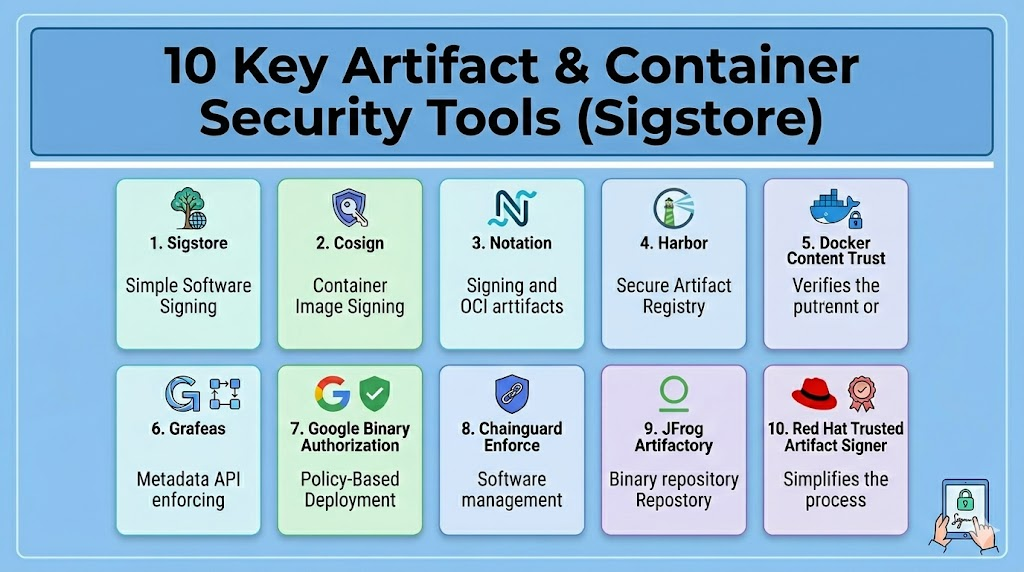
Top 10 Artifact/Container Signing & Verification Tools
1- Sigstore
Short description: Sigstore is an open-source software supply chain security platform designed to simplify artifact signing and verification for modern DevSecOps teams. It introduces a keyless signing model that reduces operational overhead while improving trust and traceability. Organizations use it to secure containers, binaries, CI/CD pipelines, Kubernetes workloads, and software releases across cloud-native environments.
Key Features
- Keyless signing using OpenID Connect identities
- Fulcio certificate authority for short-lived certificates
- Rekor transparency log for immutable verification records
- Software provenance and attestation generation
- Native integration with Cosign
- Kubernetes-friendly verification workflows
- OCI artifact support
Pros
- Removes complexity associated with long-term key management
- Strong CNCF ecosystem alignment and industry adoption
- Excellent fit for modern Kubernetes and DevSecOps workflows
Cons
- Requires teams to understand modern supply-chain security concepts
- Some enterprise governance features require complementary tools
- Operational models may differ from traditional PKI workflows
Platforms / Deployment
Cloud / Self-hosted / Hybrid
Security & Compliance
Sigstore focuses heavily on identity-based cryptographic trust, transparency logging, and tamper-evident verification. The platform enables organizations to improve software provenance tracking and deployment integrity across distributed environments. Its transparency log architecture provides strong auditability for compliance-driven environments. RBAC and authentication capabilities depend on integrated infrastructure and deployment architecture.
Integrations & Ecosystem
Sigstore has become one of the most influential projects in the software supply-chain ecosystem because of its interoperability and cloud-native adoption. Many modern DevOps platforms now support Sigstore-based workflows directly.
- Kubernetes
- GitHub Actions
- GitLab CI/CD
- Tekton
- OCI Registries
- SLSA Framework
- Cosign
- Policy Controllers
The ecosystem around Sigstore continues expanding rapidly as organizations move toward zero-trust software delivery architectures and automated provenance validation.
Support & Community
Sigstore has one of the strongest open-source communities in the cloud-native security ecosystem. Documentation quality is strong, enterprise adoption is growing rapidly, and major technology vendors actively contribute to the project.
2- Cosign
Short description: Cosign is the primary signing and verification tool within the Sigstore ecosystem and is widely used for securing container images and OCI artifacts. It enables developers and DevSecOps teams to sign, verify, and attach attestations directly within container registries. The tool is particularly popular in Kubernetes environments and modern CI/CD pipelines.
Key Features
- Container image signing and verification
- Keyless signing workflows
- OCI-native artifact support
- SBOM attachment support
- Attestation generation
- Registry-based signature storage
- Kubernetes deployment compatibility
Pros
- Simple CLI-based developer experience
- Strong compatibility with modern OCI registries
- Excellent automation support in CI/CD pipelines
Cons
- CLI-first design may feel technical for non-engineering users
- Policy governance requires external enforcement tools
- Advanced enterprise workflows can require additional integrations
Platforms / Deployment
Linux / Windows / macOS
Security & Compliance
Cosign supports cryptographic verification, signed attestations, provenance validation, and secure registry-native workflows. It enables teams to establish trusted deployment pipelines without relying entirely on static signing keys. Transparency logging and identity-based verification improve auditability and reduce key exposure risks.
Integrations & Ecosystem
Cosign integrates deeply with cloud-native tooling and is widely supported in Kubernetes ecosystems.
- Kubernetes
- Harbor
- Docker
- GitHub Actions
- Tekton
- OCI Registries
- Sigstore
Many organizations adopt Cosign as the operational signing layer while using Sigstore infrastructure for certificate and transparency management.
Support & Community
Cosign benefits from the broader Sigstore ecosystem and has excellent community support, active development, and extensive adoption among Kubernetes-focused engineering teams.
3- Notation
Short description: Notation is an OCI-focused signing and verification project designed to standardize artifact trust across cloud-native environments. It provides structured trust policy management and interoperable signing workflows for container registries and enterprise software delivery pipelines. Organizations seeking standards-based OCI signing often evaluate Notation alongside Sigstore technologies.
Key Features
- OCI-compliant artifact signing
- Signature verification policies
- Trust store management
- Pluggable key providers
- Registry interoperability
- Enterprise policy controls
- Standardized signature specifications
Pros
- Strong OCI standards alignment
- Flexible trust policy architecture
- Growing support among cloud-native vendors
Cons
- Smaller ecosystem than Sigstore currently
- Fewer integrations compared to Cosign
- Enterprise adoption is still maturing
Platforms / Deployment
Linux / Windows / macOS
Security & Compliance
Notation focuses heavily on trust policy enforcement, cryptographic validation, and standardized OCI security workflows. It supports multiple trust providers and enterprise governance models, helping organizations align software verification with broader container security strategies.
Integrations & Ecosystem
Notation is increasingly being integrated into OCI-compliant registries and cloud-native deployment systems.
- OCI Registries
- Azure Container Registry
- Kubernetes
- Harbor
- Cloud-native CI/CD systems
Its standards-driven architecture makes it attractive for enterprises prioritizing interoperability and long-term ecosystem compatibility.
Support & Community
Notation has growing CNCF ecosystem visibility and is backed by organizations focused on OCI standardization and enterprise cloud-native security.
4- Harbor
Short description: Harbor is an enterprise-grade container registry platform that combines artifact management, image signing, vulnerability scanning, and policy enforcement within a unified registry environment. Organizations frequently use Harbor as a centralized trusted registry for Kubernetes and cloud-native deployments. It is especially popular among enterprises seeking self-hosted registry governance and security controls.
Key Features
- Integrated container registry management
- Image signing support
- Vulnerability scanning
- Role-based access controls
- Replication and synchronization policies
- Helm chart management
- Registry-level policy enforcement
Pros
- Combines registry management and security capabilities
- Strong enterprise governance controls
- Excellent Kubernetes ecosystem integration
Cons
- Requires operational management and infrastructure planning
- Broader platform scope may be excessive for small teams
- Scaling large deployments may require architectural tuning
Platforms / Deployment
Self-hosted / Hybrid
Security & Compliance
Harbor includes RBAC, audit logging, image scanning, replication security controls, and registry governance features. Enterprises frequently use Harbor to centralize trusted software delivery pipelines and reduce unauthorized artifact distribution risks.
Integrations & Ecosystem
Harbor integrates deeply with Kubernetes and cloud-native delivery workflows while supporting multiple artifact formats.
- Kubernetes
- Docker
- Helm
- Trivy
- Cosign
- OCI Registries
- CI/CD Platforms
The platform is commonly deployed in enterprise Kubernetes environments where governance, compliance, and private registry control are priorities.
Support & Community
Harbor has strong enterprise adoption, active open-source development, and mature operational documentation for Kubernetes-centric organizations.
5- Docker Content Trust
Short description: Docker Content Trust provides image signing and publisher verification capabilities within Docker ecosystems. It helps teams validate trusted container publishers and secure image distribution workflows. While newer supply-chain security solutions have emerged, Docker Content Trust remains relevant for organizations operating heavily within Docker-native environments.
Key Features
- Trusted image publishing
- Image signature validation
- Publisher delegation
- Key-based trust management
- Secure image distribution
- Registry verification
- Docker-native integration
Pros
- Familiar workflow for Docker users
- Straightforward deployment model
- Strong integration with Docker tooling
Cons
- Less flexible than modern keyless systems
- Primarily focused on Docker ecosystems
- Limited provenance and attestation functionality
Platforms / Deployment
Windows / Linux / macOS
Security & Compliance
Docker Content Trust provides cryptographic image validation and publisher authenticity verification. It helps organizations prevent untrusted container deployments and improve software distribution security within Docker-centric infrastructures.
Integrations & Ecosystem
The platform integrates primarily within Docker-based environments and registries.
- Docker Hub
- Docker Engine
- CI/CD Pipelines
- Container Registries
Although newer technologies are gaining momentum, Docker Content Trust still serves organizations maintaining established Docker workflows.
Support & Community
Documentation and operational familiarity remain strong due to Docker’s broad ecosystem adoption.
6- Grafeas
Short description: Grafeas is an open metadata API and supply-chain security framework designed for managing software provenance, attestations, and vulnerability metadata. It helps organizations centralize artifact intelligence across software delivery pipelines. Many enterprise security architectures use Grafeas as a foundational metadata layer.
Key Features
- Artifact metadata storage
- Vulnerability tracking
- Provenance management
- Attestation handling
- Compliance metadata support
- Policy integration
- Supply-chain intelligence
Pros
- Flexible metadata architecture
- Useful for compliance-driven workflows
- Strong integration potential with Kubernetes security ecosystems
Cons
- Requires complementary signing tools
- More infrastructure complexity than standalone signing platforms
- Developer onboarding can be technical
Platforms / Deployment
Cloud / Self-hosted
Security & Compliance
Grafeas focuses on artifact metadata integrity, provenance tracking, and compliance visibility. Organizations use it to strengthen auditability, maintain deployment evidence, and centralize software supply-chain intelligence.
Integrations & Ecosystem
Grafeas often operates as part of broader Kubernetes and DevSecOps ecosystems.
- Kubernetes
- Binary Authorization
- CI/CD Pipelines
- Container Registries
- Security Scanners
Its extensible architecture makes it valuable for enterprises building customized supply-chain governance frameworks.
Support & Community
Grafeas maintains solid open-source community support and remains influential in cloud-native supply-chain security design patterns.
7- Google Binary Authorization
Short description: Google Binary Authorization is a deployment security platform that enforces trusted software policies before workloads reach Kubernetes environments. It validates signed images and attestations against organizational trust policies. Enterprises use it to strengthen deployment governance across cloud-native production systems.
Key Features
- Admission policy enforcement
- Trusted image validation
- Attestation verification
- Kubernetes integration
- Deployment governance controls
- CI/CD policy enforcement
- Provenance validation
Pros
- Strong Kubernetes deployment security
- Excellent policy enforcement capabilities
- Well-suited for regulated environments
Cons
- Most effective within Google Cloud ecosystems
- Cloud dependency considerations
- Advanced governance may increase operational complexity
Platforms / Deployment
Cloud
Security & Compliance
Binary Authorization supports trusted deployment enforcement, cryptographic verification, and policy-based admission controls. It strengthens software governance and helps organizations reduce deployment risks from compromised artifacts.
Integrations & Ecosystem
The platform integrates closely with Google cloud-native infrastructure and Kubernetes delivery pipelines.
- Google Kubernetes Engine
- Grafeas
- CI/CD Systems
- Container Registries
Organizations focused on Kubernetes governance often combine Binary Authorization with broader provenance and attestation workflows.
Support & Community
Enterprise documentation and support quality are strong, particularly for organizations standardized on Google Cloud infrastructure.
8- Chainguard Enforce
Short description: Chainguard Enforce is an enterprise software supply-chain security platform focused on policy enforcement, artifact trust validation, and secure software delivery governance. It helps organizations continuously verify that only trusted artifacts enter production environments. The platform is heavily aligned with modern Sigstore-based security models.
Key Features
- Artifact verification policies
- Supply-chain governance
- Kubernetes policy enforcement
- Trusted deployment validation
- Compliance reporting
- CI/CD security workflows
- Sigstore ecosystem compatibility
Pros
- Strong focus on modern supply-chain threats
- Enterprise-ready governance capabilities
- Excellent Kubernetes alignment
Cons
- Enterprise-oriented deployment model
- Commercial licensing considerations
- Advanced workflows may require planning
Platforms / Deployment
Cloud / Hybrid
Security & Compliance
Chainguard Enforce provides artifact trust validation, deployment governance, and verification enforcement across cloud-native environments. The platform is designed for organizations implementing zero-trust software delivery architectures and modern DevSecOps controls.
Integrations & Ecosystem
Chainguard integrates with modern Kubernetes and software delivery ecosystems.
- Sigstore
- Kubernetes
- OCI Registries
- Policy Engines
- CI/CD Systems
Its focus on automated policy enforcement makes it attractive for enterprises scaling software supply-chain governance.
Support & Community
Commercial support quality is strong, particularly for organizations prioritizing enterprise-grade software supply-chain security programs.
9- JFrog Artifactory
Short description: JFrog Artifactory is an enterprise artifact repository platform that supports secure package management, repository governance, and artifact signing across multiple software ecosystems. Large organizations frequently use it as a centralized software distribution and trust platform. It supports containers, binaries, packages, and modern CI/CD workflows.
Key Features
- Universal artifact repository
- Multi-package ecosystem support
- Artifact signing capabilities
- Access governance controls
- Repository replication
- CI/CD integrations
- Enterprise scalability
Pros
- Supports diverse software ecosystems
- Strong enterprise governance capabilities
- Mature DevOps integration ecosystem
Cons
- Broader than pure signing-focused platforms
- Can become operationally complex
- Premium enterprise capabilities may increase costs
Platforms / Deployment
Cloud / Self-hosted / Hybrid
Security & Compliance
Artifactory includes RBAC, audit logging, repository governance, access controls, and enterprise-grade artifact management features. Organizations frequently use it to centralize software trust and delivery governance.
Integrations & Ecosystem
Artifactory has one of the broadest DevOps integration ecosystems available.
- Jenkins
- GitHub
- GitLab
- Docker
- Kubernetes
- CI/CD Platforms
- Package Managers
Its multi-ecosystem support makes it especially attractive for large enterprises managing diverse technology stacks.
Support & Community
JFrog provides mature enterprise support, extensive documentation, and strong onboarding resources for complex deployments.
10- Red Hat Trusted Artifact Signer
Short description: Red Hat Trusted Artifact Signer is an enterprise signing and verification platform built around Sigstore technologies and OpenShift-native security workflows. It helps organizations establish trusted software delivery across hybrid Kubernetes environments. Enterprises adopting Red Hat ecosystems often use it to strengthen software supply-chain governance.
Key Features
- Sigstore-based signing architecture
- OpenShift integration
- Artifact verification policies
- Attestation support
- Governance controls
- Enterprise lifecycle management
- Hybrid Kubernetes compatibility
Pros
- Strong enterprise Kubernetes alignment
- Supported Sigstore implementation
- Excellent fit for OpenShift environments
Cons
- Most beneficial within Red Hat ecosystems
- Enterprise licensing considerations
- Smaller ecosystem than fully open-source alternatives
Platforms / Deployment
Cloud / Hybrid / Self-hosted
Security & Compliance
The platform provides policy enforcement, RBAC integration, cryptographic signing, auditability, and enterprise governance capabilities. It helps organizations strengthen deployment trust and software provenance visibility.
Integrations & Ecosystem
Red Hat Trusted Artifact Signer integrates closely with enterprise Kubernetes infrastructure and cloud-native security tooling.
- OpenShift
- Kubernetes
- Sigstore
- CI/CD Systems
- Enterprise Security Platforms
Its enterprise integration focus makes it attractive for organizations already standardized on Red Hat infrastructure.
Support & Community
Red Hat provides enterprise-grade support, lifecycle management, and operational guidance for production deployments.
Comparison Table (Top 10)
| Tool Name | Best For | Platforms Supported | Deployment | Standout Feature | Public Rating |
|---|---|---|---|---|---|
| Sigstore | Open-source supply-chain security | Multi-platform | Hybrid | Keyless signing | N/A |
| Cosign | Container image signing | Windows, Linux, macOS | Self-hosted | OCI-native signing | N/A |
| Notation | OCI standard compliance | Multi-platform | Hybrid | Trust policy management | N/A |
| Harbor | Enterprise container registry security | Multi-platform | Self-hosted | Registry governance | N/A |
| Docker Content Trust | Docker environments | Multi-platform | Hybrid | Trusted publishers | N/A |
| Grafeas | Metadata and provenance management | Multi-platform | Cloud/Self-hosted | Provenance tracking | N/A |
| Binary Authorization | Kubernetes policy enforcement | Cloud | Cloud | Admission control | N/A |
| Chainguard Enforce | Enterprise supply-chain governance | Multi-platform | Hybrid | Policy enforcement | N/A |
| JFrog Artifactory | Enterprise artifact management | Multi-platform | Hybrid | Universal repository support | N/A |
| Red Hat Trusted Artifact Signer | OpenShift security | Multi-platform | Hybrid | Enterprise Sigstore integration | N/A |
Evaluation & Scoring of Artifact/Container Signing & Verification Tools
| Tool Name | Core | Ease | Integrations | Security | Performance | Support | Value | Weighted Total |
|---|---|---|---|---|---|---|---|---|
| Sigstore | 10 | 8 | 10 | 10 | 9 | 9 | 10 | 9.5 |
| Cosign | 10 | 8 | 9 | 10 | 9 | 9 | 10 | 9.3 |
| Notation | 8 | 8 | 8 | 9 | 8 | 8 | 9 | 8.3 |
| Harbor | 9 | 8 | 9 | 9 | 9 | 9 | 8 | 8.8 |
| Docker Content Trust | 7 | 8 | 7 | 8 | 8 | 8 | 8 | 7.7 |
| Grafeas | 8 | 6 | 8 | 8 | 8 | 8 | 8 | 7.8 |
| Binary Authorization | 9 | 8 | 8 | 10 | 9 | 9 | 7 | 8.5 |
| Chainguard Enforce | 9 | 8 | 8 | 10 | 9 | 9 | 7 | 8.6 |
| JFrog Artifactory | 9 | 8 | 10 | 9 | 9 | 9 | 7 | 8.8 |
| Red Hat Trusted Artifact Signer | 9 | 7 | 8 | 10 | 9 | 9 | 7 | 8.5 |
Which Artifact/Container Signing & Verification Tool Is Right for You?
Solo / Freelancer
Cosign and Sigstore are usually the best starting points because they are developer-friendly, open-source, and highly compatible with modern container workflows.
SMB
Harbor provides a strong balance between registry management, artifact security, and operational control without requiring extremely large infrastructure teams.
Mid-Market
JFrog Artifactory and Chainguard Enforce are strong choices for organizations needing broader governance, policy controls, and software lifecycle management.
Enterprise
Large enterprises running Kubernetes at scale often benefit most from Sigstore ecosystems, Binary Authorization, Red Hat Trusted Artifact Signer, and enterprise policy enforcement platforms.
Budget vs Premium
Budget-conscious teams should prioritize Sigstore, Cosign, Harbor, and Notation. Premium enterprise environments may prefer Artifactory, Chainguard, and Red Hat platforms for governance and lifecycle management.
Feature Depth vs Ease of Use
Cosign offers strong simplicity for developers, while Harbor balances usability and enterprise functionality. Platforms like Artifactory and Chainguard provide deeper governance but involve more operational complexity.
Integrations & Scalability
Organizations operating multi-cloud Kubernetes platforms should prioritize strong OCI integrations, CI/CD compatibility, policy enforcement, and scalable registry architectures.
Security & Compliance Needs
Regulated industries should focus on provenance tracking, attestation support, audit logging, policy enforcement, and deployment verification capabilities.
Frequently Asked Questions
1. What are Artifact/Container Signing & Verification tools?
Artifact signing and verification tools use cryptographic signatures to confirm that software packages, container images, and binaries have not been modified after creation. These tools establish trust across the software supply chain and help organizations prevent unauthorized or malicious artifacts from reaching production systems. They are widely used in Kubernetes, DevSecOps, and CI/CD environments. Many enterprises now consider them essential for secure software delivery.
2. Why is container image signing important?
Container image signing ensures that only trusted and verified images are deployed into production environments. Security teams can validate image authenticity before deployment and automatically block unapproved workloads. This reduces the risk of software supply-chain attacks and strengthens Kubernetes security posture. It is especially valuable for organizations managing large-scale containerized applications.
3. What is Sigstore?
Sigstore is an open-source software supply-chain security project designed to simplify artifact signing and verification. It provides capabilities such as keyless signing, transparency logging, and identity-based trust validation. Organizations use Sigstore to secure software releases, container images, and CI/CD pipelines. It has become one of the most influential projects in the cloud-native security ecosystem.
4. What is the difference between Sigstore and Cosign?
Sigstore is the broader ecosystem that includes infrastructure components such as Fulcio and Rekor. Cosign is the actual tool used to sign and verify artifacts within the Sigstore ecosystem. Developers commonly use Cosign for container image signing and OCI artifact verification. Together, they create a complete framework for modern software supply-chain security.
5. Can signing tools integrate with CI/CD pipelines?
Yes, most modern signing platforms integrate directly with GitHub Actions, Jenkins, GitLab CI/CD, Tekton, Azure DevOps, and other automation systems. This allows organizations to automatically sign and verify artifacts during software delivery workflows. Automated verification improves consistency and reduces manual security processes. It also helps organizations scale DevSecOps operations more efficiently.
6. Are artifact signing tools only useful for Kubernetes?
No, these tools can secure much more than Kubernetes container images. Organizations also use them for binaries, software packages, APIs, virtual machine images, and deployment artifacts. Kubernetes remains one of the largest use cases because of its cloud-native adoption. However, software signing is valuable across many modern application delivery environments.
7. What are software attestations?
Software attestations are signed records that provide metadata about how software was built, tested, scanned, or deployed. These records help organizations validate software provenance and improve supply-chain visibility. Attestations are often used for compliance reporting and deployment policy enforcement. Many enterprises now use them as part of zero-trust software delivery strategies.
8. What is keyless signing?
Keyless signing eliminates the need to manage long-lived private keys by using identity-based authentication and short-lived certificates. This reduces operational complexity while improving overall security posture. Platforms such as Sigstore popularized this model for cloud-native environments. Many organizations prefer keyless signing because it simplifies large-scale deployment workflows.
9. How do organizations benefit from software provenance?
Software provenance provides visibility into where software originated and how it was created throughout the build process. This helps security teams detect tampering, improve audit readiness, and strengthen software trust. Provenance tracking is becoming increasingly important for regulatory compliance and supply-chain governance. It also improves transparency across modern DevSecOps pipelines.
10. How should organizations choose a signing and verification tool?
Organizations should evaluate deployment requirements, Kubernetes compatibility, policy enforcement capabilities, scalability, and CI/CD integrations before selecting a platform. Open-source tools may work well for smaller teams, while enterprises often require stronger governance and compliance features. Running a pilot deployment is usually the best way to validate operational fit. Long-term ecosystem maturity and integration flexibility should also be considered.
Conclusion
Artifact and container signing tools are becoming foundational components of modern software supply-chain security strategies. As organizations continue adopting Kubernetes, AI-driven development workflows, multi-cloud deployments, and zero-trust architectures, software provenance and trusted deployment verification are now critical operational requirements. Sigstore and Cosign currently lead much of the cloud-native ecosystem, while Harbor, JFrog Artifactory, Binary Authorization, Chainguard Enforce, and Red Hat Trusted Artifact Signer provide stronger enterprise governance and deployment policy capabilities. The right platform ultimately depends on operational maturity, Kubernetes adoption, compliance needs, deployment scale, and governance expectations. Rather than selecting a single universal winner, organizations should shortlist two or three platforms, validate integrations with existing CI/CD pipelines and registries, test verification workflows in non-production environments, and evaluate long-term operational complexity before full deployment.

Find Trusted Cardiac Hospitals
Compare heart hospitals by city and services — all in one place.
Explore Hospitals