Introduction
In the face of unexpected medical crises, the difference between a positive outcome and a complicated recovery often comes down to timing and the quality of care received. Emergency medical care serves as the vital lifeline for communities, providing rapid stabilization for life-threatening injuries and conditions. Specialized trauma care is a highly refined discipline, requiring seamless coordination between paramedics, surgeons, and critical care specialists.As the demand for high-quality, efficient medical intervention grows, patients and families need to understand what constitutes a top-tier facility. Knowing which institutions possess the capacity to manage complex trauma cases can empower individuals to make informed decisions when every second counts. Whether dealing with accidents or sudden critical health events, the presence of robust infrastructure is non-negotiable. For those seeking comprehensive details on high-quality medical facilities, MYHOSPITALNOW provides an essential resource for navigating the healthcare landscape. This guide explores the structure, technology, and importance of leading trauma and emergency hospitals.
Understanding Trauma and Emergency Care
Trauma care is a specialized branch of medicine focused on treating severe, physical injuries resulting from accidents, violence, or sudden catastrophic events. While routine emergency care may address common ailments like flu or minor injuries, trauma centers are equipped specifically to handle complex, multi-system physiological damage.
The primary distinction lies in the intensity of resources. Trauma centers operate under a strict, protocol-driven environment where time-to-treatment is measured in minutes. These centers are designed for high-acuity patients who require immediate surgical intervention or advanced diagnostic imaging to prevent permanent damage or mortality.
Why Specialized Trauma Hospitals Matter
The effectiveness of an emergency response is defined by its infrastructure. Specialized trauma hospitals are distinguished by their ability to provide 24/7 coverage, meaning a full surgical team is either on-site or available within minutes at any hour of the day or night.
24/7 Emergency Services
Emergency departments in these facilities never close. They are staffed by physicians trained in emergency medicine who serve as the “gatekeepers” of the hospital, ensuring that incoming patients receive immediate triage and assessment.
Trauma Surgeons and Critical Care Specialists
These facilities maintain a multidisciplinary team. When a trauma patient arrives, it is not just one doctor, but a collective of experts—including orthopedic surgeons, neurosurgeons, and anesthesiologists—who collaborate to stabilize the patient.
Advanced Diagnostic Capabilities
A trauma center is only as good as its diagnostic tools. Modern facilities utilize high-speed imaging, such as rapid-sequence CT scanners and point-of-care ultrasound, to identify internal injuries before physical symptoms even manifest.
QUICK COMPARISON TABLE
| Hospital Name | Trauma Services | Emergency Dept. Capabilities | Critical Care Units | Patient Support |
| Metro Central Trauma | Level 1 Full Spectrum | Advanced Stabilization | High-Dependency | 24/7 Social Work |
| Summit Emergency | Ortho/Neurological | Rapid Triage | Intensive Care | Family Counseling |
| City General Medical | Multi-Specialty | Immediate Surgical | Critical Care | Rehabilitation |
| Pacific Trauma Inst. | Comprehensive | Advanced Imaging | Specialized ICU | Trauma Recovery |
| Horizon Emergency | Acute Injury | Life-Support Focus | Ventilatory Care | Patient Advocacy |
Leading Trauma & Emergency Hospitals
1. Metro Central Trauma
Overview: A premier institution focused on high-acuity trauma and rapid response.
- Emergency Department: Features an integrated triage area designed for high-volume intake.
- Trauma Services: Specialized teams for blunt force and penetrating injuries.
- Critical Care: Equipped with advanced monitoring and life-support systems.
- Strengths: Exceptional speed in surgical deployment and diagnostic precision.
2. Summit Emergency
Overview: Known for its excellence in neuro-trauma and complex orthopedic reconstructions.
- Emergency Department: Utilizes a seamless flow system to minimize wait times.
- Trauma Services: Focuses on spinal injuries and complex limb salvage.
- Advanced Technologies: State-of-the-art robotic surgical assistance.
- Strengths: High concentration of neurological surgical expertise.
3. City General Medical
Overview: A massive facility handling a wide breadth of both trauma and systemic emergency needs.
- Emergency Department: Large-scale capacity with specialized bays for cardiac and respiratory arrest.
- Critical Care Facilities: Extensive ICU capacity with 1-to-1 nurse-to-patient ratios.
- Strengths: Versatility in handling diverse medical emergencies simultaneously.
Common Emergencies Managed by Trauma Hospitals
Trauma hospitals are the primary destination for injuries that exceed the capability of standard urgent care centers:
- Road Traffic Accidents: Managing complex fractures, internal organ damage, and shock.
- Head Injuries: Utilizing specialized monitoring to prevent intracranial pressure buildup.
- Severe Bleeding: Deploying immediate blood transfusion protocols and surgical vascular repair.
- Burns: Providing specialized fluid management and infection control for major thermal injuries.
- Cardiac Emergencies: Rapid intervention for arrhythmias or cardiac arrest requiring advanced life support.
EMERGENCY CARE SERVICES TABLE
| Emergency Type | Typical Response Team | Primary Goal |
| Trauma Injury | Trauma surgeons/ED physicians | Stabilization and treatment |
| Cardiac Emergency | Cardiologists and ICU team | Restore heart function |
| Stroke | Neurology specialists | Minimize brain damage |
| Severe Burns | Burn care specialists | Prevent complications |
| Major Fractures | Orthopedic trauma team | Restore mobility |
Technologies Used in Modern Emergency Hospitals
The landscape of emergency care has been transformed by technology. Modern hospitals now prioritize:
- Advanced Imaging Systems: Enabling rapid scanning of the entire body to detect internal hemorrhaging.
- Point-of-Care Diagnostics: Allowing for blood chemistry analysis within minutes at the bedside.
- AI-Assisted Triage: Software that tracks patient vitals in real-time, alerting staff to even minor deteriorations.
- Telemedicine Support: Allowing trauma surgeons to consult on cases from remote locations instantly.
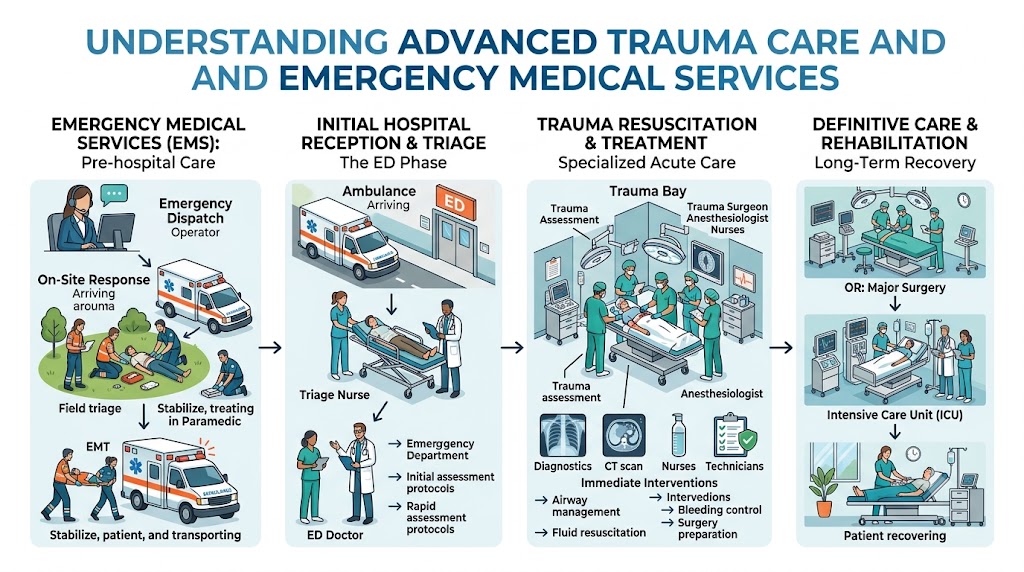
How Trauma Teams Respond During Emergencies
The response is a choreographed process designed to eliminate cognitive load under pressure:
- Initial Triage: Assessing the “ABCDE” (Airway, Breathing, Circulation, Disability, Exposure) protocol.
- Stabilization: Securing vitals through fluids, oxygen, or mechanical support.
- Diagnostic Evaluation: Imaging to confirm injuries.
- Emergency Surgery: Immediate operative intervention when stabilization is insufficient.
- Intensive Care Monitoring: Continued support to prevent systemic failure post-surgery.
TRAUMA RESPONSE PROCESS TABLE
| Stage | Purpose |
| Triage | Assess severity |
| Stabilization | Secure vital functions |
| Diagnosis | Identify injuries |
| Treatment | Provide medical intervention |
| Recovery Monitoring | Ensure patient stability |
How to Choose the Right Trauma Hospital
When preparing for emergencies or evaluating care, consider these factors:
- Specialist Availability: Do they have surgeons on-site 24/7?
- Intensive Care Facilities: Is the ICU equipped for complex mechanical ventilation and organ support?
- Diagnostic Tech: Do they have immediate access to MRI/CT/Interventional Radiology?
- Accessibility: Is the location accessible by ground and air emergency transport?
Benefits of Advanced Trauma Centers
Advanced centers operate on a multidisciplinary model. Instead of fragmented care, the patient is treated by a team that shares data, goals, and protocols. This reduces the risk of human error, speeds up the decision-making process, and ensures that rehabilitation support begins the moment the patient enters the hospital doors.
Common Mistakes People Make During Emergencies
- Delaying Care: Waiting to see if symptoms “go away” often worsens outcomes in stroke or cardiac events.
- Self-Transporting: Calling an ambulance is safer, as paramedics can start treatment on the way.
- Ignoring Symptoms: Mild chest pain or confusion after a bump to the head can be deceptive.
- Lack of Preparation: Not having a list of current medications or allergies readily available slows down the triage process.
Real-Life Emergency Care Scenarios
Consider a high-speed vehicle collision. The patient arrives in shock. Within seconds, a trauma nurse administers intravenous fluids, while an ultrasound is performed to check for internal bleeding. Simultaneously, a surgeon is notified. Because the hospital utilizes a pre-coordinated response team, the patient is in the operating room in under fifteen minutes. This speed is the hallmark of effective trauma care.
Future of Trauma and Emergency Medicine
The future lies in the “Smart Hospital” concept. We are moving toward:
- AI-Assisted Triage: Predicting complications before they occur.
- Smart Ambulances: Transmitting high-definition data to the hospital so the team is ready before the patient arrives.
- Remote Specialist Consultations: Ensuring that the best experts in the world can assist in local trauma cases via high-speed, secure connections.
FAQs
- What is a trauma hospital?
A facility specialized in treating severe, life-threatening physical injuries. - What emergencies require trauma care?
Major accidents, falls from height, penetrating wounds, and severe burns. - Are trauma centers open 24/7?
Yes, they provide round-the-clock emergency surgical and critical care coverage. - What happens during emergency triage?
Patients are sorted based on the urgency of their condition to ensure those at highest risk receive the fastest care. - When should an ambulance be called?
Whenever there is an injury or condition that could result in death or permanent disability. - What is critical care?
Specialized medical care for people who have life-threatening injuries or illnesses. - How do emergency departments prioritize patients?
Using objective clinical markers such as heart rate, oxygen levels, and neurological status. - Can I pre-register at a trauma center?
Trauma centers focus on immediate emergencies; pre-registration is not applicable for sudden accidents. - What is the difference between an ER and an Urgent Care?
ERs handle life-threatening issues; Urgent Cares handle non-life-threatening illnesses. - Do trauma centers offer follow-up care?
Yes, they usually provide continuity through outpatient clinics and rehab. - How do I find a local trauma center?
Use tools like the resources found on MYHOSPITALNOW. - Are there different levels of trauma centers?
Yes, typically categorized by the breadth of services and depth of specialist availability. - Is trauma care expensive?
It is intensive care; however, the focus is always on life-saving outcomes first. - Can I request a specific hospital during an emergency?
Paramedics will transport you to the most appropriate facility based on your medical needs and distance. - What documentation is needed?
While ID and insurance are requested, medical personnel will treat you regardless of documentation in a life-or-death scenario.
Final Thoughts
The existence of highly advanced trauma and emergency hospitals is a testament to the progress of modern medicine. When minutes matter, the structured, technology-driven, and expert-led care found in these centers saves lives. Being informed about these facilities and understanding how to act during an emergency is a form of personal health preparedness that everyone should prioritize. For further information and resources on high-quality medical facilities, explore the comprehensive guides available at MYHOSPITALNOW.

Find Trusted Cardiac Hospitals
Compare heart hospitals by city and services — all in one place.
Explore Hospitals