Introduction
AI-generated content is transforming marketing, journalism, media production, education, software development, and enterprise communications. However, the rapid growth of generative AI has created new challenges around misinformation, deepfakes, intellectual property protection, content ownership, and trust. AI Content Authenticity & Provenance Tools help organizations verify where content originated, whether it has been modified, who created it, and whether AI was involved in its generation. As governments, media organizations, enterprises, and technology providers introduce stricter transparency requirements, content authenticity is becoming a strategic priority. These tools leverage cryptographic signatures, metadata standards, watermarking technologies, provenance chains, and verification frameworks to establish trust across digital content ecosystems.
Real-World Use Cases
- News and Media Verification: News organizations use provenance tools to verify the origin of images, videos, and articles before publication. This helps reduce misinformation risks and improves audience trust in digital journalism.
- Deepfake Detection and Validation: Enterprises use authenticity frameworks to determine whether videos, audio recordings, and visual content have been manipulated by AI systems. This is becoming increasingly important for brand protection and executive communications.
- Intellectual Property Protection: Content creators, photographers, designers, and publishers use provenance records to prove ownership and establish creation history. This helps resolve disputes and protect digital assets.
- Enterprise Content Governance: Organizations implementing generative AI use provenance tracking to monitor AI-generated content, maintain audit trails, and comply with internal governance requirements.
- Advertising and Brand Trust: Marketing teams use authenticity solutions to verify creative assets and ensure consumers can identify trusted brand content. This improves transparency and reduces reputational risks.
- Regulatory Compliance and Auditing: Industries facing regulatory scrutiny use provenance records and verification workflows to demonstrate content integrity, creation history, and responsible AI usage practices.
Evaluation Criteria for Buyers
- Content provenance capabilities
- Metadata standards support
- AI-generated content detection
- Watermarking functionality
- Enterprise governance controls
- API and workflow integrations
- Verification accuracy
- Scalability and performance
- Compliance support
- Ecosystem adoption
Best for
Media organizations, content publishers, marketing agencies, enterprises using generative AI, legal teams, digital asset managers, and organizations focused on trust and transparency in digital content.
Not ideal for
Organizations with minimal digital content workflows or teams that do not require content verification, provenance tracking, or AI transparency controls.
Key Trends in AI Content Authenticity & Provenance Tools
- Content Credentials adoption continues expanding across creative ecosystems.
- Governments are introducing AI transparency requirements.
- Deepfake detection is becoming a core enterprise security capability.
- Cryptographic content signing is gaining mainstream adoption.
- AI watermarking standards are maturing.
- Cross-platform provenance interoperability is improving.
- Enterprise governance frameworks increasingly require content traceability.
- Real-time authenticity verification is becoming more common.
- Digital asset management systems are integrating provenance workflows.
- Multi-modal content verification is expanding beyond images to video and audio.
How We Selected These Tools (Methodology)
- Industry recognition and market adoption
- Content authenticity and provenance capabilities
- AI transparency support
- Metadata and standards compliance
- Enterprise deployment readiness
- Integration flexibility
- Scalability for large content operations
- Security and governance capabilities
- Developer and API ecosystem
- Long-term industry relevance
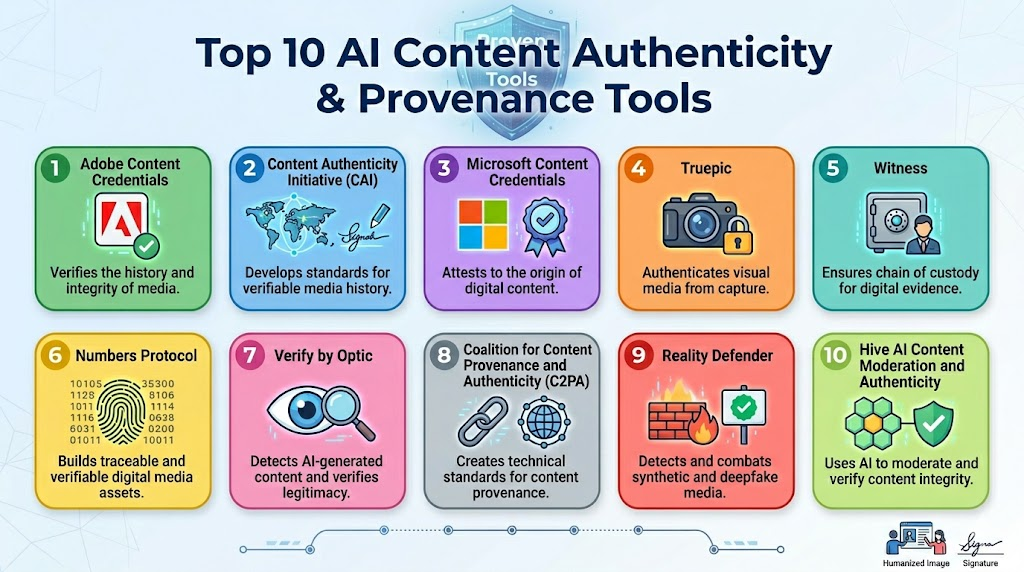
Top 10 AI Content Authenticity & Provenance Tools
1- Adobe Content Credentials
Short description: Adobe Content Credentials is one of the most widely adopted provenance solutions in the creative industry. It allows creators and organizations to attach verified metadata to digital assets, helping audiences understand how content was created, edited, or generated. The platform plays a central role in the broader Content Authenticity Initiative ecosystem.
Key Features
- Content Credentials support
- Provenance metadata tracking
- AI disclosure capabilities
- Creative workflow integration
- Content history records
- Asset verification
- Industry-standard adoption
Pros
- Strong ecosystem adoption
- Seamless Adobe integration
- Excellent creator-focused workflows
Cons
- Primarily focused on creative content
- Best value within Adobe ecosystems
- Enterprise customization may vary
Platforms / Deployment
Cloud
Security & Compliance
Supports cryptographically signed provenance information and verification workflows. Additional compliance information varies by deployment and Adobe product ecosystem.
Integrations & Ecosystem
Adobe Content Credentials integrates deeply across Adobe creative products and authenticity initiatives.
- Adobe Photoshop
- Adobe Lightroom
- Adobe Firefly
- Creative Cloud
- Content Authenticity Initiative
Support & Community
Strong documentation, large industry adoption, and significant ecosystem momentum.
2- Content Authenticity Initiative
Short description: The Content Authenticity Initiative promotes open standards for digital content provenance and transparency. It focuses on helping creators, publishers, and technology providers establish trust through verifiable content histories. Many industry-leading organizations participate in the initiative.
Key Features
- Open provenance standards
- Content history tracking
- Creator attribution
- Transparency frameworks
- Ecosystem interoperability
- Metadata verification
- Industry collaboration
Pros
- Broad industry participation
- Open ecosystem approach
- Strong standards focus
Cons
- Not a standalone software platform
- Depends on ecosystem adoption
- Implementation varies by vendor
Platforms / Deployment
Varies / N/A
Security & Compliance
Focuses on content provenance frameworks and standards rather than enterprise security controls.
Integrations & Ecosystem
Supports interoperability across participating vendors and platforms.
- Adobe ecosystem
- Publishing platforms
- Media organizations
- Creative workflows
Support & Community
Large industry-backed initiative with strong momentum.
3- Microsoft Content Credentials
Short description: Microsoft has integrated content authenticity technologies into various AI and media workflows to support transparency and provenance. The solution helps identify AI-generated content and improve trust in digital communications. It is increasingly relevant for enterprise AI governance.
Key Features
- AI content labeling
- Provenance support
- Verification workflows
- Enterprise governance alignment
- Metadata integration
- Transparency controls
- AI disclosure capabilities
Pros
- Enterprise-friendly
- Strong Microsoft ecosystem integration
- Growing AI governance support
Cons
- Availability varies by product
- Ecosystem dependent
- Feature coverage continues evolving
Platforms / Deployment
Cloud
Security & Compliance
Benefits from Microsoft enterprise security infrastructure. Specific authenticity-related compliance certifications vary by product.
Integrations & Ecosystem
Integrates across Microsoft productivity and AI ecosystems.
- Microsoft 365
- Azure
- Copilot
- Enterprise workflows
Support & Community
Strong enterprise support and documentation.
4- Truepic
Short description: Truepic specializes in image authenticity, secure media capture, and verification technologies. Organizations use it to establish trust in visual content and verify the integrity of photos and videos. It is widely used in insurance, financial services, and digital verification workflows.
Key Features
- Secure image capture
- Authenticity verification
- Visual content validation
- Metadata protection
- Fraud prevention
- Chain-of-custody tracking
- Enterprise APIs
Pros
- Strong visual verification capabilities
- Enterprise-focused architecture
- Useful fraud prevention workflows
Cons
- Focused primarily on visual content
- Specialized use cases
- Enterprise deployment focus
Platforms / Deployment
Cloud
Security & Compliance
Supports secure capture and authenticity verification workflows. Additional compliance information is not publicly stated.
Integrations & Ecosystem
Provides APIs and enterprise workflow integrations.
- Enterprise applications
- Verification platforms
- Mobile workflows
- Digital inspection systems
Support & Community
Strong enterprise support model.
5- Witness
Short description: Witness provides digital evidence authentication and verification capabilities that help organizations validate the integrity of digital content. It is commonly used in legal, investigative, and compliance-oriented environments. Provenance and verification are central to its value proposition.
Key Features
- Digital evidence verification
- Provenance tracking
- Chain-of-custody support
- Metadata validation
- Compliance workflows
- Content integrity monitoring
- Audit support
Pros
- Strong evidence management capabilities
- Useful compliance workflows
- Good auditability
Cons
- Niche focus
- Limited creative workflow capabilities
- Specialized deployment requirements
Platforms / Deployment
Cloud / Hybrid
Security & Compliance
Designed around integrity verification and audit requirements.
Integrations & Ecosystem
Supports legal and compliance-oriented workflows.
- Audit systems
- Compliance platforms
- Verification processes
Support & Community
Professional support focused on regulated use cases.
6- Numbers Protocol
Short description: Numbers Protocol uses blockchain-based provenance technology to establish trusted records for digital content creation and ownership. The platform focuses on transparency, traceability, and content authenticity. It is often discussed in Web3 content verification circles.
Key Features
- Blockchain provenance
- Content registration
- Ownership verification
- Authenticity records
- Transparency tracking
- Decentralized architecture
- Verification workflows
Pros
- Strong transparency model
- Decentralized trust architecture
- Content ownership focus
Cons
- Blockchain adoption considerations
- Learning curve for some users
- Specialized ecosystem
Platforms / Deployment
Cloud
Security & Compliance
Uses blockchain-based verification mechanisms and content registration records.
Integrations & Ecosystem
Supports Web3-oriented content authenticity ecosystems.
- Blockchain networks
- Creator platforms
- Content marketplaces
Support & Community
Growing community and ecosystem participation.
7- Verify by Optic
Short description: Verify helps organizations understand and validate the origin of AI-generated content through authenticity and provenance technologies. It supports content transparency initiatives and helps organizations improve trust in AI outputs. The platform focuses on enterprise AI governance.
Key Features
- AI content validation
- Provenance tracking
- Verification workflows
- Enterprise governance support
- Transparency reporting
- Metadata analysis
- Content monitoring
Pros
- AI-focused workflows
- Governance-oriented capabilities
- Growing enterprise relevance
Cons
- Market maturity evolving
- Specialized use cases
- Adoption still developing
Platforms / Deployment
Cloud
Security & Compliance
Not publicly stated.
Integrations & Ecosystem
Supports enterprise AI and content workflows.
- AI platforms
- Governance systems
- Enterprise applications
Support & Community
Growing ecosystem and vendor support.
8- Coalition for Content Provenance and Authenticity C2PA
Short description: C2PA is a standards body that defines specifications for content provenance and authenticity. While not a standalone commercial product, its standards power many authenticity solutions used across media and technology ecosystems. It is one of the most influential initiatives shaping content verification.
Key Features
- Provenance standards
- Metadata specifications
- Interoperability frameworks
- Verification models
- Content authenticity support
- Ecosystem collaboration
- Industry adoption
Pros
- Widely supported standards
- Strong ecosystem influence
- Interoperability benefits
Cons
- Not a standalone platform
- Depends on implementation partners
- Technical adoption required
Platforms / Deployment
Varies / N/A
Security & Compliance
Provides standards rather than direct security controls.
Integrations & Ecosystem
Supported across multiple authenticity vendors.
- Adobe ecosystem
- Microsoft ecosystem
- Media platforms
- Creative workflows
Support & Community
Large industry participation and ongoing development.
9- Reality Defender
Short description: Reality Defender focuses on deepfake detection and AI-generated media verification. Organizations use it to identify manipulated images, video, audio, and synthetic content. It is increasingly relevant for enterprise risk management and digital trust initiatives.
Key Features
- Deepfake detection
- Audio analysis
- Video verification
- Image authenticity analysis
- Enterprise monitoring
- Real-time detection
- AI risk assessment
Pros
- Strong deepfake detection focus
- Multi-modal capabilities
- Enterprise security relevance
Cons
- Detection accuracy can vary
- Specialized deployment scenarios
- Enterprise-focused pricing
Platforms / Deployment
Cloud
Security & Compliance
Not publicly stated.
Integrations & Ecosystem
Supports enterprise monitoring and verification workflows.
- Security platforms
- Media workflows
- Enterprise monitoring systems
Support & Community
Growing enterprise adoption and support.
10- Hive AI Content Moderation and Authenticity
Short description: Hive provides AI-powered content analysis, moderation, and authenticity capabilities that help organizations identify manipulated or synthetic content. It supports enterprises managing large-scale content operations and AI governance initiatives. The platform combines moderation and verification capabilities within a unified environment.
Key Features
- AI content analysis
- Deepfake detection
- Content moderation
- Authenticity assessment
- Risk scoring
- API access
- Enterprise workflows
Pros
- Scalable content analysis
- Strong API capabilities
- Useful for large content platforms
Cons
- Enterprise-focused deployment
- Some features may require customization
- Broad platform scope
Platforms / Deployment
Cloud
Security & Compliance
Not publicly stated.
Integrations & Ecosystem
Supports high-volume content operations through APIs and workflow integrations.
- Content platforms
- Enterprise applications
- Moderation systems
- Media workflows
Support & Community
Strong enterprise support capabilities.
Comparison Table (Top 10)
| Tool Name | Best For | Platform Supported | Deployment | Standout Feature | Public Rating |
|---|---|---|---|---|---|
| Adobe Content Credentials | Creative professionals | Cloud | Cloud | Content Credentials | N/A |
| Content Authenticity Initiative | Standards adoption | Varies | N/A | Open authenticity framework | N/A |
| Microsoft Content Credentials | Enterprise AI | Cloud | Cloud | Enterprise provenance | N/A |
| Truepic | Image verification | Cloud | Cloud | Secure media capture | N/A |
| Witness | Evidence validation | Cloud | Hybrid | Chain of custody | N/A |
| Numbers Protocol | Web3 provenance | Cloud | Cloud | Blockchain verification | N/A |
| Verify by Optic | AI governance | Cloud | Cloud | AI provenance tracking | N/A |
| C2PA | Industry standards | Varies | N/A | Authenticity standards | N/A |
| Reality Defender | Deepfake detection | Cloud | Cloud | Multi-modal verification | N/A |
| Hive AI | Content authenticity | Cloud | Cloud | AI-powered detection | N/A |
Evaluation & Scoring of AI Content Authenticity & Provenance Tools
| Tool | Core | Ease | Integration | Security | Performance | Support | Value | Weighted Total |
|---|---|---|---|---|---|---|---|---|
| Adobe Content Credentials | 10 | 9 | 9 | 8 | 9 | 9 | 8 | 8.95 |
| Content Authenticity Initiative | 8 | 7 | 9 | 8 | 8 | 8 | 9 | 8.15 |
| Microsoft Content Credentials | 9 | 8 | 9 | 9 | 9 | 9 | 8 | 8.75 |
| Truepic | 9 | 8 | 8 | 8 | 9 | 8 | 8 | 8.35 |
| Witness | 8 | 7 | 7 | 8 | 8 | 8 | 8 | 7.75 |
| Numbers Protocol | 8 | 7 | 7 | 8 | 8 | 7 | 8 | 7.65 |
| Verify by Optic | 8 | 8 | 8 | 8 | 8 | 8 | 8 | 8.00 |
| C2PA | 9 | 7 | 10 | 8 | 8 | 8 | 9 | 8.55 |
| Reality Defender | 9 | 8 | 8 | 8 | 9 | 8 | 8 | 8.35 |
| Hive AI | 9 | 8 | 9 | 8 | 9 | 8 | 8 | 8.50 |
Which AI Content Authenticity & Provenance Tool Is Right for You?
Solo / Freelancer
Adobe Content Credentials and Numbers Protocol are strong options for creators, photographers, designers, and independent publishers looking to establish content ownership and transparency.
SMB
Truepic, Hive AI, and Verify by Optic offer practical authenticity and verification capabilities without requiring massive enterprise deployments.
Mid-Market
Microsoft Content Credentials, Reality Defender, and Hive AI provide stronger governance and verification capabilities for growing organizations.
Enterprise
Adobe Content Credentials, Microsoft Content Credentials, Reality Defender, and Truepic offer the strongest combination of scalability, governance, and ecosystem maturity.
Budget vs Premium
Open standards initiatives such as C2PA and the Content Authenticity Initiative provide strong foundational value. Enterprise platforms generally provide deeper workflow integration and governance capabilities.
Feature Depth vs Ease of Use
Adobe offers some of the easiest creator-focused workflows, while enterprise platforms prioritize governance, verification, and compliance capabilities.
Integrations & Scalability
Organizations with large content ecosystems should prioritize platforms offering API access, enterprise integrations, and scalable verification infrastructure.
Security & Compliance Needs
Industries facing regulatory oversight should focus on provenance tracking, auditability, verification workflows, and content transparency capabilities.
Frequently Asked Questions
1. What are AI Content Authenticity & Provenance tools?
These tools help organizations verify where digital content originated and whether it has been modified. They establish trust by recording metadata, provenance information, and authenticity records. Many platforms also help identify AI-generated content. This improves transparency across digital ecosystems.
2. Why is content provenance important?
Content provenance provides visibility into how content was created, edited, and distributed. It helps reduce misinformation and strengthens audience trust. Organizations can also use provenance records to support compliance and governance requirements. Provenance is becoming increasingly important in AI-driven environments.
3. What are Content Credentials?
Content Credentials are metadata records attached to digital content that describe creation history and modifications. They help audiences understand how content was produced. Many creative professionals use them to improve transparency. They are becoming a leading industry standard.
4. Can these tools detect deepfakes?
Some platforms focus specifically on detecting manipulated images, videos, and audio. Deepfake detection capabilities vary significantly between vendors. Organizations should evaluate detection accuracy and workflow compatibility carefully. Not every provenance platform includes deepfake detection.
5. Are these tools only for media companies?
No. Enterprises, government agencies, educational institutions, marketers, and legal teams also use authenticity solutions. Any organization concerned about digital trust can benefit. Adoption is expanding rapidly beyond traditional media environments.
6. How do authenticity tools support compliance?
These tools create verifiable records showing how content was created and modified. Audit trails help organizations demonstrate transparency and responsible AI usage. This can simplify regulatory reporting and governance activities. Compliance value continues increasing as AI regulations evolve.
7. What is the role of C2PA?
C2PA provides technical standards for content provenance and authenticity. Many vendors build products that align with C2PA specifications. The goal is to improve interoperability across platforms. It plays a major role in shaping industry standards.
8. Can provenance records be altered?
Modern authenticity systems often use cryptographic protections and secure metadata approaches to reduce tampering risks. Some solutions also use transparency logs or blockchain technologies. Protection levels vary by platform. Organizations should evaluate security architecture carefully.
9. How difficult is implementation?
Implementation complexity depends on existing workflows and content systems. Some creator-focused solutions can be adopted quickly, while enterprise deployments may require governance planning. API availability can simplify integration efforts. Pilot testing is often recommended.
10. What should organizations evaluate before purchasing?
Organizations should evaluate provenance capabilities, verification accuracy, integration options, governance features, scalability, and ecosystem adoption. Compliance requirements should also be considered. Long-term interoperability is becoming increasingly important. Running a pilot helps validate operational fit.
Conclusion
AI-generated content is reshaping digital communication, but it also introduces new challenges around trust, transparency, ownership, and accountability. AI Content Authenticity & Provenance Tools help organizations establish confidence in digital assets by providing verification records, provenance histories, authenticity metadata, and governance controls. Adobe Content Credentials, Microsoft Content Credentials, Truepic, Reality Defender, Hive AI, and emerging standards such as C2PA are helping define the future of trustworthy digital content. The best solution depends on whether your priority is creative transparency, deepfake detection, enterprise governance, regulatory compliance, or content ownership protection. Organizations should shortlist two or three platforms, evaluate integration requirements, conduct pilot deployments, and verify alignment with long-term content governance strategies before making a final decision.

Find Trusted Cardiac Hospitals
Compare heart hospitals by city and services — all in one place.
Explore Hospitals