Introduction
Change Data Capture (CDC) tools monitor and capture database changes—such as inserts, updates, and deletes—in real-time or near real-time. They allow organizations to stream these changes to analytics platforms, warehouses, data lakes, or operational systems without scanning entire databases. CDC helps businesses maintain up-to-date data for reporting, analytics, AI-driven insights, and operational applications. CDC tools are critical for organizations using hybrid cloud, multi-cloud, microservices, and event-driven architectures. Real-time data replication reduces latency, prevents duplicate data, and supports disaster recovery. CDC tools now also include AI-assisted schema detection, automated monitoring, and simplified cloud integrations.
Real-world use cases include:
- Real-time analytics: Streaming live database changes into warehouses and BI platforms for immediate reporting and dashboards.
- Database replication: Keeping operational databases synchronized across regions to ensure high availability and disaster recovery.
- Event-driven architectures: Feeding database changes into microservices, Kafka streams, or event-driven workflows.
- Cloud migration: Continuous replication of on-premises or legacy databases to cloud systems to minimize downtime.
- Compliance and governance: Maintaining up-to-date replicas for audit, regulatory reporting, and disaster recovery readiness.
What buyers should evaluate:
- Supported databases, cloud services, and SaaS applications
- Real-time vs batch replication capabilities
- Change capture granularity, latency, and consistency handling
- Integration with analytics platforms, warehouses, and streaming systems
- Security: encryption, RBAC, SSO/SAML, audit logging
- Automation, monitoring, and error handling
- Scalability for high-volume or multi-region workloads
- Ease of deployment, UI/UX, and technical requirements
- Vendor support, documentation, and community ecosystem
- Total cost of ownership and licensing model
Best for: Database administrators, data engineers, IT architects, analytics teams, and enterprises needing real-time replication for operational, analytical, or cloud migration workloads.
Not ideal for: Teams with small datasets, low-frequency updates, or workflows where batch ETL or periodic exports suffice. CDC may be overkill for simple reporting or low-volume applications.
Key Trends in CDC Tools for
- Real-time streaming and low-latency replication are now standard expectations.
- Multi-cloud and hybrid database support is increasingly common.
- AI-assisted schema change detection and conflict resolution improve reliability.
- Integration with Kafka, Snowflake, Redshift, BigQuery, and lakehouse architectures is growing.
- Automated monitoring, alerting, and health dashboards enhance operational visibility.
- Security-first design: encryption, RBAC, SSO/SAML, and audit logging are standard.
- CDC adoption is expanding beyond analytics to support event-driven microservices.
- Open-source CDC tools are increasingly adopted for flexibility and cost efficiency.
- Continuous validation and automated reconciliation reduce replication errors.
- Cloud-native managed CDC platforms reduce operational overhead for teams.
How We Selected These Tools
- Evaluated market adoption, enterprise usage, and popularity.
- Reviewed feature completeness: real-time replication, batch processing, streaming, monitoring, automation, and schema handling.
- Considered supported databases and SaaS connectors.
- Assessed performance, latency, and reliability in production workloads.
- Reviewed security posture including encryption, RBAC, and audit logging.
- Checked integration ecosystem with warehouses, lakes, BI tools, Kafka, and APIs.
- Measured scalability for large datasets, high-velocity workloads, and multi-region replication.
- Evaluated ease of deployment, user experience, and operational automation.
- Considered vendor support, documentation, and community strength.
- Balanced tools for enterprise, mid-market, and SMB usage scenarios.
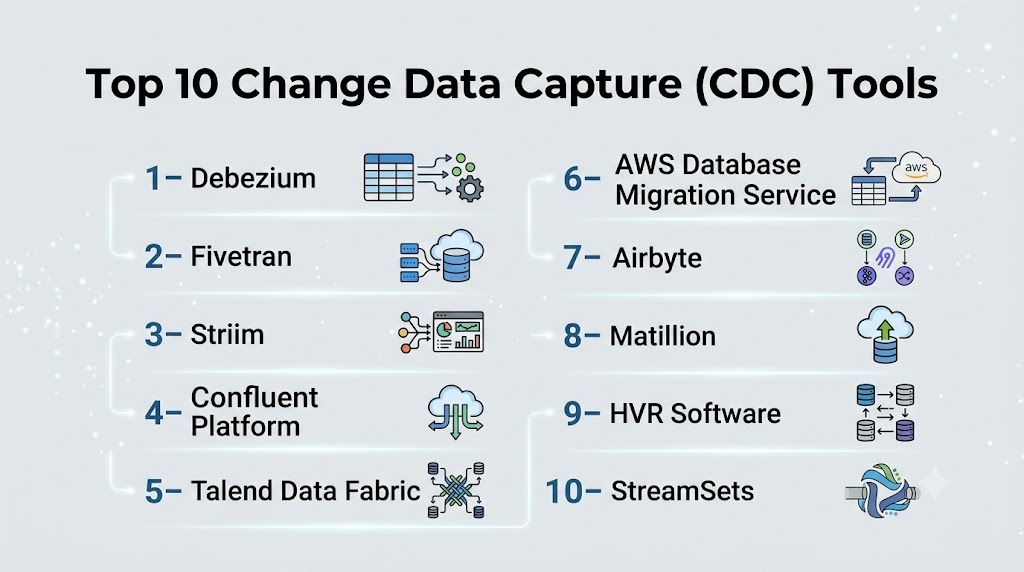
Top 10 Change Data Capture (CDC) Tools
1‑ Debezium
Short description: Open-source CDC platform that streams database changes to Kafka and event-driven architectures.
Key Features
- Row-level change capture for multiple databases
- Kafka-native streaming
- Supports MySQL, PostgreSQL, SQL Server, MongoDB, Oracle
- Handles schema evolution
- Low-latency replication
- Extensible connectors
- Open-source ecosystem
Pros
- Flexible open-source platform
- Strong developer community
- Ideal for Kafka-based streaming pipelines
Cons
- Requires Kafka knowledge
- Operational management can be complex
- Enterprise support limited unless via Confluent
Platforms / Deployment
Linux / Cloud / Self-hosted
Security & Compliance
Not publicly stated
Integrations & Ecosystem
- Kafka Streams
- Data warehouses and lakes
- CI/CD pipelines
- Custom connectors
Support & Community
Open-source community support; commercial support via Confluent.
2‑ Fivetran
Short description: Managed CDC platform for SaaS and cloud databases with automated replication and transformation pipelines.
Key Features
- Prebuilt SaaS and database connectors
- Incremental sync and CDC support
- Cloud warehouse and lakehouse destinations
- Schema drift handling
- Monitoring dashboards
- Managed, low-maintenance pipelines
- Real-time replication
Pros
- Quick setup
- Minimal maintenance
- Reliable analytics replication
Cons
- Limited transformation control
- Cloud-only deployment
- Pricing scales with data volume
Platforms / Deployment
Web / Cloud
Security & Compliance
Encryption, RBAC, SOC 2, GDPR
Integrations & Ecosystem
- Snowflake, Redshift, BigQuery
- Salesforce, HubSpot, Shopify
- APIs and analytics pipelines
Support & Community
Enterprise support, strong documentation, active user community.
3‑ Striim
Short description: Streaming CDC platform with in-flight transformation for hybrid and cloud data integration.
Key Features
- Real-time CDC
- In-flight transformations
- Low-latency replication
- Multi-cloud and hybrid support
- Monitoring dashboards
- Alerts and error handling
- Analytics and event pipeline support
Pros
- Streaming analytics support
- Low-latency replication
- Multi-cloud capability
Cons
- Technical expertise required
- Enterprise pricing
- Complex configuration
Platforms / Deployment
Web / Cloud / Hybrid
Security & Compliance
Encryption, RBAC, audit logging; certifications vary
Integrations & Ecosystem
- Databases, warehouses, cloud platforms
- Kafka, messaging systems
- APIs for custom pipelines
Support & Community
Vendor support and documentation; moderate community presence.
4‑ Confluent Platform
Short description: Kafka-based enterprise CDC platform for real-time streaming pipelines.
Key Features
- Fully managed Kafka streaming
- CDC for multiple databases
- Schema registry and change validation
- Prebuilt connectors for warehouses and lakes
- Monitoring dashboards
- Alerts and operational tools
Pros
- Enterprise-grade streaming
- Real-time replication
- Rich connector ecosystem
Cons
- Requires Kafka expertise
- Higher cost for enterprise edition
- Complex setup for small teams
Platforms / Deployment
Cloud / Self-hosted
Security & Compliance
Encryption, RBAC, audit logs, SOC 2, GDPR
Integrations & Ecosystem
- Kafka Connect
- Snowflake, Redshift, BigQuery
- Data lakes, ETL pipelines
Support & Community
Enterprise support, strong Kafka community, documentation.
5‑ Talend Data Fabric
Short description: Enterprise CDC and integration platform for real-time and batch replication.
Key Features
- Relational database CDC
- Data transformation and cleansing
- Hybrid cloud support
- Multi-source integration
- Monitoring and automation dashboards
Pros
- Enterprise-grade reliability
- Hybrid and on-prem support
- Governance and compliance features
Cons
- Deployment complexity
- Pricing scales with usage
- Learning curve for advanced features
Platforms / Deployment
Cloud / Self-hosted / Hybrid
Security & Compliance
Encryption, RBAC, audit logging; GDPR, SOC 2
Integrations & Ecosystem
- SQL, NoSQL, cloud databases
- Warehouses and lakes
- Analytics pipelines and ETL tools
Support & Community
Enterprise support, professional services, active community.
6‑ AWS Database Migration Service
Short description: Cloud-native CDC tool for replicating databases into AWS environments.
Key Features
- Continuous replication
- Multiple database engine support
- Incremental updates
- AWS Schema Conversion Tool integration
- Monitoring dashboards
Pros
- Native AWS integration
- Minimal downtime migrations
- Reliable replication
Cons
- Best for AWS targets
- Limited transformation control
- Requires AWS knowledge
Platforms / Deployment
Web / Cloud
Security & Compliance
IAM, encryption, audit logging, SOC 2
Integrations & Ecosystem
AWS RDS, Aurora, Redshift; analytics and ETL integration
Support & Community
AWS documentation, enterprise support, community resources.
7‑ Airbyte
Short description: Open-source CDC and data sync platform for warehouses, lakes, and cloud systems.
Key Features
- 200+ prebuilt connectors
- Incremental sync and CDC
- Extensible open-source framework
- Cloud or self-hosted deployment
- Monitoring dashboards
Pros
- Open-source and flexible
- Supports modern data stacks
- Extensible connectors
Cons
- Self-hosted requires technical expertise
- Transformation limited
- Enterprise support depends on plan
Platforms / Deployment
Cloud / Self-hosted
Security & Compliance
Varies / N/A
Integrations & Ecosystem
- Snowflake, Redshift, BigQuery
- SaaS applications
- APIs and ETL pipelines
Support & Community
Active community; optional commercial support.
8‑ Matillion
Short description: Cloud-native ETL with CDC support for warehouses.
Key Features
- Drag-and-drop pipelines
- CDC and incremental replication
- Cloud-native deployment
- Monitoring dashboards
- Analytics integration
Pros
- Easy to deploy
- Optimized for cloud warehouses
- Minimal maintenance
Cons
- Limited on-prem support
- Basic transformations
- Cloud resource costs apply
Platforms / Deployment
Web / Cloud
Security & Compliance
Encryption, access control, SOC 2
Integrations & Ecosystem
- Snowflake, Redshift, BigQuery
- SaaS connectors and pipelines
- API extensibility
Support & Community
Documentation, training, cloud support.
9‑ HVR Software
Short description: Enterprise CDC platform for real-time database replication across clouds.
Key Features
- Real-time replication
- Multi-cloud support
- Conflict detection
- Monitoring and alerts
- Heterogeneous database support
Pros
- Enterprise-grade replication
- Low-latency and reliable
- Broad database coverage
Cons
- High licensing cost
- Technical expertise required
- Setup complexity
Platforms / Deployment
Windows / Linux / Cloud / Hybrid
Security & Compliance
Encryption, RBAC, audit logs; Not publicly stated
Integrations & Ecosystem
- Oracle, SQL Server, MySQL
- Snowflake, Redshift, BigQuery
- Cloud analytics and messaging
Support & Community
Enterprise support and documentation.
10‑ StreamSets
Short description: Modern streaming ETL and CDC platform for hybrid cloud environments.
Key Features
- Real-time CDC
- Multi-source replication
- Monitoring dashboards
- Transformation pipelines
- Hybrid cloud support
Pros
- Supports streaming and batch pipelines
- Flexible deployment
- Real-time replication
Cons
- Technical expertise needed
- Transformation may be limited
- Enterprise cost can be high
Platforms / Deployment
Cloud / Hybrid
Security & Compliance
Encryption, RBAC, audit logs; Not publicly stated
Integrations & Ecosystem
- Warehouses, lakes, SaaS apps
- Kafka and messaging systems
- Analytics and ETL pipelines
Support & Community
Vendor support, documentation, active data engineering community.
Comparison Table
| Tool Name | Best For | Platform(s) Supported | Deployment | Standout Feature | Public Rating |
|---|---|---|---|---|---|
| Debezium | Open-source CDC | Linux / Cloud | Cloud / Self-hosted | Kafka-native CDC | N/A |
| Fivetran | Managed CDC | Web / Cloud | Cloud | SaaS connectors | N/A |
| Striim | Streaming CDC | Web / Cloud | Cloud / Hybrid | In-flight transformations | N/A |
| Confluent Platform | Enterprise Kafka CDC | Cloud / Self-hosted | Cloud / Self-hosted | Kafka-native enterprise streaming | N/A |
| Talend Data Fabric | Enterprise CDC | Cloud / Hybrid | Cloud / Hybrid | Governance-led CDC | N/A |
| AWS Database Migration Service | Cloud replication | Web / Cloud | Cloud | Continuous replication for AWS | N/A |
| Airbyte | Open-source CDC | Cloud / Self-hosted | Cloud / Self-hosted | Extensible connector ecosystem | N/A |
| Matillion | Cloud ETL with CDC | Web / Cloud | Cloud | Cloud-native warehouse replication | N/A |
| HVR Software | Enterprise replication | Windows / Linux / Cloud | Cloud / Hybrid | Low-latency real-time replication | N/A |
| StreamSets | Streaming CDC | Cloud / Hybrid | Cloud / Hybrid | Hybrid pipelines | N/A |
Evaluation & Scoring of CDC Tools
| Tool Name | Core 25% | Ease 15% | Integrations 15% | Security 10% | Performance 10% | Support 10% | Value 15% | Weighted Total |
|---|---|---|---|---|---|---|---|---|
| Debezium | 8 | 6 | 9 | 6 | 8 | 7 | 9 | 7.45 |
| Fivetran | 8 | 9 | 9 | 8 | 8 | 8 | 7 | 8.10 |
| Striim | 8 | 7 | 9 | 8 | 9 | 8 | 7 | 8.05 |
| Confluent Platform | 9 | 7 | 9 | 8 | 9 | 8 | 7 | 8.20 |
| Talend Data Fabric | 9 | 7 | 9 | 9 | 8 | 9 | 7 | 8.35 |
| AWS Database Migration Service | 8 | 8 | 9 | 9 | 8 | 9 | 8 | 8.35 |
| Airbyte | 7 | 8 | 8 | 6 | 7 | 7 | 9 | 7.45 |
| Matillion | 8 | 9 | 8 | 8 | 8 | 8 | 7 | 8.00 |
| HVR Software | 9 | 7 | 9 | 8 | 9 | 8 | 7 | 8.25 |
| StreamSets | 8 | 8 | 8 | 7 | 8 | 7 | 8 | 7.75 |
Which CDC Tool Is Right for You?
Solo / Freelancer
Open-source tools like Debezium and Airbyte are ideal for freelancers and consultants building small-scale pipelines or event-driven architectures. Managed tools like Fivetran or StreamSets can reduce operational overhead.
SMB
SMBs should focus on ease-of-use and low maintenance. Fivetran, Airbyte, or Matillion allow rapid deployment with minimal engineering effort. AWS-native tools can simplify cloud migrations.
Mid-Market
Mid-market organizations need balance: Striim, Confluent, Talend, or HVR provide enterprise-grade replication with real-time analytics and hybrid support. Choose based on existing infrastructure.
Enterprise
Enterprises prioritize scalability, governance, and support. Talend, HVR, Striim, Confluent, and AWS DMS suit large, multi-region, multi-cloud, or regulated environments.
Budget vs Premium
Budget-conscious teams should consider Debezium or Airbyte. Premium buyers benefit from managed or enterprise platforms with support, monitoring, and compliance features.
Feature Depth vs Ease of Use
For simplicity: Fivetran, Airbyte, StreamSets, AWS DMS. For advanced enterprise control: Talend, Striim, Confluent, HVR.
Integrations & Scalability
For integration coverage: Fivetran, Airbyte, Striim, Confluent, Talend. For high-volume replication, enterprise tools like HVR, Talend, and AWS DMS perform better.
Security & Compliance Needs
Regulated industries should validate encryption, RBAC, audit logs, SSO, and compliance certifications. Enterprise platforms like Talend, HVR, Striim, and AWS DMS are stronger for regulated workloads.
Frequently Asked Questions (FAQs)
1- What is Change Data Capture (CDC)?
CDC is a method for capturing database changes as they occur, enabling real-time replication, analytics, and event-driven workflows.
2- How is CDC different from batch ETL?
ETL processes periodically extract and transform entire datasets. CDC streams only changes, reducing latency and source load.
3- Which CDC tools are best for open-source pipelines?
Debezium and Airbyte are strong open-source options suitable for Kafka pipelines and modern data stacks.
4- Can CDC tools support cloud migrations?
Yes. CDC enables near-zero downtime migrations by continuously replicating changes to the target system during cutover.
5- What security features should I look for?
Encryption in transit and at rest, access control, RBAC, audit logs, SSO/SAML, and compliance certifications like SOC 2 or GDPR.
6- Do CDC tools affect source database performance?
They can, depending on the method. CDC reduces load compared with full extracts but should be tested under production workloads.
7- Are managed CDC tools better than self-hosted?
Managed CDC reduces operational burden and accelerates deployment. Self-hosted options provide flexibility but require more expertise.
8- How much do CDC tools cost?
Pricing varies: open-source is free but requires self-management; managed or enterprise platforms use subscription or volume-based pricing.
9- Can CDC handle SaaS applications?
Many CDC platforms now support SaaS connectors for Salesforce, HubSpot, Stripe, and other cloud applications.
10- How should I choose between real-time and batch CDC?
Real-time CDC is ideal for analytics, operational pipelines, and event-driven architectures. Batch CDC suffices for reporting or lower-frequency workloads.
Conclusion
Change Data Capture (CDC) tools are critical for organizations that need real-time data replication, analytics, cloud migration, and event-driven workflows. The best tool depends on your database environment, cloud strategy, data volume, compliance requirements, and technical resources. Open-source platforms like Debezium and Airbyte are ideal for developer-led pipelines, while managed or enterprise tools like Fivetran, Striim, and Talend offer robust scalability, monitoring, and governance. Cloud-native options such as AWS Database Migration Service simplify replication for cloud-first teams. When selecting a CDC tool, evaluate latency, integrations, security, and operational overhead to match your business needs. A practical next step is to shortlist 2–3 tools, test them with real workloads, validate performance and security, and then scale replication pipelines systematically.

Find Trusted Cardiac Hospitals
Compare heart hospitals by city and services — all in one place.
Explore Hospitals
Change Data Capture (CDC) tools are most valuable when they continuously detect and stream database changes in real time without disrupting production systems. By capturing inserts, updates, and deletes as they occur, these platforms enable real-time data replication, analytics, event-driven architectures, and system synchronization, helping organizations reduce latency, improve data consistency, and support modern cloud, integration, and data pipeline workflows.