Introduction
Drone Flight Planning Software is a category of tools designed to help operators plan, execute, and monitor drone missions efficiently and safely. These platforms allow pilots to map flight paths, avoid obstacles, comply with airspace regulations, optimize battery usage, and collect mission-critical data. with drones increasingly used for industrial inspection, delivery, mapping, agriculture, and emergency response, these tools have become essential for both commercial and enterprise operations.
Real-world use cases include:
- Precision agriculture: planning crop surveys and multispectral data collection.
- Infrastructure inspection: monitoring pipelines, power lines, and bridges.
- Emergency response: mapping disaster zones or conducting search-and-rescue operations.
- Surveying and construction: generating 3D models and topographical maps.
- Delivery and logistics: planning safe urban and rural drone delivery routes.
Evaluation Criteria for Buyers:
- Ease of mission planning and interface intuitiveness.
- Compliance with local and international aviation regulations.
- Integration with drones, sensors, and payloads.
- Data collection, analytics, and visualization capabilities.
- Flight safety features, including obstacle avoidance and geofencing.
- Cloud connectivity, real-time monitoring, and reporting.
- Pricing models and licensing flexibility.
- Customer support, training, and community resources.
Best for: Drone operators, enterprise teams, industrial inspectors, surveyors, and logistics providers requiring precision and regulatory compliance.
Not ideal for: Hobbyists or casual drone users who may prefer lightweight, free mobile apps or consumer drone SDKs.
Key Trends in Drone Flight Planning Software
- AI-driven route optimization for energy-efficient and obstacle-aware flight paths.
- Autonomous flight capabilities reducing manual intervention for complex missions.
- Cloud-based collaboration for multi-operator teams and remote mission oversight.
- Enhanced regulatory compliance with automatic geofencing and restricted airspace alerts.
- Integration with advanced sensors (LiDAR, thermal, multispectral cameras).
- Real-time telemetry and analytics dashboards for operational visibility.
- Hybrid deployment models supporting both cloud and on-premises data storage.
- Subscription-based pricing and modular add-ons for scaling with enterprise needs.
- Interoperability with fleet management and GIS platforms.
- Focus on cybersecurity and data privacy, including encrypted flight logs and secure APIs.
How We Selected These Tools (Methodology)
- Evaluated market adoption and presence across commercial drone operators.
- Assessed feature completeness, including autonomous mission planning and analytics.
- Reviewed performance and reliability reports from pilots and enterprise users.
- Considered security posture, including encryption, access controls, and audit logs.
- Analyzed integration capabilities with drones, sensors, GIS platforms, and APIs.
- Checked customer fit across Solo/Freelancer, SMB, and Enterprise segments.
- Examined support quality, onboarding resources, and community engagement.
- Prioritized tools that demonstrate 2026+ readiness, including AI and cloud features.
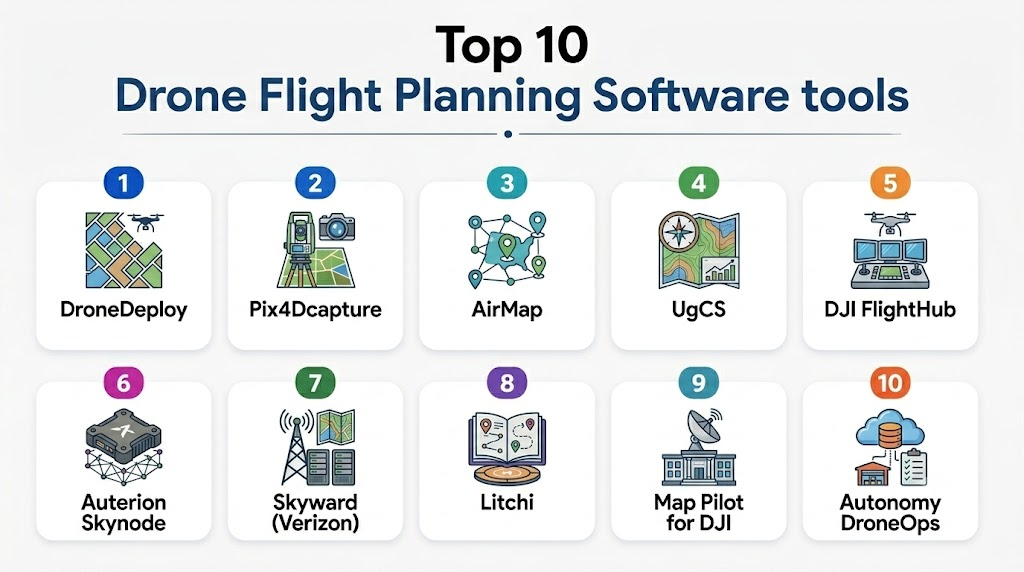
Top 10 Drone Flight Planning Software Tools
1- DroneDeploy
Short description: Cloud-based platform for mapping, surveying, and inspection missions, ideal for enterprise teams and commercial operators.
Key Features
- Automated flight planning with obstacle avoidance.
- 2D and 3D mapping with real-time telemetry.
- Integration with multispectral and LiDAR sensors.
- Collaboration dashboards for team operations.
- Offline map support and data export options.
Pros
- Intuitive interface suitable for enterprise and SMB.
- Strong integration with GIS and asset management tools.
Cons
- Subscription cost can be high for small teams.
- Some advanced analytics require additional modules.
Platforms / Deployment
- Web / iOS / Android
- Cloud-based
Security & Compliance
- Not publicly stated
Integrations & Ecosystem
Supports GIS platforms, CAD software, cloud storage, and API access.
- GIS platforms (ArcGIS, QGIS)
- CAD software integrations
- Cloud storage options
- API access for automation
Support & Community
Comprehensive documentation, online training, and enterprise support tiers.
2- Pix4Dcapture
Short description: Mobile and desktop app for automated flight path creation and photogrammetry data collection for surveyors and mapping professionals.
Key Features
- Customizable flight grids and waypoints.
- Automated image capture for 3D modeling.
- Supports various commercial drone brands.
- Integration with Pix4Dmapper for post-processing.
- Real-time flight telemetry.
Pros
- Excellent for mapping and construction surveys.
- Lightweight and mobile-friendly.
Cons
- Advanced features require Pix4Dmapper subscription.
- Limited fleet management capabilities.
Platforms / Deployment
- iOS / Android
- Cloud / Desktop for processing
Security & Compliance
- Not publicly stated
Integrations & Ecosystem
Integrates with Pix4Dmapper, GIS platforms, and drone hardware APIs.
- Pix4Dmapper post-processing
- GIS platform import/export
- Drone SDK APIs
Support & Community
Active user forums, tutorials, and responsive support team.
3- AirMap
Short description: Real-time airspace management and flight planning solution for commercial drone operators and urban operations.
Key Features
- Automated airspace notifications and approvals.
- Geofencing and restricted airspace alerts.
- Flight logging and compliance reporting.
- API access for custom integration.
- Multi-operator fleet management.
Pros
- Strong regulatory compliance features.
- Scales for enterprise fleet management.
Cons
- Limited offline functionality.
- Requires subscription for advanced features.
Platforms / Deployment
- Web / iOS / Android
- Cloud
Security & Compliance
- Not publicly stated
Integrations & Ecosystem
APIs for integration with enterprise fleet tools, GIS, and data platforms.
- Enterprise fleet management
- GIS integration
- Telemetry API
Support & Community
Enterprise support plans, developer documentation, and community forums.
4- UgCS
Short description: Advanced ground control software for mapping, inspection, and industrial drone operations.
Key Features
- 3D flight path planning and terrain following.
- Supports multiple drone brands simultaneously.
- Scripting and mission automation.
- Cloud or local data storage.
- Geotagging and telemetry visualization.
Pros
- High flexibility for enterprise operations.
- Supports complex missions and multi-drone coordination.
Cons
- Learning curve is steeper for beginners.
- UI less polished than competitors.
Platforms / Deployment
- Windows / macOS / Linux
- Hybrid / Cloud optional
Security & Compliance
- Not publicly stated
Integrations & Ecosystem
Compatible with GIS platforms, photogrammetry tools, and custom APIs.
- GIS software
- LiDAR and camera sensors
- Drone SDK APIs
Support & Community
Active documentation, training modules, and support tiers.
5- DJI FlightHub
Short description: Enterprise-grade drone management and planning software designed for fleet oversight and mission coordination.
Key Features
- Real-time fleet tracking and telemetry.
- Mission planning with geofencing.
- Data collection dashboards.
- Cloud storage and analytics.
- Role-based access and team management.
Pros
- Excellent integration with DJI hardware.
- Strong fleet and compliance management.
Cons
- Primarily tied to DJI drones.
- Limited non-DJI drone support.
Platforms / Deployment
- Web / iOS / Android
- Cloud
Security & Compliance
- Not publicly stated
Integrations & Ecosystem
Works with DJI sensors, payloads, and APIs for enterprise integration.
- DJI drone models
- Payload sensor integration
- Cloud analytics API
Support & Community
Enterprise support, detailed documentation, and online tutorials.
6- Auterion Skynode
Short description: Open-source and enterprise-ready flight management platform enabling autonomous drone missions and fleet oversight.
Key Features
- Autonomous mission execution.
- Open-source APIs for custom drone applications.
- Multi-drone coordination and telemetry.
- Integration with enterprise backend systems.
- Cloud and edge processing support.
Pros
- Flexibility for developers and enterprise customization.
- Supports both autonomous and manual flight.
Cons
- Requires technical expertise for setup.
- Limited turnkey support compared to closed platforms.
Platforms / Deployment
- Windows / Linux / Web
- Cloud / Self-hosted
Security & Compliance
- Not publicly stated
Integrations & Ecosystem
Supports ROS, MAVLink, GIS, and custom enterprise systems.
- ROS and MAVLink
- GIS integration
- API extensibility
Support & Community
Open-source community, developer documentation, enterprise support optional.
7- Skyward (Verizon)
Short description: Drone operations management and flight planning platform focused on regulatory compliance and enterprise oversight.
Key Features
- Airspace authorization and flight logging.
- Fleet scheduling and mission templates.
- Automated compliance alerts.
- Integration with ERP and asset management tools.
- Data export and analytics dashboards.
Pros
- Excellent regulatory management for enterprises.
- Scales well for large fleets.
Cons
- Subscription pricing can be high for SMBs.
- Limited support for hobbyist drones.
Platforms / Deployment
- Web / iOS / Android
- Cloud
Security & Compliance
- Not publicly stated
Integrations & Ecosystem
Integrates with asset management, GIS, and telemetry systems.
- ERP systems
- GIS platforms
- Telemetry integration
Support & Community
Enterprise support, webinars, and online resources.
8- Litchi
Short description: User-friendly mobile app for automated waypoint and cinematic flight planning, primarily for DJI drones.
Key Features
- Waypoint, orbit, and follow modes.
- Virtual reality and first-person view (FPV) support.
- Mission recording and playback.
- Advanced camera control for cinematography.
- Offline map support.
Pros
- Ideal for aerial photography and video professionals.
- Easy to learn and deploy.
Cons
- Limited enterprise fleet features.
- Primarily supports DJI drones.
Platforms / Deployment
- iOS / Android
- Cloud optional
Security & Compliance
- Not publicly stated
Integrations & Ecosystem
Integrates with DJI SDKs, camera payloads, and mission export tools.
- DJI SDK
- Camera payloads
- Video editing export
Support & Community
Active user forums, tutorials, and community sharing.
9- Map Pilot for DJI
Short description: Mobile app focused on agricultural mapping and crop surveys using DJI drones.
Key Features
- Automated grid mapping.
- Supports NDVI and multispectral imagery.
- Real-time flight telemetry.
- Data export for GIS and analytics platforms.
- Mission logging and replay.
Pros
- Tailored for agriculture and environmental monitoring.
- Fast setup for routine mapping missions.
Cons
- DJI drone-dependent.
- Limited enterprise fleet oversight.
Platforms / Deployment
- iOS / Android
- Cloud optional
Security & Compliance
- Not publicly stated
Integrations & Ecosystem
Supports GIS platforms, cloud storage, and multispectral camera sensors.
- GIS software
- Cloud storage
- Multispectral cameras
Support & Community
Documentation, user guides, and active agriculture-focused forums.
10- Autonomy DroneOps
Short description: End-to-end flight operations software enabling automated missions, compliance, and enterprise analytics.
Key Features
- AI-assisted route optimization.
- Regulatory compliance and geofencing.
- Multi-drone coordination.
- Telemetry, reporting, and dashboards.
- Cloud-based mission management.
Pros
- Strong enterprise and industrial focus.
- AI features for optimized flight planning.
Cons
- Complexity may overwhelm small teams.
- Pricing details vary / N/A.
Platforms / Deployment
- Web / iOS / Android
- Cloud
Security & Compliance
- Not publicly stated
Integrations & Ecosystem
Integrates with GIS, sensors, ERP, and cloud analytics.
- GIS platforms
- Drone sensors
- ERP integration
- Cloud analytics
Support & Community
Enterprise support, online documentation, and onboarding resources.
Comparison Table (Top 10)
| Tool Name | Best For | Platform(s) Supported | Deployment | Standout Feature | Public Rating |
|---|---|---|---|---|---|
| DroneDeploy | Enterprise mapping & inspections | Web, iOS, Android | Cloud | 3D mapping & team collaboration | N/A |
| Pix4Dcapture | Surveying & photogrammetry | iOS, Android | Cloud/Desktop | Automated photogrammetry capture | N/A |
| AirMap | Urban & commercial compliance | Web, iOS, Android | Cloud | Airspace & fleet management | N/A |
| UgCS | Industrial missions | Windows, macOS, Linux | Hybrid/Cloud | Multi-drone coordination | N/A |
| DJI FlightHub | DJI fleet management | Web, iOS, Android | Cloud | Real-time telemetry & dashboards | N/A |
| Auterion Skynode | Autonomous enterprise drones | Windows, Linux, Web | Cloud/Self-hosted | Open-source API & autonomy | N/A |
| Skyward (Verizon) | Regulatory & enterprise oversight | Web, iOS, Android | Cloud | Compliance & fleet scheduling | N/A |
| Litchi | Cinematic drone photography | iOS, Android | Cloud optional | Waypoint & orbit modes | N/A |
| Map Pilot for DJI | Agricultural mapping | iOS, Android | Cloud optional | NDVI & multispectral support | N/A |
| Autonomy DroneOps | Enterprise AI-assisted operations | Web, iOS, Android | Cloud | AI-assisted route optimization | N/A |
Evaluation & Scoring of Drone Flight Planning Software
| Tool Name | Core (25%) | Ease (15%) | Integrations (15%) | Security (10%) | Performance (10%) | Support (10%) | Value (15%) | Weighted Total |
|---|---|---|---|---|---|---|---|---|
| DroneDeploy | 9 | 8 | 8 | 7 | 9 | 8 | 7 | 8.25 |
| Pix4Dcapture | 8 | 9 | 7 | 7 | 8 | 7 | 7 | 7.85 |
| AirMap | 8 | 8 | 7 | 8 | 8 | 7 | 7 | 7.9 |
| UgCS | 9 | 7 | 8 | 7 | 9 | 7 | 7 | 8.0 |
| DJI FlightHub | 8 | 8 | 7 | 8 | 8 | 7 | 7 | 7.9 |
| Auterion Skynode | 9 | 7 | 9 | 7 | 9 | 7 | 7 | 8.3 |
| Skyward (Verizon) | 8 | 8 | 7 | 8 | 8 | 7 | 7 | 7.9 |
| Litchi | 7 | 9 | 6 | 7 | 7 | 6 | 7 | 7.3 |
| Map Pilot for DJI | 7 | 8 | 6 | 7 | 7 | 6 | 7 | 7.2 |
| Autonomy DroneOps | 9 | 7 | 8 | 7 | 9 | 7 | 7 | 8.0 |
Which Drone Flight Planning Software Is Right for You?
Solo / Freelancer
- Litchi or Pix4Dcapture are ideal due to simplicity, mobile support, and lower cost.
- Focus on easy-to-learn flight automation and single-drone missions.
SMB
- DroneDeploy or Map Pilot for DJI for small teams needing mapping and inspection capabilities.
- Balances usability, feature set, and moderate fleet support.
Mid-Market
- UgCS or Autonomy DroneOps for multi-drone coordination, industrial operations, and regulatory compliance.
- Includes telemetry and cloud analytics for mission oversight.
Enterprise
- DJI FlightHub, AirMap, or Skyward (Verizon) for large fleets, urban operations, or complex compliance needs.
- Scales with multiple operators and integrates into enterprise workflows.
Budget vs Premium
- Budget: Litchi, Map Pilot — limited enterprise features but sufficient for solo/SMB.
- Premium: Auterion, DroneDeploy Enterprise — extensive integrations, analytics, and fleet management.
Feature Depth vs Ease of Use
- Feature-heavy platforms (Auterion, UgCS) offer advanced capabilities but require training.
- User-friendly apps (Pix4Dcapture, Litchi) prioritize ease of use at the expense of enterprise scaling.
Integrations & Scalability
- Consider Auterion Skynode or DroneDeploy for GIS, ERP, and custom drone SDK integrations.
- Evaluate cloud vs hybrid deployment for enterprise data management and scalability.
Security & Compliance Needs
- AirMap, Skyward, and DJI FlightHub emphasize airspace compliance and fleet security.
- Ensure encryption, role-based access, and audit logs align with organizational standards.
Frequently Asked Questions (FAQs)
1- What pricing models are common for drone flight planning software?
Most platforms use subscription-based pricing, often tiered by fleet size or feature set. Some offer free or trial versions with limited missions. Enterprise plans typically include advanced analytics and team management.
2- Can I use these tools with any drone?
Many platforms support DJI and MAVLink-compatible drones. Some tools are DJI-specific, while others allow multiple brands. Check hardware compatibility before purchasing to avoid limitations.
3- How long does onboarding take?
Lightweight apps can be ready to use within hours. Enterprise platforms with fleet and regulatory integrations may take weeks. Training resources and tutorials can accelerate adoption.
4- Are these tools compliant with local aviation rules?
Top platforms integrate geofencing and restricted airspace alerts. Full compliance still depends on the operator following regulations. Enterprise tools help track flight logs for auditing purposes.
5- Can I plan autonomous flights with these tools?
Yes, many platforms support waypoint automation and obstacle avoidance. AI-assisted route optimization is available on advanced enterprise tools. Autonomous features reduce manual piloting effort and improve efficiency.
6- Do these tools provide data analytics?
Enterprise platforms offer dashboards, reporting, and telemetry visualization. Data can be exported to GIS, CAD, or cloud analytics systems. Analytics support decision-making for inspections, mapping, and surveys.
7- Can multiple operators collaborate on the same mission?
Yes, collaboration dashboards allow teams to plan and monitor together. Multi-user access supports fleet coordination and shared missions. Role-based permissions ensure secure operation and data integrity.
8- How do integrations work?
Most platforms provide APIs for custom integrations. Native connections exist with GIS, CAD, ERP, and fleet management software. Integration ensures seamless data flow and automation across systems.
9- What are common mistakes when choosing a tool?
Ignoring compliance and airspace regulations can cause operational issues. Selecting software without proper integration or fleet support limits efficiency. Underestimating learning curves can slow adoption and reduce ROI.
10- Are there alternatives for hobbyists?
Yes, mobile apps and drone SDKs are suitable for casual pilots. They often offer waypoint planning and simple flight automation. Enterprise features like fleet management and analytics are usually unnecessary.
Conclusion
Selecting the right Drone Flight Planning Software depends on your operational needs, fleet size, and regulatory requirements. Solo operators benefit from mobile-friendly and lightweight apps, while enterprises need AI-assisted, multi-drone, and compliance-focused platforms. Consider ease of use, integration capabilities, and mission complexity when making a choice. Evaluate tools for data analytics, telemetry, and collaborative features to ensure operational efficiency. Shortlist 2–3 options and run pilot missions to assess real-world performance. Validate integrations, regulatory compliance, and security measures before full deployment. A thoughtful selection process ensures safer, more efficient, and scalable drone operations.

Find Trusted Cardiac Hospitals
Compare heart hospitals by city and services — all in one place.
Explore Hospitals
Drone flight planning software delivers the greatest value when it helps operators move from manual route design to fully optimized, regulation-compliant missions. By factoring in terrain, weather conditions, airspace restrictions, and battery life, these platforms improve flight safety, efficiency, and mission success rates.