Introduction
IoT Security Platforms are specialized solutions designed to safeguard the growing ecosystem of connected devices, sensors, gateways, and applications. As businesses increasingly rely on IoT for automation, monitoring, and data-driven decision-making, securing these endpoints and the data they generate has become critical. The landscape demands real-time threat detection, compliance management, and scalable device authentication to ensure business continuity and protect sensitive information.
Real-world use cases include:
- Securing smart factories and industrial IoT networks against cyberattacks.
- Protecting healthcare devices and patient data from breaches.
- Safeguarding connected vehicles and transportation systems.
- Monitoring critical infrastructure such as energy grids and water systems.
- Ensuring smart home and building automation devices remain resilient to attacks.
Key Evaluation Criteria for IoT Security Platforms
- Device Coverage – Ability to monitor and secure a wide range of connected devices.
- Threat Detection Capabilities – Real-time detection of anomalies, malware, and unauthorized access.
- Scalability – Capacity to grow with increasing numbers of devices and complex networks.
- Compliance Support – Features that help meet regulations like GDPR, HIPAA, ISO 27001.
- Integration Flexibility – Ability to connect with SIEM, SOAR, ITSM, and other enterprise systems.
- Ease of Deployment – Simplicity and speed of setup across cloud, hybrid, or on-premises environments.
- Automation Features – Automated alerts, remediation, and policy enforcement to reduce manual intervention.
- AI-driven Analytics – Use of machine learning to detect anomalies and predict potential threats.
- Cost of Ownership – Total cost including licensing, infrastructure, and maintenance.
- Support Ecosystem – Availability of vendor support, documentation, and community resources.
Best for: Enterprises, industrial operators, healthcare organizations, smart city planners, and IT security teams managing large-scale IoT deployments.
Not ideal for: Small businesses with minimal connected devices or organizations that only need basic endpoint protection without advanced IoT-specific security features.
Key Trends in IoT Security Platforms
- AI-powered anomaly detection for real-time threat identification.
- Edge security deployment to reduce latency and ensure localized threat mitigation.
- Zero-trust architecture adoption for device authentication and network segmentation.
- Integration with cloud-native security frameworks for multi-cloud IoT environments.
- Automated patch management and firmware updates for connected devices.
- Compliance modules aligned with GDPR, HIPAA, ISO 27001, and industry-specific regulations.
- Blockchain-based identity management for device authentication and data integrity.
- Unified dashboards combining OT (operational technology) and IT security visibility.
- Subscription-based pricing models with scalable tiering for device count and features.
- Support for heterogeneous device ecosystems including legacy and modern IoT devices.
How We Selected These Tools (Methodology)
- Assessed market adoption and mindshare among IoT security buyers.
- Evaluated feature completeness including anomaly detection, device monitoring, and compliance management.
- Reviewed reliability and performance signals from real-world deployments.
- Verified security posture through encryption standards, audit capabilities, and access control.
- Analyzed integration and ecosystem capabilities with existing IT/OT infrastructure.
- Considered customer fit across SMB, mid-market, and enterprise deployments.
- Verified deployment flexibility (cloud, hybrid, on-premises).
- Examined vendor support, documentation, and training resources.
- Factored in pricing models relative to device count and capabilities.
- Ensured relevance for 2026 IoT security requirements and AI-enabled features.
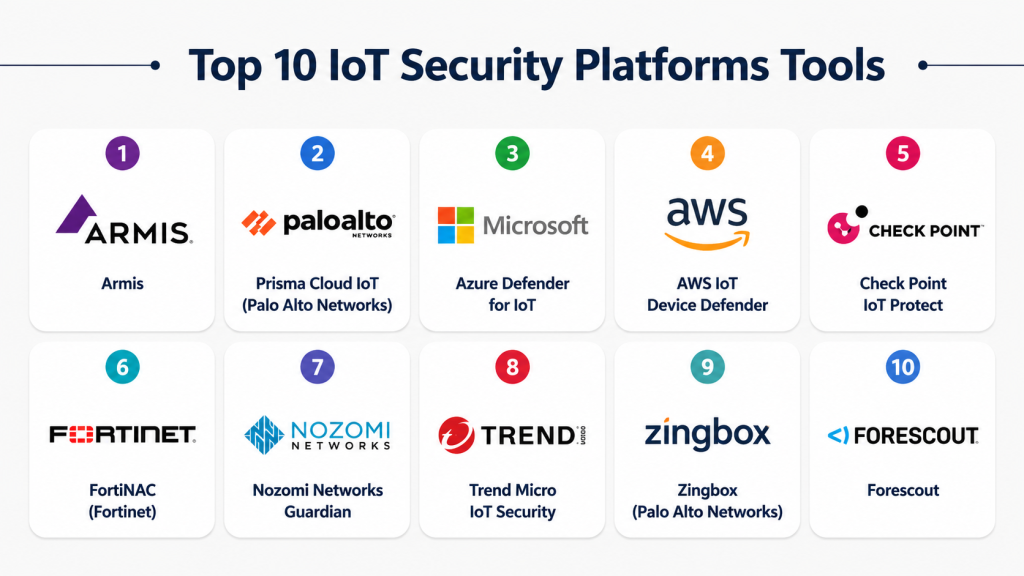
Top 10 IoT Security Platforms
1- Armis
Short description: Armis offers agentless security for enterprise IoT, OT, and unmanaged devices, targeting industries with complex device ecosystems.
Key Features
- Agentless device discovery and classification.
- Real-time threat detection and response.
- OT and IoT network segmentation.
- Vulnerability assessment and risk scoring.
- Compliance reporting and dashboards.
- Integration with SIEM and ITSM systems.
- AI-driven anomaly detection.
Pros
- Comprehensive visibility across all connected devices.
- Strong AI-driven threat detection.
Cons
- Deployment may require extensive configuration for large environments.
- Limited native support for consumer IoT devices.
Platforms / Deployment
- Web
- Cloud
Security & Compliance
- SOC 2, ISO 27001
- SSO/SAML, MFA, encryption, audit logs
Integrations & Ecosystem
Integrates with SIEM, SOAR, and ITSM platforms. Offers REST APIs for automation.
- Splunk, ServiceNow, IBM QRadar
- Microsoft Sentinel
- Ticketing systems for incident management
Support & Community
Varies / Not publicly stated
2- Palo Alto Networks Prisma Cloud IoT
Short description: Prisma Cloud IoT extends cloud security controls to connected devices, focusing on unified visibility and automated threat protection.
Key Features
- Continuous IoT device monitoring.
- AI-based anomaly detection.
- Cloud-native integration and automation.
- Policy enforcement and compliance reporting.
- Device lifecycle management.
Pros
- Strong cloud and IoT integration.
- Automated compliance checks.
Cons
- Complexity in configuring multi-cloud deployments.
- May require subscription to broader Prisma Cloud ecosystem.
Platforms / Deployment
- Web / Cloud
Security & Compliance
- SOC 2, ISO 27001
- SSO/SAML, RBAC, encryption
Integrations & Ecosystem
Integrates with cloud platforms, DevOps pipelines, and SIEMs.
- AWS IoT, Azure IoT Hub
- GitHub, Jenkins for CI/CD
- SIEM tools for incident correlation
Support & Community
Varies / Not publicly stated
3- Microsoft Azure Defender for IoT
Short description: Azure Defender for IoT secures industrial and enterprise IoT devices with integrated threat detection and operational intelligence.
Key Features
- Agentless IoT and OT discovery.
- Continuous threat monitoring.
- Network segmentation recommendations.
- Anomaly detection with machine learning.
- Integration with Microsoft Sentinel.
Pros
- Native integration with Azure cloud ecosystem.
- Strong support for industrial IoT environments.
Cons
- Optimized primarily for Azure environments.
- May require additional licensing for advanced analytics.
Platforms / Deployment
- Web / Cloud
Security & Compliance
- SOC 2, ISO 27001
- MFA, RBAC, encryption
Integrations & Ecosystem
Integrates with Azure IoT, Sentinel, and SIEM tools.
- Azure IoT Hub
- Power BI dashboards
- Logic Apps and workflow automation
Support & Community
Microsoft support tiers; strong community forums
4- AWS IoT Device Defender
Short description: AWS IoT Device Defender provides continuous monitoring, auditing, and security management for AWS-connected devices.
Key Features
- Audit of device configurations and security policies.
- Behavior monitoring and anomaly detection.
- Alerts for compromised devices.
- Integration with AWS cloud services.
- Customizable mitigation actions.
Pros
- Deep AWS ecosystem integration.
- Automated monitoring at scale.
Cons
- Limited for multi-cloud or on-premise IoT networks.
- Learning curve for configuration and alerts.
Platforms / Deployment
- Web / Cloud
Security & Compliance
- SOC 2, ISO 27001
- Encryption in transit and at rest, audit logs
Integrations & Ecosystem
- AWS IoT Core, Lambda, CloudWatch
- SIEM integration via APIs
- Kinesis Data Streams for analytics
Support & Community
AWS support plans; active developer community
5- Check Point IoT Protect
Short description: Check Point IoT Protect delivers security for enterprise and industrial devices through network-based monitoring and access control.
Key Features
- Device discovery and profiling.
- Threat intelligence feeds integration.
- Segmentation and access enforcement.
- Policy management dashboards.
- Automated alerts for security incidents.
Pros
- Rich threat intelligence integration.
- Network-level device control.
Cons
- Focused on enterprise and industrial environments; consumer IoT less supported.
- May require dedicated network hardware.
Platforms / Deployment
- Web
- Cloud / On-premises
Security & Compliance
- SOC 2, ISO 27001
- SSO, MFA, encryption
Integrations & Ecosystem
- SIEM integration
- Threat intelligence feeds
- APIs for automation
Support & Community
Varies / Not publicly stated
6- Fortinet FortiNAC IoT
Short description: FortiNAC offers network access control and IoT security to protect devices from unauthorized access and threats.
Key Features
- Device identification and profiling.
- Policy-based access control.
- Automated threat response.
- Integration with Fortinet security fabric.
- Compliance reporting.
Pros
- Strong NAC features for enterprise networks.
- Tight integration with Fortinet products.
Cons
- Deployment can be complex in large, heterogeneous networks.
- Focused heavily on enterprise-grade networks.
Platforms / Deployment
- Web
- Cloud / On-premises / Hybrid
Security & Compliance
- ISO 27001, SOC 2
- Encryption, RBAC, MFA
Integrations & Ecosystem
- FortiGate, FortiSIEM
- API support for custom workflows
- Third-party SIEMs
Support & Community
Varies / Not publicly stated
7- Nozomi Networks Guardian
Short description: Guardian provides cybersecurity for industrial IoT and operational technology networks, focusing on visibility and threat detection.
Key Features
- Continuous network monitoring.
- Device fingerprinting and anomaly detection.
- OT-specific threat intelligence.
- Compliance reporting.
- Integration with SIEM and SOC tools.
Pros
- Strong focus on OT and industrial IoT.
- High-fidelity anomaly detection.
Cons
- Less suitable for consumer IoT devices.
- May require dedicated resources for large deployments.
Platforms / Deployment
- Web
- Cloud / On-premises
Security & Compliance
- SOC 2
- Encryption, audit logs
Integrations & Ecosystem
- SIEM tools
- IT/OT bridging solutions
- APIs for custom dashboards
Support & Community
Varies / Not publicly stated
8- Trend Micro IoT Security
Short description: Trend Micro IoT Security protects devices across manufacturing, healthcare, and consumer networks with threat detection and patching guidance.
Key Features
- Device inventory and profiling.
- Malware and vulnerability detection.
- Automated patch and firmware recommendations.
- Cloud-based analytics.
- Integration with enterprise security consoles.
Pros
- Broad device coverage including endpoints and IoT gateways.
- Continuous threat intelligence updates.
Cons
- Cloud-centric, may have latency for local OT networks.
- Setup and onboarding can be complex for heterogeneous devices.
Platforms / Deployment
- Web / Cloud
Security & Compliance
- SOC 2, ISO 27001
- MFA, RBAC, encryption
Integrations & Ecosystem
- SIEM and EDR tools
- APIs for automation
- Dashboard integration with enterprise consoles
Support & Community
Varies / Not publicly stated
9- Zingbox (acquired by Palo Alto)
Short description: Zingbox specializes in AI-driven IoT security and device visibility for enterprise networks, now part of Palo Alto Networks.
Key Features
- AI-based device behavior analytics.
- Device inventory and risk scoring.
- Threat detection and anomaly alerts.
- Policy recommendations for segmentation.
- Integration with security operations tools.
Pros
- Strong AI-driven analytics.
- Enterprise-ready for heterogeneous IoT networks.
Cons
- Now integrated with Palo Alto; standalone product may be limited.
- Requires cloud connectivity for full capabilities.
Platforms / Deployment
- Web / Cloud
Security & Compliance
- SOC 2, ISO 27001
- Encryption, audit logs
Integrations & Ecosystem
- SIEMs, Palo Alto firewalls
- APIs for orchestration
- Threat intelligence feeds
Support & Community
Varies / Not publicly stated
10- Forescout
Short description: Forescout provides real-time device visibility, risk assessment, and automated policy enforcement for enterprise and industrial IoT.
Key Features
- Continuous device monitoring.
- Risk scoring and threat detection.
- Automated segmentation and policy enforcement.
- Integration with IT and OT security solutions.
- Compliance reporting.
Pros
- Broad device support including legacy and modern devices.
- Strong integration with enterprise security ecosystem.
Cons
- High licensing costs for large deployments.
- Implementation may require professional services.
Platforms / Deployment
- Web / Cloud / On-premises / Hybrid
Security & Compliance
- SOC 2, ISO 27001
- Encryption, audit logs, MFA
Integrations & Ecosystem
- SIEM, SOAR, EDR
- APIs for orchestration and dashboards
- IT/OT bridging systems
Support & Community
Varies / Not publicly stated
Comparison Table (Top 10)
| Tool Name | Best For | Platform(s) Supported | Deployment | Standout Feature | Public Rating |
|---|---|---|---|---|---|
| Armis | Enterprise IoT/OT | Web | Cloud | Agentless device discovery | N/A |
| Prisma Cloud IoT | Cloud-native IoT | Web | Cloud | Unified cloud + IoT visibility | N/A |
| Azure Defender for IoT | Industrial IoT | Web | Cloud | Integrated OT/IT threat detection | N/A |
| AWS IoT Device Defender | AWS IoT | Web | Cloud | Automated behavior monitoring | N/A |
| Check Point IoT Protect | Enterprise IoT | Web | Cloud/On-prem | Network-based threat intelligence | N/A |
| FortiNAC | Enterprise networks | Web | Cloud/On-prem/Hybrid | Network access control | N/A |
| Nozomi Networks Guardian | Industrial OT | Web | Cloud/On-prem | OT-focused anomaly detection | N/A |
| Trend Micro IoT Security | Manufacturing & healthcare | Web | Cloud | Device vulnerability and patch guidance | N/A |
| Zingbox | Enterprise IoT | Web | Cloud | AI-driven device behavior analytics | N/A |
| Forescout | Enterprise IoT/OT | Web | Cloud/On-prem/Hybrid | Real-time device visibility and policy enforcement | N/A |
Evaluation & Scoring of IoT Security Platforms
| Tool Name | Core (25%) | Ease (15%) | Integrations (15%) | Security (10%) | Performance (10%) | Support (10%) | Value (15%) | Weighted Total (0–10) |
|---|---|---|---|---|---|---|---|---|
| Armis | 9 | 8 | 8 | 9 | 8 | 7 | 8 | 8.5 |
| Prisma Cloud IoT | 8 | 7 | 8 | 8 | 8 | 7 | 7 | 7.7 |
| Azure Defender | 9 | 7 | 8 | 9 | 8 | 7 | 7 | 8.1 |
| AWS IoT Device Defender | 8 | 7 | 7 | 8 | 8 | 7 | 7 | 7.6 |
| Check Point IoT Protect | 8 | 7 | 7 | 8 | 8 | 7 | 7 | 7.6 |
| FortiNAC | 8 | 7 | 7 | 8 | 7 | 6 | 7 | 7.4 |
| Nozomi Networks Guardian | 9 | 7 | 7 | 9 | 8 | 7 | 7 | 8.0 |
| Trend Micro IoT Security | 8 | 7 | 7 | 8 | 8 | 7 | 7 | 7.6 |
| Zingbox | 9 | 7 | 7 | 8 | 8 | 7 | 7 | 7.9 |
| Forescout | 9 | 7 | 8 | 9 | 8 | 7 | 7 | 8.2 |
Which IoT Security Platform Is Right for You?
Solo / Freelancer
Freelancers or small offices with a few IoT devices may prefer cloud-native, lightweight platforms with simple dashboards like Trend Micro IoT Security or AWS IoT Device Defender.
SMB
Small to mid-sized businesses should focus on solutions offering ease of deployment and device visibility across multiple sites. Armis or Prisma Cloud IoT are strong candidates.
Mid-Market
Organizations with mixed IT and OT environments need robust threat detection and anomaly monitoring. Azure Defender for IoT or Zingbox can provide enterprise-grade insights.
Enterprise
Large enterprises managing thousands of devices across OT and IT networks benefit from full-scale solutions like Forescout, Armis, or Nozomi Networks Guardian.
Budget vs Premium
Budget-conscious organizations should prioritize cloud-native and agentless solutions to minimize infrastructure costs. Premium deployments deliver advanced AI analytics, automated remediation, and compliance reporting.
Feature Depth vs Ease of Use
Tools like Forescout and Armis provide extensive capabilities but may require more setup. Cloud-native solutions prioritize ease of use and quick deployment, suitable for smaller IT teams.
Integrations & Scalability
Platforms with robust APIs and SIEM/SOAR integrations support complex enterprise workflows and scalability, essential for organizations expecting device growth.
Security & Compliance Needs
Industries like healthcare, finance, and energy should prioritize solutions with strong audit, encryption, and compliance capabilities. SOC 2 and ISO 27001 alignment are recommended.
Frequently Asked Questions (FAQs)
1- What pricing models do IoT Security Platforms use?
Most platforms offer subscription-based pricing, typically calculated per device, per year, or by service tier. Some enterprise licenses include additional modules.
2- How long does onboarding take?
Onboarding varies from a few hours for cloud-native platforms to weeks for complex enterprise OT deployments, depending on device heterogeneity and network size.
3- Are AI features essential for IoT security?
AI enhances anomaly detection, threat prediction, and automated remediation, especially in large-scale deployments, but smaller deployments may function without AI.
4- Can these platforms integrate with existing SIEMs?
Yes, most top platforms provide APIs or connectors for SIEM, SOAR, and ITSM integration, ensuring central visibility and incident management.
5- What are common implementation mistakes?
Mistakes include underestimating device diversity, skipping firmware management, not segmenting networks, and insufficient staff training on alert handling.
6- Are these solutions suitable for OT networks?
Many platforms, like Nozomi Networks Guardian and Armis, specifically support industrial OT environments with protocol-aware monitoring.
7- How scalable are these solutions?
Cloud-native platforms can scale to thousands of devices quickly, while hybrid or on-prem solutions may require infrastructure upgrades for large deployments.
8- Can IoT devices be monitored without agents?
Yes, platforms like Armis and Azure Defender offer agentless monitoring, reducing operational overhead and supporting unmanaged devices.
9- What about compliance reporting?
Top platforms provide automated compliance dashboards for GDPR, HIPAA, ISO 27001, and industry-specific requirements, helping reduce audit workload.
10- What alternatives exist if I don’t use an IoT security platform?
Alternatives include traditional endpoint protection, NAC (network access control), firewalls, and custom scripts, but they lack specialized IoT visibility and analytics.
Conclusion
IoT Security Platforms are essential for protecting the rapidly expanding ecosystem of connected devices, sensors, and networks. Selecting the right platform depends on your environment, scale, compliance requirements, and integration needs. While cloud-native options offer simplicity and speed, enterprise solutions provide depth, OT-specific insights, and AI-driven threat detection. Start by shortlisting 2–3 platforms, pilot in a controlled environment, and validate integration, security, and scalability before full deployment to ensure optimal protection.

Find Trusted Cardiac Hospitals
Compare heart hospitals by city and services — all in one place.
Explore Hospitals
Many IoT deployments involve devices that remain in service for years, making lifecycle management just as important as initial protection. Platforms that simplify firmware updates, device inventory tracking, and secure onboarding can significantly reduce long-term operational risk.