Introduction
Smart City IoT Platforms are integrated technology solutions that enable cities to manage urban infrastructure, resources, and services more efficiently through connected devices and sensors. These platforms allow city administrators to monitor traffic, energy consumption, environmental conditions, public safety, and citizen services in real-time. In 2026, with urban populations growing and sustainability goals becoming critical, these platforms are essential for creating resilient, responsive, and data-driven urban environments.
Real-world use cases include:
- Smart traffic management to reduce congestion and improve transit efficiency.
- Intelligent street lighting and energy optimization for sustainable cities.
- Environmental monitoring for air quality, water, and waste management.
- Public safety and emergency response systems for citizen protection.
- Smart parking and transportation services to improve mobility.
Key Evaluation Criteria for Smart City IoT Platforms
- Device Coverage – Ability to monitor and manage a wide range of IoT devices and sensors deployed across the city.
- Scalability – Capacity to handle growing numbers of devices, sensors, and urban data streams without performance degradation.
- Integration Capabilities – Ability to connect with existing city systems, IT/OT infrastructure, and third-party applications.
- AI-driven Analytics – Use of machine learning and AI for predictive insights, anomaly detection, and decision support.
- Security and Compliance – Strong data protection, access control, and adherence to standards such as ISO 27001, SOC 2, or local regulations.
- Ease of Deployment – Simplicity and speed in setting up the platform across cloud, hybrid, or on-premise environments.
- Automation Features – Automated alerts, remediation, and operational workflows to reduce manual intervention.
- Real-time Monitoring – Continuous tracking and visualization of city operations, utilities, and services.
- Cost of Ownership – Total expenses including licensing, hardware, maintenance, and operational costs.
- Support Ecosystem – Availability of vendor support, training resources, and a strong user community.
Best for: City planners, municipal IT teams, utility operators, urban mobility managers, and government agencies implementing large-scale IoT initiatives.
Not ideal for: Small towns or organizations with limited IoT deployments that do not require full-scale city management platforms.
Key Trends in Smart City IoT Platforms
- AI-powered predictive analytics for traffic, energy, and resource management.
- Edge computing deployment to reduce latency and support real-time decision-making.
- Integration of sustainability and ESG data for environmental compliance.
- Multi-cloud and hybrid deployment support for scalability and resilience.
- Automated device management including firmware updates and security patches.
- Interoperability frameworks for heterogeneous IoT devices and sensors.
- Citizen-centric applications with mobile and public interfaces.
- Advanced cybersecurity measures including zero-trust and encrypted communication.
- Blockchain-based identity management for secure service access and data integrity.
- Subscription and pay-per-use pricing models aligned with city budgets and device count.
How We Selected These Tools (Methodology)
- Market adoption and deployment in major smart cities globally.
- Feature completeness covering traffic, energy, environmental, and citizen services.
- Reliability and performance signals from operational deployments.
- Security posture and compliance with GDPR, ISO 27001, and local regulations.
- Integration capabilities with existing IT, OT, and cloud infrastructure.
- AI and automation features supporting predictive analytics and process optimization.
- Scalability for large urban deployments with heterogeneous devices.
- Vendor support quality, documentation, and community engagement.
- Total cost of ownership relative to platform capabilities.
- Relevance to 2026 urban technology and sustainability goals.
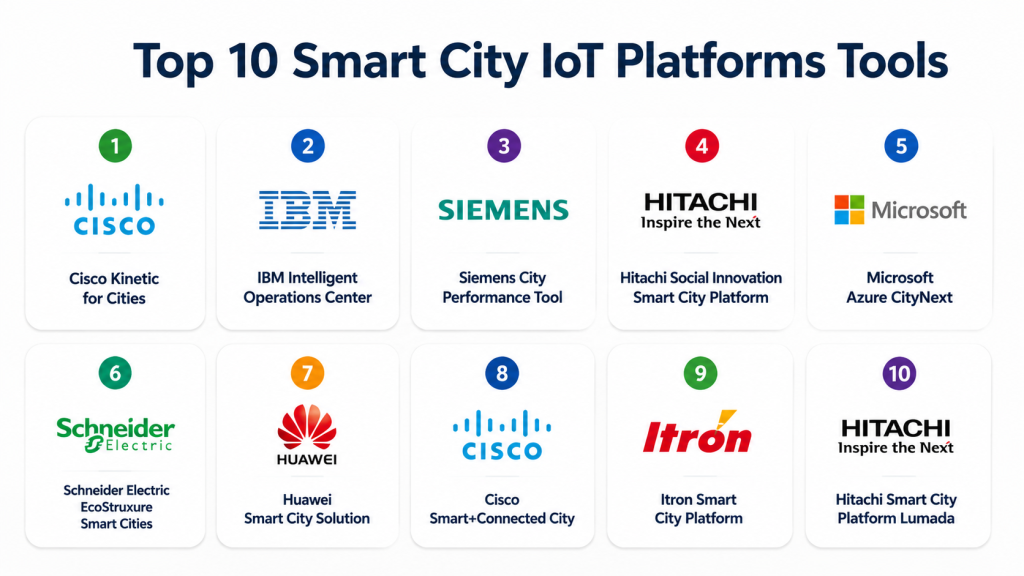
Top 10 Smart City IoT Platforms Tools
1- Cisco Kinetic for Cities
Short description: Cisco Kinetic for Cities provides a unified platform to connect, manage, and secure urban IoT devices across traffic, utilities, and public services.
Key Features
- Real-time IoT device monitoring and management.
- Integration with smart traffic and street lighting systems.
- AI-driven analytics for resource optimization.
- Multi-cloud and hybrid deployment support.
- Security and compliance controls for public sector use.
Pros
- Strong enterprise-grade networking support.
- Scalable for large city-wide deployments.
Cons
- Complexity in initial setup and integration.
- Higher cost for smaller municipalities.
Platforms / Deployment
- Web
- Cloud / Hybrid
Security & Compliance
- SSO/SAML, MFA, encryption, audit logs
- ISO 27001, SOC 2
Integrations & Ecosystem
Supports integration with traffic, utilities, and public service applications.
- APIs for third-party applications
- SIEM and analytics tools
- Device management protocols
Support & Community
Varies / Not publicly stated
2- IBM Intelligent Operations Center
Short description: IBM Intelligent Operations Center centralizes data from multiple city systems to provide real-time insights for urban operations and emergency response.
Key Features
- Unified operational dashboards.
- Predictive analytics and AI modeling for urban planning.
- Integration with public safety, transportation, and utilities.
- Scenario planning and simulation tools.
- Compliance and security monitoring for municipal operations.
Pros
- Strong data analytics and visualization capabilities.
- Effective for emergency management and city planning.
Cons
- May require extensive configuration for multi-domain integration.
- Premium pricing for full-scale deployment.
Platforms / Deployment
- Web
- Cloud / Hybrid
Security & Compliance
- Encryption, RBAC, MFA
- SOC 2, ISO 27001
Integrations & Ecosystem
- Transportation management systems
- Utility IoT sensors
- Public safety databases
Support & Community
Varies / Not publicly stated
3- Siemens City Performance Tool
Short description: Siemens City Performance Tool provides analytics and IoT integration for energy, transport, and environmental monitoring in urban areas.
Key Features
- Real-time data collection from city infrastructure.
- Predictive energy and traffic management.
- AI-enabled environmental monitoring.
- Scenario modeling for urban planning.
- Integration with city dashboards and citizen apps.
Pros
- Strong industrial IoT integration.
- Focus on sustainability metrics.
Cons
- Limited focus on citizen engagement applications.
- Specialized expertise needed for configuration.
Platforms / Deployment
- Web
- Cloud / Hybrid
Security & Compliance
- Not publicly stated
Integrations & Ecosystem
- Smart energy grids
- Transport management systems
- Environmental sensor networks
Support & Community
Varies / Not publicly stated
4- Hitachi Social Innovation Smart City Platform
Short description: Hitachi’s platform provides comprehensive urban IoT management with analytics for transport, energy, and citizen services.
Key Features
- Integrated dashboards for city operations.
- Predictive analytics for traffic and energy use.
- Sensor and device lifecycle management.
- AI-driven insights for decision-making.
- Citizen engagement applications.
Pros
- Broad focus across city systems.
- AI capabilities support predictive planning.
Cons
- High initial deployment complexity.
- May require ongoing professional services.
Platforms / Deployment
- Web
- Cloud / Hybrid
Security & Compliance
- Not publicly stated
Integrations & Ecosystem
- Public transit systems
- Energy management solutions
- Municipal IoT sensors
Support & Community
Varies / Not publicly stated
5- Microsoft Azure CityNext
Short description: Azure CityNext offers cloud-based IoT and analytics for urban management, emphasizing scalable and intelligent city operations.
Key Features
- Real-time urban IoT monitoring.
- AI-driven predictive analytics.
- Multi-cloud integration and hybrid deployments.
- Citizen services and mobile interfaces.
- Compliance and security modules.
Pros
- Cloud-native scalability.
- Strong integration with Microsoft ecosystem.
Cons
- Optimized primarily for Azure-centric deployments.
- Subscription costs may scale with device volume.
Platforms / Deployment
- Web / Windows / Cloud
Security & Compliance
- SOC 2, ISO 27001
- Encryption, MFA
Integrations & Ecosystem
- Azure IoT Hub
- Power BI and analytics pipelines
- Smart public services APIs
Support & Community
Microsoft support tiers; strong community
6- Schneider Electric EcoStruxure Smart Cities
Short description: EcoStruxure integrates energy, transportation, and building management IoT systems with analytics for urban efficiency.
Key Features
- Energy and utilities monitoring.
- Building and infrastructure IoT integration.
- Predictive analytics for city operations.
- Automated control and alerts.
- Sustainability reporting.
Pros
- Strong energy and infrastructure management.
- Focus on sustainability metrics.
Cons
- Limited citizen-facing services.
- Requires domain expertise for deployment.
Platforms / Deployment
- Web
- Cloud / Hybrid
Security & Compliance
- Not publicly stated
Integrations & Ecosystem
- Building management systems
- Energy grids and meters
- Transportation infrastructure
Support & Community
Varies / Not publicly stated
7- Huawei Smart City Solution
Short description: Huawei’s solution offers IoT integration, AI analytics, and cloud management for traffic, energy, and city services.
Key Features
- Citywide IoT connectivity.
- AI-powered analytics for transport and utilities.
- Cloud management for urban operations.
- Data-driven citizen services.
- Device lifecycle management.
Pros
- Comprehensive IoT platform for large-scale cities.
- Strong AI and cloud capabilities.
Cons
- Vendor-specific ecosystem; interoperability may require customization.
- Regulatory considerations depending on region.
Platforms / Deployment
- Web
- Cloud / Hybrid
Security & Compliance
- Not publicly stated
Integrations & Ecosystem
- Urban sensors and IoT gateways
- Transport systems
- Utility management platforms
Support & Community
Varies / Not publicly stated
8- Cisco Smart+Connected City
Short description: Cisco Smart+Connected City provides infrastructure monitoring, analytics, and IoT integration for efficient city operations.
Key Features
- Traffic and mobility management.
- Public safety monitoring.
- Environmental IoT analytics.
- Energy and lighting optimization.
- Real-time dashboards and alerts.
Pros
- Enterprise-grade networking and IoT management.
- Real-time operational insights.
Cons
- Focused on large-scale municipal projects.
- Higher implementation costs.
Platforms / Deployment
- Web
- Cloud / Hybrid
Security & Compliance
- SOC 2, ISO 27001
- Encryption, RBAC, MFA
Integrations & Ecosystem
- Networking and IT infrastructure
- Traffic systems
- Energy grids
Support & Community
Varies / Not publicly stated
9- Itron Smart City Platform
Short description: Itron’s platform specializes in utility management, smart grids, and energy efficiency through connected city devices.
Key Features
- Metering and utilities IoT integration.
- Predictive energy analytics.
- Real-time alerts and notifications.
- Sustainability and efficiency dashboards.
- Device management for energy and water infrastructure.
Pros
- Specialized in energy and utility IoT.
- Supports sustainability initiatives.
Cons
- Less focus on transport and citizen services.
- Integration with other city systems may require customization.
Platforms / Deployment
- Web / Cloud
Security & Compliance
- Not publicly stated
Integrations & Ecosystem
- Smart grids
- Energy meters
- Environmental sensors
Support & Community
Varies / Not publicly stated
10- Hitachi Smart City Platform Lumada
Short description: Lumada provides a data-driven platform integrating IoT, AI, and analytics for city operations, including transport, energy, and citizen services.
Key Features
- IoT device integration and management.
- Predictive analytics for urban planning.
- AI-enabled traffic and utility optimization.
- Citizen engagement dashboards.
- Security and compliance controls.
Pros
- Comprehensive data-driven urban management.
- Strong AI and analytics capabilities.
Cons
- Deployment complexity for multi-domain cities.
- Premium pricing for full-scale adoption.
Platforms / Deployment
- Web / Cloud / Hybrid
Security & Compliance
- Not publicly stated
Integrations & Ecosystem
- Public transport systems
- Utility IoT
- Environmental monitoring networks
Support & Community
Varies / Not publicly stated
Comparison Table (Top 10)
| Tool Name | Best For | Platform(s) Supported | Deployment | Standout Feature | Public Rating |
|---|---|---|---|---|---|
| Cisco Kinetic | Enterprise municipal IoT | Web | Cloud/Hybrid | Device management and analytics | N/A |
| IBM Intelligent Operations Center | Large city operations | Web | Cloud/Hybrid | Centralized operational dashboards | N/A |
| Siemens City Performance Tool | Energy and transport | Web | Cloud/Hybrid | Sustainability and predictive analytics | N/A |
| Hitachi Smart City | Citizen services + infrastructure | Web | Cloud/Hybrid | AI-driven insights | N/A |
| Microsoft Azure CityNext | Cloud-native smart city | Web/Windows | Cloud | Multi-cloud scalability | N/A |
| Schneider Electric EcoStruxure | Energy and building IoT | Web | Cloud/Hybrid | Integrated energy and building management | N/A |
| Huawei Smart City Solution | Large-scale urban IoT | Web | Cloud/Hybrid | AI-powered city analytics | N/A |
| Cisco Smart+Connected | Enterprise municipal IoT | Web | Cloud/Hybrid | Real-time dashboards | N/A |
| Itron Smart City | Utilities and energy management | Web | Cloud | Energy efficiency and sustainability | N/A |
| Hitachi Lumada | Data-driven urban planning | Web | Cloud/Hybrid | AI and analytics | N/A |
Evaluation & Scoring of Smart City IoT Platforms
| Tool Name | Core (25%) | Ease (15%) | Integrations (15%) | Security (10%) | Performance (10%) | Support (10%) | Value (15%) | Weighted Total (0–10) |
|---|---|---|---|---|---|---|---|---|
| Cisco Kinetic | 9 | 7 | 8 | 9 | 8 | 7 | 7 | 8.0 |
| IBM IOC | 8 | 7 | 8 | 8 | 8 | 7 | 7 | 7.7 |
| Siemens | 8 | 7 | 7 | 8 | 7 | 7 | 7 | 7.4 |
| Hitachi Smart City | 9 | 7 | 7 | 8 | 8 | 7 | 7 | 7.8 |
| Azure CityNext | 8 | 8 | 8 | 8 | 8 | 7 | 7 | 7.8 |
| EcoStruxure | 8 | 7 | 7 | 8 | 8 | 7 | 7 | 7.5 |
| Huawei | 8 | 7 | 7 | 7 | 8 | 7 | 7 | 7.4 |
| Cisco Smart+Connected | 9 | 7 | 8 | 8 | 8 | 7 | 7 | 7.9 |
| Itron | 8 | 7 | 7 | 7 | 7 | 7 | 7 | 7.3 |
| Lumada | 9 | 7 | 7 | 8 | 8 | 7 | 7 | 7.8 |
Which Smart City IoT Platform Is Right for You?
Solo / Freelancer
Smaller city initiatives or pilot projects may favor cloud-native, easy-to-deploy platforms like Microsoft Azure CityNext or EcoStruxure.
SMB
Small municipalities or regional pilot cities should focus on platforms with balanced deployment and analytics like Cisco Kinetic or Itron.
Mid-Market
Mid-sized cities with multiple domains (transport, energy, safety) benefit from IBM IOC, Hitachi Smart City, or Siemens platforms.
Enterprise
Large metropolitan cities need comprehensive platforms with AI and multi-domain integration such as Hitachi Lumada, Huawei Smart City, or Cisco Smart+Connected.
Budget vs Premium
Budget options focus on cloud-native, modular deployments; premium platforms provide AI analytics, multi-domain integrations, and advanced dashboards.
Feature Depth vs Ease of Use
Feature-rich platforms like IBM IOC or Hitachi Lumada may require specialized setup; cloud-native platforms prioritize usability for municipal IT teams.
Integrations & Scalability
For cities expecting rapid IoT growth, platforms with APIs, multi-cloud support, and broad device compatibility ensure long-term scalability.
Security & Compliance Needs
Municipal platforms should comply with ISO 27001, SOC 2, and local regulatory standards for citizen data, energy, and public safety.
Frequently Asked Questions (FAQs)
1- What pricing models do smart city IoT platforms use?
Platforms typically offer subscription-based pricing, device-based licensing, or pay-per-module approaches depending on the number of sensors and deployment scale.
2- How long does onboarding take?
Onboarding varies: small deployments can be completed in weeks, while full city-wide integrations may take several months.
3- Are AI features essential for smart cities?
AI improves traffic, energy, and environmental predictions but smaller pilots may operate without AI modules.
4- Can these platforms integrate with existing IT systems?
Yes, most provide APIs or connectors for municipal IT, OT, and cloud-based systems.
5- What are common implementation mistakes?
Skipping device inventory audits, underestimating network complexity, or not training city staff can hinder successful deployment.
6- Are these platforms scalable?
Yes, cloud-native platforms can scale city-wide, while on-premise solutions may require additional infrastructure for larger deployments.
7- Do these platforms provide citizen-facing applications?
Some, like Azure CityNext and Hitachi Lumada, offer apps and dashboards for citizens to interact with services.
8- How is security ensured?
Platforms use encryption, RBAC, MFA, and auditing; compliance with standards like ISO 27001 or SOC 2 is often part of enterprise offerings.
9- Can they integrate heterogeneous IoT devices?
Yes, leading platforms support multiple communication protocols and vendor devices for broad interoperability.
10- What alternatives exist if I don’t adopt a full platform?
Alternative approaches include point solutions for traffic, energy, or environmental monitoring, but these lack centralized analytics and unified management.
Conclusion
Smart City IoT Platforms are essential for creating efficient, sustainable, and data-driven urban environments.
Choosing the right platform depends on city size, integration needs, and desired AI capabilities.
Scalability and real-time monitoring ensure the platform can grow with urban demands.
Security, compliance, and automation features protect sensitive data and streamline operations.
Integration with existing IT/OT systems maximizes the value of city infrastructure.
Municipalities should pilot 2–3 platforms to evaluate performance, cost, and usability.
The right platform enables smarter decision-making, improved citizen services, and long-term urban resilience.

Find Trusted Cardiac Hospitals
Compare heart hospitals by city and services — all in one place.
Explore Hospitals
Smart city initiatives often succeed or fail based on interoperability rather than the number of connected devices. Platforms that can seamlessly exchange data across transportation, utilities, and public services tend to create much greater long-term value for citizens and city administrators alike.