Introduction
HPC job schedulers are specialized software platforms designed to manage, prioritize, and optimize high-performance computing workloads across clusters of servers. They allow organizations to efficiently allocate CPU, GPU, memory, and other resources, ensuring maximum throughput, reduced wait times, and reliable execution for compute-intensive tasks. with AI, machine learning, scientific simulations, and big data analytics expanding rapidly, HPC job schedulers have become critical for research labs, enterprises, and cloud providers.
Real-world use cases include:
- Running large-scale scientific simulations in physics, chemistry, and climate modeling.
- AI model training across multi-node GPU clusters for deep learning research.
- Financial modeling and risk analysis in real-time trading environments.
- Genomics analysis and bioinformatics workflows.
- Rendering and visual effects pipelines for film and media studios.
Evaluation criteria for buyers:
- Multi-node and multi-cluster scheduling capabilities
- GPU and CPU resource allocation efficiency
- Job queuing, prioritization, and preemption policies
- Containerized workload support (Docker, Singularity)
- Monitoring, logging, and analytics dashboards
- Integration with cloud, hybrid, and on-prem infrastructure
- User management and role-based access controls
- Scalability for thousands of concurrent jobs
- Cost-effectiveness and licensing flexibility
- Vendor support and community ecosystem
Best for: Research institutions, enterprise AI teams, cloud service providers, and organizations with HPC workloads requiring tight resource management and high throughput.
Not ideal for: Small teams with minimal workloads, single-node clusters, or organizations that do not require advanced scheduling or GPU optimization.
Key Trends in HPC Job Schedulers
- Hybrid cloud scheduling with on-prem integration for flexible HPC deployments.
- AI-assisted predictive scheduling to improve GPU and CPU utilization.
- Kubernetes and container-native orchestration support for AI/ML pipelines.
- Multi-tenant cluster management for shared HPC resources.
- GPU sharing, virtualization, and partitioning for cost efficiency.
- Real-time monitoring, performance metrics, and predictive maintenance.
- Security enhancements with RBAC, audit logs, and encrypted job data.
- Energy-aware scheduling to reduce power consumption in HPC clusters.
- Integration with workflow automation and AI pipelines.
- Subscription-based and usage-based pricing models for enterprise flexibility.
How We Selected These Tools (Methodology)
- Reviewed market adoption and mindshare in research, AI, and enterprise HPC sectors.
- Evaluated feature completeness, including resource allocation, queuing, and scheduling policies.
- Assessed reliability and performance signals from multi-node deployments.
- Considered security posture, compliance, and access management features.
- Analyzed integration with cloud providers, container frameworks, and workflow automation.
- Prioritized tools capable of handling large-scale HPC, AI, and scientific workloads.
- Evaluated community engagement, documentation quality, and vendor support.
- Ensured alignment with modern 2026 HPC and AI/ML infrastructure trends.
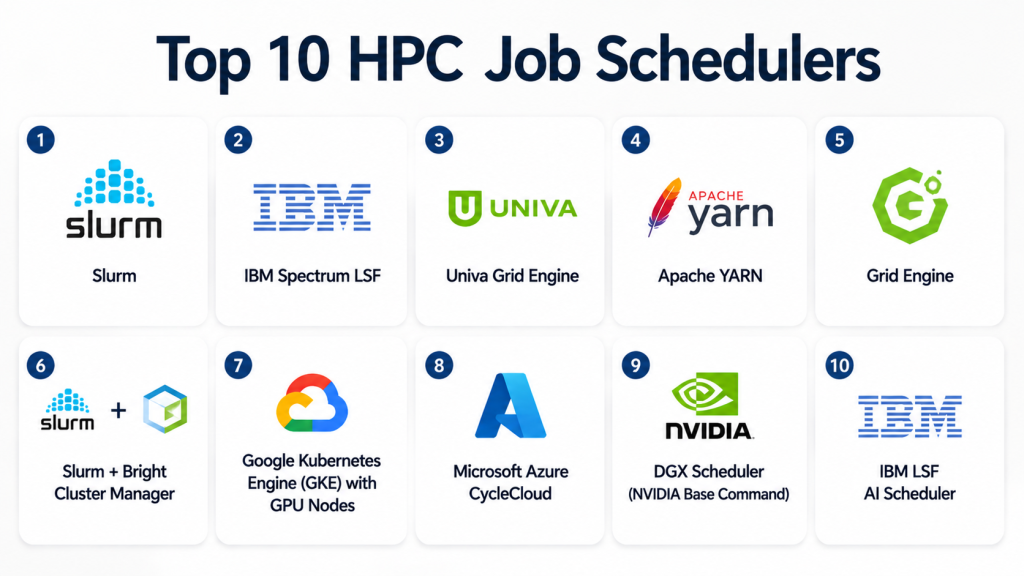
Top 10 HPC Job Schedulers
1- Slurm
Short description: Open-source HPC scheduler widely used for multi-node CPU and GPU clusters in research and enterprise environments.
Key Features
- Advanced job queuing and prioritization
- Multi-cluster and federation support
- GPU and CPU resource allocation
- Accounting and usage tracking
- Plugin and scripting extensibility
Pros
- Proven reliability and scalability
- Large user community
- Highly configurable
Cons
- Steep learning curve
- Complex setup for new users
- Cloud integration requires additional tools
Platforms / Deployment
- Linux / Self-hosted / Cloud
Security & Compliance
- Not publicly stated
Integrations & Ecosystem
- Python and Bash job scripts
- Monitoring with Prometheus/Ganglia
- AI frameworks: TensorFlow, PyTorch
Support & Community
- Active open-source community; enterprise support via SchedMD
2- IBM Spectrum LSF
Short description: Enterprise-grade scheduler for HPC and AI workloads, offering job analytics, multi-cluster management, and GPU optimization.
Key Features
- AI-aware GPU scheduling
- Multi-cluster federation
- Job prioritization and preemption
- Monitoring dashboards and usage analytics
- SLA and cost management
Pros
- Enterprise-grade reliability
- Strong hybrid cloud support
- Detailed job analytics
Cons
- Licensing cost can be high
- Requires trained administrators
- Limited flexibility outside IBM ecosystem
Platforms / Deployment
- Linux / Cloud / Hybrid
Security & Compliance
- Not publicly stated
Integrations & Ecosystem
- AI frameworks: PyTorch, TensorFlow
- Cloud orchestration and resource APIs
- Monitoring via Grafana/Prometheus
Support & Community
- Enterprise IBM support; extensive documentation
3- Univa Grid Engine
Short description: GPU- and CPU-aware HPC scheduler for large clusters, providing high throughput and efficient resource allocation.
Key Features
- Multi-cluster support
- Policy-based scheduling
- GPU reservation and sharing
- Monitoring dashboards
- Job accounting and analytics
Pros
- Efficient resource allocation
- Stable in enterprise HPC environments
- Flexible policy management
Cons
- Open-source version limited
- Less support for containerized workloads
- Learning curve for complex configurations
Platforms / Deployment
- Linux / Self-hosted
Security & Compliance
- Not publicly stated
Integrations & Ecosystem
- Python API for job submission
- Logging and monitoring tools
- AI frameworks integration
Support & Community
- Vendor support available; active enterprise users
4- Apache YARN
Short description: Resource manager and scheduler for big data and HPC workloads, with extensions for GPU-aware AI scheduling.
Key Features
- Centralized resource management
- GPU scheduling support
- Multi-tenant cluster allocation
- Integration with Hadoop and Spark
- Monitoring and logging
Pros
- Strong Big Data integration
- Mature enterprise tool
- Handles mixed CPU/GPU workloads
Cons
- Less suited for modern containerized AI workflows
- GPU support limited
- Setup can be complex
Platforms / Deployment
- Linux / Self-hosted / Cloud
Security & Compliance
- Not publicly stated
Integrations & Ecosystem
- Hadoop, Spark, TensorFlow
- REST APIs for automation
- Resource analytics dashboards
Support & Community
- Mature open-source community; enterprise support via vendors
5- Grid Engine (Oracle/Univa)
Short description: HPC job scheduler optimized for multi-node CPU/GPU clusters with fair-share and priority policies.
Key Features
- GPU-aware scheduling
- Multi-cluster management
- Preemption and priority policies
- Job monitoring and logging
- Plugin extensibility
Pros
- Efficient allocation of resources
- Proven HPC enterprise deployment
- Supports legacy workflows
Cons
- Learning curve for administrators
- Limited container support
- Vendor licensing cost
Platforms / Deployment
- Linux / Self-hosted
Security & Compliance
- Not publicly stated
Integrations & Ecosystem
- APIs for job submission
- Monitoring integrations
- AI frameworks support
Support & Community
- Enterprise vendor support; documentation available
6- Slurm + Bright Cluster Manager
Short description: Combines Slurm scheduling with Bright Cluster Manager for cluster management, monitoring, and GPU optimization.
Key Features
- Centralized job scheduling
- GPU resource allocation
- Node provisioning and monitoring
- Multi-cluster management
- Dashboards and alerts
Pros
- Simplifies HPC cluster management
- Visual dashboards for monitoring
- Enterprise-grade support
Cons
- Higher cost with Bright license
- Complex setup for heterogeneous clusters
- Requires ongoing maintenance
Platforms / Deployment
- Linux / Cloud / Hybrid
Security & Compliance
- Not publicly stated
Integrations & Ecosystem
- Slurm plugins
- GPU-aware job scripts
- Monitoring and analytics APIs
Support & Community
- Vendor support; active documentation
7- Google Kubernetes Engine (GKE) with GPU Nodes
Short description: Cloud-native GPU scheduling solution using Kubernetes for AI/ML workloads.
Key Features
- Auto-scaling GPU nodes
- Kubernetes-native scheduling
- Containerized workload support
- Logging and monitoring
- Hybrid cloud orchestration
Pros
- Fully managed
- Elastic scaling for GPU clusters
- Supports containerized AI workloads
Cons
- Cloud dependency
- Costs can escalate with large clusters
- Limited control over infrastructure
Platforms / Deployment
- Linux / Cloud / Hybrid
Security & Compliance
- Not publicly stated
Integrations & Ecosystem
- TensorFlow, PyTorch, ONNX
- Cloud monitoring and logging
- Kubernetes ecosystem
Support & Community
- Google Cloud support; Kubernetes community
8- Microsoft Azure CycleCloud
Short description: GPU and CPU cluster orchestration for HPC and AI workloads with hybrid cloud capabilities.
Key Features
- Multi-cluster GPU scheduling
- Hybrid cloud support
- Job prioritization
- Monitoring and cost tracking
- Automation via scripts and APIs
Pros
- Strong Azure integration
- Scales cloud and on-prem clusters
- Detailed monitoring and reporting
Cons
- Vendor lock-in to Azure
- Complexity for heterogeneous clusters
- Licensing cost
Platforms / Deployment
- Linux / Cloud / Hybrid
Security & Compliance
- Not publicly stated
Integrations & Ecosystem
- Azure AI/ML services
- Kubernetes support
- APIs for automation and monitoring
Support & Community
- Enterprise Azure support; extensive documentation
9- NVIDIA DGX Scheduler (NVIDIA Base Command)
Short description: Scheduler optimized for NVIDIA DGX systems, supporting multi-node AI model training.
Key Features
- GPU resource allocation for DGX nodes
- AI framework integration
- Job preemption and prioritization
- Real-time monitoring
- Hybrid cloud extension support
Pros
- High-performance GPU scheduling
- Optimized for AI workloads
- Scales across DGX clusters
Cons
- NVIDIA hardware required
- Focused on AI workloads
- Licensing cost
Platforms / Deployment
- Linux / Cloud / Self-hosted
Security & Compliance
- Not publicly stated
Integrations & Ecosystem
- NVIDIA GPU ecosystem
- TensorFlow, PyTorch support
- DGX management APIs
Support & Community
- Enterprise support via NVIDIA; active DGX forums
10- IBM LSF AI Scheduler
Short description: Enterprise GPU scheduler for HPC and AI, with advanced analytics, multi-cluster scheduling, and containerized workload support.
Key Features
- AI-aware GPU scheduling
- Multi-cluster management
- Job prioritization and GPU reservation
- Monitoring, reporting, SLA tracking
- Containerized workload support
Pros
- Advanced analytics and reporting
- Large-scale AI workload support
- Hybrid cloud and multi-tenant support
Cons
- Enterprise-focused, high cost
- Requires trained administrators
- Complexity in large deployments
Platforms / Deployment
- Linux / Cloud / Hybrid
Security & Compliance
- Not publicly stated
Integrations & Ecosystem
- AI frameworks
- Hybrid cloud orchestration
- REST APIs for automation
Support & Community
- Enterprise IBM support; extensive documentation
Comparison Table (Top 10)
| Tool Name | Best For | Platform(s) Supported | Deployment | Standout Feature | Public Rating |
|---|---|---|---|---|---|
| Slurm | HPC/AI | Linux | Self-hosted | Open-source, highly configurable | N/A |
| IBM Spectrum LSF | Enterprise AI | Linux | Cloud/Hybrid | SLA-aware GPU scheduling | N/A |
| Univa Grid Engine | HPC/AI | Linux | Self-hosted | Policy-based GPU allocation | N/A |
| Apache YARN | Big Data/HPC | Linux | Cloud/Self-hosted | GPU-aware scheduling | N/A |
| Grid Engine | HPC/AI | Linux | Self-hosted | Multi-cluster resource allocation | N/A |
| Slurm + Bright Cluster Manager | Enterprise HPC | Linux | Cloud/Hybrid | Cluster management + monitoring | N/A |
| GKE with GPU Nodes | Cloud-native AI | Linux | Cloud | Auto-scaling GPU nodes | N/A |
| Azure CycleCloud | AI/HPC hybrid | Linux | Cloud/Hybrid | Multi-cluster GPU orchestration | N/A |
| NVIDIA DGX Scheduler | DGX AI clusters | Linux | Self-hosted | Optimized DGX GPU scheduling | N/A |
| IBM LSF AI Scheduler | Enterprise AI/HPC | Linux | Hybrid | AI-aware multi-cluster scheduling | N/A |
Evaluation & Scoring of HPC Job Schedulers
| Tool Name | Core (25%) | Ease (15%) | Integrations (15%) | Security (10%) | Performance (10%) | Support (10%) | Value (15%) | Weighted Total |
|---|---|---|---|---|---|---|---|---|
| Slurm | 10 | 7 | 8 | 7 | 9 | 8 | 9 | 8.6 |
| IBM Spectrum LSF | 9 | 7 | 8 | 8 | 9 | 8 | 7 | 8.3 |
| Univa Grid Engine | 8 | 7 | 7 | 7 | 8 | 7 | 8 | 7.7 |
| Apache YARN | 8 | 7 | 7 | 7 | 7 | 6 | 8 | 7.5 |
| Grid Engine | 8 | 7 | 7 | 7 | 8 | 7 | 8 | 7.7 |
| Slurm + Bright Cluster Manager | 9 | 7 | 8 | 8 | 8 | 8 | 7 | 8.1 |
| GKE with GPU Nodes | 8 | 8 | 9 | 7 | 8 | 7 | 8 | 8.0 |
| Azure CycleCloud | 8 | 7 | 8 | 8 | 8 | 7 | 7 | 7.8 |
| NVIDIA DGX Scheduler | 9 | 7 | 8 | 7 | 9 | 8 | 7 | 8.1 |
| IBM LSF AI Scheduler | 9 | 7 | 8 | 8 | 9 | 8 | 7 | 8.2 |
Which HPC Job Scheduler Is Right for You?
Solo / Freelancer
Slurm or Apache YARN suits small-scale experimentation and academic research clusters.
SMB
Univa Grid Engine or Slurm + Bright Cluster Manager balances ease of deployment with enterprise-grade features.
Mid-Market
IBM Spectrum LSF, Azure CycleCloud, and GKE with GPU Nodes provide robust hybrid and cloud cluster management.
Enterprise
IBM LSF AI Scheduler and NVIDIA DGX Scheduler optimize multi-node AI/HPC workloads with analytics and hybrid cloud support.
Budget vs Premium
Open-source solutions (Slurm, YARN) fit tight budgets; enterprise-grade schedulers (LSF, DGX Scheduler) provide advanced monitoring, analytics, and SLA features.
Feature Depth vs Ease of Use
Enterprise schedulers offer deeper features but require trained administrators; cloud-native options (GKE, Azure CycleCloud) offer simpler deployment.
Integrations & Scalability
Cloud-native schedulers excel at scaling GPU workloads and integrating with AI/ML pipelines.
Security & Compliance Needs
Enterprise schedulers offer role-based access control, auditing, and hybrid deployment security for regulated HPC workloads.
Frequently Asked Questions (FAQs)
1- What is an HPC job scheduler?
Software that allocates CPU, GPU, and memory resources across HPC clusters to optimize throughput and efficiency.
2- Can these schedulers manage GPU workloads?
Yes, most modern schedulers support GPU-aware scheduling and multi-node GPU resource allocation.
3- Do they support containers?
Many schedulers integrate with Docker, Singularity, or Kubernetes for containerized AI/ML workloads.
4- How complex is deployment?
Open-source schedulers like Slurm require expertise, while cloud-managed solutions are easier for smaller teams.
5- Can I schedule across multiple clusters?
Enterprise schedulers like IBM LSF or Bright Cluster Manager support multi-cluster federation.
6- Are there open-source options?
Yes, Slurm, Apache YARN, and Grid Engine have open-source versions.
7- Is cloud-based scheduling better than on-prem?
It depends on workload size, cost, and latency requirements. Cloud offers elastic scaling; on-prem offers predictable performance.
8- How do schedulers improve efficiency?
By optimizing job placement, prioritization, and GPU/CPU utilization, reducing idle resources.
9- Can they integrate with AI frameworks?
Yes, they commonly support TensorFlow, PyTorch, MXNet, and other ML frameworks.
10- Are HPC job schedulers cost-effective?
By maximizing cluster utilization and reducing idle time, they help lower overall infrastructure costs.
Conclusion
HPC job schedulers are critical for managing compute-intensive AI, ML, and scientific workloads efficiently. They optimize GPU and CPU allocation, reduce idle resources, and support multi-node clusters with complex job dependencies. Selection depends on workload type, cluster size, and deployment environment. Open-source options like Slurm and YARN suit smaller teams, while enterprise-grade solutions like IBM LSF and NVIDIA DGX Scheduler provide analytics, hybrid cloud support, and GPU optimization. Cloud-native options simplify containerized AI pipelines. Security, monitoring, and multi-tenant support are essential considerations. Piloting 2–3 schedulers helps assess real-world performance. Ultimately, the best choice aligns with your infrastructure, budget, and HPC workload requirements.

Find Trusted Cardiac Hospitals
Compare heart hospitals by city and services — all in one place.
Explore Hospitals
A key real-world challenge in HPC job schedulers is balancing fair resource allocation with maximizing cluster utilization. In multi-tenant environments, preventing resource starvation while still optimizing queue throughput often requires careful tuning of priority policies and backfilling strategies.