Introduction
Data Federation Platforms provide a unified layer to query, combine, and access data from multiple, disparate sources without physically moving it. Unlike traditional ETL or data replication, these platforms enable real-time access to data across databases, cloud services, and SaaS applications while maintaining governance and security. organizations are managing increasingly complex and distributed data ecosystems. Data federation allows faster analytics, supports AI/ML pipelines, and reduces storage overhead by virtualizing access instead of duplicating data.
Real-world use cases:
- Querying financial, HR, and operational datasets from multiple systems for live dashboards.
- Enabling real-time analytics across cloud and on-prem data stores.
- Powering AI/ML models with unified, consistent datasets from distributed sources.
- Supporting self-service analytics for business users without exposing raw databases.
- Reducing compliance risk by controlling virtualized access instead of moving sensitive data.
Evaluation criteria for buyers:
- Source compatibility and connector breadth
- Query performance and caching
- Real-time versus batch capabilities
- Security and access control mechanisms
- Scalability and concurrency handling
- Integration with BI, analytics, and AI/ML platforms
- Observability, logging, and monitoring
- Deployment flexibility (cloud, on-prem, hybrid)
- Pricing and licensing transparency
- Best for: Data architects, IT leaders, and analytics teams in mid-to-large enterprises that need real-time access to distributed datasets while maintaining governance and compliance.
- Not ideal for: Small organizations with minimal data sources or simple reporting requirements where direct queries or ETL pipelines suffice.
Key Trends in Data Federation Platforms
- AI-assisted query optimization and caching to improve performance.
- Multi-cloud and hybrid deployment support for seamless distributed data access.
- Low-code interfaces enabling analysts to define virtual datasets.
- Stronger security features including RBAC, SSO, encryption, and audit logging.
- Integration with modern BI, analytics, and AI/ML platforms.
- Real-time data federation for live dashboards and machine learning pipelines.
- Pre-built connectors to popular SaaS apps, cloud databases, and legacy systems.
- Flexible subscription and usage-based pricing models.
- Metadata management and automated data lineage tracking.
- Enhanced monitoring and observability of federated queries.
How We Selected These Tools (Methodology)
- Evaluated market adoption and enterprise mindshare.
- Assessed feature completeness, including query federation and caching.
- Reviewed performance and reliability for large-scale workloads.
- Checked security posture, compliance certifications, and access controls.
- Examined integration breadth with analytics, BI, and AI/ML platforms.
- Evaluated scalability across hybrid and multi-cloud deployments.
- Considered customer fit for SMBs, mid-market, and enterprises.
- Reviewed documentation quality and ease of onboarding.
- Balanced commercial, open-source, and cloud-native tools.
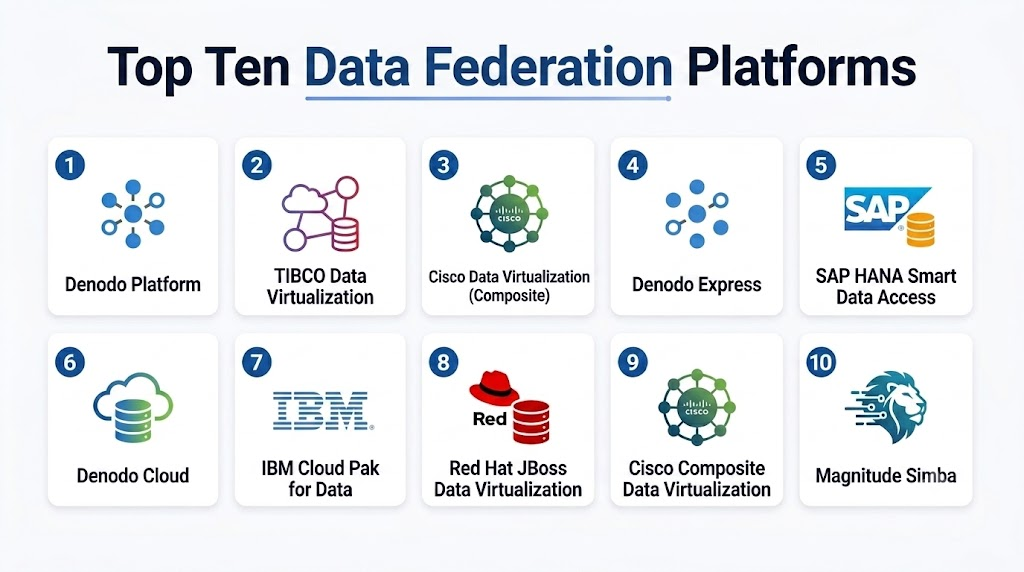
Top 10 Data Federation Platforms
1- Denodo Platform
Short description: Enterprise-grade data federation platform offering real-time access to heterogeneous data sources for analytics teams.
Key Features
- Real-time query federation and caching
- Unified virtual data layer
- Metadata and lineage management
- Security and governance controls
- Multi-source connectivity
Pros
- High performance and scalability
- Strong enterprise-grade governance
Cons
- Premium licensing cost
- Steeper learning curve for new users
Platforms / Deployment
- Web / Cloud / On-prem / Hybrid
Security & Compliance
- SSO/SAML, RBAC, encryption
- SOC 2, GDPR
Integrations & Ecosystem
Supports major BI tools and cloud databases.
- Tableau, Power BI, Looker
- Snowflake, Redshift, BigQuery
- REST APIs for custom integrations
Support & Community
Comprehensive documentation, enterprise support, active user community
2- TIBCO Data Virtualization
Short description: Connects diverse data sources into a single virtual layer, simplifying access and analytics for medium to large organizations.
Key Features
- Visual data modeling
- Real-time and batch virtualization
- Query optimization and caching
- Policy-based security
- Extensive connector library
Pros
- Flexible for hybrid environments
- Robust governance controls
Cons
- Licensing can be expensive
- Complex for small teams
Platforms / Deployment
- Web / Cloud / Hybrid
Security & Compliance
- SSO/SAML, MFA, encryption
- Not publicly stated
Integrations & Ecosystem
- BI tools: Power BI, Qlik
- Cloud platforms: AWS, Azure, GCP
- REST, JDBC connectors
Support & Community
Documentation and enterprise support tiers; active user forums
3- Cisco Data Virtualization (Composite)
Short description: Provides real-time federation and virtualized access across distributed enterprise data systems.
Key Features
- High-performance query federation
- Virtual data views
- Security and policy enforcement
- Monitoring dashboards
- Metadata management
Pros
- Optimized for distributed enterprise data
- Supports hybrid cloud and on-prem
Cons
- Complex deployment
- Limited community resources
Platforms / Deployment
- Web / Cloud / On-prem
Security & Compliance
- SSO/SAML, RBAC
- Not publicly stated
Integrations & Ecosystem
- Databases: Oracle, SQL Server
- Cloud: AWS, Azure
- BI: Tableau, Power BI
Support & Community
Enterprise support available; limited community forums
4- Denodo Express
Short description: Lightweight version of Denodo for evaluation or small-scale data federation projects.
Key Features
- Basic virtual layer
- Lightweight caching
- Metadata management
- Limited connectors
- Simple query federation
Pros
- Free to use for pilots
- Quick setup
Cons
- Limited scalability
- Fewer connectors and features
Platforms / Deployment
- Web / Cloud / On-prem
Security & Compliance
- Not publicly stated
Integrations & Ecosystem
- Supports basic databases and BI tools
- Limited API access
Support & Community
Community support; limited official support
5- SAP HANA Smart Data Access
Short description: Enables virtualized access to remote sources within SAP HANA for analytics and reporting.
Key Features
- Native SAP integration
- Virtual tables and views
- Query federation
- Security and governance
- Metadata management
Pros
- Deep SAP ecosystem integration
- Strong security features
Cons
- Best for SAP customers
- Limited third-party connector support
Platforms / Deployment
- Web / Cloud / On-prem
Security & Compliance
- SSO/SAML, RBAC
- Not publicly stated
Integrations & Ecosystem
- SAP apps and databases
- Limited external connectors
Support & Community
SAP documentation and enterprise support
6- Denodo Cloud
Short description: Cloud-native platform for enterprise data federation with hybrid source support.
Key Features
- Real-time query federation
- Cloud scalability and integration
- Caching and optimization
- Security and governance
- Monitoring and alerts
Pros
- SaaS deployment reduces infra overhead
- Hybrid source support
Cons
- Subscription cost can be high
- Complex for small deployments
Platforms / Deployment
- Web / Cloud
Security & Compliance
- SSO/SAML, RBAC, encryption
- SOC 2, GDPR
Integrations & Ecosystem
- Snowflake, BigQuery, Redshift
- Tableau, Power BI
- REST APIs
Support & Community
Enterprise support and documentation
7- IBM Cloud Pak for Data
Short description: Unified platform combining data federation, AI, and analytics for hybrid cloud enterprises.
Key Features
- Virtual layer and governance
- Query federation and caching
- AI-driven optimization
- Security controls
- Multi-cloud support
Pros
- Enterprise-grade performance
- Integrated AI/ML features
Cons
- Complex licensing
- Steeper learning curve
Platforms / Deployment
- Web / Cloud / Hybrid
Security & Compliance
- SSO/SAML, RBAC, encryption
- SOC 2, GDPR
Integrations & Ecosystem
- IBM databases, cloud services, BI tools
- REST, JDBC connectors
Support & Community
Enterprise support and documentation
8- Red Hat JBoss Data Virtualization
Short description: Open-source solution for federated queries and unified access in hybrid environments.
Key Features
- Virtual data views
- Query federation
- Open-source flexibility
- Security and policy controls
- Multi-source connectivity
Pros
- Low-cost, open-source
- Flexible deployment
Cons
- Requires technical expertise
- Limited community support for advanced features
Platforms / Deployment
- Linux / Cloud / On-prem
Security & Compliance
- Not publicly stated
Integrations & Ecosystem
- JDBC/ODBC connectors
- BI tool integration
Support & Community
- Community support; optional enterprise support
9- Cisco Composite Data Virtualization
Short description: Enterprise-focused high-performance federation platform for large-scale datasets.
Key Features
- Real-time query federation
- Virtual views
- Metadata management
- Security enforcement
- Monitoring dashboards
Pros
- Optimized for distributed analytics
- Enterprise-ready
Cons
- Complex deployment
- Cisco ecosystem familiarity recommended
Platforms / Deployment
- Web / Cloud / On-prem
Security & Compliance
- Not publicly stated
Integrations & Ecosystem
- Cloud and on-prem databases
- BI tools
Support & Community
- Enterprise support
10- Magnitude Simba
Short description: Provides federated access and query optimization for analytics workloads across multiple sources.
Key Features
- Query federation and caching
- Virtual data layer
- Metadata and lineage management
- Security enforcement
- Multi-source connectivity
Pros
- High-performance query execution
- Optimized for analytics
Cons
- Limited community resources
- Licensing complexity
Platforms / Deployment
- Web / Cloud / On-prem
Security & Compliance
- Not publicly stated
Integrations & Ecosystem
- Databases and cloud warehouses
- BI tool connectors
Support & Community
- Enterprise support
Comparison Table (Top 10)
| Tool Name | Best For | Platform(s) Supported | Deployment | Standout Feature | Public Rating |
|---|---|---|---|---|---|
| Denodo Platform | Enterprise analytics | Web | Cloud/On-prem/Hybrid | Real-time federation | N/A |
| TIBCO DV | Hybrid environments | Web | Cloud/Hybrid | Visual modeling | N/A |
| Cisco DV | Distributed enterprise | Web | Cloud/On-prem | High-performance federation | N/A |
| Denodo Express | Pilot projects | Web | Cloud/On-prem | Lightweight virtualization | N/A |
| SAP HANA SDA | SAP-centric analytics | Web | Cloud/On-prem | Native SAP integration | N/A |
| Denodo Cloud | Cloud-first enterprise | Web | Cloud | SaaS virtualization | N/A |
| IBM Cloud Pak | AI/ML integration | Web | Cloud/Hybrid | Unified virtual layer | N/A |
| Red Hat JBoss DV | Open-source flexibility | Linux | Cloud/On-prem | Federation + open-source | N/A |
| Cisco Composite DV | Enterprise performance | Web | Cloud/On-prem | High-speed queries | N/A |
| Magnitude Simba | Analytics optimization | Web | Cloud/On-prem | Query optimization | N/A |
Evaluation & Scoring of Data Federation Platforms
| Tool Name | Core (25%) | Ease (15%) | Integrations (15%) | Security (10%) | Performance (10%) | Support (10%) | Value (15%) | Weighted Total |
|---|---|---|---|---|---|---|---|---|
| Denodo Platform | 9 | 8 | 9 | 9 | 9 | 8 | 7 | 8.6 |
| TIBCO DV | 8 | 8 | 8 | 8 | 8 | 7 | 7 | 7.9 |
| Cisco DV | 8 | 7 | 8 | 8 | 8 | 7 | 7 | 7.8 |
| Denodo Express | 7 | 9 | 7 | 7 | 7 | 7 | 8 | 7.5 |
| SAP HANA SDA | 8 | 7 | 7 | 8 | 7 | 7 | 6 | 7.2 |
| Denodo Cloud | 9 | 8 | 8 | 9 | 8 | 8 | 7 | 8.3 |
| IBM Cloud Pak | 9 | 7 | 8 | 9 | 8 | 8 | 7 | 8.1 |
| Red Hat JBoss DV | 8 | 6 | 7 | 7 | 8 | 7 | 7 | 7.3 |
| Cisco Composite DV | 8 | 7 | 8 | 8 | 8 | 7 | 7 | 7.8 |
| Magnitude Simba | 8 | 7 | 7 | 7 | 8 | 7 | 7 | 7.4 |
Which Data Federation Platform Is Right for You?
Solo / Freelancer
Use Denodo Express or Red Hat JBoss DV for small-scale projects or evaluation.
SMB
Denodo Cloud and TIBCO DV are ideal for hybrid or cloud-first deployments.
Mid-Market
Cisco DV and IBM Cloud Pak support multi-cloud and governance for mid-sized enterprises.
Enterprise
Denodo Platform, Magnitude Simba, and SAP HANA SDA handle large-scale distributed datasets with robust security.
Budget vs Premium
Open-source tools reduce licensing costs but require technical expertise. Premium tools offer managed services, automation, and enterprise support.
Feature Depth vs Ease of Use
Enterprise tools provide rich governance and performance features; lightweight/cloud-first tools focus on ease of setup and self-service.
Integrations & Scalability
Ensure connectors to BI, analytics, and AI platforms. Scalable architecture is critical for large datasets.
Security & Compliance Needs
Choose SOC 2, GDPR, or HIPAA-ready platforms with audit logs, RBAC, and encryption for regulated industries.
Frequently Asked Questions (FAQs)
1- What is a data federation platform?
It provides a virtual layer to access and query multiple data sources in real-time without moving data. This enables analytics, reporting, and AI workflows across distributed systems.
2- How is it different from ETL?
Unlike ETL, which physically extracts and loads data, federation queries the data at source. This reduces duplication, speeds up access, and enables live insights.
3- Can these platforms handle real-time data?
Yes, they support streaming and real-time query federation, allowing live dashboards and AI models to access up-to-date information seamlessly.
4- Are open-source solutions production-ready?
Yes, platforms like Red Hat JBoss DV can handle production workloads but require engineering resources for deployment, scaling, and monitoring.
5- What pricing models are available?
Cloud-based platforms typically use subscription or pay-per-use models. Open-source versions are free but incur operational costs for infrastructure and support.
6- How steep is the learning curve?
Enterprise platforms may require technical expertise in data architecture, while cloud or express editions offer simplified interfaces for analysts and developers.
7- How do these platforms ensure security?
They implement SSO/SAML, RBAC, encryption in transit and at rest, and maintain audit logs. Enterprise tools often comply with SOC 2, GDPR, and HIPAA standards.
8- Can these platforms integrate with multiple cloud/on-prem systems?
Yes, they support connections to relational and NoSQL databases, SaaS apps, and cloud warehouses, enabling hybrid and multi-cloud deployments.
9- How long does implementation take?
Pilot deployments can be completed in days, while enterprise deployments may take weeks depending on complexity, governance setup, and compliance requirements.
10- Can I switch platforms easily?
Migration requires updating virtual views, connectors, and security policies. Proper documentation and open standards reduce friction during transition.
Conclusion
Data federation platforms are key to unifying access to distributed datasets without heavy replication. Selecting the right platform depends on organization size, complexity, and cloud strategy. Small teams may leverage free or lightweight editions for pilots, while enterprises need scalable, secure, and optimized solutions. Integration with BI, analytics, and AI platforms is essential for performance and usability. Security, compliance, and auditability are crucial for regulated industries. Running pilot projects ensures the platform fits operational and business needs. Ultimately, the ideal platform balances governance, ease of use, and performance to accelerate insights across the organization.

Find Trusted Cardiac Hospitals
Compare heart hospitals by city and services — all in one place.
Explore Hospitals
A key real-world challenge with data federation platforms is query performance when pulling data from multiple heterogeneous sources in real time. As data volumes grow, optimizing join strategies, caching layers, and minimizing cross-source latency becomes critical to maintain consistent and reliable analytics performance.