Introduction
Ontology Management Tools are specialized platforms that help organizations define, maintain, and govern ontologies structured representations of concepts and relationships in a domain. They are vital for enterprises aiming to standardize knowledge, improve semantic interoperability, and power AI-driven analytics. By centralizing ontologies, these tools support richer data understanding and enable consistent metadata across multiple systems.ontology management is increasingly relevant due to the rise of AI applications, semantic search, knowledge graphs, and complex enterprise data ecosystems. With the expansion of unstructured data, businesses need structured semantic frameworks to ensure accurate insights, compliance, and scalable AI solutions.
Real-world use cases include:
- Knowledge graph construction for AI reasoning and recommendations
- Semantic search and content discovery in large enterprises
- Regulatory compliance through standardized data definitions
- Enterprise data integration and metadata management
- NLP applications for customer support and analytics
Evaluation criteria for buyers:
- Ontology modeling and visualization capabilities
- Version control and collaboration features
- Integration with knowledge graphs and databases
- Support for semantic web standards (OWL, RDF, SKOS)
- AI/ML integration and reasoning capabilities
- Scalability and performance for large datasets
- Security, access control, and compliance features
- Usability and learning curve
- Deployment options (cloud, on-prem, hybrid)
- Best for: Data architects, AI/ML teams, enterprise knowledge managers, and organizations managing complex domain knowledge across multiple systems.
- Not ideal for: Teams with simple datasets or those not using AI, semantic search, or enterprise knowledge graphs.
Key Trends in Ontology Management Tools
- AI-assisted ontology generation and maintenance
- Automated consistency checks and semantic reasoning
- Multi-model support for integrating RDF, OWL, and property graphs
- Cloud-native deployment with elastic scalability
- Real-time collaboration and version control across teams
- Integration with knowledge graphs, data catalogs, and BI tools
- Enhanced visualization for complex ontologies
- Support for semantic standards and linked data
- Enterprise-grade security and compliance
- Adoption of low-code/no-code ontology modeling features
How We Selected These Tools (Methodology)
- Market adoption and enterprise mindshare
- Feature completeness, including modeling, reasoning, and AI integration
- Performance and reliability for large-scale ontologies
- Security posture and compliance standards
- Ecosystem integrations and extensibility
- User experience and onboarding ease
- Deployment flexibility (cloud, on-prem, hybrid)
- Community support and documentation quality
- Fit across enterprise, SMB, and developer segments
- Longevity and vendor reputation
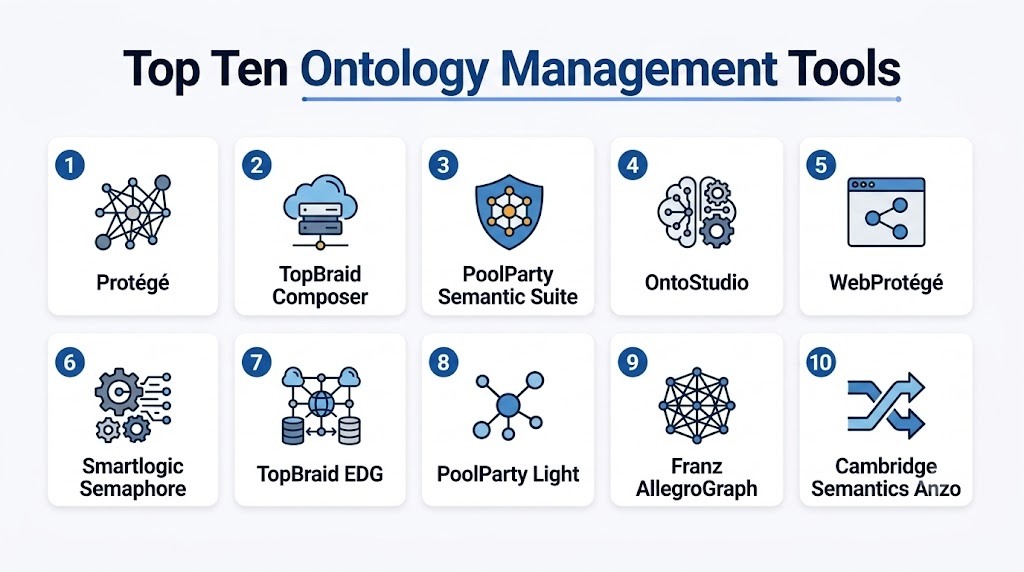
Top 10 Ontology Management Tools
1- Protégé
Short description: Open-source ontology editor widely used for creating, visualizing, and managing OWL and RDF ontologies.
Key Features
- Ontology modeling and visualization
- Supports OWL, RDF, and SWRL
- Extensible plugin architecture
- Collaboration through WebProtégé
- Version control and annotation capabilities
Pros
- Free and widely adopted
- Extensive community support
Cons
- Steep learning curve for beginners
- Desktop-based editing can limit large-scale collaboration
Platforms / Deployment
- Web / Windows / macOS / Linux
- Cloud (WebProtégé) / Desktop
Security & Compliance
- Not publicly stated
Integrations & Ecosystem
Supports APIs and plugins for custom tools
- SPARQL endpoints
- Knowledge graph integration
- BI and data analytics connectors
Support & Community
Strong open-source community; optional professional support through Stanford
2- TopBraid Composer
Short description: Enterprise-grade ontology and metadata management platform for modeling, reasoning, and integrating semantic data.
Key Features
- OWL and RDF ontology editing
- SPARQL query support
- Graph-based visualization
- Semantic reasoning and validation
- Integration with enterprise data sources
Pros
- Strong enterprise features
- Scales for large knowledge graphs
Cons
- Commercial licensing
- Requires training for full capabilities
Platforms / Deployment
- Windows / Linux / Cloud / Hybrid
Security & Compliance
- RBAC, encryption
- Not publicly stated
Integrations & Ecosystem
- Databases, BI tools, AI/ML pipelines
- REST APIs, SPARQL endpoints
Support & Community
Professional enterprise support; active user forums
3- PoolParty Semantic Suite
Short description: Knowledge management and ontology platform specializing in semantic web, taxonomies, and linked data.
Key Features
- Ontology and taxonomy management
- Linked data support and SKOS compliance
- NLP integration for text analytics
- Semantic search and enrichment
- API-based extensibility
Pros
- Strong in semantic search and AI integration
- Multi-domain capabilities
Cons
- Premium pricing
- Complex for small teams
Platforms / Deployment
- Web / Cloud / Hybrid
Security & Compliance
- SSO, RBAC, encryption
- Not publicly stated
Integrations & Ecosystem
- Knowledge graphs, CMS, BI tools
- REST APIs and connectors
Support & Community
Enterprise support; active documentation and community
4- OntoStudio
Short description: Ontology engineering environment for professional semantic modeling and reasoning across complex domains.
Key Features
- UML-based ontology modeling
- OWL, RDF, and SKOS support
- Semantic reasoning engine
- Collaboration tools
- Integration with databases and knowledge graphs
Pros
- Enterprise-grade reasoning
- Advanced modeling features
Cons
- Commercial license required
- Learning curve for beginners
Platforms / Deployment
- Windows / Cloud / Hybrid
Security & Compliance
- Not publicly stated
Integrations & Ecosystem
- SPARQL, APIs, BI connectors
- Knowledge graph integration
Support & Community
Professional vendor support; limited open-source community
5- WebProtégé
Short description: Web-based version of Protégé for collaborative ontology development and management in enterprises.
Key Features
- Browser-based ontology editing
- OWL and RDF support
- Collaboration with version control
- Commenting and discussion threads
- Reasoning plug-ins
Pros
- Free and collaborative
- Cloud-accessible
Cons
- Limited advanced enterprise features
- Dependent on plugins for reasoning
Platforms / Deployment
- Web / Cloud
Security & Compliance
- Not publicly stated
Integrations & Ecosystem
- SPARQL endpoints
- API-based access for knowledge graphs
Support & Community
Open-source community; Stanford-supported
6- Smartlogic Semaphore
Short description: Semantic platform for ontology management, metadata management, and content enrichment.
Key Features
- Ontology creation and management
- Semantic enrichment and linking
- AI/NLP integration
- Compliance and data governance
- Knowledge graph support
Pros
- Enterprise-grade AI integration
- Supports compliance initiatives
Cons
- High licensing costs
- Complex setup for small teams
Platforms / Deployment
- Cloud / Hybrid
Security & Compliance
- SSO, encryption
- Not publicly stated
Integrations & Ecosystem
- CMS, BI tools, AI pipelines
- REST APIs and connectors
Support & Community
Enterprise support with professional services
7- TopQuadrant TopBraid EDG
Short description: Enterprise Data Governance platform with ontology management, metadata governance, and semantic modeling.
Key Features
- Ontology-based governance
- Semantic reasoning
- Metadata management
- SPARQL querying
- Workflow and approvals
Pros
- Strong governance capabilities
- Enterprise-ready
Cons
- Premium pricing
- Requires training
Platforms / Deployment
- Cloud / Hybrid
Security & Compliance
- RBAC, encryption
- Not publicly stated
Integrations & Ecosystem
- BI tools, knowledge graphs, AI pipelines
- API and SPARQL endpoints
Support & Community
Enterprise support with professional consulting
8- PoolParty Light
Short description: Lightweight version of PoolParty for SMEs needing semantic enrichment and ontology management.
Key Features
- Taxonomy and ontology management
- Linked data support
- Semantic tagging and enrichment
- Lightweight reasoning
- API integration
Pros
- Affordable for small teams
- Easy to deploy
Cons
- Limited enterprise capabilities
- Fewer AI integrations
Platforms / Deployment
- Web / Cloud
Security & Compliance
- Not publicly stated
Integrations & Ecosystem
- REST APIs, CMS connectors
- BI tool integration
Support & Community
Professional support for SMEs; smaller community
9- Franz AllegroGraph
Short description: Enterprise RDF graph database with ontology and semantic reasoning for complex knowledge management.
Key Features
- RDF triple store
- Ontology reasoning and inferencing
- SPARQL query support
- Scalable graph storage
- AI and ML integration
Pros
- High-performance reasoning
- Enterprise-grade scalability
Cons
- Commercial licensing
- Complex setup
Platforms / Deployment
- Linux / Cloud / Hybrid
Security & Compliance
- Encryption, RBAC
- Not publicly stated
Integrations & Ecosystem
- AI/ML pipelines, BI tools
- REST APIs, SPARQL endpoints
Support & Community
Professional enterprise support
10- Cambridge Semantics Anzo
Short description: Data platform integrating ontology management, semantic reasoning, and knowledge graph analytics for enterprises.
Key Features
- Ontology modeling and reasoning
- Knowledge graph creation
- AI/ML integration
- Semantic data virtualization
- Collaboration and governance tools
Pros
- Strong analytics capabilities
- Enterprise-focused
Cons
- Premium pricing
- Steep learning curve
Platforms / Deployment
- Cloud / Hybrid
Security & Compliance
- RBAC, encryption
- Not publicly stated
Integrations & Ecosystem
- BI tools, AI pipelines, knowledge graphs
- APIs and connectors
Support & Community
Enterprise support and professional services
Comparison Table (Top 10)
| Tool Name | Best For | Platform(s) Supported | Deployment | Standout Feature | Public Rating |
|---|---|---|---|---|---|
| Protégé | Academic & enterprise | Web, Desktop | Cloud/Desktop | Open-source ontology editor | N/A |
| TopBraid Composer | Enterprise | Windows | Cloud/Hybrid | Semantic reasoning | N/A |
| PoolParty Semantic Suite | Enterprise semantic search | Web | Cloud | Linked data management | N/A |
| OntoStudio | Professional modeling | Windows | Cloud/Hybrid | Ontology reasoning | N/A |
| WebProtégé | Collaboration | Web | Cloud | Browser-based ontology editing | N/A |
| Smartlogic Semaphore | Enterprise AI | Web | Cloud/Hybrid | Semantic enrichment | N/A |
| TopBraid EDG | Data governance | Web | Cloud/Hybrid | Ontology-based governance | N/A |
| PoolParty Light | SMEs | Web | Cloud | Lightweight ontology management | N/A |
| Franz AllegroGraph | Enterprise RDF | Linux | Cloud/Hybrid | RDF triple store + reasoning | N/A |
| Cambridge Semantics Anzo | Enterprise analytics | Web | Cloud/Hybrid | Semantic data virtualization | N/A |
Evaluation & Scoring of Ontology Management Tools
| Tool Name | Core (25%) | Ease (15%) | Integrations (15%) | Security (10%) | Performance (10%) | Support (10%) | Value (15%) | Weighted Total |
|---|---|---|---|---|---|---|---|---|
| Protégé | 8 | 7 | 7 | 6 | 7 | 6 | 9 | 7.3 |
| TopBraid Composer | 9 | 7 | 8 | 8 | 8 | 8 | 7 | 8.0 |
| PoolParty Semantic Suite | 9 | 8 | 9 | 8 | 8 | 8 | 7 | 8.2 |
| OntoStudio | 8 | 6 | 7 | 7 | 7 | 7 | 6 | 7.1 |
| WebProtégé | 7 | 8 | 7 | 6 | 6 | 6 | 8 | 7.1 |
| Smartlogic Semaphore | 9 | 7 | 8 | 8 | 8 | 8 | 6 | 7.9 |
| TopBraid EDG | 9 | 7 | 8 | 8 | 8 | 8 | 6 | 7.9 |
| PoolParty Light | 7 | 8 | 7 | 6 | 6 | 6 | 8 | 7.0 |
| Franz AllegroGraph | 9 | 6 | 8 | 8 | 9 | 7 | 6 | 7.9 |
| Cambridge Semantics Anzo | 9 | 7 | 8 | 8 | 8 | 8 | 6 | 7.9 |
Which Ontology Management Tool Is Right for You?
Solo / Freelancer
Open-source Protégé or WebProtégé is ideal for learning and small projects.
SMB
PoolParty Light or TopBraid Composer offers manageable costs with sufficient semantic features.
Mid-Market
Smartlogic Semaphore and TopBraid EDG provide governance and semantic AI integration.
Enterprise
PoolParty Semantic Suite, Franz AllegroGraph, and Cambridge Semantics Anzo are suitable for large-scale knowledge graph and AI projects.
Budget vs Premium
Open-source options reduce costs but require expertise. Premium tools provide enterprise support, scalability, and advanced AI/semantic features.
Feature Depth vs Ease of Use
Premium tools offer deeper semantic modeling and reasoning; cloud-based editions provide simplified collaboration and visualization.
Integrations & Scalability
Ensure support for AI/ML pipelines, BI tools, and large-scale knowledge graphs to handle complex enterprise scenarios.
Security & Compliance Needs
Choose tools with RBAC, SSO, encryption, and compliance capabilities aligned with SOC 2, ISO 27001, and GDPR.
Frequently Asked Questions (FAQs)
1- What is an ontology management tool?
It is a platform to create, maintain, and govern structured knowledge representations (ontologies) for semantic understanding and AI.
2- How does it differ from a graph database?
Ontologies define relationships and concepts; graph databases store and query relationships. Many tools integrate both.
3- Are these tools suitable for AI applications?
Yes, ontologies support reasoning, knowledge graphs, and AI/ML pipelines.
4- Can I use open-source options in production?
Yes, tools like Protégé and WebProtégé can be production-ready with proper governance.
5- What are common licensing models?
Open-source for free use; commercial tools use subscription or perpetual licensing.
6- Do they support collaboration?
Web-based platforms like WebProtégé and PoolParty allow multiple users to collaborate with version control.
7- Are they scalable for large enterprises?
Yes, premium tools like Franz AllegroGraph and Cambridge Semantics Anzo handle enterprise-scale ontologies.
8- How do I integrate them with BI or AI tools?
Most provide APIs, SPARQL endpoints, or connectors for integration with analytics, ML, and BI pipelines.
9- How steep is the learning curve?
Open-source tools require more expertise; commercial SaaS editions offer guided modeling and user-friendly interfaces.
10- Can I migrate between tools?
Migration requires ontology mapping and export/import using OWL, RDF, or other supported formats.
Conclusion
Ontology management tools are critical for enterprises aiming to standardize knowledge, improve semantic interoperability, and enable AI-driven analytics. Open-source solutions are suitable for small projects, while enterprise-grade platforms provide advanced reasoning, AI integration, and governance capabilities. Selecting the right tool depends on organizational size, budget, deployment preferences, and integration needs. Pilot testing and small-scale adoption help validate suitability before enterprise deployment. Security, compliance, and scalability should guide tool selection for mission-critical data projects. Ultimately, ontology management accelerates insights, enables AI applications, and ensures knowledge consistency across the enterprise.

Find Trusted Cardiac Hospitals
Compare heart hospitals by city and services — all in one place.
Explore Hospitals
One important aspect often overlooked is how ontology management tools handle versioning and backward compatibility when schemas evolve. As multiple teams contribute, maintaining consistency across changes without breaking dependent systems becomes critical for long-term knowledge graph reliability.