Introduction
Federated Learning Platforms enable organizations to train machine learning and AI models across multiple data sources without moving sensitive data into a centralized repository. Instead of collecting data from participants, these platforms send models to the data, train locally, and aggregate learning results while preserving privacy. As AI adoption accelerates and data privacy regulations become stricter, federated learning has become increasingly important. Organizations in healthcare, financial services, telecommunications, government, manufacturing, and research sectors are using federated learning to build accurate AI models while maintaining compliance and protecting sensitive information.
Real-World Use Cases
- Healthcare institutions collaborating on medical AI models without sharing patient records
- Financial organizations building fraud detection systems across multiple banks
- Mobile device AI personalization while preserving user privacy
- Cross-company machine learning partnerships
- Government and defense AI initiatives requiring data sovereignty
Evaluation Criteria for Buyers
When evaluating federated learning platforms, consider:
- Privacy-preserving capabilities
- Scalability and performance
- Model orchestration features
- Security controls
- Integration flexibility
- Multi-cloud support
- Compliance readiness
- Monitoring and observability
- Ease of deployment
- Community and ecosystem maturity
Best for: Large enterprises, healthcare organizations, financial institutions, AI research groups, government agencies, and companies operating under strict privacy regulations.
Not ideal for: Small projects with centralized data, organizations without distributed datasets, or teams requiring simple machine learning workflows without privacy concerns.
Key Trends in Federated Learning Platforms
- Integration of federated learning with generative AI workflows
- Increased adoption of differential privacy techniques
- Growth of cross-silo enterprise federated learning
- Confidential computing integration for enhanced security
- Federated analytics alongside federated model training
- Hybrid cloud and multi-cloud federated deployments
- Automated model governance and compliance tracking
- Edge AI and IoT federated learning expansion
- Secure multiparty computation becoming more common
- Growing focus on explainability and model transparency
How We Selected These Tools
The platforms included in this list were evaluated based on:
- Market adoption and industry recognition
- Feature completeness and maturity
- Enterprise deployment capabilities
- Security and privacy features
- Federated orchestration capabilities
- Documentation and community support
- Integration ecosystem
- Scalability across distributed environments
- Support for modern AI frameworks
- Fit across enterprise and research use cases
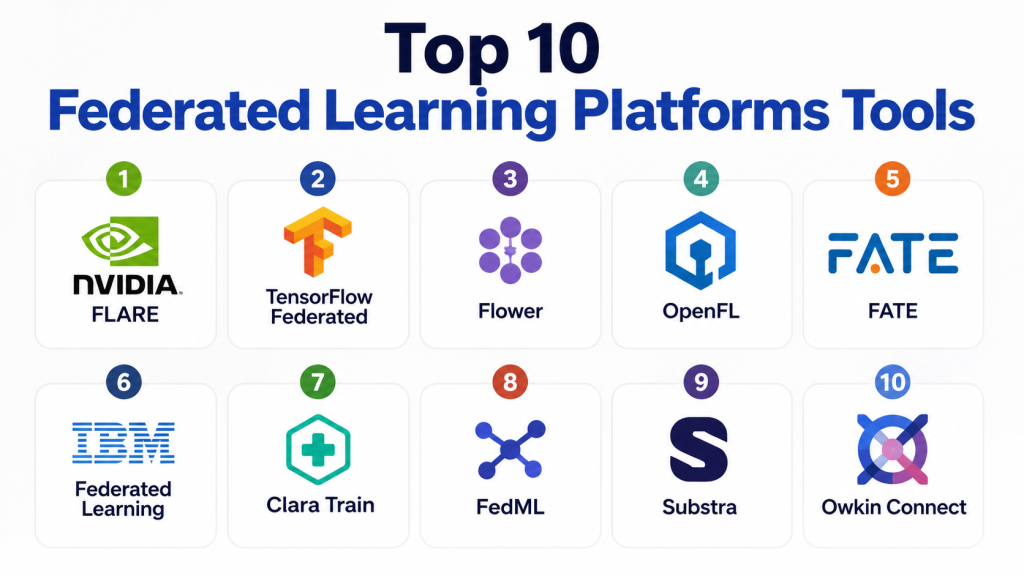
Top 10 Federated Learning Platforms
1- NVIDIA FLARE
Short description: NVIDIA FLARE is an enterprise-grade federated learning framework designed for healthcare, research, and large-scale AI collaboration projects. It focuses on secure distributed AI development.
Key Features
- Federated model training orchestration
- Privacy-preserving workflows
- Multi-site collaboration
- Secure aggregation support
- Healthcare AI optimization
- Open architecture
- Advanced monitoring tools
Pros
- Strong healthcare adoption
- Enterprise-grade architecture
- Extensive NVIDIA ecosystem support
Cons
- Learning curve for beginners
- Infrastructure complexity
- Advanced deployment requirements
Platforms / Deployment
- Linux
- Cloud / Self-hosted / Hybrid
Security & Compliance
- Encryption support
- Role-based access controls
- Audit capabilities
- Additional compliance controls vary by deployment
Integrations & Ecosystem
NVIDIA FLARE integrates well with NVIDIA AI infrastructure and common machine learning frameworks.
- PyTorch
- TensorFlow
- Kubernetes
- NVIDIA AI Enterprise
- MLFlow
Support & Community
Strong enterprise documentation, active development, and growing adoption in healthcare and research communities.
2- TensorFlow Federated
Short description: TensorFlow Federated is Google’s open-source framework for machine learning and federated learning research built on the TensorFlow ecosystem.
Key Features
- Federated training simulation
- Custom algorithm development
- TensorFlow integration
- Research-focused architecture
- Distributed model aggregation
- Privacy experimentation
- Extensible framework
Pros
- Strong research ecosystem
- Open-source flexibility
- Large developer community
Cons
- Limited enterprise tooling
- Research-oriented design
- Requires technical expertise
Platforms / Deployment
- Linux
- Windows
- macOS
- Self-hosted
Security & Compliance
Not publicly stated. Security depends on implementation architecture.
Integrations & Ecosystem
Strong integration with Google’s machine learning ecosystem.
- TensorFlow
- Keras
- Python
- Jupyter
- ML research tools
Support & Community
Excellent documentation and extensive academic community support.
3- Flower
Short description: Flower is a popular open-source federated learning framework that supports multiple machine learning frameworks and simplifies federated AI deployment.
Key Features
- Framework-agnostic architecture
- Cross-device learning
- Cross-silo learning
- Flexible orchestration
- Production deployment support
- Simulation environment
- Scalable architecture
Pros
- Easy to adopt
- Supports multiple frameworks
- Strong open-source community
Cons
- Limited enterprise features
- Some advanced capabilities require customization
- Support depends on community engagement
Platforms / Deployment
- Linux
- Windows
- macOS
- Cloud / Self-hosted
Security & Compliance
Encryption support available through deployment architecture. Additional compliance controls vary.
Integrations & Ecosystem
Flower supports a broad machine learning ecosystem.
- TensorFlow
- PyTorch
- JAX
- NumPy
- Kubernetes
Support & Community
Rapidly growing developer community with strong documentation.
4- OpenFL
Short description: OpenFL is an open-source federated learning framework originally developed to facilitate secure AI collaboration across organizations.
Key Features
- Secure model federation
- Flexible architecture
- Distributed collaboration
- Privacy-preserving workflows
- Enterprise scalability
- Research support
- Open governance
Pros
- Open-source transparency
- Enterprise-ready design
- Strong privacy focus
Cons
- Smaller community
- Limited commercial ecosystem
- Technical deployment process
Platforms / Deployment
- Linux
- Cloud / Self-hosted
Security & Compliance
Encryption support and secure collaboration controls. Additional certifications not publicly stated.
Integrations & Ecosystem
Supports major AI frameworks and enterprise environments.
- TensorFlow
- PyTorch
- Kubernetes
- Python
- Cloud infrastructure
Support & Community
Active open-source development with growing enterprise adoption.
5- FATE
Short description: FATE is one of the most widely adopted industrial federated learning frameworks designed for secure multi-party machine learning collaboration.
Key Features
- Federated machine learning algorithms
- Secure multiparty computation
- Data privacy protection
- Enterprise workflow management
- Distributed computing support
- Cross-organization collaboration
- Model lifecycle management
Pros
- Mature platform
- Rich algorithm library
- Strong privacy capabilities
Cons
- Complex deployment
- Significant infrastructure requirements
- Steeper learning curve
Platforms / Deployment
- Linux
- Cloud / Self-hosted
Security & Compliance
Encryption and privacy-preserving technologies included. Additional certifications not publicly stated.
Integrations & Ecosystem
Supports enterprise-scale machine learning deployments.
- Kubernetes
- Spark
- TensorFlow
- PyTorch
- Distributed computing systems
Support & Community
Large international community and active open-source development.
6- IBM Federated Learning
Short description: IBM Federated Learning is part of IBM’s enterprise AI portfolio, enabling privacy-preserving machine learning across distributed environments.
Key Features
- Enterprise federated learning
- Governance capabilities
- Model management
- Privacy controls
- Enterprise AI integration
- Monitoring tools
- Hybrid deployment options
Pros
- Enterprise support
- Strong governance capabilities
- Integration with IBM AI ecosystem
Cons
- Enterprise-focused pricing
- May be excessive for smaller projects
- IBM ecosystem dependency
Platforms / Deployment
- Cloud / Hybrid
Security & Compliance
Enterprise security controls, encryption, RBAC, and governance features available through IBM offerings.
Integrations & Ecosystem
Works closely with IBM’s AI and data management portfolio.
- IBM Watson
- Red Hat OpenShift
- Kubernetes
- Enterprise data platforms
Support & Community
Enterprise-grade support and professional services.
7- Clara Train
Short description: Clara Train is NVIDIA’s healthcare-focused federated learning solution designed for medical imaging and clinical AI collaboration.
Key Features
- Medical imaging optimization
- Federated healthcare AI
- Secure training workflows
- Clinical research collaboration
- Imaging model support
- Distributed AI management
- Privacy controls
Pros
- Healthcare specialization
- Medical imaging expertise
- Strong AI performance
Cons
- Healthcare-focused use case
- Limited applicability outside healthcare
- Specialized deployment requirements
Platforms / Deployment
- Linux
- Cloud / Hybrid
Security & Compliance
Healthcare-focused privacy controls. Additional compliance certifications vary by deployment.
Integrations & Ecosystem
Designed for healthcare AI ecosystems.
- NVIDIA AI stack
- Medical imaging systems
- Healthcare data platforms
Support & Community
Strong healthcare and research community support.
8- FedML
Short description: FedML provides a unified federated learning platform supporting research, enterprise deployments, and edge AI environments.
Key Features
- Federated AI lifecycle management
- Edge AI support
- Cross-device learning
- Model deployment tools
- Simulation capabilities
- Federated analytics
- Multi-cloud support
Pros
- Broad feature coverage
- Strong edge AI capabilities
- Active innovation
Cons
- Advanced configuration requirements
- Enterprise adoption still growing
- Learning curve for new users
Platforms / Deployment
- Cloud / Self-hosted / Hybrid
Security & Compliance
Encryption and privacy-preserving capabilities supported. Compliance certifications not publicly stated.
Integrations & Ecosystem
Supports modern AI infrastructure environments.
- TensorFlow
- PyTorch
- Kubernetes
- Edge computing platforms
Support & Community
Growing open-source and research community.
9- Substra
Short description: Substra is a federated learning software platform designed for secure collaborative AI development across organizations.
Key Features
- Federated orchestration
- Secure collaboration
- Workflow management
- Model traceability
- Governance controls
- Privacy-preserving analytics
- Auditability
Pros
- Strong governance features
- Collaboration-focused architecture
- Enterprise readiness
Cons
- Smaller ecosystem
- Limited market visibility
- Specialized deployment expertise needed
Platforms / Deployment
- Cloud / Self-hosted
Security & Compliance
Access controls, auditability, and encryption support available.
Integrations & Ecosystem
Built for enterprise collaboration and AI governance.
- Kubernetes
- Python
- Enterprise AI stacks
- Data governance tools
Support & Community
Growing enterprise and research user base.
10- Owkin Connect
Short description: Owkin Connect focuses on healthcare and life sciences federated learning, enabling collaborative medical research without sharing sensitive data.
Key Features
- Healthcare AI collaboration
- Federated analytics
- Secure medical research
- Multi-site participation
- Privacy-preserving workflows
- Clinical AI support
- Data sovereignty controls
Pros
- Healthcare expertise
- Research-focused capabilities
- Strong privacy model
Cons
- Specialized industry focus
- Limited general-purpose applicability
- Enterprise-scale deployments preferred
Platforms / Deployment
- Cloud / Hybrid
Security & Compliance
Healthcare-focused security controls. Additional certifications not publicly stated.
Integrations & Ecosystem
Designed for healthcare and biomedical research ecosystems.
- Research platforms
- Clinical systems
- AI frameworks
Support & Community
Strong support for healthcare research organizations.
Comparison Table
| Tool Name | Best For | Platform(s) Supported | Deployment | Standout Feature | Public Rating |
|---|---|---|---|---|---|
| NVIDIA FLARE | Healthcare AI | Linux | Hybrid | Enterprise healthcare federation | N/A |
| TensorFlow Federated | Research | Linux, Windows, macOS | Self-hosted | TensorFlow-native federation | N/A |
| Flower | Developers | Linux, Windows, macOS | Cloud/Self-hosted | Framework-agnostic support | N/A |
| OpenFL | Secure collaboration | Linux | Self-hosted | Open federated architecture | N/A |
| FATE | Enterprise privacy | Linux | Cloud/Self-hosted | Secure multiparty learning | N/A |
| IBM Federated Learning | Enterprises | Cloud | Hybrid | Enterprise governance | N/A |
| Clara Train | Medical imaging | Linux | Hybrid | Healthcare AI specialization | N/A |
| FedML | Edge AI | Multi-platform | Hybrid | Edge federated learning | N/A |
| Substra | Collaborative AI | Cloud/Linux | Self-hosted | Governance and traceability | N/A |
| Owkin Connect | Life sciences | Cloud | Hybrid | Medical research federation | N/A |
Evaluation & Scoring of Federated Learning Platforms
| Tool | Core | Ease | Integrations | Security | Performance | Support | Value | Weighted Total |
|---|---|---|---|---|---|---|---|---|
| NVIDIA FLARE | 9.5 | 7.5 | 8.5 | 9.0 | 9.0 | 8.5 | 7.5 | 8.62 |
| TensorFlow Federated | 8.5 | 7.0 | 8.5 | 7.5 | 8.5 | 8.5 | 9.0 | 8.28 |
| Flower | 8.5 | 8.5 | 8.5 | 7.5 | 8.0 | 8.5 | 9.0 | 8.45 |
| OpenFL | 8.0 | 7.0 | 7.5 | 8.5 | 8.0 | 7.5 | 8.5 | 7.93 |
| FATE | 9.0 | 6.5 | 8.0 | 9.0 | 8.5 | 8.0 | 8.0 | 8.28 |
| IBM Federated Learning | 9.0 | 8.0 | 8.5 | 9.0 | 9.0 | 9.0 | 7.0 | 8.48 |
| Clara Train | 8.5 | 7.5 | 8.0 | 8.5 | 8.5 | 8.0 | 7.5 | 8.10 |
| FedML | 8.5 | 8.0 | 8.5 | 8.0 | 8.5 | 8.0 | 8.5 | 8.33 |
| Substra | 8.0 | 7.5 | 7.5 | 8.5 | 8.0 | 7.5 | 8.0 | 7.88 |
| Owkin Connect | 8.5 | 7.5 | 7.5 | 8.5 | 8.5 | 8.0 | 7.5 | 8.03 |
Which Federated Learning Platform Is Right for You?
Solo / Freelancer
Flower and TensorFlow Federated are typically the most accessible options. They provide strong documentation, open-source flexibility, and lower barriers to experimentation.
SMB
FedML and Flower offer a balanced combination of usability, scalability, and deployment flexibility without requiring massive enterprise infrastructure.
Mid-Market
FATE, OpenFL, and NVIDIA FLARE provide stronger governance, privacy controls, and production-ready capabilities suitable for growing organizations.
Enterprise
IBM Federated Learning, NVIDIA FLARE, and FATE are strong choices for large-scale deployments requiring governance, security, and regulatory controls.
Budget vs Premium
Budget-conscious organizations often prefer Flower, TensorFlow Federated, and OpenFL. Premium enterprise deployments typically favor IBM Federated Learning and NVIDIA FLARE.
Feature Depth vs Ease of Use
TensorFlow Federated and FATE provide deep customization capabilities. Flower and FedML generally offer easier onboarding experiences.
Integrations & Scalability
Organizations with complex AI ecosystems should evaluate NVIDIA FLARE, IBM Federated Learning, and FedML due to their integration capabilities and scalability.
Security & Compliance Needs
Healthcare, financial services, and government organizations should prioritize platforms with strong privacy-preserving mechanisms such as NVIDIA FLARE, FATE, IBM Federated Learning, and Owkin Connect.
Frequently Asked Questions
1- What is federated learning?
Federated learning is a machine learning approach where models are trained across distributed datasets without moving raw data into a centralized repository. This helps preserve privacy and data sovereignty.
2- Why is federated learning becoming popular?
Organizations face increasing privacy regulations and security concerns. Federated learning allows collaboration while minimizing data-sharing risks.
3- Is federated learning only for large enterprises?
No. While enterprises are major adopters, researchers, startups, and healthcare organizations can also benefit from federated learning platforms.
4- How secure is federated learning?
Security depends on implementation. Many platforms include encryption, secure aggregation, access controls, and privacy-preserving techniques to reduce risk.
5- What industries use federated learning most?
Healthcare, financial services, telecommunications, government, life sciences, and manufacturing are among the leading adopters.
6- How difficult is implementation?
Implementation complexity varies significantly. Open-source frameworks may require substantial engineering expertise, while enterprise platforms provide more guided deployments.
7- Can federated learning support generative AI?
Yes. Modern federated learning research increasingly focuses on distributed training and fine-tuning of large AI and generative AI models.
8- What are common deployment models?
Organizations commonly use self-hosted, cloud-based, or hybrid deployments depending on security requirements and infrastructure strategies.
9- Can federated learning integrate with existing ML tools?
Most platforms support integration with frameworks such as TensorFlow, PyTorch, Kubernetes, and other machine learning infrastructure tools.
10- What alternatives exist to federated learning?
Alternatives include centralized machine learning, secure data enclaves, confidential computing environments, synthetic data generation, and secure multiparty computation solutions.
Conclusion
Federated learning platforms are becoming a foundational technology for organizations that need to balance AI innovation with privacy, security, and regulatory compliance. The market now includes a mix of enterprise-grade solutions such as NVIDIA FLARE, IBM Federated Learning, and FATE, alongside developer-focused and research-oriented frameworks like Flower, TensorFlow Federated, and OpenFL. Healthcare and life sciences organizations may find specialized platforms such as Clara Train and Owkin Connect particularly valuable, while organizations pursuing edge AI initiatives should consider FedML. Ultimately, the best platform depends on your data distribution model, compliance requirements, AI maturity, and operational capabilities. Rather than selecting a platform solely based on features, create a shortlist of two or three candidates, conduct a pilot project, validate security and integration requirements, and evaluate long-term scalability before making a final investment decision.

Find Trusted Cardiac Hospitals
Compare heart hospitals by city and services — all in one place.
Explore Hospitals
A practical challenge often overlooked in federated learning is handling data quality inconsistencies across distributed sources. Long-term success also depends on model monitoring, privacy governance, and efficient update strategies to maintain accuracy as environments evolve.