Introduction
Multi-party Computation (MPC) Toolkits are software frameworks that allow multiple organizations or participants to jointly compute results from their private data without revealing the underlying information to each other. Instead of sharing raw datasets, parties contribute encrypted or secret-shared data, enabling collaborative computation while preserving privacy. As data privacy regulations become stricter and organizations increasingly collaborate across industries, MPC has become a foundational privacy-enhancing technology. Financial institutions, healthcare providers, governments, AI developers, and blockchain companies are leveraging MPC to unlock data-driven insights without compromising confidentiality.
Real World Use Cases
- Privacy-preserving fraud detection across financial institutions
- Collaborative healthcare and pharmaceutical research
- Secure AI and machine learning training
- Cross-company business intelligence and analytics
- Digital asset custody and blockchain security
Evaluation Criteria for Buyers
When selecting an MPC toolkit, buyers should evaluate:
- Supported MPC protocols
- Security guarantees
- Performance and scalability
- Developer experience
- AI and machine learning support
- Integration ecosystem
- Deployment flexibility
- Community maturity
- Documentation quality
- Enterprise readiness
Best for
Organizations handling highly sensitive information, AI researchers, financial institutions, healthcare organizations, government agencies, cybersecurity teams, and blockchain infrastructure providers.
Not ideal for
Teams with simple analytics requirements, small projects with non-sensitive data, or organizations that can satisfy privacy requirements through conventional encryption and access controls.
Key Trends in Multi-party Computation MPC Toolkits
- Increased adoption for privacy-preserving AI
- Integration with federated learning platforms
- Growth of confidential computing architectures
- Expansion into blockchain and Web3 infrastructure
- Stronger cloud-native deployment models
- Better GPU acceleration support
- Improved developer tooling and APIs
- Enterprise governance and audit capabilities
- Hybrid privacy-enhancing technology stacks
- Increased regulatory compliance adoption
How We Selected These Tools
The tools in this list were evaluated based on:
- Industry adoption and recognition
- Protocol diversity
- Security architecture maturity
- Research and enterprise deployment success
- Performance optimization capabilities
- Documentation quality
- Developer accessibility
- Community support
- AI ecosystem compatibility
- Long-term development activity
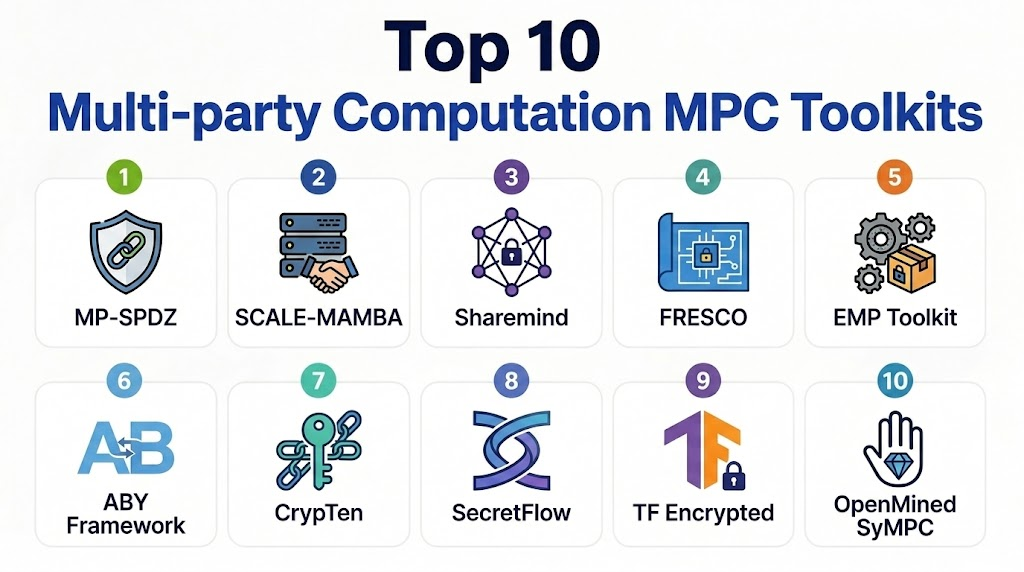
Top 10 Multi-party Computation MPC Toolkits
1- MP-SPDZ
Short description: MP-SPDZ is one of the most comprehensive open-source MPC frameworks available. It supports numerous cryptographic protocols and is widely used in research, privacy-preserving AI, and advanced secure computation projects.
Key Features
- Extensive MPC protocol library
- Active and passive security models
- Secure arithmetic and Boolean computation
- Machine learning compatibility
- High-performance execution engine
- Flexible deployment options
- Research-oriented architecture
Pros
- Supports many MPC protocols
- Highly flexible framework
- Strong academic adoption
Cons
- Steep learning curve
- Complex configuration
- Requires cryptography expertise
Platforms / Deployment
- Linux
- Self-hosted
Security & Compliance
- Advanced cryptographic security models
- Secret sharing support
- Additional certifications not publicly stated
Integrations & Ecosystem
Strong integration with research and machine learning environments.
- Python
- AI frameworks
- Research platforms
- Custom cryptographic libraries
Support & Community
Large academic community with extensive documentation and active research adoption.
2- SCALE-MAMBA
Short description: SCALE-MAMBA is a secure computation framework designed to simplify MPC development while maintaining strong privacy guarantees.
Key Features
- Secure multi-party protocols
- Secret-sharing infrastructure
- Distributed computation
- Smart contract-style programming
- Flexible execution environments
- Research-focused tooling
- Secure data processing
Pros
- Strong privacy protections
- Flexible development model
- Active academic use
Cons
- Smaller ecosystem
- Limited enterprise tooling
- Technical deployment process
Platforms / Deployment
- Linux
- Self-hosted
Security & Compliance
- Secure secret-sharing protocols
- Strong cryptographic foundations
- Compliance certifications not publicly stated
Integrations & Ecosystem
Supports research and custom application environments.
- Python
- Academic frameworks
- Cryptographic libraries
- Secure applications
Support & Community
Well-regarded in academic circles with good documentation.
3- Sharemind
Short description: Sharemind is a commercial MPC platform focused on secure analytics, privacy-preserving data collaboration, and enterprise-grade secure computation.
Key Features
- Secure analytics platform
- Enterprise-grade deployment
- Secret-sharing architecture
- Privacy-preserving collaboration
- Data governance capabilities
- Scalable infrastructure
- Secure computation workflows
Pros
- Enterprise-ready solution
- Mature deployment model
- Strong privacy protections
Cons
- Commercial licensing
- Less flexible than open-source frameworks
- Specialized expertise required
Platforms / Deployment
- Cloud
- Self-hosted
- Hybrid
Security & Compliance
- Encryption controls
- Access management capabilities
- Additional certifications not publicly stated
Integrations & Ecosystem
Designed for enterprise analytics and secure collaboration.
- Data warehouses
- Analytics platforms
- APIs
- Enterprise applications
Support & Community
Commercial support and onboarding services available.
4- FRESCO
Short description: FRESCO is a Java-based MPC framework that enables developers to build privacy-preserving applications using multiple secure computation protocols.
Key Features
- Java development environment
- Protocol abstraction layer
- Secure computation workflows
- Extensible architecture
- Multiple MPC protocols
- Open-source ecosystem
- Privacy-focused application development
Pros
- Flexible architecture
- Strong protocol support
- Open-source availability
Cons
- Java-centric ecosystem
- Requires development expertise
- Limited enterprise tooling
Platforms / Deployment
- Windows
- Linux
- macOS
- Self-hosted
Security & Compliance
- Secure computation protocols
- Strong cryptographic protections
- Additional certifications not publicly stated
Integrations & Ecosystem
Integrates with Java-based applications and research environments.
- Java frameworks
- Enterprise applications
- APIs
- Research tools
Support & Community
Active developer and research community.
5- EMP Toolkit
Short description: EMP Toolkit is a collection of libraries designed for efficient secure two-party and multi-party computation.
Key Features
- Efficient secure computation
- Two-party computation support
- Modular architecture
- Cryptographic primitives
- Performance optimization
- Open-source framework
- Developer-friendly libraries
Pros
- High performance
- Modular design
- Active research use
Cons
- Lower abstraction level
- Requires cryptography knowledge
- Limited enterprise features
Platforms / Deployment
- Linux
- Self-hosted
Security & Compliance
- Cryptographic protocol protections
- Secure computation primitives
- Additional certifications not publicly stated
Integrations & Ecosystem
Works well with research and experimental environments.
- C++
- Cryptographic libraries
- Research frameworks
- Custom applications
Support & Community
Strong research community and developer documentation.
6- ABY Framework
Short description: ABY is a framework for mixed-protocol secure two-party computation, enabling efficient privacy-preserving applications.
Key Features
- Mixed-protocol computation
- Secure arithmetic sharing
- Boolean sharing
- Yao sharing support
- Performance optimization
- Flexible architecture
- Open-source availability
Pros
- Efficient protocol switching
- Strong performance
- Research-proven architecture
Cons
- Technical implementation
- Limited enterprise tooling
- Smaller community
Platforms / Deployment
- Linux
- Self-hosted
Security & Compliance
- Cryptographic protections
- Secure protocol execution
- Additional certifications not publicly stated
Integrations & Ecosystem
- C++
- Research tools
- Cryptographic frameworks
- Custom applications
Support & Community
Good academic documentation and active research adoption.
7- CrypTen
Short description: CrypTen is a privacy-preserving machine learning framework focused on secure AI model development and inference.
Key Features
- Secure machine learning
- Deep learning support
- Privacy-preserving inference
- MPC-based computation
- PyTorch compatibility
- AI-focused architecture
- Distributed execution
Pros
- AI-focused design
- Familiar PyTorch workflow
- Strong privacy capabilities
Cons
- AI-specific focus
- Limited general-purpose MPC features
- Research-oriented deployment
Platforms / Deployment
- Linux
- Cloud
- Self-hosted
Security & Compliance
- MPC-based privacy protection
- Secure model execution
- Additional certifications not publicly stated
Integrations & Ecosystem
Strong integration with AI ecosystems.
- PyTorch
- Machine learning pipelines
- Python
- Research environments
Support & Community
Growing AI and privacy-preserving machine learning community.
8- SecretFlow
Short description: SecretFlow is an open-source privacy-preserving computing framework supporting MPC, federated learning, and secure analytics.
Key Features
- MPC support
- Federated learning integration
- Secure analytics
- Privacy-preserving AI
- Distributed computing
- Enterprise scalability
- Multi-party collaboration
Pros
- Broad privacy technology support
- Enterprise scalability
- Strong AI capabilities
Cons
- Complex deployment
- Advanced configuration requirements
- Learning curve for new users
Platforms / Deployment
- Cloud
- Self-hosted
- Hybrid
Security & Compliance
- Secure computation protocols
- Privacy-preserving technologies
- Additional certifications not publicly stated
Integrations & Ecosystem
Supports modern AI and analytics environments.
- TensorFlow
- PyTorch
- Kubernetes
- Data platforms
Support & Community
Rapidly growing open-source community.
9- TF Encrypted
Short description: TF Encrypted extends TensorFlow with privacy-preserving machine learning capabilities using secure computation techniques.
Key Features
- TensorFlow integration
- Secure machine learning
- Privacy-preserving training
- Secure inference
- Distributed computation
- Open-source architecture
- AI-focused workflows
Pros
- TensorFlow compatibility
- Familiar developer experience
- Strong AI integration
Cons
- TensorFlow dependency
- Research-focused tooling
- Limited enterprise features
Platforms / Deployment
- Linux
- Cloud
- Self-hosted
Security & Compliance
- Secure computation support
- Privacy-preserving AI workflows
- Additional certifications not publicly stated
Integrations & Ecosystem
Built around TensorFlow environments.
- TensorFlow
- Python
- AI pipelines
- Data science platforms
Support & Community
Strong academic and machine learning community support.
10- OpenMined SyMPC
Short description: SyMPC is an MPC framework from the OpenMined ecosystem designed to support secure computation and privacy-preserving AI applications.
Key Features
- MPC protocol support
- Secure computation workflows
- Privacy-preserving AI
- Open-source development
- Python ecosystem compatibility
- Distributed execution
- Research flexibility
Pros
- Open-source ecosystem
- AI-friendly architecture
- Active privacy community
Cons
- Emerging enterprise adoption
- Research-focused maturity
- Limited commercial support
Platforms / Deployment
- Linux
- Cloud
- Self-hosted
Security & Compliance
- MPC-based security protections
- Secret-sharing support
- Additional certifications not publicly stated
Integrations & Ecosystem
Part of the broader OpenMined privacy ecosystem.
- Python
- PyTorch
- OpenMined tools
- Research environments
Support & Community
Growing privacy-preserving AI community with active development.
Comparison Table
| Tool Name | Best For | Platform Supported | Deployment | Standout Feature | Public Rating |
|---|---|---|---|---|---|
| MP-SPDZ | Research | Linux | Self-hosted | Broad protocol support | N/A |
| SCALE-MAMBA | Secure computation research | Linux | Self-hosted | Flexible MPC programming | N/A |
| Sharemind | Enterprise analytics | Multi-platform | Hybrid | Commercial secure analytics | N/A |
| FRESCO | Java developers | Multi-platform | Self-hosted | Java MPC framework | N/A |
| EMP Toolkit | High-performance MPC | Linux | Self-hosted | Efficient cryptographic libraries | N/A |
| ABY Framework | Mixed-protocol MPC | Linux | Self-hosted | Protocol switching optimization | N/A |
| CrypTen | Privacy-preserving AI | Linux | Cloud/Self-hosted | Secure deep learning | N/A |
| SecretFlow | Enterprise privacy computing | Multi-platform | Hybrid | MPC plus federated learning | N/A |
| TF Encrypted | TensorFlow security | Linux | Cloud/Self-hosted | Secure TensorFlow workflows | N/A |
| OpenMined SyMPC | Open-source privacy AI | Linux | Cloud/Self-hosted | OpenMined ecosystem integration | N/A |
Evaluation & Scoring
| Tool | Core | Ease | Integrations | Security | Performance | Support | Value | Weighted Total |
|---|---|---|---|---|---|---|---|---|
| MP-SPDZ | 10 | 6 | 8 | 10 | 9 | 8 | 9 | 8.75 |
| SCALE-MAMBA | 8 | 6 | 7 | 9 | 8 | 7 | 8 | 7.60 |
| Sharemind | 9 | 8 | 8 | 9 | 9 | 9 | 7 | 8.45 |
| FRESCO | 8 | 7 | 7 | 8 | 8 | 7 | 8 | 7.65 |
| EMP Toolkit | 8 | 6 | 7 | 9 | 9 | 7 | 9 | 7.95 |
| ABY Framework | 8 | 6 | 7 | 9 | 9 | 7 | 8 | 7.80 |
| CrypTen | 9 | 8 | 8 | 8 | 8 | 8 | 8 | 8.20 |
| SecretFlow | 9 | 8 | 9 | 9 | 8 | 8 | 8 | 8.50 |
| TF Encrypted | 8 | 8 | 8 | 8 | 8 | 8 | 8 | 8.00 |
| OpenMined SyMPC | 8 | 7 | 8 | 8 | 8 | 8 | 9 | 8.00 |
Which Multi-party Computation Toolkit Is Right for You?
Solo / Freelancer
CrypTen, TF Encrypted, and OpenMined SyMPC provide accessible environments for developers interested in privacy-preserving AI.
SMB
SecretFlow and Sharemind offer a balance of privacy, scalability, and deployment flexibility.
Mid-Market
MP-SPDZ and SecretFlow provide strong capabilities for organizations needing advanced privacy-preserving analytics.
Enterprise
Sharemind and SecretFlow are often the strongest choices for large-scale privacy-preserving collaboration projects.
Budget vs Premium
Open-source frameworks such as MP-SPDZ, CrypTen, and FRESCO are ideal for budget-conscious teams. Sharemind targets organizations seeking commercial support.
Feature Depth vs Ease of Use
MP-SPDZ offers unmatched protocol flexibility, while CrypTen and SecretFlow provide more approachable developer experiences.
Integrations & Scalability
SecretFlow and Sharemind stand out for enterprise-scale deployments and ecosystem integration.
Security & Compliance Needs
Financial institutions, healthcare organizations, and governments should prioritize solutions with strong cryptographic guarantees and mature governance controls.
Frequently Asked Questions
1- What is Multi-party Computation?
MPC is a cryptographic technique that allows multiple parties to compute results together without revealing their private inputs.
2- Why is MPC important?
MPC enables secure collaboration, allowing organizations to gain insights from shared computation without exposing sensitive data.
3- Is MPC suitable for AI applications?
Yes. Many organizations use MPC to train, evaluate, and deploy privacy-preserving machine learning models.
4- How secure is MPC?
When properly implemented, MPC provides strong cryptographic protections against unauthorized data disclosure.
5- Which industries benefit most from MPC?
Financial services, healthcare, government, cybersecurity, insurance, and blockchain sectors are major adopters.
6- Does MPC replace encryption?
No. MPC complements encryption by enabling computation on protected data rather than simply securing stored information.
7- Is MPC difficult to implement?
Implementation complexity varies significantly. Some frameworks are research-focused, while others provide enterprise-friendly tooling.
8- Can MPC scale to large datasets?
Modern MPC frameworks increasingly support distributed architectures and performance optimizations for larger workloads.
9- What is the relationship between MPC and federated learning?
Federated learning and MPC are often used together to provide stronger privacy guarantees during distributed machine learning.
10- What alternatives exist to MPC?
Alternatives include federated learning, confidential computing, differential privacy, secure enclaves, and homomorphic encryption.
Conclusion
Multi-party Computation has evolved from a specialized cryptographic research field into a practical technology for secure collaboration, privacy-preserving analytics, and confidential AI. Organizations can now choose from a wide range of toolkits, including research-focused frameworks such as MP-SPDZ and SCALE-MAMBA, enterprise-oriented platforms like Sharemind, and AI-centric solutions such as CrypTen, SecretFlow, and TF Encrypted. The right choice depends on security requirements, performance expectations, developer expertise, and deployment goals. Enterprises seeking production-grade privacy-preserving collaboration may prefer Sharemind or SecretFlow, while researchers and advanced developers often benefit from the flexibility of MP-SPDZ. Before making a final decision, shortlist two or three candidates, conduct a proof of concept, validate performance and integration requirements, and ensure the toolkit aligns with your long-term privacy and compliance strategy.

Find Trusted Cardiac Hospitals
Compare heart hospitals by city and services — all in one place.
Explore Hospitals
One important aspect that could be explored further is operational complexity and key rotation management in MPC deployments. As systems scale, organizations need strong monitoring, recovery procedures, and integration strategies to maintain both security and long-term maintainability.