Introduction
Cloud Policy as Code tools help organizations define, enforce, and automate cloud governance policies using code rather than manual processes. Instead of relying on spreadsheets, checklists, or periodic audits, teams can codify security, compliance, cost management, and operational rules directly into their cloud infrastructure workflows. As organizations adopt multi-cloud architectures, Kubernetes environments, Infrastructure as Code, and AI-driven development practices, Policy as Code has become a critical component of cloud governance. These tools help prevent misconfigurations, enforce compliance standards, reduce security risks, and maintain operational consistency at scale.
Real-World Use Cases
- Enforcing security policies across AWS, Azure, and Google Cloud environments
- Validating Infrastructure as Code before deployment
- Preventing non-compliant Kubernetes configurations
- Automating regulatory compliance checks
- Enforcing cost optimization and resource governance standards
Evaluation Criteria for Buyers
When evaluating Cloud Policy as Code tools, consider:
- Policy language flexibility
- Multi-cloud support
- Kubernetes governance capabilities
- Infrastructure as Code integrations
- Compliance framework coverage
- Scalability and performance
- Automation capabilities
- Developer experience
- Reporting and auditability
- Ecosystem and community support
Best for: Cloud architects, DevOps engineers, platform teams, security engineers, compliance teams, and enterprises operating multi-cloud or Kubernetes environments.
Not ideal for: Small organizations with limited cloud infrastructure or teams managing only a few manually configured resources where governance complexity is minimal.
Key Trends in Cloud Policy as Code Tools
- AI-assisted policy creation and optimization is becoming increasingly common.
- Continuous compliance monitoring is replacing periodic audit-based governance.
- Kubernetes policy enforcement remains a primary adoption driver.
- Multi-cloud governance platforms are gaining preference over cloud-specific solutions.
- Shift-left security practices are integrating policy checks directly into CI/CD pipelines.
- Platform engineering teams are standardizing governance through reusable policy libraries.
- Policy testing and simulation capabilities are becoming more sophisticated.
- Open-source policy frameworks continue gaining enterprise adoption.
- Runtime policy enforcement is expanding beyond deployment-time validation.
- FinOps policies are increasingly integrated alongside security and compliance policies.
How We Selected These Tools (Methodology)
The tools in this list were evaluated based on:
- Market adoption and industry recognition
- Feature depth and policy management capabilities
- Multi-cloud support and flexibility
- Kubernetes and container governance features
- Integration ecosystem maturity
- Security and compliance capabilities
- Scalability in enterprise environments
- Community and documentation quality
- Automation and CI/CD integration support
- Suitability for organizations of varying sizes
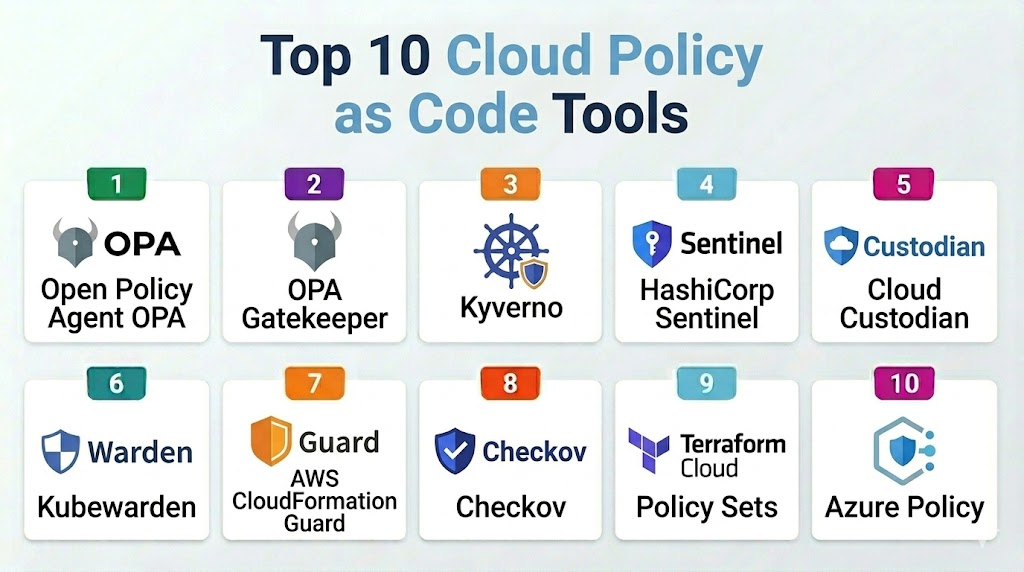
Top 10 Cloud Policy as Code Tools
1- Open Policy Agent (OPA)
Short Description: Open Policy Agent is one of the most widely adopted open-source Policy as Code frameworks. It enables organizations to create and enforce policies across cloud infrastructure, Kubernetes, APIs, and applications.
Key Features
- Rego policy language
- Kubernetes admission control
- Multi-cloud policy enforcement
- Fine-grained authorization policies
- CI/CD integrations
- Policy testing capabilities
- Extensive ecosystem support
Pros
- Highly flexible policy engine
- Strong open-source community
- Broad platform compatibility
Cons
- Learning curve for Rego language
- Initial setup complexity
- Requires governance expertise
Platforms / Deployment
Cloud / Self-hosted / Hybrid
Security & Compliance
- RBAC support
- Audit logging capabilities
- Encryption support varies by deployment
- Additional compliance certifications not publicly stated
Integrations & Ecosystem
OPA integrates with cloud platforms, Kubernetes environments, CI/CD systems, and security tools.
- Kubernetes
- Terraform
- GitHub Actions
- Jenkins
- Envoy
- Istio
Support & Community
Large open-source community with extensive documentation and enterprise adoption.
2- HashiCorp Sentinel
Short Description: Sentinel is HashiCorp’s policy framework designed to enforce governance across infrastructure managed through Terraform and related products.
Key Features
- Terraform integration
- Policy enforcement during deployment
- Governance workflows
- Fine-grained controls
- Multi-policy evaluation
- Policy versioning
- Enterprise governance support
Pros
- Deep Terraform integration
- Strong infrastructure governance
- Enterprise-focused capabilities
Cons
- Primarily optimized for HashiCorp ecosystem
- Commercial licensing requirements
- Limited outside HashiCorp workflows
Platforms / Deployment
Cloud / Hybrid
Security & Compliance
- RBAC
- Audit capabilities
- Enterprise access controls
- Additional certifications not publicly stated
Integrations & Ecosystem
Optimized for HashiCorp products and IaC workflows.
- Terraform
- HCP Terraform
- Vault
- Consul
- CI/CD platforms
Support & Community
Strong enterprise support and documentation.
3- Kyverno
Short Description: Kyverno is a Kubernetes-native policy engine that enables governance using familiar YAML syntax without requiring a separate policy language.
Key Features
- Kubernetes-native policies
- YAML-based policy definitions
- Policy validation
- Mutation capabilities
- Resource generation
- Reporting dashboards
- Admission control integration
Pros
- Easy for Kubernetes teams
- No custom language required
- Strong cloud-native adoption
Cons
- Kubernetes-focused
- Less suitable for broader governance
- Complex large-scale policy management
Platforms / Deployment
Cloud / Self-hosted
Security & Compliance
- RBAC support
- Audit reporting
- Kubernetes security enforcement
- Compliance certifications not publicly stated
Integrations & Ecosystem
Designed for Kubernetes environments and cloud-native platforms.
- Kubernetes
- Helm
- Argo CD
- Flux
- Prometheus
Support & Community
Rapidly growing Kubernetes-focused community.
4- Styra DAS
Short Description: Styra DAS provides enterprise policy management built on Open Policy Agent, offering centralized governance and policy lifecycle management.
Key Features
- Centralized policy management
- OPA integration
- Policy testing
- Compliance reporting
- Multi-cloud governance
- Policy distribution
- Enterprise dashboards
Pros
- Enterprise-ready governance
- Simplifies OPA management
- Strong compliance visibility
Cons
- Premium pricing
- OPA knowledge still beneficial
- Enterprise-oriented deployment
Platforms / Deployment
Cloud / Hybrid
Security & Compliance
- RBAC
- SSO/SAML support
- Audit logging
- Additional certifications vary by deployment
Integrations & Ecosystem
Extends OPA into enterprise governance workflows.
- Kubernetes
- Terraform
- AWS
- Azure
- Google Cloud
Support & Community
Strong enterprise support and professional services.
5- Checkov
Short Description: Checkov is a developer-focused Infrastructure as Code scanning platform that enables policy enforcement across cloud resources and configurations.
Key Features
- IaC scanning
- Compliance frameworks
- Security policy checks
- Custom policy creation
- CI/CD integrations
- Multi-cloud support
- Container scanning
Pros
- Developer-friendly
- Strong security coverage
- Open-source availability
Cons
- Primarily focused on scanning
- Limited runtime governance
- Policy complexity at scale
Platforms / Deployment
Cloud / Self-hosted
Security & Compliance
- Compliance framework mappings
- Security scanning controls
- Audit reporting
- Additional certifications not publicly stated
Integrations & Ecosystem
Widely integrated into DevSecOps workflows.
- Terraform
- CloudFormation
- Kubernetes
- GitHub
- GitLab
Support & Community
Strong open-source community and documentation.
6- Cloud Custodian
Short Description: Cloud Custodian enables governance, compliance, and cost optimization across public cloud environments through policy-driven automation.
Key Features
- Multi-cloud governance
- Resource management
- Compliance automation
- Cost control policies
- Event-driven actions
- Reporting capabilities
- Extensive cloud coverage
Pros
- Strong cloud governance
- Cost optimization support
- Mature automation framework
Cons
- Policy complexity
- Learning curve
- Operational overhead
Platforms / Deployment
Cloud / Self-hosted
Security & Compliance
- Governance controls
- Audit capabilities
- Policy-based enforcement
- Additional certifications not publicly stated
Integrations & Ecosystem
Supports major public cloud providers and automation workflows.
- AWS
- Azure
- Google Cloud
- Kubernetes
- Serverless environments
Support & Community
Well-established open-source community.
7- Terraform Cloud Policy Sets
Short Description: Terraform Cloud Policy Sets allow governance enforcement through centralized policy management across Terraform deployments.
Key Features
- Policy management
- Governance controls
- Terraform integration
- Compliance enforcement
- Centralized administration
- Policy versioning
- Automated evaluations
Pros
- Easy Terraform governance
- Centralized policy control
- Strong workflow integration
Cons
- Terraform-centric
- Limited outside Terraform ecosystem
- Enterprise features may require higher tiers
Platforms / Deployment
Cloud
Security & Compliance
- RBAC
- Audit capabilities
- Access controls
- Additional certifications not publicly stated
Integrations & Ecosystem
Focused on Terraform-driven infrastructure.
- Terraform
- GitHub
- GitLab
- Jenkins
Support & Community
Strong HashiCorp ecosystem support.
8- Conftest
Short Description: Conftest is an open-source tool that uses OPA policies to validate configuration files before deployment.
Key Features
- Configuration validation
- OPA integration
- CI/CD support
- Multi-format validation
- Policy testing
- Lightweight architecture
- Developer-focused workflows
Pros
- Simple deployment
- Flexible validation
- Open-source accessibility
Cons
- Limited governance features
- Requires OPA knowledge
- Less enterprise functionality
Platforms / Deployment
Cloud / Self-hosted
Security & Compliance
- Policy validation capabilities
- Security enforcement depends on policy design
- Additional compliance details not publicly stated
Integrations & Ecosystem
Works with infrastructure and deployment workflows.
- Kubernetes
- Terraform
- GitHub Actions
- Jenkins
Support & Community
Active open-source community.
9- Gatekeeper
Short Description: Gatekeeper extends Open Policy Agent to Kubernetes admission control, enforcing governance policies within Kubernetes clusters.
Key Features
- Admission control
- Policy enforcement
- Kubernetes governance
- Constraint templates
- Compliance reporting
- Audit functionality
- OPA integration
Pros
- Strong Kubernetes governance
- CNCF ecosystem support
- Mature policy enforcement
Cons
- Kubernetes-only focus
- OPA learning curve
- Cluster-specific deployment
Platforms / Deployment
Cloud / Self-hosted
Security & Compliance
- RBAC support
- Audit capabilities
- Kubernetes security controls
- Additional certifications not publicly stated
Integrations & Ecosystem
Deeply integrated into Kubernetes environments.
- Kubernetes
- OPA
- Prometheus
- GitOps platforms
Support & Community
Large cloud-native community and ecosystem backing.
10- Fugue
Short Description: Fugue focuses on cloud security posture management combined with Policy as Code governance for cloud environments.
Key Features
- Cloud governance
- Compliance monitoring
- Security posture management
- Policy automation
- Infrastructure visibility
- Drift detection
- Multi-cloud support
Pros
- Security-focused governance
- Continuous compliance monitoring
- Strong visibility capabilities
Cons
- Security-centric orientation
- Enterprise focus
- Complexity for smaller teams
Platforms / Deployment
Cloud
Security & Compliance
- Audit capabilities
- Compliance monitoring
- Access controls
- Additional certifications not publicly stated
Integrations & Ecosystem
Supports major cloud providers and security workflows.
- AWS
- Azure
- Google Cloud
- Infrastructure as Code platforms
Support & Community
Enterprise-focused support and documentation.
Comparison Table
| Tool Name | Best For | Platform(s) Supported | Deployment | Standout Feature | Public Rating |
|---|---|---|---|---|---|
| Open Policy Agent | Enterprise governance | Multi-platform | Hybrid | Universal policy engine | N/A |
| Sentinel | Terraform users | Terraform ecosystem | Hybrid | Terraform-native governance | N/A |
| Kyverno | Kubernetes teams | Kubernetes | Self-hosted | YAML-based policies | N/A |
| Styra DAS | Large enterprises | Multi-cloud | Hybrid | Enterprise OPA management | N/A |
| Checkov | DevSecOps teams | Multi-cloud | Cloud/Self-hosted | IaC security scanning | N/A |
| Cloud Custodian | Cloud governance | AWS Azure GCP | Self-hosted | Automated governance actions | N/A |
| Terraform Policy Sets | Terraform organizations | Terraform | Cloud | Centralized policy control | N/A |
| Conftest | Developers | Multi-platform | Self-hosted | Configuration validation | N/A |
| Gatekeeper | Kubernetes governance | Kubernetes | Self-hosted | Admission control policies | N/A |
| Fugue | Security teams | Multi-cloud | Cloud | Continuous compliance | N/A |
Evaluation & Scoring of Cloud Policy as Code Tools
| Tool | Core | Ease | Integrations | Security | Performance | Support | Value | Weighted Total |
|---|---|---|---|---|---|---|---|---|
| Open Policy Agent | 10 | 7 | 10 | 9 | 9 | 9 | 9 | 9.1 |
| Styra DAS | 9 | 8 | 9 | 9 | 9 | 9 | 7 | 8.7 |
| Kyverno | 9 | 9 | 8 | 8 | 8 | 8 | 9 | 8.6 |
| Cloud Custodian | 9 | 7 | 8 | 9 | 8 | 8 | 9 | 8.4 |
| Sentinel | 8 | 8 | 8 | 9 | 8 | 8 | 7 | 8.0 |
| Checkov | 8 | 9 | 8 | 8 | 8 | 8 | 9 | 8.4 |
| Gatekeeper | 8 | 7 | 8 | 9 | 8 | 8 | 8 | 8.0 |
| Fugue | 8 | 8 | 8 | 9 | 8 | 8 | 7 | 8.0 |
| Terraform Policy Sets | 8 | 8 | 7 | 8 | 8 | 8 | 8 | 7.9 |
| Conftest | 7 | 8 | 7 | 7 | 8 | 7 | 9 | 7.7 |
Which Cloud Policy as Code Tool Is Right for You?
Solo / Freelancer
Conftest and Checkov offer simple adoption paths with minimal overhead. They are suitable for developers managing smaller infrastructure environments.
SMB
Checkov, Kyverno, and Cloud Custodian provide strong governance capabilities without requiring large governance teams.
Mid-Market
OPA, Sentinel, and Terraform Policy Sets offer balanced governance, flexibility, and scalability.
Enterprise
Styra DAS, OPA, Fugue, and Cloud Custodian provide enterprise-grade governance, compliance, and multi-cloud support.
Budget vs Premium
- Budget: OPA, Kyverno, Conftest, Cloud Custodian
- Premium: Styra DAS, Fugue, Sentinel
Feature Depth vs Ease of Use
- Maximum flexibility: OPA
- Easier Kubernetes governance: Kyverno
- Simplified Terraform governance: Sentinel
Integrations & Scalability
Organizations with diverse infrastructure should prioritize OPA, Styra DAS, and Cloud Custodian due to broader ecosystem coverage.
Security & Compliance Needs
For highly regulated environments, consider Styra DAS, Fugue, OPA, and Cloud Custodian because of their governance and compliance-focused capabilities.
Frequently Asked Questions (FAQs)
1- What is Cloud Policy as Code?
Cloud Policy as Code is the practice of defining governance, security, and compliance rules in code so they can be automatically enforced across cloud environments.
2- Why is Policy as Code important?
It reduces manual errors, improves compliance consistency, and enables automated governance at cloud scale.
3- Is Open Policy Agent the industry standard?
OPA is widely considered one of the most adopted and flexible open-source policy engines available today.
4- Can Policy as Code improve cloud security?
Yes. It helps prevent misconfigurations, enforces security standards, and supports continuous compliance monitoring.
5- Which tool is best for Kubernetes?
Kyverno and Gatekeeper are among the most commonly adopted Kubernetes policy enforcement tools.
6- Which tool is best for Terraform users?
HashiCorp Sentinel and Terraform Cloud Policy Sets are specifically designed for Terraform governance workflows.
7- Are open-source tools sufficient for enterprises?
Many enterprises successfully use OPA, Kyverno, Gatekeeper, and Cloud Custodian, often supplemented with enterprise support or management platforms.
8- How difficult is Policy as Code adoption?
The complexity depends on governance requirements, existing infrastructure, and organizational maturity. Most teams start with security and compliance policies.
9- Can these tools support multiple cloud providers?
Many tools on this list support AWS, Azure, and Google Cloud either directly or through integrations.
10- Do Policy as Code tools replace CSPM platforms?
Not entirely. Many organizations use Policy as Code alongside Cloud Security Posture Management platforms for broader visibility and governance.
Conclusion
Cloud Policy as Code has become a foundational component of modern cloud governance. As organizations continue adopting multi-cloud architectures, Kubernetes platforms, platform engineering practices, and automated compliance programs, governance through code provides consistency, scalability, and operational efficiency that manual approaches cannot match. For organizations seeking maximum flexibility and ecosystem support, Open Policy Agent remains one of the strongest options available. Kubernetes-centric teams should evaluate Kyverno and Gatekeeper, while Terraform-heavy organizations may benefit from Sentinel or Terraform Policy Sets. Enterprises requiring centralized governance and compliance visibility should consider Styra DAS or Fugue. The best solution depends on your cloud architecture, compliance requirements, operational maturity, and budget. Start by shortlisting two or three tools, testing policy workflows in a pilot environment, and validating integration, security, and compliance requirements before wider deployment.

Find Trusted Cardiac Hospitals
Compare heart hospitals by city and services — all in one place.
Explore Hospitals
Cloud Policy as Code becomes especially powerful when security and platform teams collaborate on reusable policy libraries instead of creating isolated rules for each project. A consistent approach helps reduce exceptions, simplifies audits, and makes cloud governance easier to manage as environments expand.