Introduction
Infrastructure as Code (IaC) tools allow organizations to define, provision, configure, and manage infrastructure using code instead of manual processes. Rather than creating servers, networks, databases, and cloud services through web consoles, teams can automate deployments using version-controlled configuration files. As cloud adoption, Kubernetes deployments, multi-cloud strategies, and platform engineering practices continue to expand, IaC has become a foundational component of modern DevOps. Organizations increasingly require repeatable deployments, security controls, compliance automation, disaster recovery, and scalable infrastructure management.
Real-World Use Cases
- Cloud infrastructure provisioning across AWS, Azure, and Google Cloud.
- Kubernetes cluster deployment and management.
- Multi-environment consistency for development, testing, and production.
- Disaster recovery automation and infrastructure replication.
- Compliance-driven infrastructure governance through policy enforcement.
What Buyers Should Evaluate
- Multi-cloud support
- Kubernetes integration
- State management capabilities
- Collaboration and governance features
- Security and compliance controls
- Scalability for large environments
- CI/CD integration support
- Learning curve and usability
- Ecosystem maturity
- Community and vendor support
Best for: DevOps engineers, cloud architects, platform engineering teams, SRE teams, enterprises managing cloud infrastructure, and organizations adopting GitOps and automation practices.
Not ideal for: Small organizations with minimal cloud infrastructure, teams lacking automation expertise, or environments where manual provisioning remains sufficient.
Key Trends in Infrastructure as Code IaC Tools
- AI-assisted infrastructure generation and validation.
- GitOps becoming the default deployment methodology.
- Increased focus on policy-as-code and governance.
- Kubernetes-native infrastructure automation.
- Multi-cloud and hybrid-cloud management growth.
- Security scanning integrated directly into IaC workflows.
- Platform engineering adoption driving standardization.
- Drift detection and automated remediation becoming common.
- Developer self-service infrastructure platforms gaining traction.
- Greater emphasis on compliance automation and auditability.
How We Selected These Tools
The tools in this list were evaluated based on:
- Market adoption and industry recognition.
- Feature completeness and maturity.
- Multi-cloud and Kubernetes capabilities.
- Security and governance functionality.
- Reliability and scalability in production environments.
- Integration ecosystem strength.
- Community support and documentation quality.
- Enterprise readiness.
- Innovation in automation and platform engineering.
- Suitability across organizations of different sizes.
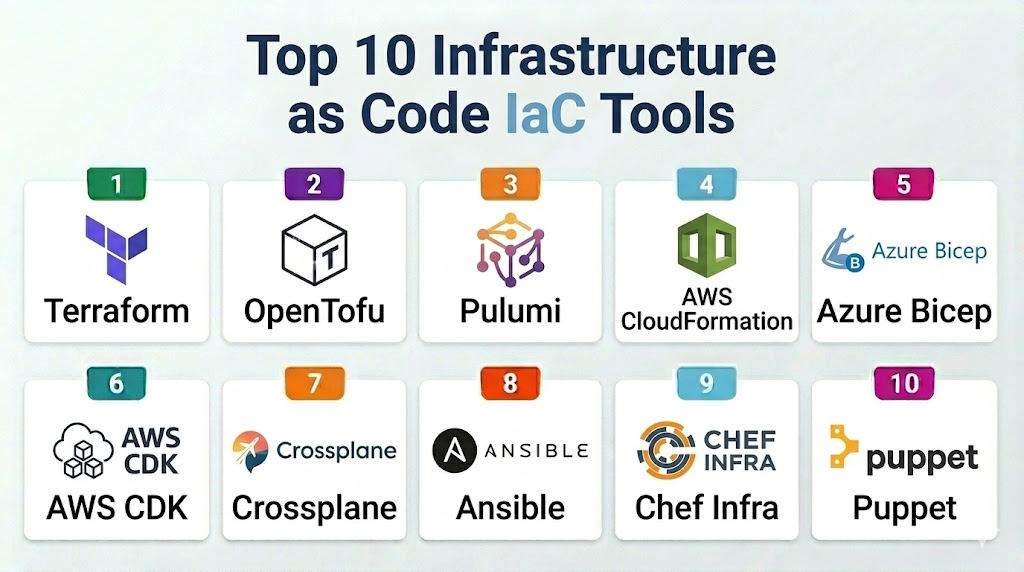
Top 10 Infrastructure as Code IaC Tools
1- Terraform
Short Description: Terraform is one of the most widely adopted IaC platforms. It enables infrastructure provisioning across hundreds of cloud providers and services through a consistent declarative language.
Key Features
- Multi-cloud provisioning
- Terraform modules
- State management
- Large provider ecosystem
- Infrastructure dependency graph
- Drift detection
- Policy integration
Pros
- Extensive cloud support
- Strong community ecosystem
- Mature enterprise adoption
Cons
- State management complexity
- Learning curve for large deployments
- Enterprise features require paid offerings
Platforms / Deployment
Cloud / Self-hosted / Hybrid
Security & Compliance
RBAC, audit logging, encryption support. Additional enterprise controls available through commercial offerings.
Integrations & Ecosystem
Terraform integrates with virtually every major cloud and DevOps platform.
- AWS
- Azure
- Google Cloud
- Kubernetes
- GitHub
- GitLab
Support & Community
Excellent documentation, large open-source community, strong enterprise support options.
2- OpenTofu
Short Description: OpenTofu is an open-source Terraform-compatible IaC platform created to provide community-driven infrastructure automation while maintaining compatibility with Terraform workflows.
Key Features
- Terraform compatibility
- Open governance model
- State management
- Multi-cloud support
- Provider ecosystem compatibility
- Community-driven roadmap
- Open-source licensing
Pros
- Vendor-neutral approach
- Familiar Terraform workflow
- Growing adoption
Cons
- Smaller ecosystem than Terraform
- Newer project maturity
- Enterprise tooling still evolving
Platforms / Deployment
Cloud / Self-hosted
Security & Compliance
Encryption support, role-based access capabilities through surrounding platforms.
Integrations & Ecosystem
Compatible with many Terraform providers and workflows.
- AWS
- Azure
- Google Cloud
- Kubernetes
- GitHub Actions
Support & Community
Rapidly growing open-source community and active contributor ecosystem.
3- Pulumi
Short Description: Pulumi allows developers to define infrastructure using general-purpose programming languages instead of domain-specific configuration languages.
Key Features
- Infrastructure using code languages
- Multi-cloud support
- Kubernetes management
- State management
- Policy controls
- Automation API
- Reusable components
Pros
- Developer-friendly
- Strong language support
- Excellent Kubernetes integration
Cons
- Smaller ecosystem than Terraform
- Requires programming knowledge
- Higher complexity for some teams
Platforms / Deployment
Cloud / Self-hosted
Security & Compliance
RBAC, policy controls, audit capabilities, encryption support.
Integrations & Ecosystem
Works with modern developer platforms and cloud services.
- AWS
- Azure
- Google Cloud
- Kubernetes
- GitHub
- GitLab
Support & Community
Strong documentation and growing enterprise adoption.
4- AWS CloudFormation
Short Description: CloudFormation is Amazon’s native IaC service designed for provisioning and managing AWS infrastructure resources.
Key Features
- Native AWS integration
- Stack management
- Change sets
- Drift detection
- Rollback capabilities
- Resource dependency handling
- AWS service coverage
Pros
- Deep AWS integration
- No third-party dependency
- Strong reliability
Cons
- AWS-only focus
- Complex templates
- Less flexible than multi-cloud tools
Platforms / Deployment
Cloud
Security & Compliance
Supports IAM integration, audit logging, encryption, and AWS security services.
Integrations & Ecosystem
Tightly integrated with AWS services.
- EC2
- VPC
- Lambda
- EKS
- IAM
Support & Community
Comprehensive AWS documentation and enterprise support.
5- Azure Bicep
Short Description: Azure Bicep simplifies Azure infrastructure deployment through a more readable syntax than traditional ARM templates.
Key Features
- Azure-native IaC
- Simplified syntax
- Resource modules
- Azure integration
- Deployment automation
- Dependency management
- ARM compatibility
Pros
- Easy Azure adoption
- Cleaner syntax
- Strong Microsoft support
Cons
- Azure-specific
- Limited multi-cloud functionality
- Smaller community than Terraform
Platforms / Deployment
Cloud
Security & Compliance
Integrates with Azure RBAC, audit logging, and security controls.
Integrations & Ecosystem
Strong Azure ecosystem integration.
- Azure DevOps
- Azure Kubernetes Service
- Azure Policy
- GitHub
Support & Community
Excellent Microsoft documentation and enterprise support.
6- AWS CDK
Short Description: AWS Cloud Development Kit allows developers to define cloud infrastructure using familiar programming languages.
Key Features
- Programming language support
- AWS-native deployment
- Reusable constructs
- Infrastructure abstraction
- Testing support
- CI/CD integration
- Resource composition
Pros
- Developer-centric
- Strong AWS integration
- Reusable infrastructure patterns
Cons
- AWS-focused
- Requires programming skills
- Additional abstraction complexity
Platforms / Deployment
Cloud
Security & Compliance
Leverages AWS security framework and IAM controls.
Integrations & Ecosystem
Works closely with AWS development services.
- Lambda
- ECS
- EKS
- CodePipeline
- CloudFormation
Support & Community
Large AWS community and documentation ecosystem.
7- Crossplane
Short Description: Crossplane extends Kubernetes into a control plane for cloud infrastructure management and platform engineering.
Key Features
- Kubernetes-native control plane
- Multi-cloud support
- GitOps integration
- Infrastructure APIs
- Composition framework
- Self-service platforms
- Policy enforcement
Pros
- Ideal for platform engineering
- Kubernetes-native approach
- Strong GitOps alignment
Cons
- Steep learning curve
- Kubernetes expertise required
- Operational complexity
Platforms / Deployment
Self-hosted / Hybrid
Security & Compliance
RBAC, Kubernetes security controls, policy integrations.
Integrations & Ecosystem
Deep integration with Kubernetes ecosystems.
- Argo CD
- Flux
- AWS
- Azure
- Google Cloud
Support & Community
Strong CNCF ecosystem support and growing adoption.
8- Ansible
Short Description: Ansible is widely used for configuration management and infrastructure automation through agentless deployments.
Key Features
- Agentless automation
- Playbooks
- Configuration management
- Orchestration
- Inventory management
- Infrastructure provisioning
- Automation workflows
Pros
- Easy to learn
- Agentless architecture
- Large ecosystem
Cons
- Less declarative than Terraform
- Scaling complexity
- State management limitations
Platforms / Deployment
Cloud / Self-hosted / Hybrid
Security & Compliance
RBAC and audit capabilities available through enterprise offerings.
Integrations & Ecosystem
Extensive integrations across infrastructure platforms.
- AWS
- Azure
- VMware
- Kubernetes
- Linux
Support & Community
One of the largest automation communities in the industry.
9- Chef Infra
Short Description: Chef Infra provides infrastructure automation and configuration management for large-scale enterprise environments.
Key Features
- Configuration management
- Compliance automation
- Infrastructure testing
- Desired-state management
- Policy controls
- Enterprise scalability
- Automation workflows
Pros
- Mature platform
- Strong compliance capabilities
- Enterprise-ready
Cons
- Learning curve
- Complex deployments
- Smaller community than Terraform
Platforms / Deployment
Cloud / Self-hosted / Hybrid
Security & Compliance
Compliance automation, RBAC, auditing, and policy management capabilities.
Integrations & Ecosystem
Supports broad enterprise infrastructure ecosystems.
- AWS
- Azure
- VMware
- Kubernetes
Support & Community
Strong enterprise support and mature documentation.
10- Puppet
Short Description: Puppet helps organizations automate infrastructure configuration and enforce desired system states across large environments.
Key Features
- Desired-state management
- Configuration automation
- Compliance management
- Reporting
- Drift detection
- Policy enforcement
- Enterprise scalability
Pros
- Mature enterprise platform
- Strong governance features
- Proven scalability
Cons
- Steeper learning curve
- Legacy architecture perceptions
- More complex administration
Platforms / Deployment
Cloud / Self-hosted / Hybrid
Security & Compliance
RBAC, auditing, compliance reporting, and policy enforcement.
Integrations & Ecosystem
Supports enterprise infrastructure and cloud environments.
- AWS
- Azure
- VMware
- Kubernetes
Support & Community
Well-established enterprise user base and support ecosystem.
Comparison Table
| Tool Name | Best For | Platforms Supported | Deployment | Standout Feature | Public Rating |
|---|---|---|---|---|---|
| Terraform | Multi-cloud IaC | Linux, Windows, macOS | Hybrid | Massive provider ecosystem | N/A |
| OpenTofu | Open-source IaC | Linux, Windows, macOS | Self-hosted | Terraform compatibility | N/A |
| Pulumi | Developer-first IaC | Linux, Windows, macOS | Hybrid | Real programming languages | N/A |
| CloudFormation | AWS environments | AWS | Cloud | Native AWS integration | N/A |
| Azure Bicep | Azure deployments | Azure | Cloud | Simplified ARM syntax | N/A |
| AWS CDK | Developers on AWS | AWS | Cloud | Infrastructure in code languages | N/A |
| Crossplane | Platform engineering | Kubernetes | Self-hosted | Kubernetes control plane | N/A |
| Ansible | Automation and configuration | Linux, Windows | Hybrid | Agentless automation | N/A |
| Chef Infra | Enterprise compliance | Linux, Windows | Hybrid | Compliance automation | N/A |
| Puppet | Large enterprises | Linux, Windows | Hybrid | Desired-state management | N/A |
Evaluation & Scoring of Infrastructure as Code Tools
| Tool | Core | Ease | Integrations | Security | Performance | Support | Value | Weighted Total |
|---|---|---|---|---|---|---|---|---|
| Terraform | 10 | 8 | 10 | 9 | 9 | 10 | 9 | 9.35 |
| OpenTofu | 9 | 8 | 9 | 8 | 8 | 8 | 10 | 8.65 |
| Pulumi | 9 | 8 | 9 | 8 | 9 | 8 | 8 | 8.55 |
| CloudFormation | 8 | 7 | 7 | 9 | 9 | 9 | 9 | 8.20 |
| Azure Bicep | 8 | 9 | 7 | 9 | 8 | 8 | 9 | 8.30 |
| AWS CDK | 8 | 8 | 8 | 9 | 8 | 9 | 8 | 8.20 |
| Crossplane | 9 | 6 | 9 | 8 | 8 | 8 | 8 | 8.10 |
| Ansible | 8 | 9 | 9 | 7 | 8 | 9 | 9 | 8.45 |
| Chef Infra | 8 | 6 | 8 | 9 | 8 | 8 | 7 | 7.80 |
| Puppet | 8 | 6 | 8 | 9 | 8 | 8 | 7 | 7.80 |
Which Infrastructure as Code Tool Is Right for You?
Solo / Freelancer
Terraform and OpenTofu offer the best balance of flexibility, community support, and affordability. Ansible is also attractive for simple automation projects.
SMB
Terraform, Pulumi, and Ansible provide strong automation capabilities without excessive enterprise complexity. Azure-focused businesses may prefer Bicep.
Mid-Market
Terraform, Pulumi, AWS CDK, and Crossplane provide scalability while supporting growing cloud environments and DevOps teams.
Enterprise
Terraform, Crossplane, Puppet, Chef Infra, and CloudFormation offer governance, compliance, and large-scale deployment capabilities.
Budget vs Premium
OpenTofu and Ansible provide excellent value. Terraform offers the broadest ecosystem, while enterprise editions add governance and collaboration features.
Feature Depth vs Ease of Use
Pulumi and AWS CDK appeal to developers comfortable with programming languages. Terraform balances feature depth with broad usability.
Integrations & Scalability
Terraform remains the strongest choice for organizations requiring extensive integrations and multi-cloud scalability.
Security & Compliance Needs
Chef Infra, Puppet, Terraform Enterprise, and cloud-native offerings provide stronger governance and compliance controls for regulated environments.
Frequently Asked Questions
1- What is Infrastructure as Code?
Infrastructure as Code is the practice of managing infrastructure through machine-readable configuration files instead of manual processes. It improves consistency, automation, and scalability.
2- Why is IaC important for DevOps?
IaC enables repeatable deployments, version control, automation, and faster infrastructure delivery. It is a core component of modern DevOps workflows.
3- Is Terraform still the leading IaC tool?
Terraform remains one of the most widely adopted IaC platforms due to its extensive provider ecosystem and multi-cloud support.
4- What is the difference between Terraform and OpenTofu?
OpenTofu is a community-driven open-source project designed to maintain compatibility with Terraform workflows while operating under open governance.
5- Can IaC tools manage Kubernetes?
Yes. Tools such as Terraform, Pulumi, Crossplane, and Ansible support Kubernetes deployment and management workflows.
6- Are IaC tools suitable for small businesses?
Yes. Small organizations can benefit from reduced operational overhead, improved consistency, and faster deployments using IaC tools.
7- What is state management in IaC?
State management tracks the current infrastructure configuration and helps tools determine what changes are required during deployments.
8- How long does IaC implementation take?
Simple deployments can be implemented within days, while enterprise-wide infrastructure automation initiatives may require several months.
9- Are IaC tools secure?
When properly configured, IaC tools support secure infrastructure deployment through access controls, auditing, encryption, and policy enforcement.
10- Can I switch from one IaC tool to another?
Yes, but migration complexity depends on the size of the infrastructure, state management requirements, and integration dependencies.
Conclusion
Infrastructure as Code has become a foundational capability for modern cloud operations, DevOps, platform engineering, and digital transformation initiatives. The right tool depends heavily on your infrastructure strategy, cloud footprint, team skills, governance requirements, and long-term scalability goals. Terraform continues to lead for multi-cloud flexibility, OpenTofu provides a strong open-source alternative, Pulumi appeals to software developers, and cloud-native options like CloudFormation, Bicep, and AWS CDK deliver deep platform integration. Meanwhile, Crossplane is redefining platform engineering, while Ansible, Puppet, and Chef remain valuable for automation and configuration management. Rather than searching for a universal winner, organizations should identify their deployment model, security requirements, and integration needs. Start by shortlisting two or three tools, running a pilot project, validating governance and security capabilities, and then scaling adoption across production environments.

Find Trusted Cardiac Hospitals
Compare heart hospitals by city and services — all in one place.
Explore Hospitals
Infrastructure as Code delivers the greatest long-term value when teams focus on maintainability and reuse instead of simply automating provisioning. Well-structured modules and clear documentation often have a bigger impact on scalability than the choice of tool itself.