Introduction
Compliance automation platforms help organizations continuously manage regulatory requirements, security controls, audits, and risk evidence collection through software-driven workflows instead of manual spreadsheets and fragmented processes. These tools are now essential as enterprises face increasing pressure from SOC 2, ISO 27001, GDPR, HIPAA, and industry-specific mandates while operating across cloud-native, hybrid, and distributed environments. compliance is no longer a periodic audit activity it is a continuous, real-time operational function tightly integrated with DevOps, cloud infrastructure, and security operations. Compliance automation platforms reduce human error, accelerate audit readiness, and improve visibility into organizational risk posture.
Real-world use cases include:
- Automating SOC 2 and ISO 27001 audit evidence collection
- Continuous compliance monitoring across cloud infrastructure
- Vendor risk management and third-party assessments
- Policy lifecycle management and enforcement tracking
- Security control mapping across multi-cloud environments
What buyers should evaluate:
- Depth of compliance framework coverage
- Automation level of evidence collection
- Integration with cloud providers and security tools
- Real-time monitoring and alerting capabilities
- Audit workflow and collaboration features
- Policy management flexibility
- Scalability for multi-entity organizations
- Reporting and dashboard clarity
- API and extensibility options
- Security posture and access controls
Best for: Security, compliance, GRC, DevSecOps, and IT risk teams in mid-size to enterprise organizations that need continuous compliance automation across cloud and hybrid environments.
Not ideal for: Very small teams with minimal regulatory exposure or organizations without formal audit or governance requirements.
Key Trends in Compliance Automation Platforms
- Shift from periodic audits to continuous compliance monitoring models
- Deep integration with cloud-native infrastructure (AWS, Azure, GCP)
- AI-driven control mapping and automated evidence classification
- Expansion of real-time risk scoring and compliance posture dashboards
- Increased adoption of policy-as-code frameworks in DevSecOps pipelines
- Automated vendor risk management using external intelligence feeds
- Stronger alignment with cybersecurity frameworks like NIST and CIS benchmarks
- Increased regulatory complexity across global jurisdictions
- Embedded compliance reporting directly within security operations workflows
- Growth of API-first platforms enabling customizable compliance pipelines
How We Selected These Tools (Methodology)
- Evaluated market adoption across enterprise and mid-market segments
- Prioritized platforms with strong compliance framework coverage
- Assessed automation depth for evidence collection and reporting
- Considered integration ecosystems with cloud and security tools
- Reviewed scalability for multi-cloud and hybrid environments
- Focused on tools supporting continuous compliance models
- Analyzed security posture features like RBAC and audit logs
- Included both enterprise leaders and emerging innovators
- Ensured coverage across GRC, DevSecOps, and security compliance workflows
- Selected platforms with strong operational reliability signals
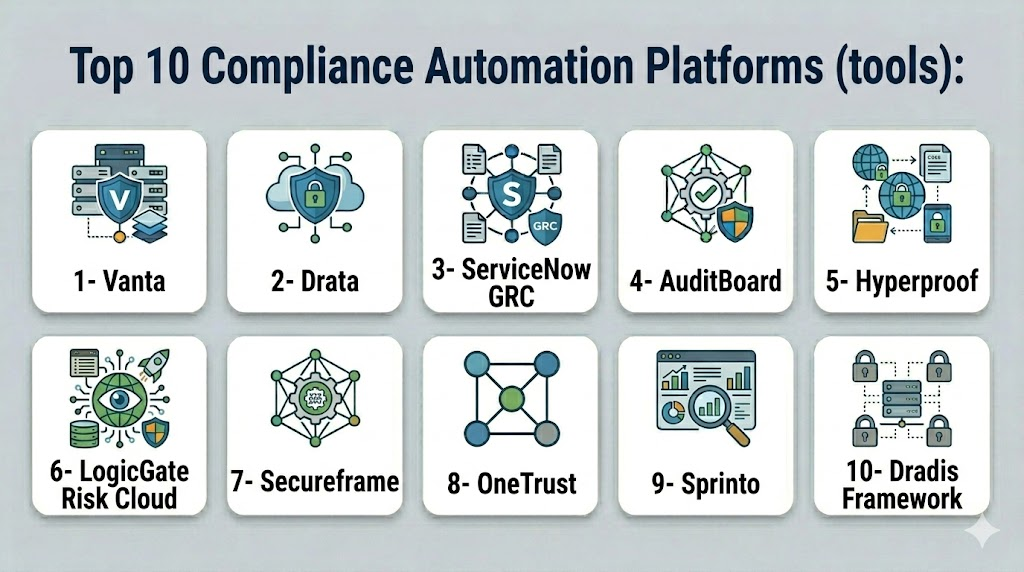
Top 10 Compliance Automation Platforms
1 — Vanta
Short description:
Vanta is a widely used compliance automation platform designed to help organizations achieve and maintain security certifications like SOC 2 and ISO 27001 with minimal manual effort. It is commonly used by startups and mid-market companies scaling security programs.
Key Features
- Automated evidence collection from cloud and SaaS systems
- Continuous security monitoring for compliance drift detection
- Pre-built compliance frameworks (SOC 2, ISO 27001, HIPAA-ready workflows)
- Vendor risk management tracking and questionnaires
- Policy templates and lifecycle management
- Employee security training tracking and enforcement
- Centralized compliance dashboard with audit readiness scoring
Pros
- Fast onboarding for early-stage compliance programs
- Strong automation reduces manual audit workload
- Excellent visibility into compliance posture
Cons
- Less customizable for complex enterprise GRC needs
- Limited advanced risk modeling capabilities
Platforms / Deployment
- Web / Cloud
Security & Compliance
- RBAC, MFA, encryption supported
- SOC 2: Not publicly stated
- ISO 27001: Not publicly stated
Integrations & Ecosystem
Integrates with cloud providers, HR systems, identity providers, and engineering tools.
- AWS, Azure, GCP
- Okta, Google Workspace
- GitHub, Jira, Slack
- Cloud monitoring tools via API
Support & Community
Strong onboarding support and documentation for compliance workflows. Community resources are growing but more vendor-driven than open ecosystem-led.
2 — Drata
Short description:
Drata is a compliance automation platform focused on continuous control monitoring and audit readiness for modern SaaS organizations. It emphasizes automation-first compliance workflows.
Key Features
- Continuous control monitoring across infrastructure and SaaS apps
- Automated evidence collection pipelines
- Risk and control mapping dashboards
- Policy management and approval workflows
- Vendor risk tracking automation
- Audit preparation and readiness reports
- Security control testing automation
Pros
- Strong automation for continuous compliance
- Good visibility into control health over time
- Scales well for fast-growing companies
Cons
- Requires configuration effort for complex environments
- Some advanced governance features are limited
Platforms / Deployment
- Web / Cloud
Security & Compliance
- MFA, RBAC, encryption supported
- SOC 2: Not publicly stated
- ISO 27001: Not publicly stated
Integrations & Ecosystem
Supports cloud infrastructure, SaaS applications, and security tools.
- AWS, Azure, GCP
- Okta, Azure AD
- GitHub, GitLab
- Slack, Jira
Support & Community
Strong customer onboarding and audit preparation assistance. Community engagement is moderate.
3 — ServiceNow GRC
Short description:
ServiceNow GRC is an enterprise-grade governance, risk, and compliance platform designed for large organizations with complex regulatory and operational risk requirements.
Key Features
- Enterprise risk and compliance workflow automation
- Policy and control lifecycle management
- Advanced audit management workflows
- Risk scoring and aggregation dashboards
- Regulatory change tracking
- Third-party risk management modules
- Integration with ITSM and security operations
Pros
- Extremely powerful enterprise-grade GRC capabilities
- Highly configurable workflows
- Strong integration with IT operations
Cons
- Complex implementation and setup
- High operational overhead for smaller teams
Platforms / Deployment
- Web / Cloud / Hybrid
Security & Compliance
- Strong RBAC, MFA, encryption, audit logging
- SOC 2: Not publicly stated
- ISO 27001: Not publicly stated
Integrations & Ecosystem
Deep integration within ServiceNow ecosystem and enterprise tools.
- ITSM modules
- Security Operations
- ERP systems
- Identity providers
Support & Community
Extensive enterprise support ecosystem and documentation. Large global user base.
4 — AuditBoard
Short description:
AuditBoard is a compliance and audit management platform widely used by enterprises for internal audit, risk management, and compliance workflows.
Key Features
- Audit lifecycle management workflows
- Risk assessment and control mapping
- Compliance documentation tracking
- SOX compliance support workflows
- Cross-functional audit collaboration tools
- Reporting and audit dashboards
- Evidence tracking automation
Pros
- Strong audit-focused capabilities
- Excellent enterprise governance workflows
- Scales well for large audit teams
Cons
- Less developer-centric automation
- Can be complex for non-enterprise users
Platforms / Deployment
- Web / Cloud
Security & Compliance
- RBAC, encryption, audit logs supported
- SOC 2: Not publicly stated
- ISO 27001: Not publicly stated
Integrations & Ecosystem
Integrates with enterprise IT and finance systems.
- ERP platforms
- Cloud providers
- Identity systems
- Collaboration tools
Support & Community
Strong enterprise onboarding and audit consulting support.
5 — Hyperproof
Short description:
Hyperproof is a compliance operations platform focused on continuous monitoring, evidence management, and audit readiness across multiple frameworks.
Key Features
- Continuous compliance tracking dashboards
- Automated evidence collection workflows
- Control mapping across frameworks
- Risk tracking and mitigation workflows
- Audit readiness reporting tools
- Policy lifecycle management
- Task automation and reminders
Pros
- Strong multi-framework support
- Good automation for compliance workflows
- Clear visibility into audit readiness
Cons
- UI complexity for new users
- Limited deep security analytics features
Platforms / Deployment
- Web / Cloud
Security & Compliance
- MFA, RBAC, encryption supported
- SOC 2: Not publicly stated
- ISO 27001: Not publicly stated
Integrations & Ecosystem
Supports integrations with cloud, SaaS, and security tools.
- AWS, Azure, GCP
- Okta
- Jira
- Slack
Support & Community
Solid onboarding and enterprise support channels.
6 — LogicGate Risk Cloud
Short description:
LogicGate Risk Cloud is a flexible GRC platform focused on configurable workflows for risk, compliance, and audit management.
Key Features
- No-code workflow builder for compliance processes
- Risk and control mapping engine
- Audit management workflows
- Vendor risk tracking
- Policy lifecycle automation
- Reporting dashboards
- Custom application building for GRC needs
Pros
- Highly flexible workflow customization
- Strong enterprise risk modeling capabilities
- Scalable for complex compliance programs
Cons
- Requires setup expertise
- Learning curve for non-technical users
Platforms / Deployment
- Web / Cloud
Security & Compliance
- RBAC, MFA, encryption supported
- SOC 2: Not publicly stated
- ISO 27001: Not publicly stated
Integrations & Ecosystem
Supports enterprise system integrations via APIs.
- Cloud platforms
- Identity systems
- ERP tools
- Security monitoring tools
Support & Community
Strong enterprise onboarding and consulting support.
7 — Secureframe
Short description:
Secureframe is a compliance automation platform designed to simplify SOC 2, ISO 27001, and other certification readiness through automation and guided workflows.
Key Features
- Automated evidence collection pipelines
- Compliance readiness dashboards
- Policy templates and enforcement tracking
- Continuous monitoring of cloud environments
- Vendor risk management tools
- Employee training tracking
- Audit preparation workflows
Pros
- Very fast compliance readiness setup
- Strong automation for startups and SMBs
- Easy-to-use interface
Cons
- Limited advanced GRC features
- Less suitable for complex enterprises
Platforms / Deployment
- Web / Cloud
Security & Compliance
- MFA, RBAC, encryption supported
- SOC 2: Not publicly stated
- ISO 27001: Not publicly stated
Integrations & Ecosystem
Integrates with cloud and SaaS tools.
- AWS, GCP, Azure
- GitHub
- Okta
- Slack
Support & Community
Strong onboarding support and compliance guidance.
8 — OneTrust Compliance Automation
Short description:
OneTrust provides enterprise-grade privacy, governance, and compliance automation capabilities across global regulatory frameworks.
Key Features
- Privacy and compliance management workflows
- Data governance and mapping tools
- Consent and policy management
- Vendor risk management
- Regulatory compliance tracking
- Audit reporting and documentation
- Workflow automation engine
Pros
- Strong global compliance coverage
- Extensive enterprise governance features
- Broad regulatory framework support
Cons
- Complex implementation
- High configuration overhead
Platforms / Deployment
- Web / Cloud
Security & Compliance
- RBAC, MFA, encryption supported
- SOC 2: Not publicly stated
- ISO 27001: Not publicly stated
Integrations & Ecosystem
Extensive enterprise integrations across governance stack.
- ERP systems
- Identity providers
- Cloud platforms
- Data governance tools
Support & Community
Large enterprise support ecosystem and documentation base.
9 — Sprinto
Short description:
Sprinto is a compliance automation platform focused on continuous monitoring and fast certification readiness for SaaS companies.
Key Features
- Continuous compliance monitoring
- Automated evidence collection workflows
- Control mapping and tracking dashboards
- Policy automation and approvals
- Vendor risk tracking
- Audit preparation workflows
- Real-time compliance alerts
Pros
- Fast implementation for startups
- Strong automation capabilities
- Good for scaling SaaS compliance programs
Cons
- Limited enterprise GRC depth
- Fewer customization options
Platforms / Deployment
- Web / Cloud
Security & Compliance
- MFA, RBAC, encryption supported
- SOC 2: Not publicly stated
- ISO 27001: Not publicly stated
Integrations & Ecosystem
Supports major cloud and SaaS tools.
- AWS, Azure, GCP
- GitHub
- Slack
- Okta
Support & Community
Strong onboarding and compliance advisory support.
10 — Dradis Framework (Open Source / Hybrid Use)
Short description:
Dradis is an open framework often used for security and compliance reporting, evidence tracking, and collaboration in penetration testing and audit workflows.
Key Features
- Centralized evidence and reporting repository
- Collaboration tools for security teams
- Plugin-based architecture
- Custom report generation
- Import/export of security findings
- Workflow customization
- Integration via extensions
Pros
- Highly flexible and customizable
- Open-source extensibility
- Good for security-driven compliance workflows
Cons
- Requires technical setup
- Not a full enterprise compliance suite
Platforms / Deployment
- Web / Self-hosted
Security & Compliance
- Depends on deployment configuration
- Not publicly stated certifications
Integrations & Ecosystem
Extensible via plugins and APIs.
- Security testing tools
- CI/CD systems
- Reporting frameworks
Support & Community
Strong open-source community support, documentation varies by implementation.
Comparison Table (Top 10)
| Tool Name | Best For | Platform(s) Supported | Deployment | Standout Feature | Public Rating |
|---|---|---|---|---|---|
| Vanta | Startup compliance | Web | Cloud | Automated SOC 2 readiness | N/A |
| Drata | Continuous compliance | Web | Cloud | Control monitoring automation | N/A |
| ServiceNow GRC | Enterprise governance | Web | Hybrid | Enterprise GRC workflows | N/A |
| AuditBoard | Audit teams | Web | Cloud | Audit lifecycle management | N/A |
| Hyperproof | Compliance ops | Web | Cloud | Multi-framework tracking | N/A |
| LogicGate | Risk management | Web | Cloud | No-code workflow builder | N/A |
| Secureframe | SMB compliance | Web | Cloud | Fast certification readiness | N/A |
| OneTrust | Global compliance | Web | Cloud | Privacy + governance suite | N/A |
| Sprinto | SaaS startups | Web | Cloud | Continuous monitoring automation | N/A |
| Dradis | Security teams | Web | Self-hosted | Evidence & reporting framework | N/A |
Evaluation & Scoring of Compliance Automation Platforms
| Tool Name | Core (25%) | Ease (15%) | Integrations (15%) | Security (10%) | Performance (10%) | Support (10%) | Value (15%) | Weighted Total |
|---|---|---|---|---|---|---|---|---|
| Vanta | 9 | 9 | 8 | 9 | 9 | 8 | 8 | 8.7 |
| Drata | 9 | 8 | 9 | 9 | 9 | 8 | 8 | 8.6 |
| ServiceNow GRC | 10 | 6 | 9 | 10 | 9 | 10 | 7 | 8.5 |
| AuditBoard | 9 | 7 | 8 | 9 | 8 | 9 | 7 | 8.2 |
| Hyperproof | 8 | 8 | 8 | 8 | 8 | 8 | 8 | 8.0 |
| LogicGate | 9 | 7 | 8 | 9 | 8 | 8 | 7 | 8.1 |
| Secureframe | 8 | 9 | 8 | 8 | 8 | 8 | 8 | 8.3 |
| OneTrust | 10 | 6 | 10 | 10 | 9 | 9 | 7 | 8.4 |
| Sprinto | 8 | 9 | 8 | 8 | 8 | 8 | 8 | 8.2 |
| Dradis | 7 | 7 | 7 | 7 | 7 | 7 | 8 | 7.2 |
Which Compliance Automation Tool Is Right for You?
Solo / Freelancer
- Lightweight platforms like Secureframe or Sprinto (if applicable)
- Focus on fast certification readiness and ease of use
SMB
- Vanta, Drata, Secureframe
- Prioritize automation and low operational overhead
Mid-Market
- Hyperproof, LogicGate, AuditBoard
- Focus on scalability and multi-framework compliance
Enterprise
- ServiceNow GRC, OneTrust, AuditBoard
- Prioritize governance, integration depth, and risk modeling
Budget vs Premium
- Budget: Secureframe, Sprinto, Vanta
- Premium: ServiceNow GRC, OneTrust, AuditBoard
Feature Depth vs Ease of Use
- Ease-focused: Secureframe, Vanta
- Feature-rich: ServiceNow GRC, LogicGate
Integrations & Scalability
- Strongest: ServiceNow, OneTrust, Drata
- Balanced: Vanta, Hyperproof, AuditBoard
Security & Compliance Needs
- Enterprise-grade governance: ServiceNow, OneTrust
- Startup compliance readiness: Vanta, Drata, Secureframe
Frequently Asked Questions
1. What are compliance automation platforms used for?
They automate evidence collection, control monitoring, and audit readiness for standards like SOC 2 and ISO 27001. They reduce manual compliance work significantly.
2. Are these tools only for large enterprises?
No. Many tools like Vanta and Secureframe are designed specifically for startups and SMBs needing fast certification readiness.
3. Do compliance platforms replace auditors?
No. They assist with audit preparation but do not replace external auditors required for certification.
4. How long does implementation take?
It varies from a few days (SMB tools) to several weeks or months (enterprise GRC systems).
5. What integrations are most important?
Cloud providers, identity systems, HR tools, and DevOps platforms are essential for automation.
6. Are these tools secure themselves?
Most offer encryption, RBAC, and MFA, but certifications vary and are not always publicly stated.
7. Can they handle multiple frameworks?
Yes, advanced platforms support multiple frameworks simultaneously like SOC 2, ISO 27001, and GDPR.
8. Do they support continuous compliance?
Yes, modern tools focus heavily on continuous monitoring rather than periodic audits.
9. What is the biggest mistake buyers make?
Choosing overly complex enterprise tools too early or underestimating integration requirements.
10. Can small teams benefit from these tools?
Yes, especially startups preparing for security certifications or enterprise contracts.
Conclusion
Compliance automation platforms have become essential infrastructure for modern organizations navigating complex regulatory environments. From startups preparing for SOC 2 audits to global enterprises managing multi-framework governance, these tools dramatically reduce manual effort and improve compliance reliability. The right platform depends heavily on organizational scale, regulatory complexity, and integration needs. SMBs often benefit from lightweight automation tools, while enterprises require deep governance and risk management capabilities. A practical next step is to shortlist 2–3 tools based on company size, run a pilot implementation, and validate integration depth with existing security and cloud systems before full adoption.

Find Trusted Cardiac Hospitals
Compare heart hospitals by city and services — all in one place.
Explore Hospitals
One practical gap in many compliance automation solutions is how they handle audit evidence collection in real time across distributed systems. If evidence is gathered only at checkpoints instead of continuously, it can create blind spots that become painful during surprise audits or incident investigations.