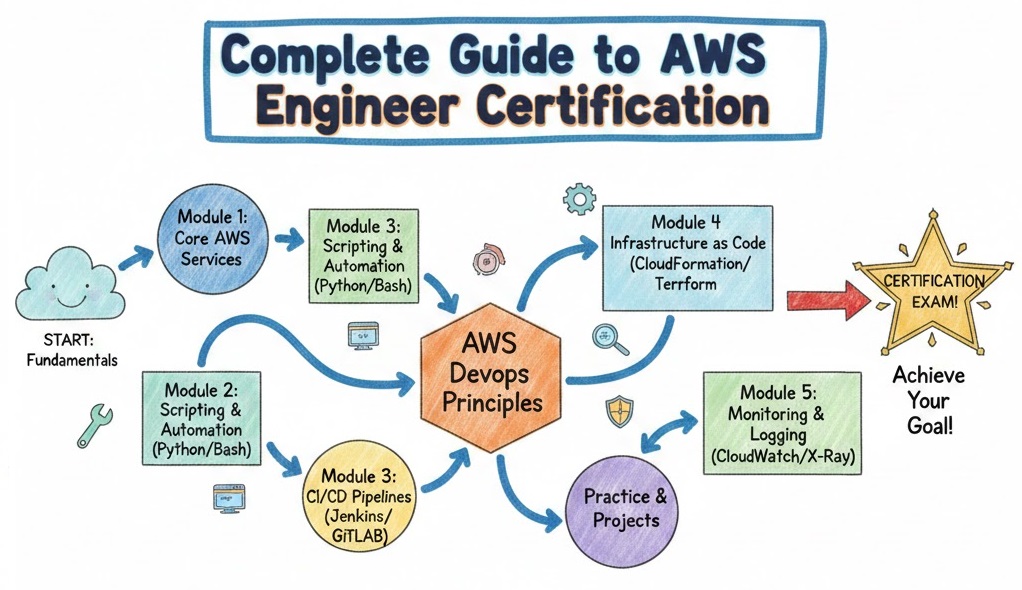
Introduction
The AWS DevOps Engineer – Professional certification is one of the highest levels of AWS certifications that specifically focuses on DevOps practices within the AWS ecosystem. In today’s fast-paced IT environment, organizations are increasingly adopting cloud infrastructure to improve automation, scalability, and reliability. This certification ensures that individuals have the required expertise to build and manage these cloud-based environments, integrating development and operations for seamless deployment and management of software systems.By becoming AWS Certified, professionals validate their ability to perform complex DevOps tasks in an AWS environment, making them highly valuable in organizations that use AWS for infrastructure management. In this guide, we will dive into everything you need to know about the AWS DevOps Engineer – Professional certification.
What is AWS DevOps Engineer – Professional?
The AWS Certified DevOps Engineer – Professional is designed for experienced individuals who have a background in DevOps principles and practices, particularly within the AWS environment. It validates a professional’s ability to deploy, manage, and operate scalable, highly available, and fault-tolerant systems on AWS.
The certification focuses on the operational skills required to automate deployment pipelines, integrate AWS services, and ensure the security and reliability of cloud-based applications. The exam tests your knowledge of automation, continuous delivery, monitoring, and infrastructure management with a strong emphasis on security and cost optimization.
Key Skills Covered:
- Automating the deployment process and using CI/CD tools.
- Building scalable systems with AWS.
- Managing infrastructure through infrastructure-as-code (IaC) principles.
- Monitoring and troubleshooting applications.
- Implementing security best practices.
Who Should Take It?
This certification is ideal for professionals who have a deep understanding of DevOps concepts and AWS tools. It is designed for those who already work with AWS and have experience in development, system administration, or operations. Here are the key roles that will benefit from this certification:
- DevOps Engineers looking to validate their AWS skills.
- Software Engineers with an interest in automating and scaling AWS applications.
- System Administrators wanting to transition into DevOps roles in the cloud.
- Cloud Engineers with a background in managing cloud environments.
- IT Managers looking to improve operational efficiency using AWS DevOps practices.
Skills You’ll Gain
By preparing for and passing the AWS Certified DevOps Engineer – Professional exam, you will gain a comprehensive understanding of the following skills:
- Automation: You’ll learn to automate the software deployment process and build continuous integration/continuous deployment (CI/CD) pipelines with AWS tools.
- Scalability: Understanding how to design scalable AWS infrastructures that can handle high traffic loads with minimal effort.
- Security: Implementing robust security measures in your DevOps pipelines, ensuring that your applications are secure from both internal and external threats.
- Infrastructure as Code (IaC): Using tools like AWS CloudFormation and Terraform to manage infrastructure, making the process faster, more reliable, and less prone to human error.
- Monitoring and Troubleshooting: Gaining the ability to monitor application performance using AWS CloudWatch, logging services, and CloudTrail for audit trails.
- Cost Management: Learning how to optimize cloud resources to save costs, making use of AWS’s cost management tools.
Real-World Projects You Should Be Able to Do After It
Upon completion of the certification, you will be able to contribute to and lead the following types of projects:
- Building CI/CD Pipelines: Automate testing, building, and deploying applications using AWS tools like AWS CodePipeline, CodeBuild, and CodeDeploy.
- Infrastructure Automation: Implement automated infrastructure management using AWS CloudFormation and other tools like Terraform, saving time and minimizing errors.
- Deployment Automation: Create robust, repeatable processes for deploying applications to different AWS environments (e.g., staging, production).
- Scalable Architectures: Design and implement scalable, highly available systems using AWS services like Auto Scaling, Elastic Load Balancing (ELB), and EC2.
- Security Implementation: Apply AWS security best practices, such as IAM policies, role-based access control, and encryption, to secure applications in the cloud.
Preparation Plan
7-14 Days (Beginner to Intermediate)
- Learn Core Concepts: Understand AWS core services such as EC2, S3, IAM, and CloudFormation. You should have hands-on experience with at least one AWS service.
- DevOps Fundamentals: Refresh your knowledge of DevOps principles, including continuous integration, continuous delivery, and automation.
- Practice Labs: Set up basic CI/CD pipelines using AWS CodePipeline and explore container services like Amazon ECS and EKS.
30 Days (Intermediate)
- Advanced AWS Services: Dive into more complex AWS services like Lambda, ECS, EKS, and CloudFormation.
- Security and Monitoring: Learn AWS security features, IAM roles, and policies. Gain experience in monitoring and troubleshooting with CloudWatch and CloudTrail.
- Hands-on Projects: Set up end-to-end deployment pipelines, monitor resource usage, and automate scaling on AWS.
60 Days (Advanced)
- Advanced Automation and Scaling: Deepen your knowledge of automating AWS deployments and scaling applications.
- Continuous Testing: Implement continuous testing within the pipeline and apply automated rollback strategies.
- Practice Exams: Take multiple practice exams to simulate the actual test environment and understand the exam format.
Common Mistakes
- Ignoring Hands-on Practice: Relying only on theory and not enough practice with AWS services can lead to failure in the exam.
- Overlooking AWS Whitepapers: AWS whitepapers provide a clear understanding of best practices that are necessary for the exam.
- Underestimating Security and Cost Optimization: Security is a key part of the DevOps Engineer role, and AWS provides various tools and best practices to enhance security and manage costs effectively.
- Skipping the Official AWS Exam Guide: Many fail to prepare by not reviewing the AWS official exam guide, which outlines important topics for the exam.
Best Next Certification After This
Once you have completed the AWS Certified DevOps Engineer – Professional certification, here are some recommended follow-up certifications to continue building your expertise:
- Same Track: AWS Certified Advanced Networking – Specialty
- Cross-Track: AWS Certified Security – Specialty
- Leadership Track: AWS Certified Solutions Architect – Professional
Choose Your Path
After completing the AWS Certified DevOps Engineer – Professional certification, you can specialize further in one of these six career paths:
1. DevOps
- Focus: Automating and streamlining development and operations.
- Skills: CI/CD, Infrastructure as Code (IaC), monitoring.
- Certifications: AWS Certified DevOps Engineer – Professional.
2. DevSecOps
- Focus: Integrating security into DevOps practices.
- Skills: Security automation, vulnerability scanning, secure cloud applications.
- Certifications: AWS Certified Security – Specialty.
3. SRE (Site Reliability Engineering)
- Focus: Ensuring reliability and scalability of systems.
- Skills: Distributed systems, SLOs, incident management.
- Certifications: Google Professional Cloud DevOps Engineer.
4. AIOps/MLOps
- Focus: Applying AI/ML in DevOps pipelines.
- Skills: Predictive scaling, anomaly detection, automation with AI/ML.
- Certifications: AWS Certified Machine Learning – Specialty.
5. DataOps
- Focus: Automating data pipelines and workflows.
- Skills: Data pipeline automation, data governance, and monitoring.
- Certifications: AWS Certified Big Data – Specialty.
6. FinOps
- Focus: Managing and optimizing cloud costs.
- Skills: Cloud cost management, billing optimization, cloud financial forecasting.
- Certifications: AWS Certified Cloud Financial Management.
Role → Recommended Certifications Mapping
For those interested in mapping their roles to appropriate certifications:
| Role | Recommended Certifications |
|---|---|
| DevOps Engineer | AWS DevOps Engineer – Professional, AWS Certified Solutions Architect |
| SRE | Google Professional Cloud DevOps Engineer, AWS DevOps Engineer |
| Platform Engineer | AWS Certified SysOps Administrator, AWS DevOps Engineer |
| Cloud Engineer | AWS Certified Solutions Architect – Associate, AWS DevOps Engineer |
| Security Engineer | AWS Certified Security – Specialty, AWS DevOps Engineer |
| Data Engineer | AWS Certified Big Data – Specialty, AWS DevOps Engineer |
| FinOps Practitioner | AWS Certified Cloud Financial Management, AWS DevOps Engineer |
| Engineering Manager | AWS Certified Solutions Architect – Professional, AWS DevOps Engineer |
Certification Comparison Table
| Certification | Track | Level | Who It’s For | Prerequisites | Skills Covered | Recommended Order |
|---|---|---|---|---|---|---|
| AWS DevOps Engineer – Professional | DevOps | Professional | DevOps Engineers, Cloud Engineers, IT Operations | 2+ years of hands-on AWS experience, Basic DevOps knowledge | Automating AWS environments, CI/CD, Infrastructure as Code (IaC), security, monitoring | AWS Certified Solutions Architect – Associate (Recommended) |
| AWS Certified Solutions Architect – Professional | Cloud Architecture | Professional | Cloud Architects, Technical Leads | AWS Certified Solutions Architect – Associate | Advanced cloud architecture, high-availability design, cost management, security | Start with AWS Certified Solutions Architect – Associate |
| Google Cloud Professional Cloud DevOps Engineer | Cloud DevOps | Professional | DevOps Engineers, Cloud Engineers | Experience with Google Cloud Platform (GCP) and DevOps tools | Automation, monitoring, CI/CD, Google Cloud services | AWS DevOps Engineer or similar certification |
| Microsoft Azure DevOps Engineer Expert | DevOps | Expert | DevOps Engineers, Azure Cloud Engineers | Microsoft Certified: Azure Administrator Associate | CI/CD, infrastructure management, Azure DevOps tools, security, governance | Microsoft Certified: Azure Developer Associate |
| Certified Kubernetes Administrator (CKA) | Kubernetes/Cloud | Associate | Kubernetes Administrators, Cloud Engineers | Experience with Kubernetes, cloud platforms | Managing and orchestrating Kubernetes clusters, scaling, monitoring, troubleshooting | DevOps/Cloud experience required |
| Certified Kubernetes Application Developer (CKAD) | Kubernetes/Cloud | Associate | Developers, Cloud Engineers, Kubernetes Specialists | Experience with Kubernetes and containerized applications | Application development using Kubernetes, deploying workloads, services, and storage | CKA recommended for a deeper understanding |
Institutions Offering Training for AWS DevOps Engineer – Professional
If you’re looking to get certified as an AWS DevOps Engineer – Professional, here are some of the top institutions that offer expert-led training with hands-on labs, real-world project experience, and exam preparation support:
- DevOpsSchool
DevOpsSchool is a leading platform for DevOps training, offering comprehensive courses in AWS DevOps Engineer – Professional. Their courses include live instructor-led sessions, real-world project simulations, and mock exams. They provide a structured learning path, ensuring that learners gain practical experience in setting up AWS environments, automating processes, and managing cloud infrastructure. - Cotocus
Cotocus specializes in AWS DevOps certifications and provides an instructor-led, practical learning experience. Their training includes hands-on projects with real AWS environments, covering key concepts like CI/CD pipelines, automation, and cloud security. Cotocus is known for its personalized mentorship and guidance, helping learners with career support and exam preparation. - Scmgalaxy
Scmgalaxy offers affordable yet effective AWS DevOps training. Their courses are ideal for those who want to learn through practical experience. Scmgalaxy focuses on core DevOps concepts such as automation, containerization, and continuous integration with AWS. Their training also includes lab sessions, assignments, and project work to ensure hands-on practice. - BestDevOps
BestDevOps provides real-world industry-oriented training, making it highly relevant for professionals looking to scale their careers. The AWS DevOps Engineer – Professional course here covers automation techniques, monitoring, deployment strategies, and cloud security. BestDevOps also provides a deep dive into AWS best practices and hands-on labs to develop expertise in building scalable and secure cloud infrastructures. - DevSecOpsSchool
Specializing in secure DevOps practices, DevSecOpsSchool offers courses that integrate security into the DevOps process. The training covers automated security testing, vulnerability management, and how to implement security controls within AWS DevOps workflows. Ideal for those who want to focus on both security and operational automation, DevSecOpsSchool provides learners with critical skills to protect AWS environments. - SRESchool
SRESchool is focused on Site Reliability Engineering (SRE), a discipline that combines software engineering and IT operations to ensure highly reliable systems. The AWS DevOps Engineer course here incorporates SRE principles, teaching learners how to build fault-tolerant, high-availability systems on AWS. It’s an excellent choice for professionals aiming to integrate reliability and scalability with DevOps. - AIOpsSchool
AIOpsSchool blends DevOps with artificial intelligence (AI) and machine learning (ML), helping learners understand how to implement AI-driven automation in cloud infrastructures. Their training provides a deeper understanding of how to leverage AI/ML for automating tasks like anomaly detection and predictive scaling in AWS environments. This is a cutting-edge course ideal for those looking to apply AI to DevOps workflows. - DataOpsSchool
DataOpsSchool focuses on the intersection of DevOps and data management. Their training in AWS DevOps for data workflows teaches learners how to automate data pipelines, ensure data reliability, and scale data operations efficiently on AWS. If you’re looking to specialize in data automation, this is the ideal training platform to help you build expertise in managing cloud-based data infrastructures. - FinOpsSchool
FinOpsSchool focuses on financial operations in the cloud. Their training program covers how to manage and optimize cloud costs within AWS environments while maintaining performance and scalability. This training is ideal for professionals who want to combine cloud financial management with their DevOps practices, helping organizations improve cost efficiency without compromising on quality.
FAQs
Q1: What is the AWS DevOps Engineer – Professional certification?
It’s a professional-level certification designed for individuals who manage and automate AWS cloud infrastructures using DevOps principles.
Q2: How long should I prepare for the exam?
Preparation time can vary, but most candidates spend about 2–3 months if they have a solid understanding of AWS services.
Q3: Is it necessary to have the AWS Solutions Architect certification first?
While not mandatory, it is highly beneficial to have the AWS Solutions Architect certification as a foundation.
Q4: What skills should I already have before attempting the exam?
Candidates should have experience with AWS services, DevOps practices, automation, and cloud infrastructure management.
Q5: How difficult is the exam?
The exam is challenging and requires hands-on experience and in-depth knowledge of AWS services and DevOps tools.
Q6: How much does the exam cost?
The exam costs $300 USD.
Q7: What is the passing score?
The passing score for the AWS Certified DevOps Engineer – Professional exam is 750 out of 1000.
Q8: What career roles can this certification help me achieve?
It can help you secure roles like DevOps Engineer, Cloud Engineer, SRE, Platform Engineer, and other cloud-related positions.
FAQs
Q1: What is the AWS DevOps Engineer – Professional certification?
It is a professional-level certification from AWS that validates a candidate’s ability to implement and manage continuous delivery systems and methodologies on AWS. It focuses on automating and securing cloud applications while ensuring scalability and high availability.
Q2: What are the prerequisites for the AWS DevOps Engineer – Professional certification?
AWS recommends at least two years of hands-on experience in deploying, operating, and managing AWS environments, as well as a strong understanding of DevOps concepts and practices.
Q3: How much does the AWS DevOps Engineer – Professional exam cost?
The exam costs $300 USD.
Q4: How long is the AWS DevOps Engineer – Professional exam?
The exam consists of 75 multiple-choice and multiple-response questions, and candidates have 180 minutes (3 hours) to complete it.
Q5: What is the passing score for the exam?
A5: The passing score for the AWS Certified DevOps Engineer – Professional exam is 750 out of 1000.
Q6: How difficult is the AWS DevOps Engineer – Professional exam?
The exam is considered challenging, as it tests a broad range of advanced DevOps skills and requires hands-on experience with AWS services. A deep understanding of continuous delivery, automation, security, and cloud infrastructure management is necessary.
Q7: Can I take the AWS DevOps Engineer exam online?
Yes, you can take the exam online through AWS’s testing partner, Pearson VUE. The exam is also available at testing centers worldwide.
Q8: How can I prepare for the AWS DevOps Engineer – Professional exam?
You can prepare by studying AWS whitepapers, taking official AWS training courses, practicing with hands-on labs, and reviewing the exam guide and sample questions provided by AWS.
Q9: How long will it take to prepare for the exam?
The preparation time can vary based on your experience. On average, it takes about 2-3 months of study, including hands-on practice with AWS services and DevOps concepts.
Q10: What are the core topics covered in the AWS DevOps Engineer exam?
Key topics include CI/CD pipelines, automation, infrastructure as code, monitoring and logging, security, high availability, and cost optimization using AWS services.
Q11: What career opportunities can I pursue after obtaining the AWS DevOps Engineer – Professional certification?
With this certification, you can pursue roles such as DevOps Engineer, Cloud Engineer, Site Reliability Engineer (SRE), Platform Engineer, and IT Operations Manager.
Q12: What is the validity of the AWS DevOps Engineer certification?
The AWS DevOps Engineer – Professional certification is valid for three years. After that, you will need to recertify to maintain your certification status.
Conclusion
Achieving the AWS Certified DevOps Engineer – Professional certification is a significant milestone in advancing your cloud and DevOps career. This certification not only validates your expertise in AWS but also enhances your ability to build and manage scalable, reliable, and secure applications in the cloud. Whether you’re automating CI/CD pipelines, ensuring infrastructure is secure, or managing the cost and performance of cloud resources, this certification prepares you for some of the most demanding roles in the IT industry.With comprehensive preparation, hands-on experience, and strategic learning, you will be well on your way to mastering AWS and DevOps practices. The knowledge gained through this certification will open doors to various career opportunities and provide you with a competitive edge in the cloud computing domain.

Find Trusted Cardiac Hospitals
Compare heart hospitals by city and services — all in one place.
Explore Hospitals
This blog is very helpful for anyone preparing for the AWS DevOps Engineer certification. It explains the exam in simple words and covers important topics like CI/CD, automation, security, monitoring, and real project work. A nice and easy guide for learners who want to grow in AWS DevOps.