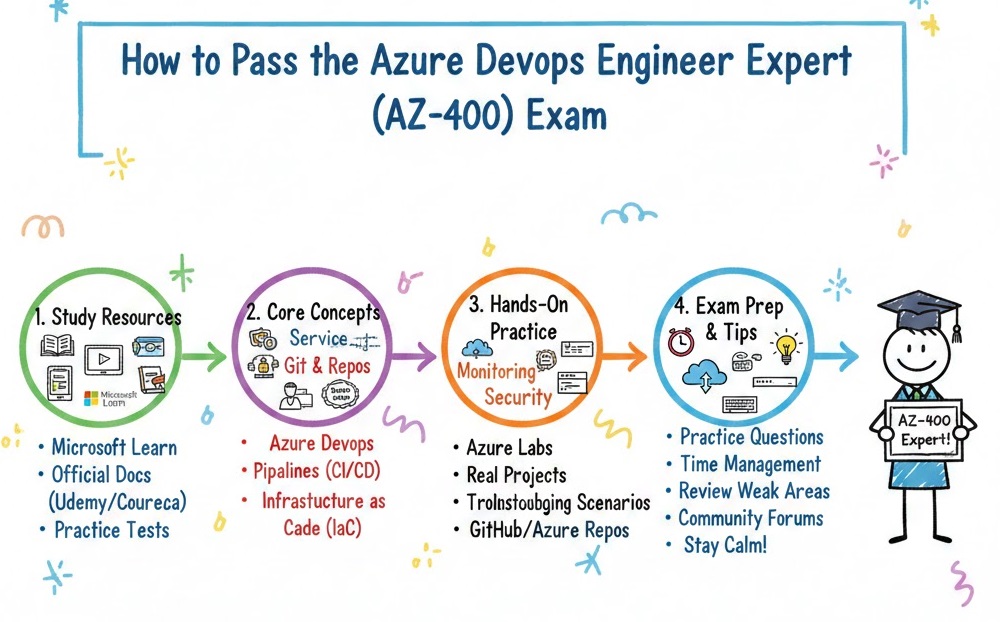
Introduction
Azure DevOps Engineer Expert (AZ-400) is a professional certification offered by Microsoft that validates a candidate’s skills and expertise in DevOps practices, focusing on Azure DevOps tools. It combines the best practices of DevOps and covers key areas like continuous integration (CI), continuous delivery (CD), testing, automation, and much more.This guide will help you understand what it takes to become a certified Azure DevOps Engineer, what you’ll learn during the process, and how it can benefit your career. Whether you’re an engineer, a manager, or a software engineer, this guide offers a thorough roadmap for passing the AZ-400 exam.
What is Azure DevOps Engineer Expert (AZ-400)?
The Azure DevOps Engineer Expert (AZ-400) certification is designed for professionals who are interested in DevOps practices with a focus on Microsoft Azure. It involves working with Azure services to deliver solutions that ensure continuous integration, continuous delivery, and deployment of applications in a cloud environment. The certification is ideal for professionals involved in the development, management, and automation of complex cloud applications.
Core Skills Covered:
- Version Control (using Git)
- CI/CD Pipeline Design and implementation
- Automation of build and release pipelines
- Infrastructure as Code (IaC) using tools like Azure Resource Manager (ARM) and Terraform
- Containerization and orchestration with Azure Kubernetes Service (AKS)
- Security in DevOps workflows, including managing secrets and credentials
- Collaboration practices between development, testing, and operations teams
Who Should Take It?
This certification is best suited for professionals with experience in software development, IT operations, and DevOps practices. It’s designed for:
- DevOps Engineers: Those already working in DevOps roles and want to validate their expertise.
- Cloud Engineers: Professionals working with cloud solutions who wish to expand their skills in DevOps practices.
- Software Engineers/Developers: Developers looking to streamline their CI/CD pipelines and integrate DevOps processes.
- IT Operations Engineers: Professionals who manage infrastructure and want to implement DevOps practices for smoother operations.
- Release Managers: Those responsible for deployment pipelines who want to understand how to integrate development and operations more effectively.
Before taking the exam, it’s recommended that candidates have a working knowledge of Azure and practical experience in DevOps.
Skills You’ll Gain
Upon successful completion of the AZ-400 certification, you’ll have mastered the following skills:
- CI/CD Implementation: Create and configure automated pipelines for continuous integration and continuous delivery of software.
- Version Control with Git: Integrate version control tools like Git into the development process.
- Infrastructure Automation: Use Azure Resource Manager (ARM) templates or Terraform to automate infrastructure provisioning.
- Containerization and Orchestration: Set up and manage containerized applications using Azure Kubernetes Service (AKS).
- Security Best Practices: Secure applications and infrastructure using best practices like key vaults and access control.
- Monitoring and Logging: Implement logging and monitoring practices for both applications and infrastructure to ensure reliability.
- Collaboration: Foster collaboration between development and operations teams, aligning them towards the shared goal of continuous delivery.
Real-World Projects You Should Be Able to Do After It
By becoming certified, you’ll be able to work on projects like:
- Automating Deployment Pipelines: Set up end-to-end automated CI/CD pipelines in Azure DevOps to automatically build, test, and deploy applications.
- Container Management: Implement containerized applications in Azure using Kubernetes, ensuring that they are scalable and manageable.
- Cloud Infrastructure Management: Create, configure, and deploy infrastructure in Azure using Infrastructure as Code (IaC) practices with ARM templates or Terraform.
- Cloud Monitoring: Set up monitoring and alerting in Azure using Azure Monitor, ensuring applications and services are continuously available.
- Security Implementation: Integrate security practices into the DevOps pipeline, such as managing secrets with Azure Key Vault and using automated security testing.
Preparation Plan
7-14 Days (For Quick Learners)
- Day 1-3: Review DevOps basics and version control (Git). Set up a small project to integrate version control using Azure Repos.
- Day 4-6: Study CI/CD pipeline creation and automated testing. Build simple pipelines in Azure DevOps.
- Day 7-9: Study containerization concepts. Deploy a containerized application using Azure Kubernetes Service (AKS).
- Day 10-12: Focus on Infrastructure as Code (IaC) using ARM templates or Terraform. Automate Azure resource provisioning.
- Day 13-14: Practice with hands-on labs. Take mock exams and identify areas that need improvement.
30 Days (Standard Preparation)
- Week 1: Introduction to Azure DevOps tools, Git, and version control.
- Week 2: Learn and practice CI/CD pipelines with Azure DevOps.
- Week 3: Study Kubernetes, container orchestration, and infrastructure automation.
- Week 4: Focus on monitoring, security practices, and hands-on labs.
60 Days (For Beginners)
- Week 1-2: Learn the basics of DevOps and Azure cloud services.
- Week 3-4: Practice with version control and integrate it into your project.
- Week 5-6: Focus on automating cloud infrastructure and containerized environments. Implement CI/CD pipelines and automated testing.
Common Mistakes
- Overlooking Security: Neglecting the importance of securing your DevOps pipeline. Always ensure that security is part of your pipeline design.
- Inconsistent CI/CD Pipelines: Failing to maintain consistent and scalable pipelines across projects.
- Skipping Hands-On Practice: While theoretical knowledge is important, hands-on practice is crucial for DevOps success. Set up mock projects.
- Underestimating Time: The AZ-400 is a demanding exam. Be sure to allocate enough time to cover all topics and do practical labs.
- Neglecting to Review the Exam Objectives: Review the official exam objectives to ensure you’re prepared for the questions you’ll face.
Best Next Certification After This
Once you’ve achieved the Azure DevOps Engineer Expert certification, here are some next steps in your certification journey:
- Azure Solutions Architect Expert (AZ-303) – A deeper dive into architecting solutions on Azure.
- Certified Kubernetes Administrator (CKA) – Master Kubernetes and container orchestration.
- Microsoft Certified: Azure AI Engineer Associate – A certification for those interested in AI and its application in DevOps pipelines.
Choose Your Path: 6 Learning Tracks
1. DevOps
DevOps is a key practice that unites development and operations to improve the delivery and maintenance of software applications. In this path, you’ll focus on CI/CD pipelines, infrastructure automation, and collaboration between development and operations teams. You will be responsible for the entire software lifecycle, ensuring continuous integration and delivery, and enhancing collaboration to speed up deployment.
Skills to Focus On:
- Continuous Integration/Continuous Deployment (CI/CD)
- Infrastructure as Code (IaC) with tools like Terraform and ARM templates
- Automation of deployment and monitoring
- Containerization and orchestration with Kubernetes and Docker
- Cloud services and automation in Azure
2. DevSecOps
In this path, security becomes a core part of the DevOps pipeline, focusing on integrating security practices into every stage of the software development lifecycle. You’ll learn to manage cloud security, implement security tools, and foster a culture of security across all aspects of DevOps.
Skills to Focus On:
- Security automation
- Vulnerability management in cloud environments
- Secure coding practices
- Continuous security monitoring
- Using Azure Key Vault and other security tools for secret management
3. SRE (Site Reliability Engineering)
As an SRE, your goal will be to ensure the reliability, availability, and performance of services at scale. This path is more focused on maintaining system uptime, managing scalability, and optimizing performance in production environments. SREs play a key role in automating operations tasks and bridging the gap between development and operations.
Skills to Focus On:
- Reliability engineering and monitoring
- Incident response and post-mortem analysis
- Automation of manual tasks
- Performance tuning and load balancing
- Managing high-availability systems and disaster recovery
4. AIOps/MLOps
The AIOps/MLOps path is ideal for professionals interested in integrating Artificial Intelligence (AI) and Machine Learning (ML) into the operations of DevOps. In this role, you will automate operational tasks using AI and ML, ensuring smarter and more efficient DevOps practices. You’ll also work on optimizing ML model deployments and automating their lifecycle within production systems.
Skills to Focus On:
- Automation of IT operations using machine learning and artificial intelligence
- Continuous monitoring and model training
- Managing data pipelines and model deployment
- Integrating AI models in CI/CD pipelines
- Using Azure AI and ML tools like Azure Machine Learning
5. DataOps
DataOps combines DevOps principles with data engineering and analytics, focusing on improving the speed, quality, and collaboration between data teams. This path is particularly suited for those who want to focus on automating data workflows and managing data pipelines. You will work on providing continuous integration and delivery for data workflows and ensure that data operations are seamless and efficient.
Skills to Focus On:
- Automating data pipelines and workflows
- Managing data lakes and data lakeshore management
- Continuous integration for data engineering
- Implementing version control for data
- Ensuring data quality and governance
6. FinOps
FinOps is a newer, specialized practice that combines financial management with cloud operations. As a FinOps professional, you’ll be responsible for managing cloud costs, optimizing spending, and improving budgeting for cloud environments. You will work with cross-functional teams to ensure cost efficiency while maintaining operational agility.
Skills to Focus On:
- Cloud cost optimization and budgeting
- Usage and billing analysis
- Cloud governance and cost allocation
- Integration of financial management tools with cloud infrastructure
- Using tools like CloudHealth, Azure Cost Management, and FinOps platforms
Role → Recommended Certifications Mapping
| Role | Recommended Certifications |
|---|---|
| DevOps Engineer | Azure DevOps Engineer Expert, Certified Kubernetes Administrator |
| SRE | Google Professional Cloud Architect, Azure DevOps Engineer Expert |
| Platform Engineer | Azure Solutions Architect Expert, Azure DevOps Engineer Expert |
| Cloud Engineer | AWS Certified Solutions Architect, Azure DevOps Engineer Expert |
| Security Engineer | Certified Information Systems Security Professional (CISSP), Azure DevOps Engineer Expert |
| Data Engineer | Microsoft Certified: Azure Data Engineer Associate |
| FinOps Practitioner | Cloud Financial Management Certification |
| Engineering Manager | Certified Scrum Master, Azure DevOps Engineer Expert |
Training Providers for Azure DevOps Engineer Expert (AZ-400)
1. DevOpsSchool
DevOpsSchool offers comprehensive training programs specifically designed for Azure DevOps and other DevOps-related certifications. Their courses include live instructor-led sessions, hands-on labs, and post-training support to help you prepare effectively for the AZ-400 exam. The training is designed for both beginners and experienced professionals, with personalized coaching to address specific needs. They also offer career support and certification assistance.
- Specialty: Live instructor-led training, real-world project implementation, post-course support.
- Course Features:
- Azure DevOps tools in depth
- Live demos and hands-on labs
- Access to recorded sessions and materials
- Real-life case studies and exam-specific focus
2. Cotocus
Cotocus provides expert-level training and certification guidance for professionals looking to specialize in DevOps, including Azure DevOps. Their AZ-400 course includes a blend of theoretical learning and practical labs, and the sessions are conducted by certified trainers with years of experience. They also offer flexible learning options, including online and in-person classes, along with exam preparation support.
- Specialty: Career-oriented training, personalized mentorship, flexible learning modes.
- Course Features:
- Tailored learning paths for individuals and organizations
- One-on-one mentorship for exam preparation
- Exam practice questions and mock tests
- Continuous support even after course completion
3. Scmgalaxy
Scmgalaxy is known for offering high-quality, interactive training for DevOps engineers. Their Azure DevOps Engineer Expert (AZ-400) course is designed to cover all essential concepts and exam objectives. The program includes live sessions, hands-on labs, and practice exams, ensuring that students are fully prepared for the real-world challenges of DevOps environments. Scmgalaxy also offers post-training assistance and career guidance.
- Specialty: Interactive and hands-on learning, professional guidance, exam preparation.
- Course Features:
- Real-world projects and practical exercises
- DevOps and Azure tools focus
- Pre-exam mock tests and certification support
- Flexible schedules with online and classroom options
4. BestDevOps
BestDevOps specializes in training for DevOps certifications, including Azure DevOps. Their AZ-400 course is designed to provide a deep understanding of DevOps principles and tools used in Azure. BestDevOps focuses on practical, hands-on training and supports students through every stage of their certification journey. They offer comprehensive learning resources, live classes, and access to post-training support.
- Specialty: Focus on both development and operations, real-world scenario-based learning.
- Course Features:
- Coverage of all topics required for AZ-400 certification
- Access to online resources and study materials
- Practical labs using Azure DevOps tools
- Career services and exam guidance
5. DevSecOpsSchool
DevSecOpsSchool offers specialized training in DevSecOps (DevOps with a focus on security). They provide a unique approach to DevOps, integrating security practices into the development pipeline. Their AZ-400 course emphasizes securing applications and cloud infrastructure using Azure, preparing students for real-world security challenges in DevOps.
- Specialty: Security-driven DevOps training, integrating security with CI/CD pipelines.
- Course Features:
- Focus on secure DevOps practices using Azure tools
- Security automation, secret management, and cloud security
- Hands-on labs with a focus on security within Azure environments
- Post-course career assistance
6. SRESchool
SRESchool is dedicated to Site Reliability Engineering (SRE) and offers training courses specifically designed for professionals interested in combining DevOps practices with reliability engineering. Their Azure DevOps course is tailored to professionals who want to implement high availability, scalability, and resilience into their DevOps practices, focusing on Azure DevOps.
- Specialty: SRE and DevOps convergence, enhancing reliability through DevOps tools.
- Course Features:
- Focus on high availability and scalability in cloud environments
- Integration of SRE practices into Azure DevOps workflows
- Real-life projects on Azure, Kubernetes, and automation
- Certification guidance and job placement assistance
7. AIOpsSchool
AIOpsSchool specializes in AIOps (Artificial Intelligence for IT Operations) and MLOps (Machine Learning Operations), which involve automating IT operations and incorporating AI/ML practices into DevOps. Their AZ-400 training program is perfect for professionals who want to learn how to integrate machine learning and AI into their DevOps workflows using Azure.
- Specialty: AI/ML in DevOps, automation, and monitoring.
- Course Features:
- Automation of operations using AI and ML tools
- Training in Azure Machine Learning and DevOps integration
- Hands-on labs and real-world case studies
- Support in integrating AIOps into your existing DevOps pipeline
8. DataOpsSchool
DataOpsSchool focuses on DataOps, which combines DevOps practices with data engineering, ensuring that data workflows are automated and optimized. Their training for Azure DevOps includes how to work with data pipelines, manage cloud data storage, and integrate data services in Azure.
- Specialty: DataOps integration with DevOps, data pipeline automation.
- Course Features:
- Focus on automation of data pipelines and analytics workflows
- Hands-on experience with Azure Data Factory and data services
- DevOps best practices for managing large-scale data operations
- Career guidance and certification preparation
9. FinOpsSchool
FinOpsSchool focuses on FinOps, which involves financial operations management for cloud environments. If you’re looking to combine DevOps with financial management in the cloud, FinOpsSchool offers specialized courses on optimizing cloud costs and using Azure tools to manage budgets and forecasts effectively.
- Specialty: Cloud cost optimization, financial management in DevOps.
- Course Features:
- Cloud cost allocation and budgeting techniques
- Integration of financial management tools with Azure DevOps
- Managing cloud spending while ensuring operational efficiency
- Exam practice and real-world financial optimization projects
Comparison Table: Azure DevOps vs Other DevOps Tools
| Feature | Azure DevOps | Jenkins | GitLab CI/CD | CircleCI | Travis CI |
|---|---|---|---|---|---|
| Platform | Cloud (Azure) and On-Premises | Open-source, primarily On-Premises | Cloud-based and On-Premises | Cloud-based | Cloud-based |
| CI/CD Support | Full CI/CD pipeline support | Full CI/CD support | Full CI/CD support | Full CI/CD support | Full CI/CD support |
| Version Control | Azure Repos (Git) | Git-based (supports multiple VCS) | Git-based (supports multiple VCS) | Git-based (supports multiple VCS) | Git-based (supports multiple VCS) |
| Integration with Azure | Seamless integration with Azure services | Requires plugins for Azure support | Azure integration with GitLab CI/CD | Requires third-party integration | Requires third-party integration |
| Container Support | Native Kubernetes and Docker integration | Through plugins (Docker, Kubernetes) | Native Docker & Kubernetes support | Native Docker & Kubernetes support | Native Docker & Kubernetes support |
| Security | Built-in security features (Azure Key Vault) | Plugins available for security setups | Native security features in GitLab CI/CD | Native security features | Basic security features |
| User Interface | Web-based with a user-friendly dashboard | Web interface (Jenkins UI) | Web-based interface | Web-based interface | Web-based interface |
| Automation | Full pipeline automation with YAML, Pipelines, and ARM templates | Jenkins Pipelines, can be scripted | Auto DevOps with GitLab CI/CD | Simple setup with automatic builds | Limited automation features |
| Monitoring & Logging | Azure Monitor integration, real-time logs | Basic logging features | Basic logging, GitLab’s monitoring tools | Built-in monitoring | Limited monitoring features |
| Pricing | Free for small projects; Paid plans for enterprise | Free (Open-source); Paid options for enterprises | Free tier, Paid tiers for enterprises | Free for open-source projects; Paid for private projects | Free for open-source; Paid for private projects |
| Scalability | Scalable across small to large enterprises | Scalable, but requires management of resources | Highly scalable, flexible | Scalable, with simple cloud integration | Scalable, with simple cloud integration |
| Ease of Setup | Easy to set up for Azure projects | Complex to set up for beginners | Easy to use, integrated with GitLab repositories | Simple to use for basic needs | Simple for open-source projects |
FAQs on Azure DevOps Engineer Expert (AZ-400)
1. What is the difficulty level of the AZ-400 exam?
The AZ-400 exam is moderately difficult. It requires a solid understanding of both Azure services and DevOps practices, so hands-on experience is crucial.
2. How long does it take to prepare for the AZ-400 exam?
Preparation time varies, but on average, it takes about 1-2 months to prepare effectively for the exam.
3. What are the prerequisites for taking the AZ-400 exam?
You should have practical experience in Azure and DevOps. It is recommended to complete the AZ-104 or similar certifications beforehand.
4. What skills do I need to have for the AZ-400 exam?
You should have skills in version control, automation, CI/CD, containerization, and Azure cloud services. Experience with security and monitoring is also essential.
5. How can I structure my preparation for the AZ-400 exam?
Begin by understanding the exam objectives, focus on hands-on practice with Azure DevOps tools, and then review the topics methodically, finishing with mock exams.
6. What is the passing score for the AZ-400 exam?
The passing score is typically around 700-750 out of 1000.
7. How many questions are in the AZ-400 exam?
The exam consists of 40-60 questions, which are a mix of multiple-choice and scenario-based questions.
8. What is the exam fee for the AZ-400?
The exam fee is typically around $165 USD.
FAQs
1. What is the difficulty level of the AZ-400 exam?
- The AZ-400 exam is moderately difficult. It requires a deep understanding of both Azure cloud services and DevOps practices. Hands-on experience with Azure DevOps tools is essential to successfully passing the exam.
2. How long does it take to prepare for the AZ-400 exam?
- Preparation time can vary depending on your prior experience. Typically, it takes between 1-2 months of dedicated study and practice to adequately prepare for the exam. For beginners, it might take up to 60 days.
3. What are the prerequisites for taking the AZ-400 exam?
- Before taking the AZ-400 exam, it is recommended to have foundational knowledge of Azure, along with experience in DevOps practices. The AZ-104 certification (Azure Administrator Associate) is often recommended as a prerequisite.
4. How can I structure my preparation for the AZ-400 exam?
- Start by reviewing the exam objectives and then focus on learning the key areas such as version control, CI/CD pipelines, automation, containerization, security, and monitoring. Hands-on practice using Azure DevOps tools is crucial. Use study resources, online courses, and take mock exams to test your knowledge.
5. What skills do I need to have for the AZ-400 exam?
- You should have knowledge of DevOps practices like continuous integration, continuous delivery, and automation. Familiarity with version control systems (like Git), build and release pipelines, containerization (Docker, Kubernetes), and Azure services (e.g., Azure Repos, Azure Pipelines) is essential.
6. What is the passing score for the AZ-400 exam?
- The passing score for the AZ-400 exam is generally around 700 out of 1000. The exam is scored based on the number of correct answers, with a focus on key topics related to DevOps and Azure.
7. How many questions are in the AZ-400 exam?
- The AZ-400 exam typically consists of 40-60 multiple-choice and scenario-based questions, designed to test your ability to apply DevOps principles in real-world situations.
8. What is the exam fee for the AZ-400?
- The exam fee for the AZ-400 is around $165 USD, though prices may vary based on location and applicable taxes.
9. Can I retake the AZ-400 exam if I fail?
- Yes, if you do not pass the AZ-400 exam, you can retake it. Microsoft allows you to retake the exam after a waiting period of 24 hours if you fail on the first attempt. Subsequent attempts require a 14-day waiting period.
10. How do I register for the AZ-400 exam?
- You can register for the AZ-400 exam via the Microsoft website or through the Pearson VUE platform. You’ll need a Microsoft account to register and schedule your exam.
11. Is there any study material available for the AZ-400 exam?
- Yes, Microsoft offers official study materials, including learning paths and documentation on their website. There are also various third-party platforms, such as Udemy, Pluralsight, and LinkedIn Learning, offering courses that cover the AZ-400 exam topics.
12. What is the format of the AZ-400 exam?
- The AZ-400 exam consists of multiple-choice questions, drag-and-drop questions, and case-study questions. You will be asked to apply your knowledge to real-world scenarios in Azure DevOps environments. The exam is conducted online, and you can take it from home or a testing center.
Conclusion
The Azure DevOps Engineer Expert (AZ-400) certification is a significant milestone in any DevOps professional’s career. It validates your expertise in the best practices of DevOps, particularly with a focus on Azure, which is one of the leading cloud platforms today. Whether you are a DevOps engineer, cloud engineer, software developer, or IT professional, this certification can open doors to numerous career opportunities.By mastering key concepts such as continuous integration, deployment pipelines, containerization, infrastructure automation, and cloud security, you’ll be equipped to handle complex DevOps projects and make significant contributions to your organization’s growth.

Find Trusted Cardiac Hospitals
Compare heart hospitals by city and services — all in one place.
Explore Hospitals
This blog is very useful for anyone preparing for the AZ-400 exam. It explains the certification in simple language and covers important topics like CI/CD, Git, Terraform, Kubernetes, security, and study planning. A nice and easy guide for learners who want to grow in Azure DevOps.