Introduction
In the rapidly evolving landscape of cloud-native infrastructure, the Certified Site Reliability Professional designation has emerged as a benchmark for excellence. This guide is designed for software engineers and systems professionals who aim to bridge the gap between development and operations through the lens of reliability. As a Site Reliability Engineer, you are tasked with creating scalable and highly reliable software systems, making this certification essential for those navigating DevOps, platform engineering, and modern cloud architectures. This comprehensive breakdown will help you evaluate the ROI of the program and align it with your long-term career trajectory in the global tech ecosystem.
What is the Certified Site Reliability Professional?
The Certified Site Reliability Professional is a specialized credential designed to validate an engineer’s ability to manage large-scale, complex systems with a focus on availability and performance. Unlike traditional certifications that focus on a single cloud provider or tool, this program emphasizes the core philosophy of SRE—treating operations as a software engineering problem. It exists to bridge the gap between theoretical knowledge of distributed systems and the hard-earned practical skills required to run production environments at scale.
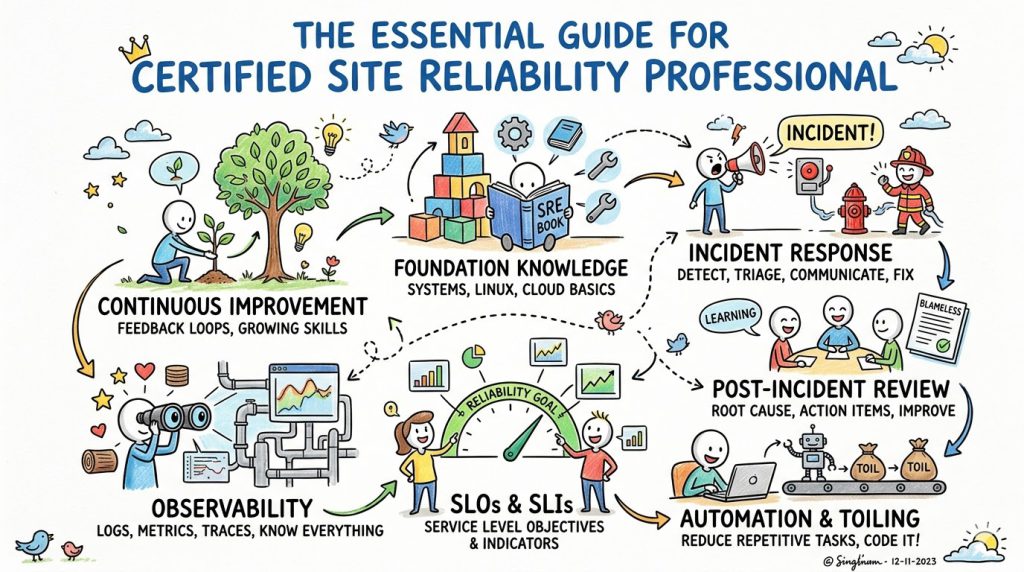
The curriculum focuses on modern engineering workflows, including error budget management, incident response automation, and the implementation of toil-reduction strategies. By aligning with enterprise practices, it ensures that professionals are not just learning “how” to use a tool, but “why” certain architectural patterns lead to more resilient systems. It provides a standardized framework for organizations to assess the competency of their engineering talent in high-stakes environments.
Who Should Pursue Certified Site Reliability Professional?
This certification is ideally suited for backend developers, DevOps engineers, and systems administrators who are looking to specialize in system reliability and scalability. It is equally valuable for platform engineers who build the internal infrastructure that product teams rely on to deploy code safely and efficiently. Security and data professionals will also find the principles of observability and incident management highly relevant to their domains, especially when managing high-traffic pipelines.
For beginners, it serves as a roadmap for understanding the complexities of production environments, while experienced seniors and architects use it to formalize their expertise and lead organizational shifts toward SRE practices. In the context of both the Indian and global tech markets, where companies are migrating to microservices and Kubernetes, this credential signals that an engineer can handle the operational rigors of a 24/7 digital business. Engineering managers also benefit from this path to better lead teams through data-driven reliability metrics.
Why Certified Site Reliability Professional is Valuable and Beyond
The demand for reliability expertise continues to outpace the supply of qualified engineers as digital transformation becomes a requirement rather than an option for enterprises. This certification offers longevity because it teaches fundamental principles—such as Service Level Objectives (SLOs) and observability—that remain constant even as specific tools or cloud providers change. It empowers professionals to stay relevant by focusing on the “engineering” aspect of operations rather than just “administration.”
From an enterprise perspective, hiring certified professionals reduces the risk of costly downtime and improves the overall speed of innovation. For the individual, the return on investment is seen through higher salary brackets, more senior roles, and the ability to work on mission-critical systems at top-tier tech firms. As organizations move toward autonomous operations and complex hybrid-cloud setups, the ability to architect for reliability becomes a definitive competitive advantage.
Certified Site Reliability Professional Certification Overview
The program is delivered via the official training portal and hosted on the Sreschool website. The certification structure is designed to be practical, moving away from simple multiple-choice questions toward performance-based assessments that mirror real-world scenarios. It is owned and governed by industry experts who ensure the content remains aligned with the latest shifts in the SRE and DevOps communities.
The assessment approach typically involves a combination of theoretical foundational knowledge and practical laboratory exercises where candidates must solve production-related issues. This ensures that a certified professional can actually perform the tasks required in a high-pressure environment. The structure is modular, allowing professionals to start with foundational concepts and progressively move toward advanced specializations as their career and experience levels grow.
Certified Site Reliability Professional Certification Tracks & Levels
The certification is organized into three distinct tiers: Foundation, Professional, and Advanced. The Foundation level introduces core SRE terminology and the cultural shift required to implement reliability practices. The Professional level dives deeper into automation, monitoring, and incident management, while the Advanced level focuses on architectural design, capacity planning, and leading SRE teams.
These levels are designed to align with a professional’s career progression, from an associate engineer to a principal or lead role. Specialization tracks allow engineers to branch out into related fields like FinOps for cost optimization or DevSecOps for integrated security. This multi-level approach ensures that there is a clear learning path regardless of where an individual currently stands in their professional journey.
Complete Certified Site Reliability Professional Certification Table
| Track | Level | Who it’s for | Prerequisites | Skills Covered | Recommended Order |
| Core SRE | Foundation | Associate Engineers | Basic Linux/Cloud | SLIs, SLOs, Error Budgets | 1 |
| Core SRE | Professional | SREs, DevOps | Foundation Level | Automation, Observability | 2 |
| Operations | Advanced | Lead Engineers | Professional Level | Capacity Planning, Architecture | 3 |
| Management | Leadership | Engineering Managers | Foundation Level | Team Building, Reliability ROI | 4 |
Detailed Guide for Each Certified Site Reliability Professional Certification
What it is
This certification validates a candidate’s understanding of the fundamental concepts of Site Reliability Engineering. it confirms that the professional understands the vocabulary, metrics, and cultural mindset required to balance feature velocity with system stability.
Who should take it
It is designed for junior engineers, developers moving into operations, and managers who need to speak the language of SRE. It is the perfect starting point for anyone new to the discipline of reliability engineering.
Skills you’ll gain
- Understanding the difference between SLA, SLO, and SLI.
- Grasping the concept of Error Budgets and how to use them.
- Identifying toil and methods for its elimination.
- Basics of incident response and post-mortem culture.
Real-world projects you should be able to do
- Define and document service level objectives for a web application.
- Perform a basic toil audit on a recurring operational task.
- Draft a blameless post-mortem report for a simulated service outage.
Preparation plan
- 7–14 days: Intensive review of the SRE Book and core terminology.
- 30 days: Practical application of SLIs and SLOs in a lab environment.
- 60 days: Full immersion including case study analysis and mock exams.
Common mistakes
- Focusing too much on specific tools rather than the underlying principles.
- Underestimating the importance of the cultural and “soft skill” aspects of SRE.
- Confusing SLAs with SLOs during the assessment.
Best next certification after this
- Same-track option: Certified Site Reliability Professional – Practitioner
- Cross-track option: Certified DevSecOps Professional
- Leadership option: Certified Engineering Manager
Choose Your Learning Path
DevOps Path
The DevOps path focuses on the seamless integration of development and operations through continuous delivery. For a Site Reliability Professional, this means ensuring that the deployment pipeline is not only fast but inherently reliable. It involves building automated gates that prevent unstable code from reaching production. This path is ideal for those who want to master the “how” of shipping software.
DevSecOps Path
Security is no longer a separate phase; it must be part of the reliability lifecycle. In this path, professionals learn to integrate automated security scanning and compliance checks into the SRE workflow. This ensures that the system is not just “up” but also “secure” and “resilient” against threats. It is a critical path for engineers working in regulated industries like finance or healthcare.
SRE Path
The pure SRE path is for those who want to go deep into system internals and distributed systems architecture. It emphasizes high-scale observability, complex incident command structures, and advanced automation for self-healing systems. This path focuses on the “engineering” side of operations, utilizing code to manage infrastructure and handle petabytes of data or millions of concurrent users.
AIOps Path
As systems become too complex for human intervention alone, AIOps introduces machine learning to the operations space. This path teaches professionals how to use AI models to predict outages, correlate alerts, and automate root cause analysis. It is designed for forward-thinking engineers who want to stay at the cutting edge of autonomous infrastructure management.
MLOps Path
MLOps is the application of SRE principles to the lifecycle of machine learning models. This path addresses the unique challenges of model drift, data lineage, and the heavy compute requirements of AI workloads. Professionals on this path ensure that ML models are deployed and scaled with the same rigor as traditional microservices, providing reliability to the data science pipeline.
DataOps Path
DataOps focuses on the reliability of data pipelines and the quality of data flowing through an organization. Like SRE, it uses automation and monitoring to ensure that data delivery is consistent and error-free. This path is perfect for data engineers who want to apply software engineering discipline to their data architecture to prevent “data outages.”
FinOps Path
FinOps brings financial accountability to the variable spend of cloud computing. By applying SRE-like metrics to cloud costs, professionals can ensure that the infrastructure is not just reliable, but also cost-effective. This path involves analyzing utilization data and driving architectural changes that maximize the value of every dollar spent on cloud resources.
Role → Recommended Certified Site Reliability Professional Certifications
| Role | Recommended Certifications |
| DevOps Engineer | Certified Site Reliability Professional – Foundation |
| SRE | Certified Site Reliability Professional – Practitioner |
| Platform Engineer | Certified Site Reliability Professional – Advanced |
| Cloud Engineer | Certified Site Reliability Professional – Foundation |
| Security Engineer | Certified DevSecOps Professional |
| Data Engineer | Certified DataOps Professional |
| FinOps Practitioner | Certified FinOps Professional |
| Engineering Manager | Certified Site Reliability Professional – Foundation |
Next Certifications to Take After Certified Site Reliability Professional
Same Track Progression
Once the foundation is established, engineers should pursue the Practitioner and Advanced levels of the SRE track. These levels focus on complex distributed systems, high-availability architecture, and advanced disaster recovery strategies. Moving deep into the same track allows you to become a subject matter expert (SME) capable of leading large-scale reliability initiatives.
Cross-Track Expansion
Broadening your skills into DevSecOps or FinOps provides a more holistic view of the software lifecycle. A Site Reliability Professional who understands the security implications of their infrastructure or the cost implications of their scaling policies is far more valuable to an organization. This expansion makes you a versatile “T-shaped” professional who can collaborate across different departments.
Leadership & Management Track
For those looking to move away from individual contributor roles, the leadership track focuses on the business value of reliability. This includes learning how to build and scale SRE teams, how to communicate reliability metrics to stakeholders, and how to manage the budget and ROI of engineering efforts. It is the natural step for those aiming for VP of Engineering or CTO roles.
Training & Certification Support Providers for Certified Site Reliability Professional
DevOpsSchool provides extensive instructor-led training and comprehensive course materials that cover the entire SRE spectrum. They focus on hands-on labs and real-world scenarios to ensure candidates are exam-ready.
Cotocus specializes in specialized training for cloud-native technologies and SRE practices. Their curriculum is designed to help professionals master the tools and mindsets required for modern infrastructure management.
Scmgalaxy offers a wealth of community resources, tutorials, and practice guides for various engineering certifications. They are a go-to source for technical blogs and deep dives into specific SRE tools.
BestDevOps focuses on delivering high-quality training programs that are aligned with industry standards. Their courses are tailored for working professionals who need flexible yet rigorous preparation.
Devsecopsschool focuses on the intersection of security and operations. They provide targeted training for those who want to integrate SRE principles with modern security practices.
Sreschool is the primary platform for SRE-specific certifications and advanced learning paths. It serves as the central hub for the Certified Site Reliability Professional community and resources.
Aiopsschool provides cutting-edge education on applying artificial intelligence to IT operations. Their programs help SREs transition into the world of automated, AI-driven system management.
Dataopsschool focuses on the reliability and efficiency of data pipelines. They offer specialized tracks for data professionals looking to adopt SRE methodologies in their daily workflows.
Finopsschool offers training dedicated to cloud financial management. They help engineers and managers understand the cost dynamics of cloud infrastructure and how to optimize them.
Frequently Asked Questions (General)
- How difficult is the certification exam?The exam is moderately difficult and requires a solid understanding of both theory and practical application.
- How long does it take to prepare?Most professionals with prior experience spend between 30 to 60 days preparing for the foundation and practitioner levels.
- Are there any prerequisites for the foundation level?There are no formal prerequisites, but a basic understanding of Linux and cloud computing is highly recommended.
- What is the validity period of the certification?The certification is typically valid for two to three years, after which recertification or moving to a higher level is required.
- Does the certification focus on a specific cloud provider?No, it is designed to be cloud-agnostic, focusing on principles that apply to AWS, Azure, GCP, and on-premises environments.
- Can I take the exam online?Yes, the certification exams are generally available through online proctored platforms for global accessibility.
- How does this certification impact my salary?Certified professionals often see a significant increase in salary, as SRE roles are among the highest-paid in the tech industry.
- Is the certification recognized globally?Yes, the program follows international standards and is recognized by major tech hubs and enterprises worldwide.
- What kind of questions are asked in the exam?The exam includes a mix of conceptual questions, scenario-based problems, and practical tasks.
- Is there a community for certified professionals?Yes, holders of the certification gain access to exclusive forums and networking groups for ongoing learning.
- How often is the course content updated?The curriculum is reviewed annually to ensure it reflects the latest trends and tools in the SRE space.
- Can managers benefit from this certification?Absolutely, the foundation level provides the necessary context for managers to support their SRE teams effectively.
FAQs on Certified Site Reliability Professional
- What is the core focus of the Certified Site Reliability Professional program?The program focuses on treating operations as a software engineering problem, emphasizing automation and data-driven reliability.
- How does this differ from a standard DevOps certification?While DevOps focuses on the lifecycle of software, SRE specifically targets the reliability and scalability of the production environment.
- What is the importance of Error Budgets in this certification?Error budgets are a central concept, teaching how to balance the need for new features with the requirement for system stability.
- Are labs included in the training?Yes, practical labs are a major component, allowing candidates to practice incident response and monitoring in a safe environment.
- Who maintains the certification standards?The standards are maintained by a committee of industry practitioners and lead engineers from the SRE community.
- Does it cover Kubernetes and containers?Yes, modern SRE practices are deeply intertwined with container orchestration, and these topics are covered extensively.
- Is there a focus on post-mortem documentation?A significant part of the training is dedicated to blameless post-mortems and learning from system failures.
- Can I skip the Foundation level?It is generally recommended to follow the sequence, but those with extensive experience can sometimes challenge the higher-level exams directly.
Conclusion
Certified Site Reliability Professional credential is a strategic move for any engineer looking to future-proof their career. As systems grow in complexity, the ability to manage them with engineering discipline rather than manual effort becomes the defining factor of a successful professional. This certification does not just provide a badge; it provides a framework for thinking about software and infrastructure that will remain relevant for decades.If you are looking for a clear path to move from general operations into a high-impact, high-reward role, this is it. The focus on real-world outcomes over marketing hype makes it a respected choice among hiring managers and technical leaders. Take the time to master the principles, and you will find yourself at the forefront of the most critical challenges in modern technology.

Find Trusted Cardiac Hospitals
Compare heart hospitals by city and services — all in one place.
Explore Hospitals
This blog explains the Certified Site Reliability Professional path in a simple and useful way. I like that it clearly shows the skills needed for reliability, automation, monitoring, and incident handling, which makes it helpful for anyone who wants to build a strong career in modern IT operations.