Introduction
Manufacturing Execution Systems (MES) are software solutions designed to manage, monitor, and optimize manufacturing operations on the shop floor. They provide real-time visibility into production processes, enabling manufacturers to improve efficiency, reduce errors, and maintain consistent product quality. MES serves as the bridge between enterprise-level planning systems, like ERP, and the operational equipment on the factory floor.
MES platforms have become increasingly important due to growing demands for digital transformation, Industry 4.0 integration, and AI-powered predictive analytics. Manufacturers are leveraging MES to respond to dynamic market demands, optimize supply chains, and ensure compliance with increasingly stringent regulatory standards.
Real-world use cases include:
- Real-time production tracking to identify bottlenecks and minimize downtime.
- Quality control and defect management to ensure product consistency.
- Equipment monitoring and predictive maintenance using IoT sensors.
- Scheduling optimization to align production with demand forecasts.
- Integration with ERP and supply chain systems for end-to-end visibility.
Buyers should evaluate MES solutions based on:
- Core production and process monitoring features
- Integration capabilities with ERP, PLM, and IoT devices
- User experience and ease of deployment
- Security and compliance standards
- Scalability for growing operations
- Reporting and analytics capabilities
- Vendor support and community strength
- Deployment flexibility (cloud, on-premise, hybrid)
Best for: mid-sized to large manufacturers, production managers, operations teams, and enterprises aiming to digitally transform manufacturing workflows.
Not ideal for: very small workshops or companies with minimal process complexity, where simpler production tracking or spreadsheets may suffice.
Key Trends in Manufacturing Execution Systems (MES)
- AI-driven production optimization: Predictive analytics for downtime prevention and yield improvement.
- IoT & IIoT integration: Real-time machine data collection for process visibility.
- Cloud & hybrid deployment: Flexible architecture allowing remote monitoring and reduced infrastructure costs.
- Industry 4.0 compliance: MES supporting connected devices, automation, and smart manufacturing workflows.
- Modular and microservices design: Enables manufacturers to adopt only needed components and scale gradually.
- Enhanced analytics dashboards: Improved visualization and actionable insights for decision-makers.
- Cybersecurity focus: Increased emphasis on SOC 2, ISO 27001 compliance, and secure data exchange.
- Integration-first approach: APIs and connectors for ERP, PLM, SCADA, and supply chain systems.
- Subscription-based pricing models: Shift from perpetual licenses to flexible SaaS consumption plans.
- Low-code and no-code interfaces: Allow faster customization without heavy IT dependency.
How We Selected These Tools (Methodology)
- Market adoption: Evaluated tools based on presence in manufacturing and mindshare.
- Feature completeness: Compared core MES functionalities such as production tracking, scheduling, and quality management.
- Reliability/performance: Considered uptime, latency, and robustness in industrial environments.
- Security posture: Assessed compliance certifications, encryption practices, and access controls.
- Integration ecosystem: Looked at APIs, connectors, and interoperability with ERP, PLM, and IoT devices.
- Customer fit across segments: Balanced enterprise, mid-market, and SMB solutions.
- Vendor support and community: Evaluated documentation quality, onboarding, and active user communities.
- Innovation & AI capabilities: Checked for predictive analytics, machine learning, and automation features.
- Deployment flexibility: Assessed cloud, on-premise, and hybrid options.
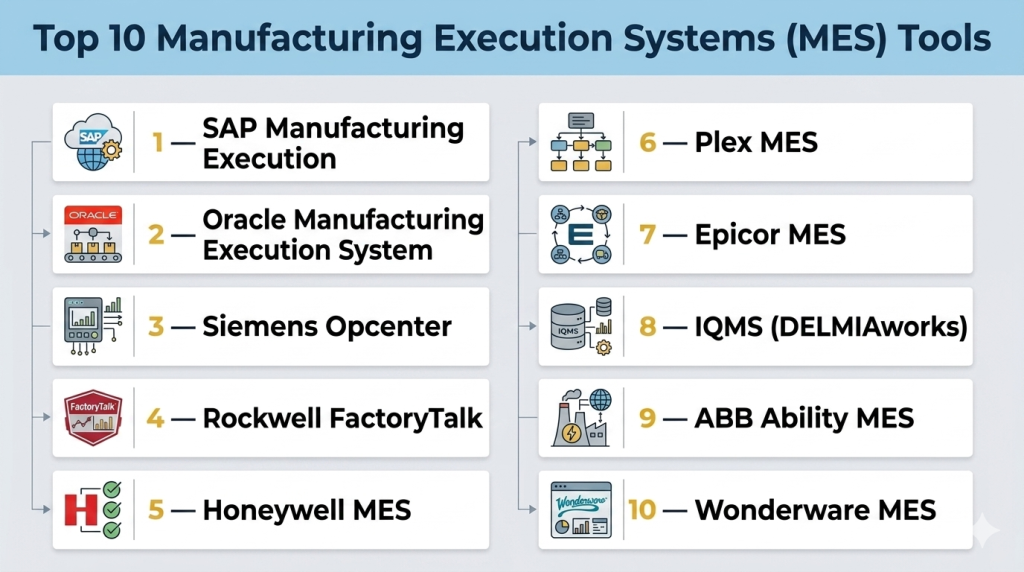
Top 10 Manufacturing Execution Systems (MES) Tools
#1 — SAP Manufacturing Execution
Short description: SAP Manufacturing Execution provides comprehensive production monitoring, scheduling, and quality management for large enterprises. Ideal for manufacturers already using SAP ERP.
Key Features
- Real-time production tracking and shop floor visibility
- Advanced scheduling and capacity planning
- Quality assurance and defect management
- Integration with SAP ERP and SCM
- Analytics dashboards for KPIs
- IoT-enabled predictive maintenance
- Compliance management tools
Pros
- Strong ERP integration for end-to-end operations
- Scalable for large enterprises
Cons
- High cost and complex deployment
- Requires significant training for operators
Platforms / Deployment
- Web, Windows
- Cloud / On-premise / Hybrid
Security & Compliance
- SSO/SAML, MFA, encryption, RBAC
- ISO 27001, SOC 2, GDPR
Integrations & Ecosystem
SAP MES integrates deeply with ERP, PLM, SCADA, and analytics tools.
- SAP ERP
- SAP Supply Chain Management
- IoT Edge devices
- SAP Analytics Cloud
- Third-party SCADA systems
Support & Community
Comprehensive documentation, enterprise-level support tiers, and a strong global user community.
#2 — Oracle Manufacturing Execution System
Short description: Oracle MES streamlines manufacturing operations with real-time monitoring, quality control, and process analytics. Best for enterprises with existing Oracle ERP or supply chain tools.
Key Features
- Production execution tracking
- Quality management and compliance support
- Integration with Oracle ERP Cloud
- Performance analytics dashboards
- Predictive maintenance alerts
- Real-time labor tracking
Pros
- Tight ERP integration for unified operations
- Strong analytics and reporting
Cons
- Can be complex for smaller teams
- Licensing costs may be high
Platforms / Deployment
- Web, Windows
- Cloud / Hybrid
Security & Compliance
- Not publicly stated
Integrations & Ecosystem
Supports Oracle ERP, supply chain modules, IoT platforms, and custom API integrations.
- Oracle ERP Cloud
- Oracle SCM Cloud
- MES connectors for IoT devices
- Analytics tools
Support & Community
Varies; enterprise-level support with professional services available.
#3 — Siemens Opcenter
Short description: Siemens Opcenter MES offers a modular approach to manufacturing operations, focusing on process optimization, quality management, and advanced analytics.
Key Features
- Production execution and traceability
- Quality management and inspection
- Advanced scheduling and dispatching
- IoT integration for smart factories
- Analytics for operational KPIs
- Compliance and audit support
Pros
- Modular deployment allows incremental adoption
- Strong for process industries
Cons
- Can require extensive configuration
- Less suitable for very small manufacturers
Platforms / Deployment
- Windows, Web
- Cloud / On-premise / Hybrid
Security & Compliance
- Not publicly stated
Integrations & Ecosystem
Opcenter integrates with ERP, PLM, and industrial automation systems.
- SAP ERP
- Siemens PLM
- SCADA and PLC systems
- IoT platforms
Support & Community
Strong industrial community with extensive documentation and onboarding support.
#4 — Rockwell FactoryTalk
Short description: Rockwell FactoryTalk MES is designed for discrete and batch manufacturing, providing visibility, control, and analytics across production lines.
Key Features
- Real-time production tracking
- Batch and discrete manufacturing support
- Quality management tools
- Reporting and analytics dashboards
- Integration with Rockwell Automation controllers
Pros
- Excellent for manufacturing process control
- Robust analytics and visualization
Cons
- Limited ERP-agnostic integration
- May require Rockwell ecosystem adoption
Platforms / Deployment
- Windows, Web
- On-premise / Hybrid
Security & Compliance
- Not publicly stated
Integrations & Ecosystem
- Rockwell PLCs and automation devices
- ERP connectors (limited)
- Data historians
Support & Community
Strong industrial support, extensive training programs, and active user forums.
#5 — Honeywell MES
Short description: Honeywell MES provides process industries with monitoring, scheduling, and quality control capabilities. Suited for chemical, energy, and food production sectors.
Key Features
- Real-time production monitoring
- Process quality management
- Predictive maintenance alerts
- Batch execution support
- Analytics and reporting
Pros
- Excellent for continuous process industries
- Strong compliance support
Cons
- May not suit discrete manufacturing
- Requires integration expertise
Platforms / Deployment
- Web, Windows
- Hybrid
Security & Compliance
- Not publicly stated
Integrations & Ecosystem
- Honeywell automation systems
- SCADA integration
- ERP and PLM connectors
Support & Community
Enterprise support with professional services; limited community resources.
#6 — Plex MES
Short description: Plex MES is a cloud-native solution targeting mid-market manufacturers, offering end-to-end production visibility, quality control, and analytics.
Key Features
- Cloud-based production tracking
- Quality and compliance management
- Scheduling and capacity planning
- Real-time analytics dashboards
- ERP and IoT integrations
Pros
- Easy cloud deployment
- Accessible for mid-market manufacturers
Cons
- May lack advanced enterprise features
- Dependent on stable internet
Platforms / Deployment
- Web, Windows, macOS
- Cloud
Security & Compliance
- Not publicly stated
Integrations & Ecosystem
- ERP connectors (Plex ERP, third-party APIs)
- IoT device integration
- Reporting and analytics tools
Support & Community
Comprehensive onboarding and support; growing mid-market user community.
#7 — Epicor MES
Short description: Epicor MES is focused on small to mid-sized manufacturers, offering production monitoring, scheduling, and quality tracking.
Key Features
- Real-time production visibility
- Quality management and audit support
- Shop floor scheduling
- Analytics dashboards
- Integration with Epicor ERP
Pros
- Affordable for smaller teams
- Tight ERP integration
Cons
- Limited scalability for very large enterprises
- Fewer advanced analytics features
Platforms / Deployment
- Web, Windows
- Cloud / On-premise
Security & Compliance
- Not publicly stated
Integrations & Ecosystem
- Epicor ERP
- IoT devices
- Reporting and analytics
Support & Community
Good documentation and support; active mid-market user community.
#8 — IQMS (DELMIAworks)
Short description: IQMS, now part of DELMIAworks, provides MES and ERP functionalities combined for manufacturing monitoring, quality, and compliance.
Key Features
- Production tracking and scheduling
- Quality management
- ERP integration
- Analytics dashboards
- IoT-enabled monitoring
Pros
- Integrated MES and ERP solution
- Strong quality and compliance features
Cons
- ERP tie-in may not suit all companies
- Deployment can be complex
Platforms / Deployment
- Web, Windows
- On-premise / Hybrid
Security & Compliance
- Not publicly stated
Integrations & Ecosystem
- IoT sensors and automation
- PLM integration
- Analytics tools
Support & Community
Enterprise support and moderate community engagement.
#9 — ABB Ability MES
Short description: ABB Ability MES is optimized for process and discrete manufacturing, focusing on production control, quality, and efficiency optimization.
Key Features
- Real-time production monitoring
- Quality assurance tools
- Equipment and energy efficiency analytics
- Batch processing support
- IoT and PLC integration
Pros
- Strong for industrial process optimization
- Energy and resource efficiency tracking
Cons
- May be complex for smaller manufacturers
- Limited non-ABB device support
Platforms / Deployment
- Web, Windows
- Hybrid
Security & Compliance
- Not publicly stated
Integrations & Ecosystem
- ABB automation and control systems
- SCADA/PLC devices
- ERP and analytics platforms
Support & Community
Enterprise-level support; technical documentation available.
#10 — Wonderware MES
Short description: Wonderware MES, part of AVEVA, provides flexible shop floor monitoring, production control, and process optimization, suitable for various manufacturing types.
Key Features
- Real-time production visibility
- Quality and process control
- Scheduling and dispatching
- Reporting and KPI dashboards
- IoT and PLC integrations
Pros
- Flexible for discrete and process manufacturing
- Strong visualization capabilities
Cons
- Can be complex to deploy
- Licensing may be costly
Platforms / Deployment
- Windows, Web
- On-premise / Hybrid
Security & Compliance
- Not publicly stated
Integrations & Ecosystem
- IoT sensors and PLC integration
- ERP connectors
- Analytics dashboards
Support & Community
Comprehensive documentation and professional support; active industrial user community.
Comparison Table (Top 10)
| Tool Name | Best For | Platform(s) Supported | Deployment | Standout Feature | Public Rating |
|---|---|---|---|---|---|
| SAP Manufacturing Execution | Large enterprises | Web, Windows | Cloud / On-premise / Hybrid | ERP integration | N/A |
| Oracle MES | Enterprises with Oracle ERP | Web, Windows | Cloud / Hybrid | Production monitoring & analytics | N/A |
| Siemens Opcenter | Process & discrete manufacturing | Windows, Web | Cloud / On-premise / Hybrid | Modular approach | N/A |
| Rockwell FactoryTalk | Discrete/batch manufacturers | Windows, Web | On-premise / Hybrid | Shop floor control | N/A |
| Honeywell MES | Process industries | Web, Windows | Hybrid | Process optimization | N/A |
| Plex MES | Mid-market manufacturers | Web, Windows, macOS | Cloud | Cloud-native MES | N/A |
| Epicor MES | Small to mid-sized manufacturers | Web, Windows | Cloud / On-premise | Tight ERP integration | N/A |
| IQMS / DELMIAworks | MES + ERP combined | Web, Windows | On-premise / Hybrid | Integrated MES & ERP | N/A |
| ABB Ability MES | Industrial optimization | Web, Windows | Hybrid | Equipment efficiency tracking | N/A |
| Wonderware MES | Flexible manufacturing | Windows, Web | On-premise / Hybrid | Visualization & process monitoring | N/A |
Evaluation & Scoring of Manufacturing Execution Systems (MES)
| Tool Name | Core (25%) | Ease (15%) | Integrations (15%) | Security (10%) | Performance (10%) | Support (10%) | Value (15%) | Weighted Total (0–10) |
|---|---|---|---|---|---|---|---|---|
| SAP Manufacturing Execution | 10 | 7 | 9 | 9 | 9 | 8 | 7 | 8.75 |
| Oracle MES | 9 | 7 | 8 | 8 | 9 | 7 | 6 | 8.05 |
| Siemens Opcenter | 9 | 7 | 8 | 8 | 8 | 7 | 7 | 8.15 |
| Rockwell FactoryTalk | 8 | 7 | 7 | 7 | 8 | 7 | 7 | 7.65 |
| Honeywell MES | 8 | 6 | 7 | 7 | 7 | 6 | 7 | 7.25 |
| Plex MES | 7 | 8 | 7 | 7 | 7 | 7 | 8 | 7.55 |
| Epicor MES | 7 | 8 | 6 | 6 | 7 | 6 | 8 | 7.10 |
| IQMS / DELMIAworks | 8 | 6 | 7 | 7 | 7 | 6 | 7 | 7.30 |
| ABB Ability MES | 8 | 6 | 6 | 6 | 8 | 6 | 7 | 7.10 |
| Wonderware MES | 8 | 7 | 6 | 6 | 7 | 6 | 7 | 7.20 |
Interpretation: Higher weighted totals indicate stronger overall solutions considering feature completeness, ease, integrations, security, performance, support, and value. Scores are comparative within the MES category.
Which Manufacturing Execution Systems (MES) Tool Is Right for You?
Solo / Freelancer
- MES is generally overkill for solo operators. Lightweight production tracking tools or spreadsheets may suffice.
SMB
- Plex MES or Epicor MES offer cloud-native deployment and cost-effective entry into MES, ideal for mid-sized manufacturers.
Mid-Market
- IQMS / DELMIAworks provides combined MES and ERP functionality for streamlined operations with room to scale.
Enterprise
- SAP Manufacturing Execution, Oracle MES, Siemens Opcenter are best suited for complex, multi-site manufacturing operations with integration-heavy environments.
Budget vs Premium
- Plex and Epicor serve budget-conscious companies. SAP, Oracle, and Siemens provide premium capabilities and scalability but at a higher cost.
Feature Depth vs Ease of Use
- Enterprises should prioritize depth and integration (SAP, Oracle, Siemens), while SMBs may benefit from simpler interfaces and faster onboarding (Plex, Epicor).
Integrations & Scalability
- Evaluate MES based on ERP, IoT, PLM, and SCADA connectivity. Enterprise-scale MES typically excels here.
Security & Compliance Needs
- Enterprises with strict compliance or global operations should favor MES with SOC 2, ISO 27001, and GDPR adherence.
Frequently Asked Questions (FAQs)
1. What is the typical pricing model for MES tools?
MES solutions use subscription-based pricing for cloud deployment or perpetual licenses for on-premise setups. Costs vary based on user count, modules, and deployment complexity.
2. How long does implementation usually take?
Deployment can range from a few weeks for mid-market cloud solutions to several months for complex enterprise setups involving ERP integration and multiple sites.
3. Can MES integrate with my existing ERP?
Most MES solutions provide APIs or native connectors for popular ERP systems. Enterprise MES like SAP and Oracle offer deep native integration.
4. Is MES suitable for small manufacturers?
For very small operations, full MES may be overkill. Lightweight tools or spreadsheets may suffice until scaling demands arise.
5. What security features should I look for?
Look for SSO/SAML, MFA, role-based access controls, encryption at rest and in transit, and audit logs. Certifications like ISO 27001 or SOC 2 are ideal.
6. Can MES handle multiple manufacturing sites?
Yes, enterprise MES platforms are designed to manage multi-site operations with centralized monitoring and reporting.
7. How do MES solutions support quality management?
MES tracks production quality metrics, supports inspection workflows, defect reporting, and audit compliance to maintain standards.
8. Are there cloud-based MES options?
Yes, several platforms like Plex MES, Epicor, and Siemens offer cloud or hybrid deployment, enabling remote monitoring and scalability.
9. What are common mistakes in MES implementation?
Over-customization, neglecting user training, poor integration planning, and underestimating data quality needs are frequent pitfalls.
10. What alternatives exist to MES?
For simpler operations, manufacturing teams may use ERP modules, spreadsheets, or basic production tracking tools until MES becomes necessary.
Conclusion
Manufacturing Execution Systems are critical for manufacturers seeking to modernize production, ensure quality, and enhance visibility across the shop floor. Selecting the right MES depends on company size, manufacturing complexity, integration needs, and budget considerations. Enterprises benefit from SAP, Oracle, and Siemens Opcenter for robust, feature-rich platforms, while mid-market companies may find Plex or Epicor MES more accessible. Evaluating security, compliance, and ecosystem integration is essential to future-proof operations. Organizations should shortlist suitable MES tools, run pilot implementations, and validate integrations before full-scale deployment to maximize ROI and operational efficiency

Find Trusted Cardiac Hospitals
Compare heart hospitals by city and services — all in one place.
Explore Hospitals
If machine readings or operator entries are missing or incorrect, the MES may show a misleading picture of production performance. Teams should have simple checks for unusual data and a clear way to correct errors. This helps managers make decisions based on reliable information rather than just real-time data.