Introduction
Bioinformatics Workflow Managers are platforms designed to automate, orchestrate, monitor, and reproduce computational biology pipelines. These tools help researchers manage complex workflows involving genomics, transcriptomics, proteomics, metabolomics, and multi-omics datasets. Instead of manually running scripts and tracking dependencies, workflow managers provide structured, scalable, and reproducible execution environments. bioinformatics workflows are becoming increasingly data-intensive due to advances in sequencing technologies, AI-driven biological modeling, and cloud-native research infrastructure. Organizations now require workflow platforms capable of handling distributed computing, containerized environments, reproducibility standards, and integration with modern HPC and cloud systems.
Real World Use Cases
- Genomics sequencing analysis pipelines for clinical and research environments
- RNA-seq and transcriptomics processing workflows
- Multi-omics integration across proteomics, metabolomics, and genomics
- AI-assisted drug discovery pipelines
- Large-scale population genomics projects
- Single-cell sequencing data orchestration
- Clinical diagnostics workflow automation
- Reproducible scientific research and publication pipelines
- High-performance computing workflow scheduling
- Cloud-native bioinformatics processing
Evaluation Criteria for Buyers
When evaluating Bioinformatics Workflow Managers, buyers should assess:
- Workflow reproducibility capabilities
- Cloud and HPC compatibility
- Container orchestration support
- Scalability for large datasets
- Pipeline portability
- Ease of workflow development
- Monitoring and logging capabilities
- Integration with bioinformatics tools
- Security and compliance controls
- Community ecosystem and long-term support
Best for: Bioinformatics teams, genomics labs, pharmaceutical companies, biotech startups, academic research institutes, clinical sequencing centers, and computational biology teams.
Not ideal for: Small teams running lightweight scripts manually or organizations without large-scale bioinformatics workflow requirements.
Key Trends in Bioinformatics Workflow Managers
- AI-assisted workflow optimization is becoming increasingly common.
- Cloud-native bioinformatics pipelines are replacing traditional on-premise-only environments.
- Kubernetes integration is becoming standard for scalable workflow orchestration.
- Workflow reproducibility and provenance tracking are gaining regulatory importance.
- Containerized bioinformatics pipelines using Docker and Singularity continue expanding.
- Multi-cloud and hybrid deployment support are becoming essential enterprise features.
- Workflow marketplaces and reusable pipeline repositories are growing rapidly.
- GPU acceleration support is improving for AI and omics processing workloads.
- Security expectations are increasing for clinical genomics workflows.
- Integration with AI-driven biological foundation models is emerging as a major trend.
How We Selected These Tools (Methodology)
The tools in this list were selected based on practical adoption, technical maturity, and workflow orchestration capabilities.
- Strong market adoption across bioinformatics communities
- Reliability in production-scale scientific workflows
- Support for reproducibility and workflow portability
- Cloud, HPC, and Kubernetes compatibility
- Integration flexibility with genomics and omics tools
- Scalability for enterprise and research workloads
- Container and orchestration support
- Developer and community ecosystem strength
- Documentation quality and onboarding resources
- Long-term ecosystem relevance for 2026+ bioinformatics workflows
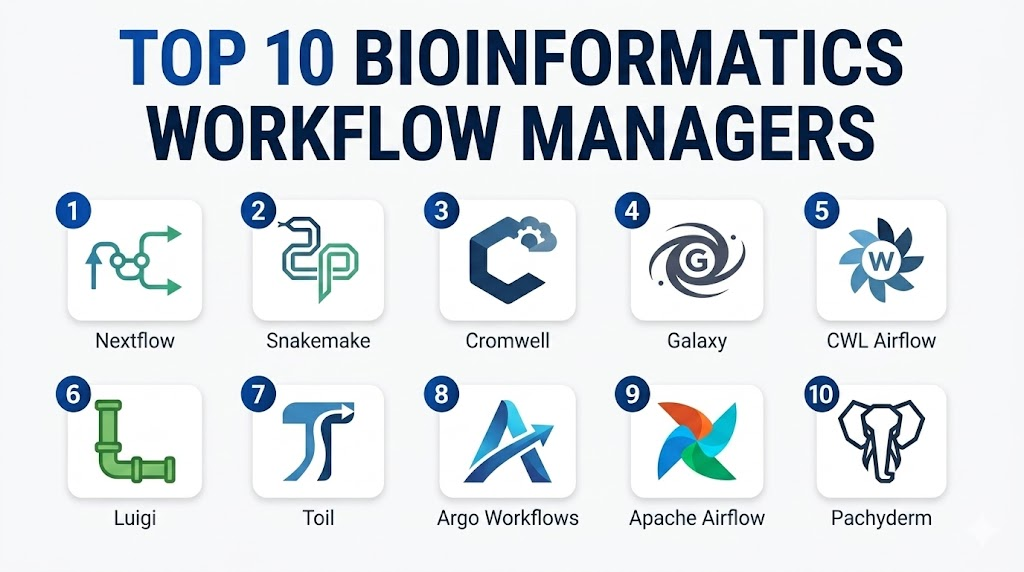
Top 10 Bioinformatics Workflow Managers
1- Nextflow
Short description: Nextflow is one of the most widely adopted workflow managers for scalable and reproducible bioinformatics pipelines. It is heavily used across genomics, transcriptomics, and cloud-native research environments.
Key Features
- DSL-based workflow scripting
- Native cloud and Kubernetes support
- Docker and Singularity integration
- HPC scheduler compatibility
- Workflow reproducibility tracking
- Parallel execution optimization
- nf-core ecosystem integration
Pros
- Excellent scalability across environments
- Strong cloud-native capabilities
- Massive bioinformatics community adoption
Cons
- DSL syntax may require learning time
- Advanced debugging can be complex
- Enterprise governance features vary
Platforms / Deployment
- Linux / macOS
- Cloud / Self-hosted / Hybrid
Security & Compliance
- RBAC and access controls depend on infrastructure deployment
- Not publicly stated for formal compliance certifications
Integrations & Ecosystem
Nextflow integrates deeply with modern cloud, HPC, and bioinformatics ecosystems, making it highly flexible for large-scale scientific computing.
- Kubernetes integration
- AWS Batch support
- Google Cloud compatibility
- Docker and Singularity support
- nf-core pipelines
- HPC scheduler integrations
Support & Community
One of the strongest bioinformatics workflow communities with extensive documentation, tutorials, and enterprise adoption.
2- Snakemake
Short description: Snakemake is a Python-based workflow management system designed for reproducible and scalable bioinformatics analysis pipelines.
Key Features
- Python-based workflow syntax
- Reproducible pipeline execution
- Scalable parallel processing
- Cloud execution support
- HPC scheduler integration
- Conda environment support
- Rule-based dependency management
Pros
- Easy for Python users
- Strong reproducibility model
- Excellent academic adoption
Cons
- Less enterprise-oriented governance
- Complex workflows can become difficult to maintain
- Visualization features are limited
Platforms / Deployment
- Linux / macOS
- Cloud / Self-hosted / Hybrid
Security & Compliance
- Not publicly stated
Integrations & Ecosystem
Snakemake supports extensive integration with modern scientific computing ecosystems and cloud infrastructure.
- Conda integration
- Kubernetes support
- Google Cloud execution
- HPC scheduler compatibility
- Container orchestration support
Support & Community
Large open-source community with strong adoption across genomics and computational biology research.
3- Cromwell
Short description: Cromwell is a workflow execution engine developed for large-scale genomics workflows, especially in clinical sequencing and population genomics environments.
Key Features
- WDL workflow support
- Scalable cloud execution
- Workflow provenance tracking
- HPC compatibility
- Distributed workflow execution
- Retry and fault-tolerance mechanisms
- Genomics workflow optimization
Pros
- Strong genomics focus
- Excellent scalability
- Reliable cloud execution
Cons
- WDL learning curve
- Limited beginner friendliness
- Some deployment complexity
Platforms / Deployment
- Linux
- Cloud / Self-hosted / Hybrid
Security & Compliance
- Security capabilities depend on infrastructure deployment
- Not publicly stated for certifications
Integrations & Ecosystem
Cromwell integrates well with genomics analysis platforms and enterprise-scale cloud workflows.
- Terra platform integration
- Google Cloud support
- HPC scheduler compatibility
- Docker support
- Workflow metadata tracking
Support & Community
Strong adoption in genomics-focused research and population-scale sequencing projects.
4- Galaxy
Short description: Galaxy is a web-based bioinformatics workflow platform designed for accessible and reproducible computational biology analysis.
Key Features
- Visual workflow builder
- Web-based interface
- Reproducibility tracking
- Thousands of integrated tools
- Shared workflow repositories
- User collaboration support
- Cloud deployment compatibility
Pros
- Beginner-friendly interface
- Massive tool ecosystem
- Excellent reproducibility
Cons
- Resource-intensive deployments
- Advanced workflows may require tuning
- Less flexible for developer-heavy environments
Platforms / Deployment
- Web / Linux
- Cloud / Self-hosted / Hybrid
Security & Compliance
- RBAC support available
- Not publicly stated for enterprise compliance certifications
Integrations & Ecosystem
Galaxy supports one of the broadest ecosystems in bioinformatics workflow management.
- Thousands of bioinformatics tools
- Cloud deployment integrations
- Workflow sharing ecosystem
- API support
- Containerized workflows
Support & Community
Large global research community with strong educational and scientific adoption.
5- CWL Airflow
Short description: CWL Airflow combines Apache Airflow orchestration with Common Workflow Language support for scalable scientific workflow execution.
Key Features
- DAG-based orchestration
- CWL workflow support
- Workflow scheduling
- Monitoring dashboards
- Distributed task execution
- Logging and observability
- Cloud execution support
Pros
- Strong orchestration features
- Mature scheduling capabilities
- Flexible workflow monitoring
Cons
- Requires DevOps expertise
- More complex setup
- Not purely bioinformatics-focused
Platforms / Deployment
- Linux
- Cloud / Self-hosted / Hybrid
Security & Compliance
- RBAC support
- Authentication integrations vary by deployment
Integrations & Ecosystem
CWL Airflow integrates with enterprise orchestration and cloud-native infrastructure.
- Kubernetes integration
- Cloud scheduler compatibility
- Monitoring integrations
- Workflow APIs
- Distributed execution support
Support & Community
Benefits from the broader Apache Airflow ecosystem and active workflow orchestration community.
6- Luigi
Short description: Luigi is a workflow orchestration framework designed for pipeline dependency management and scalable task execution.
Key Features
- Dependency-based workflows
- Task scheduling
- Pipeline monitoring
- Batch workflow execution
- Retry and failure handling
- Python workflow management
- Scalable orchestration
Pros
- Lightweight architecture
- Strong dependency handling
- Easy Python integration
Cons
- Limited native bioinformatics tooling
- UI is relatively basic
- Less modern cloud-native focus
Platforms / Deployment
- Linux / macOS
- Self-hosted / Hybrid
Security & Compliance
- Not publicly stated
Integrations & Ecosystem
Luigi integrates with general-purpose workflow and data processing ecosystems.
- Python ecosystem support
- Hadoop compatibility
- Batch processing integrations
- Workflow dependency management
- Monitoring extensions
Support & Community
Well-established open-source community with strong developer adoption.
7- Toil
Short description: Toil is a scalable workflow engine built for large biomedical data processing and cloud-native bioinformatics execution.
Key Features
- Massive-scale workflow execution
- CWL and WDL support
- Cloud-native scalability
- Fault-tolerant execution
- Distributed processing
- Containerized workflow support
- Workflow checkpointing
Pros
- Excellent scalability
- Strong distributed computing support
- Cloud-native design
Cons
- Complex deployment architecture
- Smaller ecosystem than Nextflow
- Requires infrastructure expertise
Platforms / Deployment
- Linux
- Cloud / Hybrid
Security & Compliance
- Infrastructure-dependent security controls
- Not publicly stated for certifications
Integrations & Ecosystem
Toil integrates strongly with distributed computing and cloud-based genomics infrastructure.
- AWS support
- Google Cloud compatibility
- CWL interoperability
- WDL workflow support
- Kubernetes integration
Support & Community
Strong scientific computing community with focus on large-scale genomics processing.
8- Argo Workflows
Short description: Argo Workflows is a Kubernetes-native workflow engine increasingly used for scalable bioinformatics and AI-driven scientific workflows.
Key Features
- Kubernetes-native orchestration
- DAG-based workflows
- Containerized execution
- Cloud-native scalability
- Workflow observability
- GitOps integration
- Distributed processing
Pros
- Excellent Kubernetes integration
- Highly scalable architecture
- Strong cloud-native capabilities
Cons
- Kubernetes expertise required
- Steeper operational complexity
- Bioinformatics templates may require customization
Platforms / Deployment
- Linux
- Cloud / Hybrid
Security & Compliance
- RBAC support
- Kubernetes-native security controls
Integrations & Ecosystem
Argo integrates well with modern DevOps and cloud-native infrastructure ecosystems.
- Kubernetes integration
- GitOps workflows
- Container registries
- CI/CD pipelines
- Monitoring integrations
Support & Community
Large cloud-native community with growing bioinformatics adoption.
9- Apache Airflow
Short description: Apache Airflow is a general-purpose workflow orchestration platform increasingly adapted for computational biology and bioinformatics pipelines.
Key Features
- DAG-based orchestration
- Scheduling and monitoring
- Extensible operator ecosystem
- Distributed execution
- Logging and observability
- API integrations
- Workflow automation
Pros
- Extremely flexible
- Large enterprise ecosystem
- Strong observability features
Cons
- Requires engineering expertise
- Not bioinformatics-specific
- Complex scaling for some workloads
Platforms / Deployment
- Linux
- Cloud / Self-hosted / Hybrid
Security & Compliance
- RBAC support
- Authentication integrations
- Audit logging capabilities vary by deployment
Integrations & Ecosystem
Apache Airflow integrates with extensive enterprise infrastructure and cloud services.
- Kubernetes support
- Cloud provider integrations
- Monitoring tools
- Database connectivity
- CI/CD ecosystem support
Support & Community
Massive open-source ecosystem with enterprise-grade documentation and community support.
10- Pachyderm
Short description: Pachyderm combines data versioning and containerized pipeline orchestration for reproducible bioinformatics workflows.
Key Features
- Data lineage tracking
- Containerized pipelines
- Kubernetes-native execution
- Workflow reproducibility
- Version-controlled datasets
- Distributed processing
- Pipeline automation
Pros
- Strong reproducibility model
- Excellent data versioning
- Cloud-native scalability
Cons
- Kubernetes complexity
- Premium enterprise features
- Smaller bioinformatics ecosystem
Platforms / Deployment
- Linux
- Cloud / Hybrid
Security & Compliance
- RBAC support
- Encryption capabilities vary by deployment
Integrations & Ecosystem
Pachyderm integrates with modern cloud-native infrastructure and data engineering ecosystems.
- Kubernetes integration
- Git-based workflows
- Container orchestration
- Object storage integrations
- CI/CD compatibility
Support & Community
Growing enterprise and scientific computing adoption with strong documentation resources.
Comparison Table (Top 10)
| Tool Name | Best For | Platform(s) Supported | Deployment | Standout Feature | Public Rating |
|---|---|---|---|---|---|
| Nextflow | Enterprise bioinformatics pipelines | Linux, macOS | Hybrid | nf-core ecosystem | N/A |
| Snakemake | Python-based workflows | Linux, macOS | Hybrid | Rule-based workflows | N/A |
| Cromwell | Genomics workflows | Linux | Hybrid | WDL execution | N/A |
| Galaxy | Beginner-friendly workflows | Web, Linux | Hybrid | Visual workflow builder | N/A |
| CWL Airflow | Scientific orchestration | Linux | Hybrid | CWL support | N/A |
| Luigi | Lightweight orchestration | Linux, macOS | Self-hosted | Dependency management | N/A |
| Toil | Distributed genomics processing | Linux | Hybrid | Massive scalability | N/A |
| Argo Workflows | Kubernetes-native workflows | Linux | Hybrid | Cloud-native orchestration | N/A |
| Apache Airflow | Enterprise workflow orchestration | Linux | Hybrid | DAG automation | N/A |
| Pachyderm | Reproducible pipelines | Linux | Hybrid | Data lineage tracking | N/A |
Evaluation & Scoring of Bioinformatics Workflow Managers
| Tool Name | Core 25% | Ease 15% | Integrations 15% | Security 10% | Performance 10% | Support 10% | Value 15% | Weighted Total |
|---|---|---|---|---|---|---|---|---|
| Nextflow | 9 | 8 | 9 | 7 | 9 | 9 | 9 | 8.7 |
| Snakemake | 8 | 8 | 8 | 6 | 8 | 9 | 9 | 8.0 |
| Cromwell | 8 | 7 | 8 | 7 | 9 | 8 | 8 | 8.0 |
| Galaxy | 8 | 9 | 8 | 7 | 7 | 9 | 8 | 8.1 |
| CWL Airflow | 8 | 6 | 8 | 7 | 8 | 8 | 7 | 7.5 |
| Luigi | 7 | 7 | 7 | 6 | 7 | 7 | 8 | 7.1 |
| Toil | 8 | 6 | 8 | 7 | 9 | 7 | 8 | 7.8 |
| Argo Workflows | 9 | 6 | 9 | 8 | 9 | 8 | 8 | 8.3 |
| Apache Airflow | 9 | 7 | 9 | 8 | 8 | 9 | 8 | 8.4 |
| Pachyderm | 8 | 6 | 8 | 8 | 8 | 7 | 7 | 7.6 |
Which Bioinformatics Workflow Manager Is Right for You?
Solo / Freelancer
Independent researchers and smaller computational biology teams may benefit most from Snakemake or Galaxy. These platforms offer relatively easier onboarding and strong reproducibility without requiring large DevOps investments.
SMB
Small biotech startups often prioritize workflow portability and cloud scalability. Nextflow and Cromwell provide excellent balance between scalability and manageable operational complexity.
Mid-Market
Mid-sized genomics and bioinformatics organizations frequently require hybrid deployment support and integration flexibility. Apache Airflow and Argo Workflows are strong options for infrastructure-focused teams.
Enterprise
Large pharmaceutical companies and population genomics programs typically prioritize governance, distributed scalability, workflow reproducibility, and observability. Nextflow, Argo Workflows, and Pachyderm are strong enterprise candidates.
Budget vs Premium
Open-source tools such as Snakemake, Nextflow, and Galaxy provide strong cost efficiency. Enterprise-grade managed infrastructure may introduce additional operational and cloud costs.
Feature Depth vs Ease of Use
Galaxy offers one of the most user-friendly experiences, while Argo Workflows and Pachyderm provide deeper cloud-native infrastructure control for advanced engineering teams.
Integrations & Scalability
Organizations managing large sequencing workloads should prioritize Kubernetes support, cloud integrations, and container orchestration compatibility. Argo Workflows and Nextflow perform particularly well here.
Security & Compliance Needs
Clinical genomics environments should evaluate auditability, workflow traceability, role-based access controls, and deployment security carefully before selecting a workflow platform.
Frequently Asked Questions FAQs
1. What is a bioinformatics workflow manager?
A bioinformatics workflow manager automates computational biology pipelines, manages dependencies, schedules tasks, and improves reproducibility across genomics and omics workflows.
2. Why are workflow managers important in genomics?
Genomics workflows involve massive datasets and complex multi-step pipelines. Workflow managers help automate execution, reduce human error, and improve scalability.
3. Are bioinformatics workflow managers cloud-native?
Many modern platforms such as Nextflow, Argo Workflows, and Toil support cloud-native execution across Kubernetes and major cloud providers.
4. Which workflow manager is easiest for beginners?
Galaxy is often considered one of the most beginner-friendly workflow platforms due to its visual interface and extensive educational resources.
5. Do these tools support containerization?
Yes. Most modern workflow managers support Docker, Singularity, or Kubernetes-based containerized execution environments.
6. What is workflow reproducibility?
Workflow reproducibility ensures that analyses can be rerun consistently using the same inputs, software versions, and computational environments.
7. Can workflow managers integrate with AI pipelines?
Yes. Modern workflow managers increasingly support AI-driven biological workflows, GPU acceleration, and machine learning pipeline orchestration.
8. Are these platforms suitable for enterprise use?
Several tools including Nextflow, Apache Airflow, Argo Workflows, and Pachyderm are widely used in enterprise-scale scientific computing environments.
9. What is the biggest challenge in workflow orchestration?
Infrastructure complexity and scalability management remain major challenges, especially for distributed cloud-native bioinformatics workloads.
10. Should organizations choose open-source or commercial solutions?
Open-source tools provide flexibility and lower licensing costs, while commercial ecosystems may offer stronger enterprise support, governance, and managed infrastructure capabilities.
Conclusion
Bioinformatics Workflow Managers have become essential infrastructure for modern computational biology, genomics, and multi-omics research. As sequencing technologies continue scaling and AI-driven biological modeling grows more advanced, organizations increasingly require workflow platforms capable of delivering reproducibility, automation, scalability, and cloud-native execution. The best workflow manager depends heavily on team expertise, infrastructure maturity, workflow complexity, and long-term scalability goals. Tools such as Nextflow and Snakemake remain dominant in bioinformatics research environments, while Argo Workflows, Apache Airflow, and Pachyderm are driving cloud-native and enterprise-scale orchestration strategies. Instead of searching for a single universal winner, organizations should shortlist two or three platforms, evaluate integration compatibility with existing infrastructure, test reproducibility workflows, and run pilot deployments before committing to long-term adoption.

Find Trusted Cardiac Hospitals
Compare heart hospitals by city and services — all in one place.
Explore Hospitals
Bioinformatics workflow managers are most valuable when they automate complex computational pipelines while ensuring reproducibility and scalability. By orchestrating data processing, workflow execution, resource management, and integration with cloud and high-performance computing environments, these platforms help researchers accelerate genomic analyses, improve collaboration, and produce reliable, reproducible scientific results.