Introduction
Bug bounty platforms are specialized cybersecurity marketplaces that connect organizations with ethical hackers (security researchers) who identify and report vulnerabilities in applications, APIs, and infrastructure. Instead of relying only on internal security teams, companies open their systems to vetted external researchers and pay rewards for valid security findings. bug bounty platforms are becoming a core part of modern application security strategies due to rising API exposure, cloud-native architectures, and AI-driven attack surfaces. Organizations now need continuous, real-world security validation rather than periodic penetration testing.
Real-world use cases
- Identifying vulnerabilities in web applications before attackers exploit them
- Securing APIs used in mobile apps and third-party integrations
- Validating cloud infrastructure configurations for mismanagement risks
- Continuous security testing for CI/CD pipelines
- Reducing breach risk in fintech, healthcare, SaaS, and e-commerce platforms
What buyers should evaluate
- Researcher quality and vetting mechanisms
- Platform moderation and triage efficiency
- Coverage (web, API, mobile, cloud, AI systems)
- Time-to-triage and resolution workflows
- Integration with DevSecOps tools
- Reporting and analytics depth
- Private vs public bounty program support
- Compliance readiness and audit trails
- Payment handling and reward fairness
- Scalability for enterprise programs
Best for:
Security teams, DevSecOps engineers, CISOs, and product security leaders in SaaS, fintech, enterprise IT, and digital-first companies that need continuous vulnerability discovery and global researcher access.
Not ideal for:
Small projects with no security budget, organizations without active engineering teams, or companies that only need one-time penetration testing instead of continuous security validation.
Key Trends in Bug Bounty Platforms
- AI-assisted vulnerability triage to reduce duplicate and low-quality reports
- Expansion from web apps into APIs, cloud assets, and AI model security
- Continuous security testing replacing periodic bug bounty campaigns
- Automated validation of vulnerability reports using sandbox environments
- Increased use of private and invitation-only bounty programs
- Integration with DevSecOps pipelines (CI/CD, SAST, DAST tools)
- Tokenized and reputation-based researcher incentive systems
- Faster payout systems using automated risk scoring models
- Growth of managed bug bounty services alongside platforms
- Stronger compliance mapping for SOC2, ISO, GDPR-driven industries
How We Selected These Tools (Methodology)
- Market adoption across enterprise and mid-market security teams
- Presence of active global researcher communities
- Depth of vulnerability coverage (web, API, mobile, cloud)
- Quality of triage and moderation workflows
- Integration capabilities with modern DevSecOps stacks
- Platform scalability and enterprise readiness
- Security maturity and trust signals
- Reporting, analytics, and risk visibility features
- Ease of onboarding for organizations and researchers
- Reputation for handling payouts and program fairness
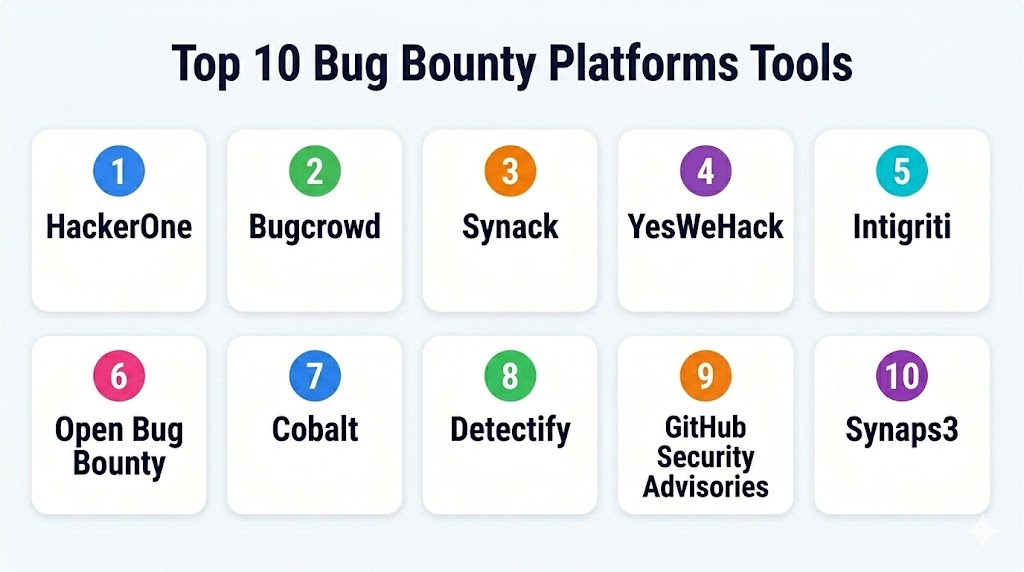
Top 10 Bug Bounty Platforms
1- HackerOne
Short description: HackerOne is one of the largest bug bounty platforms connecting global security researchers with organizations to discover vulnerabilities. It is widely used by enterprises and government agencies.
Key Features
- Public and private bug bounty programs
- Vulnerability disclosure program (VDP) support
- AI-assisted triage and deduplication
- Risk-based vulnerability prioritization
- Automated workflow integration with security tools
- Reputation scoring for researchers
- SLA-based triage and response tracking
Pros
- Large and active global researcher community
- Strong enterprise adoption and maturity
- Excellent triage and reporting workflows
Cons
- Can be expensive for smaller organizations
- High volume of duplicate or low-quality submissions in public programs
Platforms / Deployment
- Web / Cloud
Security & Compliance
- RBAC, audit logs, SSO/SAML support
- Encryption in transit and at rest
- Compliance: Not publicly stated for full certifications
Integrations & Ecosystem
- SIEM tools
- Jira and issue trackers
- Slack notifications
- APIs for automation
- DevSecOps pipelines
Support & Community
Strong documentation, enterprise support tiers, and large global researcher community.
2- Bugcrowd
Short description: Bugcrowd is a leading crowdsourced security platform offering bug bounty programs, penetration testing, and vulnerability disclosure services.
Key Features
- Managed bug bounty programs
- AI-assisted triage and validation
- Asset discovery and attack surface mapping
- Continuous testing workflows
- Private researcher access control
- Reporting dashboards for risk visibility
Pros
- Strong managed service offering
- Flexible program customization
- Good researcher diversity
Cons
- Learning curve for advanced configurations
- Pricing not transparent for all tiers
Platforms / Deployment
- Web / Cloud
Security & Compliance
- SSO, MFA, RBAC, audit logs
- Compliance: Not publicly stated
Integrations & Ecosystem
- Jira, ServiceNow
- Slack, Teams
- SIEM tools
- APIs for automation workflows
Support & Community
Enterprise-grade support with structured onboarding and active researcher ecosystem.
3- Synack
Short description: Synack combines human researchers with AI-driven security validation in a highly controlled, private testing environment.
Key Features
- Curated researcher network (Synack Red Team)
- AI-assisted vulnerability validation
- Continuous penetration testing
- Real-time attack surface monitoring
- Secure sandbox testing environment
- Risk scoring and prioritization
Pros
- High-quality vetted researchers
- Low noise and high signal reports
- Strong enterprise focus
Cons
- More expensive than open bounty platforms
- Limited public researcher pool
Platforms / Deployment
- Web / Cloud
Security & Compliance
- Strong enterprise-grade security controls
- SSO/SAML, encryption, RBAC
- Compliance: Not publicly stated
Integrations & Ecosystem
- DevSecOps tools
- SIEM platforms
- Ticketing systems like Jira
- API-based automation
Support & Community
Premium enterprise support and tightly controlled researcher community.
4- YesWeHack
Short description: YesWeHack is a global bug bounty platform popular in Europe, offering public and private programs with strong GDPR alignment.
Key Features
- Public and private bounty programs
- Vulnerability disclosure programs
- Asset scope management
- Real-time reporting dashboards
- Researcher reputation system
- Compliance-focused workflows
Pros
- Strong European presence
- GDPR-friendly structure
- Flexible program design
Cons
- Smaller researcher base than top US platforms
- Limited advanced AI triage features
Platforms / Deployment
- Web / Cloud
Security & Compliance
- GDPR-oriented design
- SSO and access controls
- Other certifications: Not publicly stated
Integrations & Ecosystem
- Jira integration
- API support
- Slack notifications
- Security tool integrations
Support & Community
Moderate but growing researcher community with responsive support.
5- Intigriti
Short description: Intigriti is a fast-growing European bug bounty platform focused on private programs and enterprise security validation.
Key Features
- Private bug bounty programs
- Security researcher marketplace
- Real-time vulnerability validation
- Automated workflow tracking
- Program scope management
- Reputation-based researcher ranking
Pros
- Strong in EU market
- High-quality private testing focus
- Fast response cycles
Cons
- Smaller global footprint
- Limited public program scale
Platforms / Deployment
- Web / Cloud
Security & Compliance
- GDPR-aligned architecture
- SSO support
- Not publicly stated certifications
Integrations & Ecosystem
- Jira integration
- Slack alerts
- API-based automation
Support & Community
Strong EU-focused support and curated researcher network.
6- Open Bug Bounty
Short description: Open Bug Bounty is a free, community-driven vulnerability disclosure platform focused on responsible disclosure.
Key Features
- Free vulnerability submission model
- Public disclosure reporting
- Web application vulnerability reporting
- No-cost participation for organizations
- Researcher transparency system
- Responsible disclosure workflow
Pros
- Free for organizations
- Easy to onboard
- Good for small businesses
Cons
- Limited triage and moderation
- Lower-quality submissions risk
Platforms / Deployment
- Web / Cloud
Security & Compliance
- Basic disclosure workflows
- Not publicly stated compliance certifications
Integrations & Ecosystem
- Minimal integrations
- Email-based workflows
- Limited API support
Support & Community
Community-driven support with limited enterprise assistance.
7- Cobalt
Short description: Cobalt offers pentesting-as-a-service combined with bug bounty-like workflows for continuous security testing.
Key Features
- On-demand penetration testing
- Continuous security validation
- Managed security researcher access
- Real-time reporting dashboards
- API and web application testing
- Workflow automation tools
Pros
- Hybrid pentest + bounty model
- Fast testing cycles
- Strong enterprise usability
Cons
- Higher cost structure
- Not purely open bounty marketplace
Platforms / Deployment
- Web / Cloud
Security & Compliance
- Enterprise-grade security controls
- SSO, RBAC
- Not publicly stated certifications
Integrations & Ecosystem
- Jira, Slack
- CI/CD pipelines
- API integrations
Support & Community
Strong enterprise support with managed testing teams.
8- Synaps3 (Bug Bounty Alternative Platform Category)
Short description: Emerging platforms like Synaps3 focus on AI-assisted vulnerability detection and managed security testing workflows.
Key Features
- AI-driven vulnerability classification
- Automated triage workflows
- Continuous testing support
- Risk scoring dashboards
- Integration with DevSecOps tools
- Researcher collaboration tools
Pros
- AI-first approach
- Faster triage cycles
- Modern architecture
Cons
- Limited market maturity
- Smaller researcher base
Platforms / Deployment
- Web / Cloud
Security & Compliance
- Not publicly stated
Integrations & Ecosystem
- APIs for DevSecOps tools
- Jira integration
- Security automation pipelines
Support & Community
Varies / Not publicly stated
9- Detectify
Short description: Detectify combines automated attack surface scanning with crowdsourced security intelligence.
Key Features
- Automated web application scanning
- Crowdsourced vulnerability database
- Continuous attack surface monitoring
- Subdomain and asset discovery
- Risk-based vulnerability scoring
- API integration capabilities
Pros
- Strong automation layer
- Good for continuous monitoring
- Easy integration with DevSecOps
Cons
- Not a pure bug bounty marketplace
- Limited manual researcher interaction
Platforms / Deployment
- Web / Cloud
Security & Compliance
- SSO, encryption, RBAC
- Not publicly stated certifications
Integrations & Ecosystem
- SIEM tools
- CI/CD pipelines
- Jira and APIs
Support & Community
Strong documentation and enterprise support.
10- GitHub Security Advisories (Bug Disclosure Ecosystem)
Short description: GitHub provides a vulnerability disclosure ecosystem integrated into repositories for responsible reporting and coordination.
Key Features
- Native vulnerability reporting in repositories
- Coordinated disclosure workflows
- Security advisory publishing
- Dependency vulnerability tracking
- Integration with GitHub ecosystem
- Automated alerts for maintainers
Pros
- Seamless developer integration
- Strong open-source ecosystem support
- Easy vulnerability reporting workflow
Cons
- Not a traditional bug bounty marketplace
- Limited reward mechanisms
Platforms / Deployment
- Web / Cloud
Security & Compliance
- Enterprise-grade GitHub security controls
- SSO, MFA, RBAC
- Compliance: Not publicly stated in detail
Integrations & Ecosystem
- GitHub Actions
- Dependency scanners
- CI/CD pipelines
- Security alerts system
Support & Community
Strong open-source community support.
Comparison Table (Top 10)
| Tool Name | Best For | Platform(s) Supported | Deployment | Standout Feature | Public Rating |
|---|---|---|---|---|---|
| HackerOne | Enterprise bug bounty programs | Web | Cloud | Large researcher network | N/A |
| Bugcrowd | Managed security testing | Web | Cloud | Managed bounty services | N/A |
| Synack | High-security enterprises | Web | Cloud | Curated red team network | N/A |
| YesWeHack | EU compliance-focused orgs | Web | Cloud | GDPR-aligned bounty programs | N/A |
| Intigriti | Private bug bounty programs | Web | Cloud | EU-focused researcher base | N/A |
| Open Bug Bounty | SMB vulnerability disclosure | Web | Cloud | Free disclosure model | N/A |
| Cobalt | Hybrid pentest + bounty | Web | Cloud | On-demand pentesting | N/A |
| Synaps3 | AI-driven security testing | Web | Cloud | AI triage automation | N/A |
| Detectify | Continuous scanning | Web | Cloud | Automated attack surface scanning | N/A |
| GitHub Security Advisories | Open-source security | Web | Cloud | Native repo-based disclosure | N/A |
Evaluation & Scoring of Bug Bounty Platforms
| Tool Name | Core (25%) | Ease (15%) | Integrations (15%) | Security (10%) | Performance (10%) | Support (10%) | Value (15%) | Weighted Total |
|---|---|---|---|---|---|---|---|---|
| HackerOne | 9.5 | 8.5 | 9.0 | 9.5 | 9.0 | 9.0 | 8.0 | 9.0 |
| Bugcrowd | 9.0 | 8.5 | 9.0 | 9.0 | 8.5 | 8.5 | 8.0 | 8.8 |
| Synack | 9.2 | 7.8 | 8.5 | 9.5 | 9.0 | 9.0 | 7.5 | 8.7 |
| YesWeHack | 8.5 | 8.0 | 8.0 | 8.8 | 8.2 | 8.0 | 8.5 | 8.3 |
| Intigriti | 8.3 | 8.2 | 8.0 | 8.5 | 8.0 | 8.0 | 8.2 | 8.2 |
| Open Bug Bounty | 6.5 | 9.0 | 6.0 | 6.5 | 6.0 | 6.5 | 9.5 | 7.2 |
| Cobalt | 8.8 | 8.5 | 8.8 | 9.0 | 8.5 | 9.0 | 7.8 | 8.6 |
| Synaps3 | 7.8 | 8.0 | 8.0 | 8.0 | 8.0 | 7.5 | 8.2 | 7.9 |
| Detectify | 8.0 | 8.5 | 9.0 | 8.5 | 8.5 | 8.0 | 8.3 | 8.4 |
| GitHub Security Advisories | 8.5 | 9.5 | 9.5 | 9.0 | 8.0 | 8.5 | 9.0 | 8.8 |
Which Bug Bounty Platform Tool Is Right for You?
Solo / Freelancer
- Open Bug Bounty
- GitHub Security Advisories
Focus on free access and learning opportunities.
SMB
- YesWeHack
- Intigriti
- Detectify
Best for affordable structured security validation.
Mid-Market
- Bugcrowd
- HackerOne
- Cobalt
Balance between scale, cost, and security coverage.
Enterprise
- HackerOne
- Synack
- Bugcrowd
Best for advanced workflows, compliance, and global researcher access.
Budget vs Premium
- Budget: Open Bug Bounty, GitHub ecosystem
- Premium: Synack, HackerOne enterprise programs
Feature Depth vs Ease of Use
- High depth: Synack, HackerOne
- Easier onboarding: Intigriti, YesWeHack
Integrations & Scalability
- Strongest: HackerOne, Bugcrowd, Detectify
- Lightweight: Open Bug Bounty
Security & Compliance Needs
- Enterprise-grade: Synack, HackerOne
- EU-focused compliance: YesWeHack, Intigriti
Frequently Asked Questions (FAQs)
1- What is a bug bounty platform?
A bug bounty platform connects ethical hackers with companies to identify security vulnerabilities.
Organizations reward researchers for valid findings, improving overall security posture.
2- Are bug bounty platforms safe for companies?
Yes, they are safe when properly configured.
They include controlled scopes, vetted researchers, and structured reporting workflows.
3- How do companies pay researchers?
Payments are based on severity of vulnerabilities.
Critical issues receive higher rewards, processed through platform-managed payout systems.
4- What types of vulnerabilities are reported?
Common issues include SQL injection, XSS, API flaws, authentication bypass, and misconfigurations.
5- Can small businesses use bug bounty platforms?
Yes, many platforms support SMB-friendly or free programs.
However, managing high report volume may require moderation tools.
6- What is the difference between bug bounty and pentesting?
Bug bounty is continuous and crowd-driven.
Pentesting is time-bound and performed by a dedicated security team.
7- How long does triage take?
It varies by platform and severity.
Enterprise platforms often triage critical issues within hours to days.
8- Do bug bounty platforms integrate with DevOps tools?
Yes, most integrate with Jira, Slack, CI/CD pipelines, and SIEM tools.
This helps automate vulnerability response workflows.
9- Can AI replace bug bounty researchers?
AI assists in triage and detection but cannot fully replace human creativity.
Human researchers remain essential for complex vulnerabilities.
10- What industries benefit most?
Fintech, SaaS, healthcare, e-commerce, and government sectors benefit most.
Any organization with digital infrastructure is a candidate.
Conclusion
Bug bounty platforms have become a foundational pillar of modern cybersecurity strategies. As organizations move deeper into cloud-native, API-driven, and AI-powered ecosystems, continuous security validation is no longer optional it is essential. The best platform depends heavily on organizational maturity, budget, and security goals. Enterprises often prefer HackerOne, Synack, or Bugcrowd, while mid-market and SMBs benefit from more flexible platforms like Intigriti, YesWeHack, or Detectify. A practical next step is to shortlist 2–3 platforms, run a pilot program, and evaluate real-world signal quality, integration fit, and triage efficiency before full adoption.

Find Trusted Cardiac Hospitals
Compare heart hospitals by city and services — all in one place.
Explore Hospitals
Bug bounty platforms are most effective when they can properly triage and validate reports without creating friction between researchers and internal security teams. In practice, the real challenge lies in filtering duplicate or low-quality submissions while still encouraging high-skill researchers to engage consistently.