Introduction
Data Governance Platforms are integrated software solutions designed to manage the availability, usability, integrity, and security of data within an enterprise. These platforms establish a blueprint for how data is handled, ensuring that organizational information assets are consistent, trustworthy, and compliant with evolving global regulations. By centralizing data policies, cataloging assets, and tracking data lineage, these tools allow organizations to transform raw information into a strategic asset.
In the current data-driven landscape, the complexity of hybrid-cloud environments and the proliferation of artificial intelligence have made robust governance a necessity rather than an option. Organizations now deal with massive volumes of unstructured data that must be governed to feed machine learning models and ensure ethical AI usage. These platforms act as the connective tissue between IT departments and business users, providing a single source of truth for metadata and data quality metrics.
Real-world use cases:
- Regulatory Compliance: Automating adherence to GDPR, CCPA, and industry-specific mandates through automated PII discovery.
- Data Migration: Ensuring data integrity and mapping lineage during large-scale cloud migration projects.
- Self-Service Analytics: Providing a searchable data catalog that allows analysts to find and trust data without IT intervention.
- AI and Machine Learning: Managing data contracts and quality to ensure that training sets for AI models are accurate and unbiased.
- Risk Management: Identifying and masking sensitive data across the entire storage ecosystem to prevent breaches.
Evaluation criteria for buyers:
- Metadata Management: The ability to automatically harvest and organize technical and business metadata.
- Data Lineage: Visual mapping of data flow from source to consumption points.
- Data Quality Tools: Built-in profiling, cleansing, and monitoring of data health.
- Policy Management: Centralized creation and enforcement of data usage and privacy policies.
- Ease of Integration: Compatibility with the modern data stack, including Snowflake, Databricks, and various ETL tools.
- Search and Discovery: The efficiency of the data catalog in helping users find specific data assets.
- Data Stewardship Workflows: Features for managing roles, approvals, and collaboration between data owners and users.
- Scalability: Performance levels when managing millions of metadata objects across multi-cloud environments.
- Security Controls: Granular role-based access control (RBAC) and data masking capabilities.
- Automation/AI: Utilization of machine learning to automate tagging, classification, and anomaly detection.
Mandatory paragraph
- Best for: Large enterprises, highly regulated industries (finance, healthcare), and data-mature organizations looking to scale AI initiatives and ensure cross-departmental data trust.
- Not ideal for: Early-stage startups with simple data needs, or small businesses with a single, centralized database where manual documentation is still feasible.
Key Trends in Data Governance Platforms for the Modern Era
- Active Metadata Management: Moving from static catalogs to active metadata that triggers automated workflows and alerts based on real-time data changes.
- AI-Augmented Data Stewardship: Leveraging large language models to automatically suggest business descriptions, tags, and classification for undocumented data.
- Data Contracts: The rise of formal agreements between data producers and consumers to ensure data quality and schema stability in decentralized architectures.
- Governance of Generative AI: Specialized modules designed to track the lineage of training data and monitor the outputs of AI models for compliance and bias.
- Decentralized Data Mesh Governance: Shifting from a monolithic “command and control” model to a federated approach where individual business domains manage their own data policies.
- Data Sovereignty and Localization: Increased focus on managing where data resides geographically to comply with strict national data residency laws.
- Integration with FinOps: Linking data usage metadata with cloud costs to help organizations optimize their spend on data processing and storage.
- Automated PII Discovery: High-precision machine learning models that identify and protect sensitive information across structured and unstructured data lakes.
How We Selected These Tools (Methodology)
The selection of the top ten platforms was based on a comprehensive analysis of the current market landscape and technical capabilities. Our methodology includes the following criteria:
- Market Presence and Adoption: Evaluation of the platform’s mindshare among Fortune 500 companies and growing data teams.
- Innovation Velocity: Assessment of how quickly the vendor integrates new technologies like automated lineage and AI-driven tagging.
- Depth of Feature Set: The platform must provide a holistic suite covering cataloging, quality, and policy management.
- Interoperability: The ability of the tool to act as an open “control plane” across diverse cloud and on-premises environments.
- Enterprise Security Signals: Analysis of administrative controls, encryption standards, and audit logging capabilities.
- Customer Satisfaction and Support: Reviewing feedback regarding onboarding complexity and the strength of the user community.
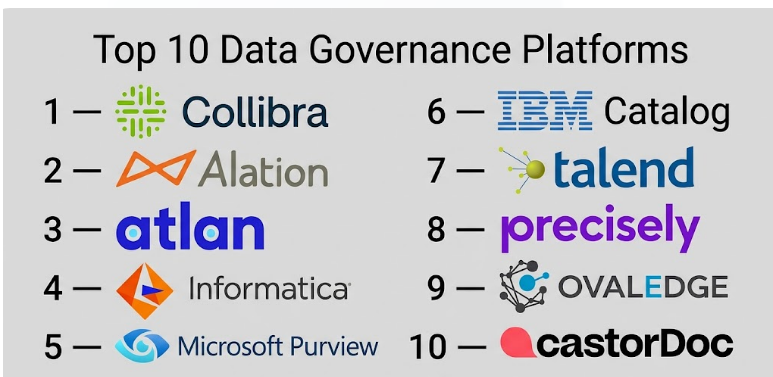
Top 10 Data Governance Platforms
#1 — Collibra
Short description: A premier enterprise-grade data intelligence platform that centralizes data governance, cataloging, and quality management for complex global organizations.
Key Features
- Data Intelligence Cloud: A unified platform that bridges the gap between technical data and business context.
- Automated Lineage: End-to-end visual mapping that tracks data movement from source systems to dashboards.
- Data Stewardship: Highly customizable workflows for managing data requests, approvals, and role assignments.
- Collibra Data Quality: Predictive data quality tools that use machine learning to detect anomalies.
- Policy Manager: A centralized hub for defining and enforcing global data usage and privacy standards.
- Marketplace Integration: A self-service portal for users to find and “shop” for trusted data assets.
Pros
- Extremely robust and scalable, capable of managing millions of metadata assets.
- Best-in-class workflow engine for complex organizational hierarchies.
Cons
- High cost of ownership, making it a significant investment for smaller teams.
- Implementation can be lengthy and often requires specialized consultants.
Platforms / Deployment
- Web / Windows / macOS
- Cloud / Hybrid
Security & Compliance
- SSO/SAML, MFA, RBAC, Encryption at rest and in transit.
- SOC 2 Type II, ISO 27001, GDPR compliant.
Integrations & Ecosystem
Collibra maintains an extensive ecosystem of connectors to ensure it acts as the “source of truth” for the enterprise.
- Snowflake, Databricks, and AWS Redshift.
- Tableau, Power BI, and Looker.
- Informatica, Talend, and Matillion.
- ServiceNow and SAP.
Support & Community
Extensive professional services, “Collibra University” for training, and a mature global community of data governance professionals.
#2 — Alation
Short description: A pioneer in the data catalog space, Alation focuses on using machine learning to improve data discovery and foster a data-driven culture.
Key Features
- Behavioral I/O: Uses machine learning to observe how users query data, automatically suggesting the best assets.
- Data Catalog: An intuitive, wiki-like interface that makes finding data as easy as a web search.
- Trust Checks: Visual indicators that show users whether a data asset is endorsed, warned, or deprecated.
- Compose: An integrated SQL editor that provides smart suggestions and helps users write better queries.
- Governance App: A specialized module that applies governance policies directly into the data discovery workflow.
- Stewardship Workbench: Tools to help stewards manage metadata at scale with automated suggestions.
Pros
- Exceptional user adoption rates due to its intuitive, user-friendly interface.
- Strong focus on “humanizing” data governance through collaboration and crowdsourcing.
Cons
- While strong in cataloging, its data quality features are often supplemented by third-party tools.
- Pricing can increase rapidly as more data sources are added.
Platforms / Deployment
- Web
- Cloud / Self-hosted
Security & Compliance
- SSO, MFA, Granular access permissions.
- SOC 2, ISO 27001, GDPR.
Integrations & Ecosystem
Alation integrates deeply with the modern data stack to capture metadata from across the pipeline.
- Salesforce and Slack.
- Snowflake and Google BigQuery.
- dbt (data build tool).
- Teradata and Oracle.
Support & Community
Active user forums, “Alation University,” and a strong emphasis on community-led best practices for data cataloging.
#3 — Atlan
Short description: A “modern data stack” native platform that focuses on active metadata and seamless integration with cloud-first tools like Snowflake and dbt.
Key Features
- Active Metadata: Dynamically syncs metadata between tools, ensuring policies follow the data wherever it goes.
- Google-like Search: High-performance search interface with advanced filtering for rapid discovery.
- Automated Lineage: Column-level lineage that is automatically generated from SQL logs and integration code.
- Persona-Based Access: Allows administrators to define data access policies based on user roles and projects.
- Embedded Governance: Brings governance insights directly into tools like Slack, Chrome, or BI dashboards.
- Data Contracts Monitoring: Helps teams define and monitor schemas to prevent breaking changes in the pipeline.
Pros
- Fastest implementation time among enterprise-grade platforms.
- Deep, native integrations with modern tools like Snowflake, dbt, and Fivetran.
Cons
- Primarily optimized for cloud-native stacks; may not be ideal for legacy on-premises environments.
- The high pace of feature updates requires teams to stay current with new platform changes.
Platforms / Deployment
- Web
- Cloud
Security & Compliance
- SSO, SAML, RBAC, Data Masking.
- SOC 2 Type II, HIPAA, GDPR.
Integrations & Ecosystem
Designed to be the center of a cloud-first data ecosystem.
- Snowflake, BigQuery, and Redshift.
- dbt, Fivetran, and Airflow.
- Tableau and Power BI.
- GitHub and Slack.
Support & Community
Responsive support teams and a growing community focused on the “Metadata Era” of data management.
#4 — Informatica Cloud Data Governance and Catalog
Short description: A comprehensive, AI-powered governance solution that is part of the broader Informatica Intelligent Data Management Cloud (IDMC).
Key Features
- CLAIRE AI: A powerful machine learning engine that automates data discovery and classification.
- Integrated Quality: Seamless connection between governance policies and data quality execution.
- Privacy Portal: Dedicated features for managing data subject access requests (DSARs) and privacy compliance.
- Full Lineage: Deep technical lineage that handles complex ETL logic and legacy systems.
- Business Glossary: A centralized repository for defining business terms and linking them to technical assets.
- Scorecards: Visual dashboards that monitor governance progress and data health across the organization.
Pros
- Unrivaled ability to handle hybrid and legacy environments alongside modern cloud stacks.
- One-stop-shop for organizations already utilizing Informatica’s integration tools.
Cons
- The interface can feel complex and “heavy” compared to newer, cloud-native entrants.
- Licensing and modular pricing can be difficult to navigate.
Platforms / Deployment
- Web
- Cloud / Hybrid
Security & Compliance
- Enterprise-grade SSO, MFA, RBAC.
- SOC 2, ISO 27001, HIPAA, FedRAMP (specific versions).
Integrations & Ecosystem
Leverages decades of connectivity expertise to link virtually any system.
- SAP, Oracle, and Microsoft SQL Server.
- Azure Data Lake and AWS S3.
- Workday and Microsoft Dynamics.
- All major BI platforms.
Support & Community
Global professional support network, extensive training programs, and a massive legacy community.
#5 — Microsoft Purview
Short description: An integrated governance service that helps manage data across on-premises, multi-cloud, and SaaS environments, specifically optimized for the Microsoft ecosystem.
Key Features
- Data Map: Automatically populates and keeps the metadata map up-to-date across all sources.
- Data Catalog: Allows users to browse and search for data using a unified interface.
- Information Protection: Uses sensitivity labels to classify and protect data based on content.
- Estate Insights: Visual reports on data health, sensitivity, and governance coverage.
- Workflow Engine: Automates common governance tasks like data access requests and business glossary approvals.
- Data Sharing: Securely share data with internal or external users without moving the underlying files.
Pros
- Deep, native integration with Azure, Microsoft 365, and Power BI.
- Cost-effective for organizations already committed to the Microsoft cloud ecosystem.
Cons
- Advanced features can be complex to configure across non-Microsoft cloud environments.
- The catalog interface is less “social” or collaborative compared to Alation or Atlan.
Platforms / Deployment
- Web / Azure Portal
- Cloud / Hybrid
Security & Compliance
- Integrated with Azure Active Directory (SSO/MFA), RBAC, Customer Lockbox.
- Extensive global compliance portfolio (ISO, SOC, HIPAA, FedRAMP).
Integrations & Ecosystem
Primary focus is on Microsoft environments but expanding rapidly to third-party sources.
- Azure Synapse, SQL Server, and Cosmos DB.
- Amazon S3 and SAP.
- Power BI and Microsoft 365.
- Teradata and Cassandra.
Support & Community
Backed by Microsoft’s global support organization and integrated into the Azure documentation ecosystem.
#6 — IBM Knowledge Catalog
Short description: A cloud-based enterprise metadata repository that is part of the IBM Cloud Pak for Data, focusing on high-end AI and data science workflows.
Key Features
- Intelligent Discovery: Uses machine learning to automatically assign terms and classes to data.
- Automated Data Masking: Dynamic masking of sensitive data based on policy and user role.
- Lineage and Impact Analysis: Visualizes how changes in source systems will affect downstream reports.
- Data Quality Profiling: Integrated profiling that assigns quality scores to every dataset.
- Watson Integration: Leverages IBM Watson for advanced natural language understanding of metadata.
- Collaborative Reviews: Allows users to rate, review, and comment on datasets within the catalog.
Pros
- Superior capabilities for organizations focused on governed AI and data science.
- Excellent handling of unstructured data classification.
Cons
- Best suited for users already within the IBM Cloud Pak for Data ecosystem.
- Can be resource-intensive to deploy and maintain.
Platforms / Deployment
- Web
- Cloud / Hybrid / Self-hosted (via OpenShift)
Security & Compliance
- SSO, MFA, Fine-grained RBAC, Dynamic Masking.
- SOC 2, ISO 27001, GDPR.
Integrations & Ecosystem
Integrates well with enterprise-grade data sources and IBM’s broader data portfolio.
- IBM Db2 and Informix.
- Hadoop and Spark.
- Microsoft and Amazon cloud storage.
- OpenPages for risk and compliance.
Support & Community
Global enterprise support from IBM and a large community of data scientists and architects.
#7 — Talend (A Qlik Company) Data Fabric
Short description: A unified platform for data integration and governance that focuses on “Data Health” and ensuring trust in the data pipeline.
Key Features
- Talend Trust Score: A unique single metric that rates the health and reliability of any dataset.
- Self-Service Data Prep: Allows business users to clean and enrich data while maintaining governance.
- Automated Harvesting: Connectors that pull metadata from a wide range of databases and file systems.
- Lineage Visualizer: Provides clear insight into how data was transformed and moved.
- Data Stewardship App: A dedicated interface for stewards to resolve data quality issues manually.
- Unified API Management: Governs how data is accessed and shared via internal and external APIs.
Pros
- Tight integration between data integration (ETL) and data governance.
- The Trust Score provides a simple way for non-technical users to understand data quality.
Cons
- Recently acquired by Qlik, leading to some uncertainty regarding long-term product roadmaps.
- Governance features are strong but may feel less “specialized” than pure-play platforms like Collibra.
Platforms / Deployment
- Web / Windows / macOS / Linux
- Cloud / Hybrid / Self-hosted
Security & Compliance
- SSO, MFA, RBAC, Data encryption.
- SOC 2, ISO 27001.
Integrations & Ecosystem
Excellent connectivity across both on-premises and cloud environments.
- AWS, Azure, and Google Cloud.
- Salesforce, SAP, and NetSuite.
- Snowflake and Databricks.
- Kafka and RabbitMQ.
Support & Community
Strong professional support and an active developer community known as Talend Forge.
#8 — Precisely Data360
Short description: An enterprise governance platform with a deep focus on data integrity, specifically for organizations with complex regulatory and financial reporting needs.
Key Features
- Data Integrity Suite: Focuses on the accuracy, consistency, and context of data.
- Automated Quality Monitoring: Continuous checks that alert users when data falls outside of defined standards.
- Impact Analysis: Deep visibility into how data changes affect upstream and downstream systems.
- Financial Reconciliation: Specialized features for ensuring data matches across different financial records.
- Business Glossary: A flexible hub for managing definitions and organizational standards.
- Metadata Harvesting: Broad support for legacy mainframe systems alongside modern cloud databases.
Pros
- Unrivaled focus on data integrity and financial accuracy.
- Excellent support for complex legacy environments (Mainframe, IBM i).
Cons
- The user interface may feel less modern compared to newer cloud-native competitors.
- Requires a more technical setup for advanced custom governance workflows.
Platforms / Deployment
- Web
- Cloud / Hybrid / Self-hosted
Security & Compliance
- MFA, SSO, RBAC.
- SOC 2, ISO 27001.
Integrations & Ecosystem
Unique strength in integrating with legacy enterprise systems.
- IBM Mainframe and AS/400.
- SAP and Oracle EBS.
- Modern cloud warehouses (Snowflake).
- ESRI (for geospatial data integrity).
Support & Community
Professional services-heavy support model with deep expertise in regulatory compliance.
#9 — OvalEdge
Short description: A versatile and affordable data governance platform that combines a data catalog with sophisticated data quality and privacy tools.
Key Features
- AI-Based Lineage: Automatically builds lineage by parsing SQL logs and stored procedures.
- Data Access Management: Built-in tools for managing and approving data access requests.
- Data Masking: Dynamic masking of PII at the source or during the query process.
- Governance Workflows: Simple but effective approval processes for metadata changes.
- Query Tool: An integrated SQL editor that allows users to query data directly from the catalog.
- Anomaly Detection: Uses statistical modeling to identify data quality outliers.
Pros
- Highly competitive pricing makes it accessible for mid-market companies.
- Includes many features (like querying and masking) that often require separate tools.
Cons
- The community and third-party ecosystem are smaller than those of market leaders.
- The interface is functional but lacks the high-end polish of platforms like Alation.
Platforms / Deployment
- Web
- Cloud / Self-hosted
Security & Compliance
- SSO, MFA, RBAC, PII Masking.
- SOC 2, GDPR.
Integrations & Ecosystem
Supports a wide range of standard data sources.
- MySQL, PostgreSQL, and SQL Server.
- Snowflake and BigQuery.
- Tableau, Power BI, and Qlik.
- S3 and Azure Blob Storage.
Support & Community
Dedicated support for onboarding and an emerging user base in the mid-market segment.
#10 — CastorDoc
Short description: A modern, automated data catalog designed for high-growth data teams who need a “no-maintenance” metadata management solution.
Key Features
- Automated Documentation: Uses AI to document tables and columns based on usage patterns.
- Seamless Lineage: Automatically maps how data flows between your warehouse and BI tools.
- Slack Integration: Brings the data catalog directly into your communication workflow.
- Popularity Scores: Shows which datasets are most used, helping users find the most reliable assets.
- dbt Integration: Native sync with dbt documentation for a unified view of the data stack.
- Low-Code Setup: Designed to be up and running in hours rather than months.
Pros
- Extremely lightweight and easy to maintain for lean data teams.
- Excellent user experience that encourages broad adoption across the business.
Cons
- Lacks the heavy-duty policy and stewardship workflows found in enterprise platforms like Collibra.
- Currently more focused on cloud-native environments than hybrid/on-premises setups.
Platforms / Deployment
- Web
- Cloud
Security & Compliance
- SSO, RBAC.
- SOC 2 Type II, GDPR.
Integrations & Ecosystem
Optimized for the modern cloud data stack.
- Snowflake, BigQuery, and Redshift.
- dbt and Looker.
- Tableau and Metabase.
- Slack and Notion.
Support & Community
High-touch support for modern data teams and a focus on the “Data Discovery” community.
Comparison Table (Top 10)
| Tool Name | Best For | Platform(s) Supported | Deployment | Standout Feature | Public Rating |
|---|---|---|---|---|---|
| Collibra | Large Enterprise | Web, Win, Mac | Hybrid | Data Intelligence Cloud | 4.6/5 |
| Alation | User Adoption | Web | Cloud / Self-hosted | Behavioral I/O Querying | 4.5/5 |
| Atlan | Modern Data Stack | Web | Cloud | Active Metadata Sync | 4.8/5 |
| Informatica | Hybrid/Complex IT | Web | Cloud / Hybrid | CLAIRE AI Engine | 4.3/5 |
| Microsoft Purview | Azure Ecosystem | Web | Cloud / Hybrid | M365 Sensitivity Labels | 4.2/5 |
| IBM Catalog | AI & Data Science | Web | Cloud / Hybrid | Watson Data Mapping | 4.4/5 |
| Talend | Data Health/ETL | Web, Win, Mac, Lin | Cloud / Hybrid | Talend Trust Score | 4.4/5 |
| Precisely | Data Integrity | Web | Cloud / Hybrid | Legacy Mainframe Support | 4.1/5 |
| OvalEdge | Mid-Market Value | Web | Cloud / Self-hosted | Integrated SQL Querying | 4.3/5 |
| CastorDoc | Lean Cloud Teams | Web | Cloud | Automated Documentation | 4.7/5 |
Evaluation & Scoring of Data Governance Platforms
This scoring model uses a weighted system to compare how each platform performs against the core pillars of a modern governance strategy.
| Tool Name | Core (25%) | Ease (15%) | Integrations (15%) | Security (10%) | Performance (10%) | Support (10%) | Value (15%) | Weighted Total |
|---|---|---|---|---|---|---|---|---|
| Collibra | 10 | 4 | 9 | 9 | 10 | 9 | 5 | 8.15 |
| Alation | 8 | 9 | 8 | 8 | 9 | 8 | 7 | 8.05 |
| Atlan | 8 | 9 | 10 | 8 | 9 | 9 | 8 | 8.65 |
| Informatica | 10 | 4 | 9 | 9 | 9 | 8 | 6 | 7.85 |
| Microsoft Purview | 7 | 6 | 7 | 10 | 8 | 9 | 9 | 7.60 |
| IBM Catalog | 9 | 5 | 8 | 9 | 9 | 8 | 6 | 7.60 |
| Talend | 8 | 7 | 8 | 8 | 8 | 8 | 8 | 7.85 |
| Precisely | 9 | 5 | 7 | 8 | 8 | 8 | 7 | 7.35 |
| OvalEdge | 7 | 7 | 7 | 8 | 8 | 7 | 9 | 7.40 |
| CastorDoc | 6 | 10 | 8 | 7 | 8 | 8 | 9 | 7.85 |
Scoring Interpretation:
- Core (25%): Measures the depth of cataloging, lineage, and policy features.
- Ease (15%): Evaluates how quickly a business user can become productive.
- Integrations (15%): Assesses the breadth and depth of connectors.
- Value (15%): Considers the feature set relative to the cost and maintenance burden.
Which Data Governance Platform Tool Is Right for You?
Solo / Freelancer
Generally, individual freelancers do not need a full governance platform. However, if you are a consultant helping clients manage their data, CastorDoc or Blender (for visualization needs) are excellent for documentation. CastorDoc is particularly useful for small projects due to its low setup time.
SMB
Small and medium-sized businesses should prioritize OvalEdge or CastorDoc. These platforms offer a lower entry price point and focus on “immediate value” features like cataloging and automated discovery, which are more critical for growing teams than complex policy workflows.
Mid-Market
For companies with 500–2,000 employees, Atlan or Alation are the standout choices. Atlan is ideal if you are heavily invested in a cloud-native stack (Snowflake/dbt), while Alation is better if you want to foster a collaborative culture where non-technical users contribute to data documentation.
Enterprise
Global organizations with thousands of data assets and complex regulatory requirements should choose Collibra or Informatica. These tools are built to handle the “heavy lifting” of global policy enforcement, complex data stewardship workflows, and massive metadata scalability.
Budget vs Premium
- Budget: OvalEdge, Microsoft Purview (if already on Azure).
- Premium: Collibra, Alation, Informatica.
Feature Depth vs Ease of Use
- Depth-First: Informatica, Collibra, IBM Knowledge Catalog.
- Ease-First: CastorDoc, Alation, Atlan.
Integrations & Scalability
- Modern Cloud Integration: Atlan, CastorDoc.
- Legacy/Hybrid Integration: Informatica, Precisely, IBM.
Security & Compliance Needs
Organizations in finance or healthcare with extreme security needs should prioritize Microsoft Purview (for its sensitivity labeling) or Collibra (for its mature policy management engine).
Frequently Asked Questions (FAQs)
- What is the difference between a Data Catalog and a Data Governance Platform?
A data catalog is primarily a search-and-discovery tool for finding data assets. A governance platform is broader, including cataloging as well as policy enforcement, data quality, lineage, and stewardship workflows. - How much do these platforms typically cost?
Pricing varies wildly. Mid-market tools may start at $20,000–$40,000 annually, while enterprise platforms like Collibra can easily exceed $150,000–$250,000 depending on modules and users. - Can these tools automate the removal of PII?
Most platforms can identify and tag PII (Personally Identifiable Information) automatically. Some can even trigger masking or anonymization, but the actual “removal” usually happens in the underlying database or ETL pipeline. - Is it possible to govern data across different cloud providers?
Yes, most of the “Top 10” tools are cloud-agnostic. For example, Atlan and Alation can govern data residing in AWS S3, Google BigQuery, and Snowflake simultaneously. - How long does a typical implementation take?
For modern tools like CastorDoc or Atlan, you can see value in a few weeks. For enterprise giants like Informatica or Collibra, full organizational rollouts often take 6 to 12 months. - Do these platforms require a dedicated team to manage?
Enterprise platforms usually require at least one dedicated administrator and a group of “Data Stewards.” Leaner, cloud-native tools are designed to be managed part-time by a data engineer. - How do these tools help with AI development?
They provide the “provenance” of data used to train AI. They ensure that the data is high quality, documented, and that the organization has the legal right to use it for training purposes. - Can I use these platforms for on-premises data?
Yes, tools like Informatica, IBM, and Precisely have deep experience and specialized connectors for on-premises databases and legacy mainframe systems. - What is “Active Metadata” and why should I care?
Active metadata is metadata that “does things.” Instead of just sitting in a catalog, it can automatically alert a user in Slack if a dataset’s quality drops or automatically mask a column if it detects sensitive data. - Do these platforms replace the need for data engineers?
No, they empower data engineers. By automating documentation and access requests, these platforms free up engineers from repetitive manual tasks, allowing them to focus on building data products.
Conclusion
Data Governance Platforms have evolved from simple repositories into intelligent command centers for the modern data estate. While Collibra and Informatica remain the titans for complex global enterprises, the rise of “Active Metadata” platforms like Atlan and automated catalogs like CastorDoc has made governance accessible to teams of all sizes.The “best” platform is the one that fits your specific data stack and organizational culture. For your next step, we recommend identifying your top three data “pain points”—whether it’s discovery, quality, or compliance—and running a pilot program with two tools that align with your current infrastructure.

Find Trusted Cardiac Hospitals
Compare heart hospitals by city and services — all in one place.
Explore Hospitals
Data governance platforms are most valuable when they help organizations establish consistent policies, ownership, standards, and controls for managing data across the enterprise. By providing data cataloging, metadata management, data lineage, business glossaries, data ownership, policy management, access controls, data quality monitoring, compliance tracking, privacy management, and governance workflows, these platforms enable organizations to improve data trust, strengthen security and regulatory compliance, clarify accountability, reduce data-related risks, and support more consistent data-driven decision-making.