Introduction
Data visualization tools are software applications designed to transform raw, complex datasets into graphical representations such as charts, graphs, heatmaps, and dashboards. In an era where organizations generate petabytes of information, these tools act as the essential bridge between raw data and actionable intelligence. By leveraging human visual perception, they enable stakeholders to identify patterns, correlations, and outliers that would remain hidden in standard spreadsheets or databases.
In the current data-driven landscape, the ability to visualize data in real-time is a core business requirement. As we move further into visualization is no longer just about static reporting; it is about interactive storytelling and predictive analytics. From monitoring global supply chains to tracking customer sentiment, these tools allow decision-makers to react with speed and precision.
Real-world use cases:
- Executive Dashboards: Providing high-level KPIs for C-suite executives to monitor organizational health.
- Financial Reporting: Visualizing market trends, revenue growth, and budget variances over time.
- Healthcare Analytics: Tracking patient outcomes and disease spread through geographic heatmaps.
- Marketing Analytics: Measuring campaign performance and customer journey funnels across digital channels.
- Scientific Research: Mapping complex experimental results and genomic data for peer review and discovery.
Evaluation criteria for buyers:
- Data Connectivity: Ease of connecting to SQL databases, cloud storage (AWS/Azure), and SaaS apps.
- Visual Variety: Range of available chart types, from basic bars to complex Sankey and chord diagrams.
- Ease of Use: Balance between “drag-and-drop” simplicity and deep customization for power users.
- Real-Time Capabilities: Ability to handle live data streams with minimal latency.
- Interactivity: Support for drill-downs, filters, and cross-tabulation within the visual interface.
- AI and ML Integration: Features like automated insight generation and natural language querying (NLQ).
- Mobile Accessibility: Quality of the experience on smartphones and tablets for remote monitoring.
- Collaboration: Features for shared workspaces, commenting, and version control.
- Security: Enterprise-grade encryption, row-level security, and compliance certifications.
- Scalability: Performance levels when handling millions or billions of rows of data.
Best for: Data analysts, business intelligence (BI) professionals, and department heads who need to translate complex data into clear, visual stories for decision-making.
Not ideal for: Pure data engineering tasks (ETL), deep statistical modeling without a visual component, or users who only require basic, static tables.
Key Trends in Data Visualization Tools
- Augmented Analytics: The use of machine learning to automatically suggest the best visualization type based on the data structure.
- Natural Language Querying (NLQ): Allowing users to type a question like “What were our sales in India last quarter?” and instantly generating a chart.
- Immersive Data (AR/VR): The emergence of three-dimensional data environments for exploring complex spatial or architectural datasets.
- Mobile-First Dashboards: A shift toward “snackable” data visuals optimized for vertical mobile screens and push notifications.
- Data Storytelling Frameworks: Moving beyond isolated charts toward narrative-driven presentations that guide the viewer through a logical “data story.”
- Automated Data Governance: Visualization tools now increasingly include built-in lineage and metadata tracking to ensure data accuracy.
- Embedded Analytics: The trend of integrating visualization capabilities directly into third-party SaaS applications via APIs.
- Edge Visualization: Processing and visualizing data directly on local devices or IoT sensors to reduce cloud latency.
How We Selected These Tools (Methodology)
To select the top 10 data visualization platforms, we applied a standardized evaluation methodology focused on technical maturity and market impact:
- Market Presence: Selection of tools with high adoption rates in enterprise and mid-market segments.
- Feature Richness: Prioritization of platforms that offer a complete BI stack (data prep, analysis, and visual).
- Integration Ecosystem: Analysis of how well the tool fits into modern data stacks (Snowflake, Databricks, etc.).
- Innovation Velocity: Evaluating the rollout of AI and automated insights over the past two years.
- Security Infrastructure: Checking for robust administrative controls and data protection protocols.
- Performance Benchmarking: Reviewing how the tools manage large-scale data rendering and user concurrency.
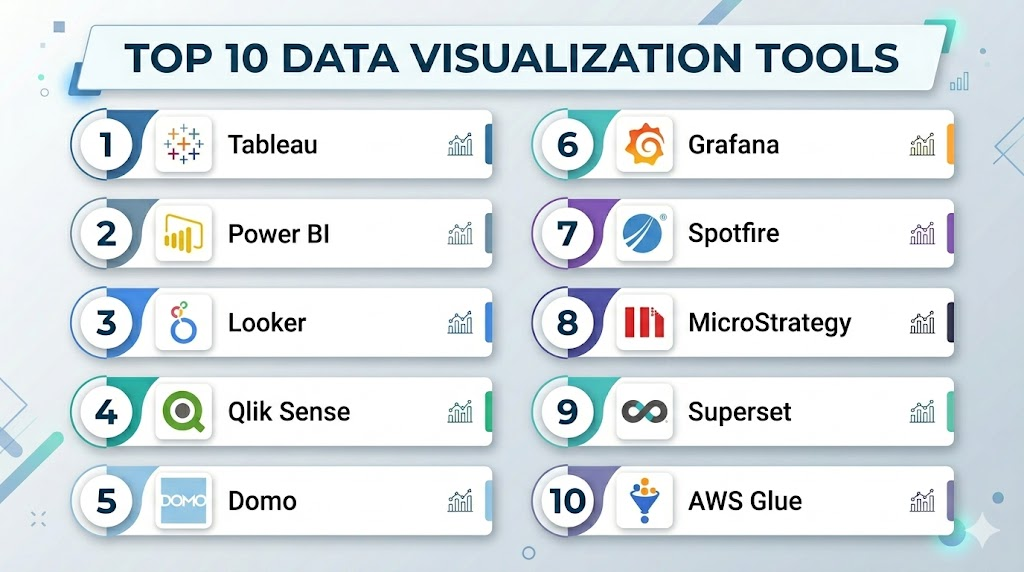
Top 10 Data Visualization Tools
#1 — Tableau
Short description: Widely regarded as the industry leader in data visualization, Tableau is known for its powerful engine and highly customizable, interactive dashboards.
Key Features
- VizQL Technology: A patented language that translates drag-and-drop actions into data queries.
- Tableau Pulse: An AI-powered insight generator that proactively delivers personalized data digests.
- Ask Data: Allows users to build visualizations using natural language queries.
- Data Blend: Seamlessly combines data from multiple sources without needing complex SQL joins.
- Advanced Mapping: Best-in-class geographic visualization with built-in postal code and administrative boundary data.
- Tableau Exchange: A marketplace for pre-built dashboard extensions and connectors.
Pros
- Unrivaled flexibility in creating complex, highly specific visual layouts.
- Massive community of users providing endless templates and support.
Cons
- Licensing costs are among the highest in the industry.
- Steep learning curve for advanced calculations and data blending.
Platforms / Deployment
- Windows / macOS
- Cloud / Self-hosted / Hybrid
Security & Compliance
- SSO/SAML, MFA, Row-level security, RBAC.
- SOC 2, ISO 27001, GDPR.
Integrations & Ecosystem
Tableau integrates deeply with the Salesforce ecosystem and various modern data warehouses.
- Salesforce CRM
- Snowflake / BigQuery / Redshift
- Slack (for data alerts)
- Python and R (for statistical modeling)
Support & Community
Extensive documentation, “Tableau Public” for community sharing, and dedicated enterprise support for corporate clients.
#2 — Microsoft Power BI
Short description: A dominant player in the BI space, Power BI is favored for its deep integration with the Microsoft 365 suite and its aggressive pricing model.
Key Features
- Power Query: A robust data transformation and cleaning engine built directly into the interface.
- DAX (Data Analysis Expressions): A powerful formula language for creating complex custom metrics.
- Quick Insights: Uses machine learning to find hidden trends and patterns in your data automatically.
- Copilot in Power BI: AI-assisted report generation and DAX writing.
- Paginated Reports: Capability to create pixel-perfect, print-ready reports for operational needs.
- Seamless Excel Integration: Allows users to push data back and forth between Excel and Power BI dashboards.
Pros
- Lowest cost of entry for organizations already using Microsoft 365.
- Extremely easy to adopt for users familiar with Excel’s logic.
Cons
- The desktop version is Windows-only, which can be a barrier for Mac users.
- Can become sluggish when handling extremely complex DAX measures on large datasets.
Platforms / Deployment
- Windows / Web / iOS / Android
- Cloud / Hybrid
Security & Compliance
- Microsoft Entra ID (formerly Azure AD), MFA, Private Links.
- HIPAA, FedRAMP, SOC 2, ISO 27001.
Integrations & Ecosystem
Designed to be the visual layer of the Microsoft Dataverse.
- Microsoft Teams / SharePoint
- Azure Synapse Analytics
- Dynamics 365
- SQL Server
Support & Community
Massive user base, integrated Microsoft support channels, and a high volume of community-driven documentation.
#3 — Google Looker
Short description: A modern, browser-based data platform that emphasizes a “single source of truth” through its unique data modeling language.
Key Features
- LookML: A powerful modeling language that centralizes business logic and prevents metric silos.
- Looker Blocks: Pre-built pieces of code for common analytical patterns and visualizations.
- Embedded Analytics: Robust APIs for integrating dashboards into third-party customer portals.
- Real-Time Data Access: Queries go directly to the database, ensuring visuals are always live.
- Git Integration: Built-in version control for data models and dashboard configurations.
- Action Hub: Allows users to trigger workflows (like sending an email) directly from a chart.
Pros
- Ensures that everyone in the organization is looking at the same metrics.
- True web-native experience with no desktop software to manage.
Cons
- Requires knowledge of LookML (SQL-like code) to set up effectively.
- Can be expensive as it is geared toward mid-market and enterprise users.
Platforms / Deployment
- Web / Browser-based
- Cloud (GCP / AWS / Azure)
Security & Compliance
- SSO/SAML, LDAP, OAuth, AES-256 encryption.
- SOC 2 Type II, ISO 27001, HIPAA.
Integrations & Ecosystem
Primarily focused on Google Cloud but supports all major SQL databases.
- Google BigQuery
- Snowflake
- Slack
- Segment
Support & Community
Google Cloud support infrastructure and a professional developer community focusing on data modeling.
#4 — Qlik Sense
Short description: Known for its “Associative Engine,” Qlik Sense allows users to explore data relationships in any direction, rather than following a linear path.
Key Features
- Associative Engine: Automatically highlights related data and shows “the power of gray” (unrelated data).
- Insight Advisor: An AI assistant that helps with visual creation and data preparation.
- Hybrid Cloud Architecture: High-performance data processing both on-prem and in the cloud.
- Qlik AutoML: Integrated machine learning for predictive visualization.
- Multi-Cloud Deployment: Consistent experience across multiple cloud providers.
- Advanced Authoring: Drag-and-drop creation for sophisticated, interactive dashboards.
Pros
- Superior at uncovering hidden connections within disparate datasets.
- Highly responsive and fast, even with large volumes of data in memory.
Cons
- The proprietary script language can be complex for standard SQL users.
- Visualization flexibility is slightly lower compared to Tableau.
Platforms / Deployment
- Windows / Web / iOS / Android
- Cloud / Self-hosted / Hybrid
Security & Compliance
- Attribute-based access control, encryption, SSO.
- SOC 2, ISO 27001, HIPAA.
Integrations & Ecosystem
Strong connectors for legacy enterprise systems and modern cloud warehouses.
- SAP / Salesforce
- Snowflake / Azure / AWS
- R and Python APIs
Support & Community
Qlik Community forums, “Qlik Continuous Learning” portal, and standard professional support.
#5 — Domo
Short description: A cloud-native business management platform that combines data integration, visualization, and collaboration in a single tool.
Key Features
- Magic ETL: A visual drag-and-drop tool for data transformation and preparation.
- Buzz Collaboration: Built-in chat and task management directly attached to data visuals.
- Domo Apps: A platform for building custom, data-driven applications for specific business roles.
- Beast Mode: A calculation engine for creating custom fields and metrics on the fly.
- Card-Based System: Visuals are organized into “cards” that are easy to share and embed.
- Mobile-First Design: Some of the best native mobile data experiences in the industry.
Pros
- Extremely fast “time to value” with built-in connectors and pre-made dashboards.
- Excellent for non-technical users who want a self-service experience.
Cons
- Pricing can be opaque and scales quickly with data volume and user count.
- Data must be moved into the Domo cloud (unless using Federated queries).
Platforms / Deployment
- Web / iOS / Android
- Cloud-native
Security & Compliance
- Bring Your Own Key (BYOK) encryption, SSO, MFA.
- SOC 2 Type II, HIPAA, GDPR.
Integrations & Ecosystem
Offers over 1,000 pre-built connectors for nearly every major SaaS platform.
- Facebook / Google Ads
- NetSuite
- AWS / Snowflake
- Jira
Support & Community
Domo University, “Dojo” community forums, and responsive technical support tiers.
#6 — Sisense
Short description: A highly scalable analytics platform focused on embedding complex visualizations into other software products.
Key Features
- In-Chip Technology: High-performance data engine that optimizes CPU cache for faster queries.
- Sisense Fusion: An AI-powered platform for infusing analytics into workflows and apps.
- Elasticube: A high-performance analytical database used to cache and crunch data.
- Sisense BloX: A framework for creating actionable, custom-designed data applications.
- Natural Language Querying: “Simply Ask” feature for visual discovery.
- Extensive API Library: Designed specifically for developers to build embedded analytics.
Pros
- Incredible performance on massive, multi-source datasets.
- The best choice for software companies looking to add white-labeled dashboards to their apps.
Cons
- The setup and administration can be technically demanding.
- The visualization library, while functional, is not as “artistic” as Tableau.
Platforms / Deployment
- Windows / Linux / Web
- Cloud / Self-hosted / Hybrid
Security & Compliance
- Encryption at rest and in transit, SSO, RBAC.
- SOC 2, ISO 27001, HIPAA.
Integrations & Ecosystem
Focuses on developer-centric integrations and cloud warehouse connectivity.
- Snowflake / Redshift
- Git / CI-CD pipelines
- Node.js / React (for embedding)
Support & Community
Strong professional services and a developer-focused community portal.
#7 — Grafana
Short description: The industry standard for monitoring and visualizing time-series data, particularly for IT infrastructure and IoT applications.
Key Features
- Time-Series Focus: Highly optimized for visualizing data from Prometheus, InfluxDB, and Graphite.
- Multi-Source Dashboards: A single dashboard can pull data from multiple different databases simultaneously.
- Alerting Engine: Visual alerts that notify teams when data thresholds are met.
- Grafana Loki: Specialized visualization for log data alongside metric data.
- Geomap Panel: Sophisticated mapping for tracking distributed infrastructure.
- Explore Mode: A scratchpad for ad-hoc data querying and debugging.
Pros
- The absolute best for real-time monitoring and observability.
- Open-source core version is highly capable and free to use.
Cons
- Not a general-purpose business intelligence tool (e.g., poor at sales/marketing reporting).
- Visualizations are functional and technical rather than “executive-ready.”
Platforms / Deployment
- Windows / macOS / Linux / Web
- Cloud / Self-hosted
Security & Compliance
- OAuth, LDAP, SSO, fine-grained permissions (in Enterprise version).
- SOC 2 (for Grafana Cloud).
Integrations & Ecosystem
The center of the observability world.
- Prometheus / Elasticsearch
- AWS CloudWatch / Azure Monitor
- MySQL / PostgreSQL
Support & Community
Massive open-source community, huge library of community-made dashboards, and commercial support through Grafana Labs.
#8 — TIBCO Spotfire
Short description: A high-end analytics platform specializing in data science, predictive visualization, and streaming data.
Key Features
- Streaming Analytics: Real-time visualization of data from Kafka, MQTT, and IoT gateways.
- Built-in Data Science: Direct integration of Python and R models into the visual interface.
- Location Analytics: High-precision geographic mapping with multi-layered data support.
- A(X) Experience: An AI-driven experience that automates data discovery.
- Dynamic Brushing: Selecting data in one chart instantly highlights and filters data in all others.
- Industry Solutions: Specialized templates for oil & gas, pharmaceuticals, and manufacturing.
Pros
- Deeply powerful for technical and scientific data exploration.
- Handles live, streaming data with significantly higher sophistication than most BI tools.
Cons
- The interface can feel “industrial” and overwhelming for casual business users.
- High cost and smaller community compared to Microsoft or Tableau.
Platforms / Deployment
- Windows / Web / iOS / Android
- Cloud / Self-hosted / Hybrid
Security & Compliance
- LDAP, SSO, row-level security, encryption.
- Varies / Not publicly stated.
Integrations & Ecosystem
Strongly linked to industrial and scientific data sources.
- SAP / Oracle
- Hadoop / Spark
- Python / R
Support & Community
Professional corporate support and a dedicated user forum for technical analysts.
#9 — MicroStrategy
Short description: A veteran enterprise BI platform known for its extreme scalability and its early adoption of mobile and AI features.
Key Features
- HyperIntelligence: Injects data directly into web browsers and apps via “cards” that appear on hover.
- MicroStrategy AI: Integrated generative AI for building dashboards and generating narratives.
- Dossier: A modern, interactive way to organize and share data stories.
- Semantic Graph: A centralized layer that ensures data consistency across the entire enterprise.
- High-Performance In-Memory Engine: Extremely fast query responses for thousands of concurrent users.
- Library: A personalized portal for users to access all their relevant data Dossiers.
Pros
- The most scalable platform for massive, global enterprise deployments.
- HyperIntelligence is a unique and highly effective way to consume data without opening a dashboard.
Cons
- Can be excessively complex and “heavy” for smaller organizations.
- High total cost of ownership (TCO) including administrative overhead.
Platforms / Deployment
- Windows / Linux / Web / iOS / Android
- Cloud (AWS / Azure) / Self-hosted
Security & Compliance
- Government-grade security, SSO, MFA, RBAC.
- SOC 2, ISO 27001, HIPAA.
Integrations & Ecosystem
Designed to sit atop large-scale enterprise data warehouses.
- Teradata / Oracle / SQL Server
- Snowflake / BigQuery
- Adobe Creative Cloud (for design)
Support & Community
Global professional services, MicroStrategy Education, and an active developer community.
#10 — Apache Superset
Short description: A modern, open-source data exploration and visualization platform capable of handling data at a massive scale.
Key Features
- SQL Lab: A rich SQL editor for exploring data before visualizing it.
- Cloud-Native Architecture: Designed to scale using Kubernetes and modern cloud infrastructure.
- Wide Range of Visuals: Dozens of built-in visualization types, including advanced Deck.gl maps.
- Thin Layer Approach: Queries the database directly rather than moving data into its own storage.
- Custom Plugin System: Allows developers to build and add their own visualization types.
- Asynchronous Querying: Prevents browser timeouts on long-running queries.
Pros
- Free to use and extremely flexible for technical teams.
- Works beautifully with modern “Headless BI” and OLAP databases.
Cons
- Requires a technical team to install, configure, and maintain.
- Lacks the “out-of-the-box” polished user training found in paid tools.
Platforms / Deployment
- Web / Browser-based
- Cloud / Self-hosted (Docker/Kubernetes)
Security & Compliance
- LDAP, OAuth, REMOTE_USER, RBAC.
- Varies / Not publicly stated.
Integrations & Ecosystem
Part of the modern data stack (MDS) and Apache ecosystem.
- Trino / Druid / ClickHouse
- Snowflake / BigQuery / PostgreSQL
- Redis (for caching)
Support & Community
Active open-source community, Slack channels, and commercial support available through third-party vendors like Preset.
Comparison Table (Top 10)
| Tool Name | Best For | Platform(s) Supported | Deployment | Standout Feature | Public Rating |
| Tableau | Deep Visual Discovery | Windows, macOS, Web | Hybrid | VizQL Engine | 4.7/5 |
| Power BI | Microsoft Ecosystem | Windows, Web, Mobile | Cloud-First | Copilot AI | 4.6/5 |
| Looker | Centralized Metrics | Web / Browser | Cloud | LookML Modeling | 4.5/5 |
| Qlik Sense | Data Relationships | Windows, Web, Mobile | Hybrid | Associative Engine | 4.5/5 |
| Domo | Self-Service BI | Web, Mobile | Cloud-Native | Magic ETL | 4.4/5 |
| Sisense | Embedded Analytics | Windows, Linux, Web | Hybrid | In-Chip Technology | 4.4/5 |
| Grafana | Infrastructure Monitoring | Windows, Linux, Web | Hybrid | Time-Series Focus | 4.8/5 |
| Spotfire | Scientific / Streaming | Windows, Web, Mobile | Hybrid | Streaming Analytics | 4.3/5 |
| MicroStrategy | Global Enterprise | Windows, Linux, Web | Cloud / On-prem | HyperIntelligence | 4.2/5 |
| Superset | Scalable Open Source | Web / Browser | Self-hosted | SQL Lab | N/A |
Evaluation & Scoring of Data Visualization Tools
This model evaluates each tool based on its suitability for a high-performance business intelligence environment.
| Tool Name | Core (25%) | Ease (15%) | Integrations (15%) | Security (10%) | Performance (10%) | Support (10%) | Value (15%) | Weighted Total |
| Tableau | 10 | 6 | 9 | 9 | 8 | 9 | 5 | 8.10 |
| Power BI | 9 | 8 | 10 | 10 | 8 | 9 | 9 | 8.85 |
| Looker | 9 | 5 | 9 | 9 | 9 | 8 | 6 | 7.75 |
| Qlik Sense | 9 | 7 | 8 | 9 | 10 | 8 | 7 | 8.20 |
| Domo | 8 | 9 | 10 | 9 | 8 | 8 | 7 | 8.15 |
| Sisense | 9 | 5 | 9 | 9 | 10 | 7 | 7 | 7.90 |
| Grafana | 7 | 6 | 9 | 8 | 10 | 7 | 10 | 8.05 |
| Spotfire | 10 | 4 | 8 | 8 | 9 | 7 | 6 | 7.40 |
| MicroStrategy | 9 | 5 | 9 | 10 | 9 | 8 | 5 | 7.55 |
| Superset | 8 | 4 | 9 | 7 | 10 | 6 | 10 | 7.55 |
Scoring Interpretation:
- Power BI leads the weighted total due to its exceptional value-to-feature ratio and security.
- Spotfire and Tableau score perfectly in “Core” features but are penalized in “Ease” or “Value” due to their complexity and cost.
- Grafana and Superset offer the best “Value” as they provide high performance without high licensing fees.
Which Data Visualization Tool Is Right for You?
Solo / Freelancer
For an individual, Microsoft Power BI (Free version) or Tableau Public are the best starting points. If you are technical, Apache Superset offers a powerful way to build a personal portfolio without cost.
SMB
Small and medium businesses should prioritize Microsoft Power BI for cost-effectiveness or Domo if they lack a dedicated data team. Both offer fast setups and plenty of pre-built dashboards.
Mid-Market
For growing companies with specific data needs, Qlik Sense provides excellent discovery features, while Looker is ideal if you have a data engineering team ready to build a centralized metric layer.
Enterprise
Global organizations should look at Tableau for artistic, high-impact visuals or MicroStrategy for massive-scale reporting and advanced security. For software teams building their own products, Sisense is the premier choice for embedding visuals.
Budget vs Premium
- Budget: Power BI, Grafana (Open Source), Superset.
- Premium: Tableau, Domo, MicroStrategy.
Feature Depth vs Ease of Use
- Deep Depth: Tableau, Spotfire, Houdini.
- Ease of Use: Power BI, Domo.
Integrations & Scalability
- Top Integrations: Domo, Power BI.
- Top Scalability: Superset, MicroStrategy, Sisense.
Security & Compliance Needs
Organizations with extreme security requirements (Defense, Finance, Healthcare) should prioritize MicroStrategy or Power BI, as these offer the most mature cloud-security certifications and on-premise control options.
Frequently Asked Questions (FAQs)
- What is the difference between BI and data visualization?Data visualization is a subset of Business Intelligence (BI). While BI includes data warehousing and ETL, visualization focuses specifically on the graphical display of information to help users understand it.
- Can these tools handle real-time data?
- Yes, tools like Grafana and Spotfire are designed for real-time streaming, while Power BI and Tableau offer “Direct Query” modes to fetch the latest data from a database instantly.
- Do I need to know how to code to use these tools?
- Most tools (Power BI, Domo, Tableau) offer drag-and-drop interfaces for basic tasks. However, advanced calculations often require languages like SQL, DAX, or Python.
- Is data visualization software secure?
Enterprise-grade tools include row-level security, ensuring that different users only see the data they are authorized to see, even within the same dashboard. - How much does a typical data visualization tool cost?
Pricing varies wildly. Power BI starts at around $10/user/month, while enterprise suites like Tableau or Looker can cost thousands of dollars per month depending on volume. - Can I use these tools on my phone?
Most leading tools have native iOS and Android apps that allow you to view dashboards, receive alerts, and sometimes even interact with filters while on the go. - What is a “Semantic Layer” in visualization?
A semantic layer (like LookML in Looker) is a translation layer that turns complex database table names into business-friendly terms like “Total Revenue” to ensure everyone uses the same definition. - Is AI replacing the need for data analysts?
AI acts as an assistant by generating charts and identifying trends, but human analysts are still required to interpret the context and ensure the data’s logic is sound.
Conclusion
Choosing the right data visualization tool is a balance between your team’s technical skill, your budget, and the complexity of your data. While Microsoft Power BI offers the most accessible entry point for most businesses, Tableau remains the gold standard for high-impact visual storytelling. For specialized needs, Grafana is unbeatable for infrastructure, and Looker provides the best path toward a governed, single source of truth.To make the best decision, we recommend starting with a small pilot project using one of your existing datasets to see how easily each tool connects, transforms, and eventually visualizes your business reality.

Find Trusted Cardiac Hospitals
Compare heart hospitals by city and services — all in one place.
Explore Hospitals
Data visualization tools are most valuable when they help organizations turn complex datasets into clear, interactive, and actionable visual insights. By providing dashboards, charts, graphs, interactive reports, filtering, drill-down analysis, real-time visualization, data storytelling, customizable views, collaboration features, and integration with databases, BI platforms, spreadsheets, and cloud data sources, these tools enable teams to understand trends, identify patterns, communicate findings effectively, and make more informed data-driven decisions.